



How to Integrate AI Responsibly for Sustainable Digital Transformation


Building responsible AI isn’t just about the tech itself - it’s about weaving transparency, fairness, accountability, and compliance into every step. When you set up a solid governance framework, you don’t just check boxes; you actually build trust, cut down on risk, and set your organisation up for the long haul. Skip that, and you’re opening the door to all sorts of ethical considerations, legal risks, and operational headaches. These days, if your organisation, among other business objectives, is chasing digital transformation, doing artificial intelligence the right way isn’t just a nice-to-have, responsible innovation. It’s a non-negotiable and crucial model development.
Why Responsible AI Governance Matters
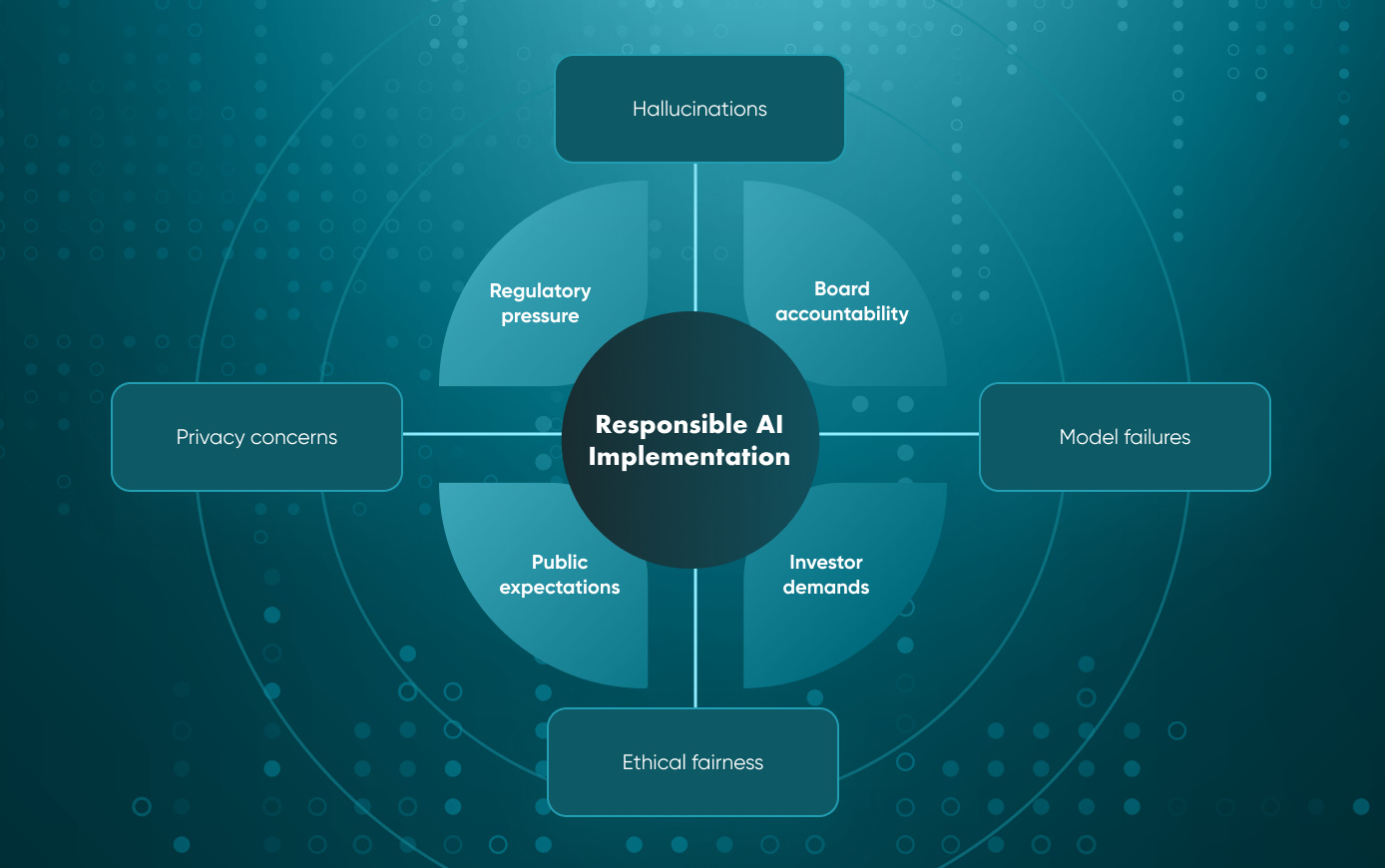
AI technologies are moving fast - everywhere from factories and warehouses to banks, hospitals, airports, and even sports arenas. But honestly, the risks are keeping pace. A recent PwC report puts it pretty simply: tech leaders are now laser-focused on AI governance and risk management. It’s not just because they want to be, either. Regulators are circling, and operational mess-ups are making headlines.
Look, global oversight of responsible AI practices is ramping up, and it’s not only about GDPR now. The EU AI Act, ISO/IEC 42001, the UK’s AI Safety Institute, and new US rules - they’re all turning up the heat. Companies can’t just plug in AI products and hope for the best anymore. Cross-functional teams have to show, step by step, that they have a risk-based classification system, how they make decisions, handle data protection and ongoing monitoring, and how they keep things from going off the rails. These days, governance isn’t just some box to tick; it’s what lets you actually grow with trustworthy AI, not just survive it.
Key Forces Driving Responsible AI Implementation
So, what’s behind the rush?
- For starters, the rules are getting tighter towards ethical standards across the EU, UK, and US.
- Boards are feeling the heat too - now they’re on the hook for AI risks.
- People care more about their data privacy and whether technology evolves to treat everyone fairly.
- Investors want proof that companies are thinking about the bigger picture, like sustainability, and potential impact on society
- And let’s not forget, one bad algorithm or an AI that starts “hallucinating” can cause real chaos.
At its core, AI governance isn’t about slowing things down. It’s about bringing order to the madness. It helps companies stay on the right side of the law, but more than that, it means their AI actually works - reliably, safely, and in a way people can trust.
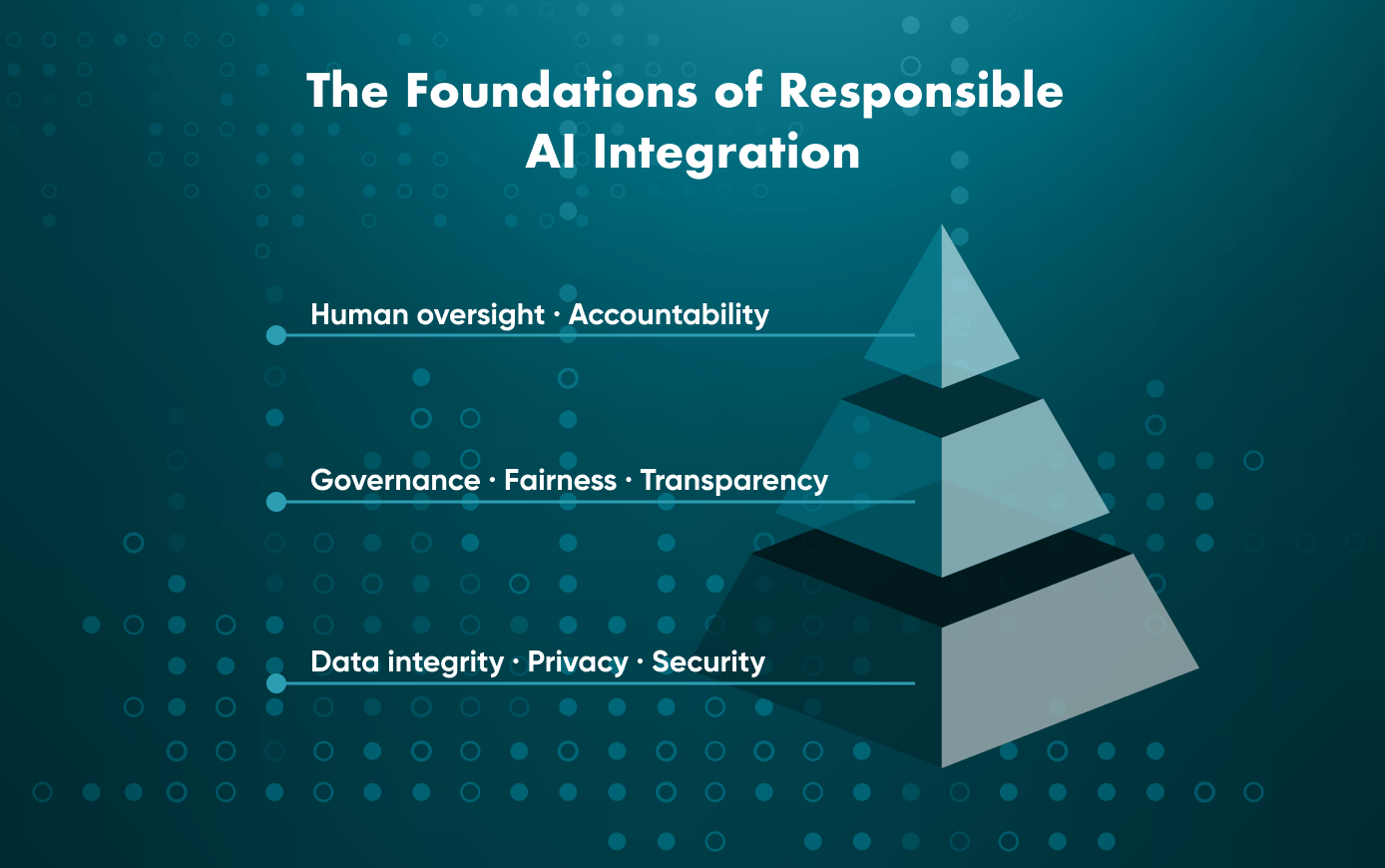
The Foundations of Responsible AI Integration
What Does Responsible AI Mean in Practice?
Responsible AI development is about the fundamental moral values, the methods and the control mechanisms which ensure that AI systems behave ethically, are lawful and transparent. Most international standards agree on five basic aspects:
- Fairness - this refers to the elimination of discrimination and the provision of fair treatment or results for all.
- Transparency - this means that the decision-making process of the model is traceable, recorded and understandable.
- Accountability - this means that the responsibility for decisions and control is clearly assigned.
- Privacy and Security - these measures are meant to protect data and safeguard the rights of individuals.
- Sustainability - this is about lessening the environmental impact throughout the AI lifespan.
Responsible AI tools are based on a set of global core principles widely accepted, such as:
- OECD AI Principles
- UNESCO AI Ethics Recommendation
- ISO/IEC 42001 (AI Management Systems Standard)
- The EU AI Act for the requirements of high-risk systems
This structured approach enables the same level of standards to be maintained by companies functioning in different parts of the world.
What Is an AI Governance Framework?
Think of an AI governance framework as the backbone that helps organisations steer their use of AI systems in the right direction. It’s how teams set the rules and clear lines, prioritise transparency, keep things in check, ensure accuracy, and make sure everyone knows what’s expected of them. When you get it right, decisions don’t happen in the shadows. Risks get flagged early, and nobody’s left guessing about their responsibilities.
Here’s what really matters:
- Policy and ethics: lay down the ground rules. What’s okay, what’s not, and where you just don’t go.
- Data management: keep your data solid. You need to know where it comes from, have permission to use it, and be able to track it.
- Risk assessment, Control and Monitoring: spot risks before they become problems and prevent harm. Handle both the tech stuff and the sticky ethical issues.
- Establish accountability Structures: spell out who calls the shots and who answers for what.
It’s easy to spot the gap between organisations that take governance seriously and those that don’t. Structured governance improves reliability, reduces operational risk, and builds stakeholder trust. This is particularly important in industries where AI decisions affect safety, finance, healthcare, public services or customer experience.
Building an AI Governance Framework: Step-by-Step
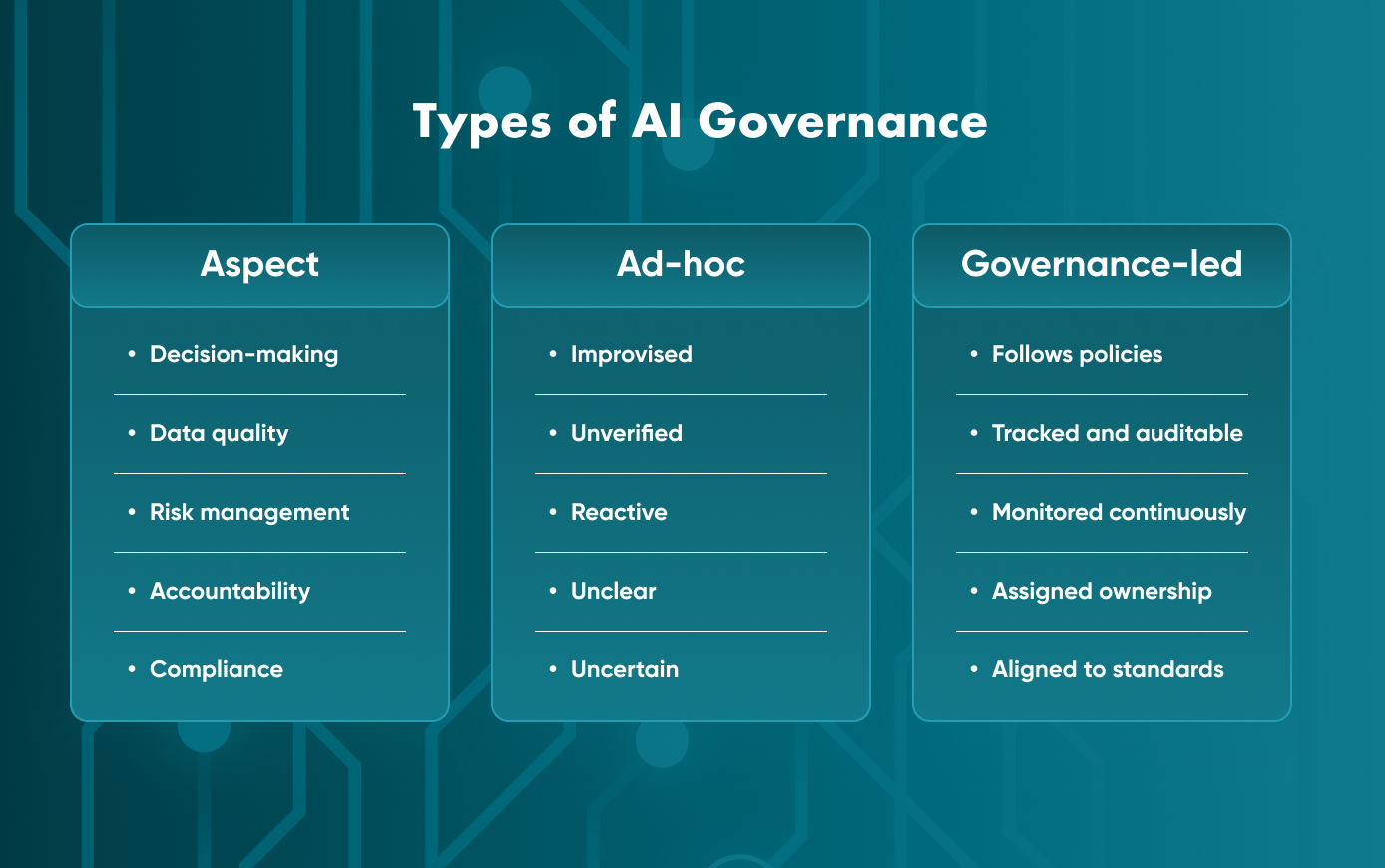
1. Establish AI Policy and Leadership Oversight
Getting governance right starts with knowing who’s in charge. Every organisation needs someone at the wheel - maybe an AI Governance Lead, a Responsible AI Officer, or even an Ethics Board.
Next up, set out what matters. Spell out your ethical principles: fairness, transparency, safety, and keeping humans in the loop.
Make sure all these line up with your company’s bigger goals and the rules you have to follow.
But here’s the thing - if leadership doesn’t back it, governance just ends up as paperwork no one reads. Real support from the top is what turns these ideas into something that actually works.
2. Create Data Governance and Transparency Practices
When talking about advanced AI, data is the base without which no AI model can work. If the data is of poor quality or is biased, the results will be unsafe and non-compliant.
Companies need to set up:
- Data lineage - understanding data origin and its changes through time.
- Consent and privacy controls - guaranteeing that data is gathered and used in a lawful way.
- Bias audits - checking datasets for demographic or structural bias.
- Clear documentation - having proper metadata and data quality standards.
Global principles and rules have a very demanding documentation requirement for the datasets that are used to train high-risk AI systems that are perilous. Companies that do not have data governance are in danger of non-compliance and losing the trust of others.
3. Implement Risk and Model Monitoring Controls
AI systems change gradually. Different checks have to be made to see if the systems are still right, fair, safe, and have the same goals as the business.
Organisations, which are in line with good governance, install:
- Model cards: short versions explaining the use, restrictions, and results.
- Explanation tools: SHAP for feature impact visualisation, LIME for local interpretable explanations
- Bias identification tools: IBM AIF360, Microsoft Fairlearn
- Drift identifying tools: Fiddler, Arize AI, Evidently
- Automated alerting: locating performance deterioration, safety risks, or outliers.
- Security measures: testing for vulnerabilities, adversarial robustness methods, and misuse prevention.
Controls should be recognisable, repeatable, and people should be able to use them every time.
4. Embed Sustainability in the AI Lifecycle
The environmental impact of AI is becoming a concern for regulatory bodies, ESG officers, and customers. Sustainable AI, or Green AI, is mainly about minimising its carbon footprint, energy use, and computational waste.
Some of the most important environmental sustainability measures are:
Efficient Model Selection
A team of developers should rather:
- Deploy smaller, more efficient AI systems that focus on specific tasks
- Make use of fine-tuning instead of full retraining
- Optimise the architectures by pruning, quantisation or distillation
By employing these methods, energy consumption can be lowered drastically, depending on the model and workload.
Optimising Training and Deployment
- Planning training sessions during the hours when low-carbon energy is used, provided that cloud services are capable of this
- Implement autoscaling in order to make full use of GPU/TPU and avoid idle periods
- Store results for repeated inference tasks locally or on a server
- Select cloud regions that run on renewable energy
Measuring Carbon Impact
Tools such as CodeCarbon and carbon dashboards provided by cloud service providers enable teams to quantify the release of carbon that comes from model training and inference. This makes the environmental footprint a tangible KPI for both technical and non-technical stakeholders.
AI Lifecycle Thinking
Long-term AI governance strategies that are also environmentally friendly:
- Application of the same models for different tasks
- Minimising retraining cycles
- Effective storage solutions
- Removing models that are not in use
Thus, AI becomes an instrument of ESG goals rather than a threat to them.
Challenges and Trade-Offs in Responsible AI
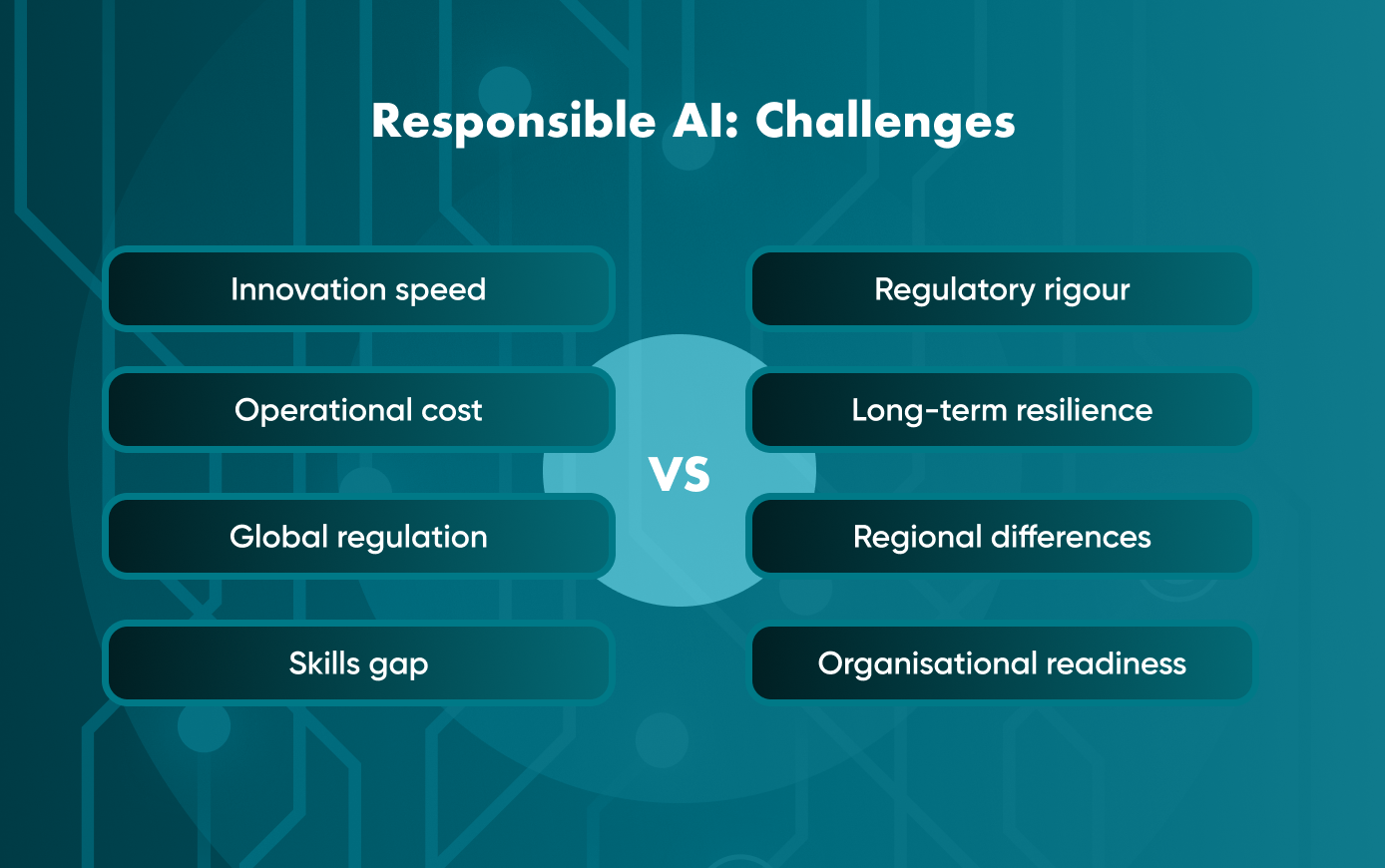
The introduction of governance to advanced systems, such as generative AI or explainable AI (XAI) brings with it consideration at cultural, operational, and financial levels. Some of the common challenges are:
Innovation speed vs regulatory rigour
Governance introduces a few necessary control points and, as a result, may be viewed as slowing down the deployment. Oversight with agile delivery is successfully balanced by teams.
Operational cost vs long-term resilience
Testing for fairness, using monitoring tools, and applying sustainability practices require spending. Nevertheless, they help in avoiding costly failures and fines from regulatory bodies.
Global regulation vs regional differences
Such companies that are active and operating in the EU, UK, US, and APAC have to comply with the conditions imposed by different authorities. Consistently mapping out requirements is the way to go.
Skills gap and organisational readiness
Deloitte has revealed that only about one-third of organisations have implemented formal policies on AI tools, ethics and governance. The majority of teams do not have sufficient skills to effectively implement governance.
How Should Companies Organise AI Governance?
Efficient governance calls for an appropriate organisational design. Various models may be suitable for different sectors, levels of maturity, and areas regulated differently.
Centralised AI ethics committee - a single governing body reviews, approves, and monitors high-risk AI decisions. Best suited for fintech, healthcare, and logistics.
Hub-and-spoke model - a central ethics board defines policies while trained AI champions embed governance within product and engineering teams. Ideal for large enterprises and manufacturing.
Model risk management - formal validation, documentation, risk scoring, and audit trails applied before deployment and throughout the AI lifecycle. Commonly used in banking and insurance.
Clinical AI governance - focuses on safety, explainability, human oversight, and regulatory compliance for medical AI. Essential in healthcare.
Operational safety governance - aligns AI governance with robotics, automation, digital twins, and predictive maintenance to reduce operational and worker-safety risks. Relevant for manufacturing and supply chains.
The suitable model is conditional on an organisation's AI maturity, intricacy, and exposure to regulation.
Conclusions
- Here’s what really matters: responsible AI isn’t optional anymore - it’s a must for any organisation that’s serious about using AI on a larger scale.
- When companies put solid governance frameworks in place, they set up clear rules, assign responsibility, and make sure people can actually see what’s going on throughout the whole AI process.
- With good governance, trust goes up. Companies get ready for compliance, and they set themselves up for success over the long haul.
- If you want digital transformation to stick, you need to focus on sustainability and ethics. That’s how you make sure all this new tech actually adds lasting value.
- And just to be clear - responsible AI doesn’t mean you’re putting the brakes on innovation with minimal risk. It means you’re making sure you can grow and experiment, but in a way that’s safe, ethical, and built to last.
In case you think about the future and need any help with installing a responsible AI governance framework, just give us a call.
FAQ
What does it mean to integrate AI responsibly?
Integrating AI systems, agents, and tools means you’re building trust and running them with ethics, laws, and sustainability in mind. The goal is to get results you can trust.
Why do we need AI governance for digital transformation?
Governance stops problems like bias, rule-breaking, and system failures before they start. It keeps your AI transparent, accountable, and working toward your business goals.
How do companies stay in line with the EU AI Act?
Document your data and the choices you make with your models. Sort your AI systems by how risky they are. Set up monitoring, and make sure you have clear oversight.
What are the main principles behind responsible AI?
Fairness, transparency, accountability, explainability, privacy, security, and sustainability.
Do governance frameworks slow down innovation?
Actually, when you design them well, they speed things up. They cut down on do-overs, boost quality, and help build trust with both customers and regulators.
Share and subscribe to our blog
Related articles

6 GDPR Compliance Principles You Need to Master
Organisations may face serious financial, legal, and reputational risk if they do not comprehend and implement GDPR compliance principles. GDPR requirements adherence is a board level concern rather than just legal, technical and organisat…

Business IT: Exploring AR, VR and MR Technologies
Filmmakers, video game developers, and similar professionals have used computer generated images for decades. Today, the introduction of artificial intelligence (AI) and other advanced technologies has empowered businesses of all sizes to…
.png)
Is Smart Cities Agentic AI A Missing Infrastructure Layer?

How can we help you ?