



What Makes Human-in-the-Loop Critical for AI Systems?

The case for autonomous AI systems is straightforward. Remove humans from repetitive, high-volume decision processes, and you get speed, consistency, and scale that no human team can match. The case has been made convincingly enough that enterprise AI deployment has accelerated significantly over the past two years, with organisations pushing agentic AI further into consequential workflows than most governance frameworks anticipated.
The problem surfaces later. An autonomous system that makes ten thousand decisions a day makes ten thousand decisions a day without anyone checking. When the decisions are right, that is the point. When they are systematically wrong, in ways that are subtle enough not to trigger immediate alerts, the damage compounds before anyone notices.
Human-in-the-loop design is not a reluctant concession to risk-averse stakeholders. It is the architectural decision that determines whether an autonomous AI system can be trusted, scaled, and defended when something goes wrong. Getting it right at the design stage is significantly cheaper than retrofitting it after the fact.
What Does Autonomous AI Actually Mean in an Enterprise Context?
Autonomy in AI systems and solutions exists on a spectrum. At one end, a system that drafts a response for a human to review and send is assistive. At the other end, a system that identifies a situation, selects a course of action, executes it, and moves on without any human involvement is fully autonomous. Most enterprise deployments sit somewhere between those poles, and the governance requirements differ significantly depending on where.
The spectrum matters because "autonomous AI" is frequently used to describe systems that are actually operating in a supervised mode with infrequent human review. The distinction between genuine autonomy and high-frequency automation with occasional oversight is not semantic. It determines the failure modes, the regulatory exposure, and the appropriate design for human involvement.
The Difference Between Automation and Autonomy
Automation executes a predefined process. The rules are set by humans in advance. The system follows them. When the situation falls outside the rules, the system either fails gracefully or escalates to a human. The decision logic is not fully explicit or exhaustively auditable in the way a traditional rules-based system would be.
Autonomy involves the system making judgments that were not fully anticipated by the designers. An agentic AI system navigating a complex, multi-step workflow is making decisions at each step about how to interpret the situation, which action to take, and how to handle edge cases. Those decisions emerge from the model rather than from explicit rules, which makes them harder to audit, harder to predict, and harder to correct when they go wrong.
Why That Distinction Matters for Governance
A governance framework designed for automated systems, with periodic audits and exception reporting, is not adequate for genuinely autonomous AI systems. The decision logic is not written down anywhere. Exceptions may not look like exceptions. The oversight model must be designed for the actual behaviour of the system, not for the behaviour of a more predictable predecessor.
What Is Human-in-the-Loop Design and What Is It Not?
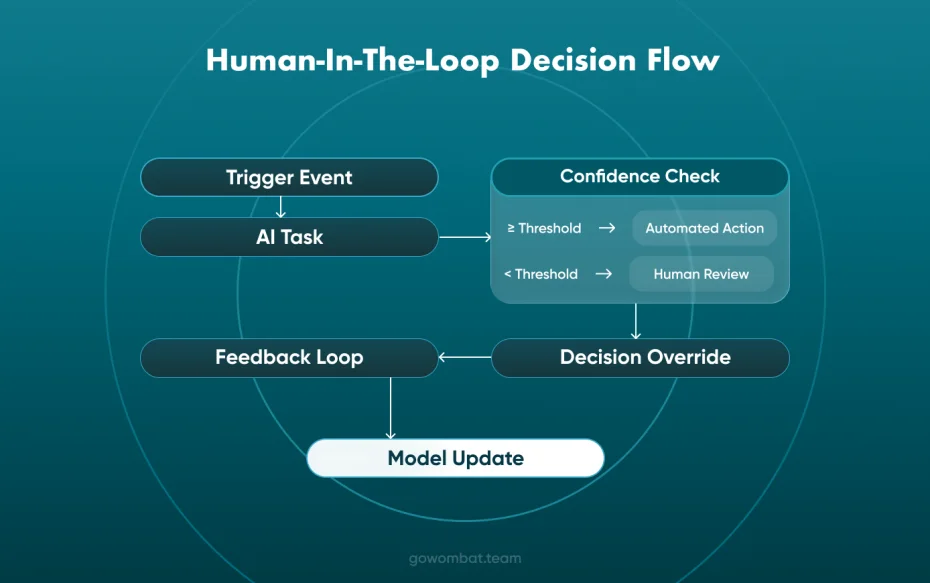
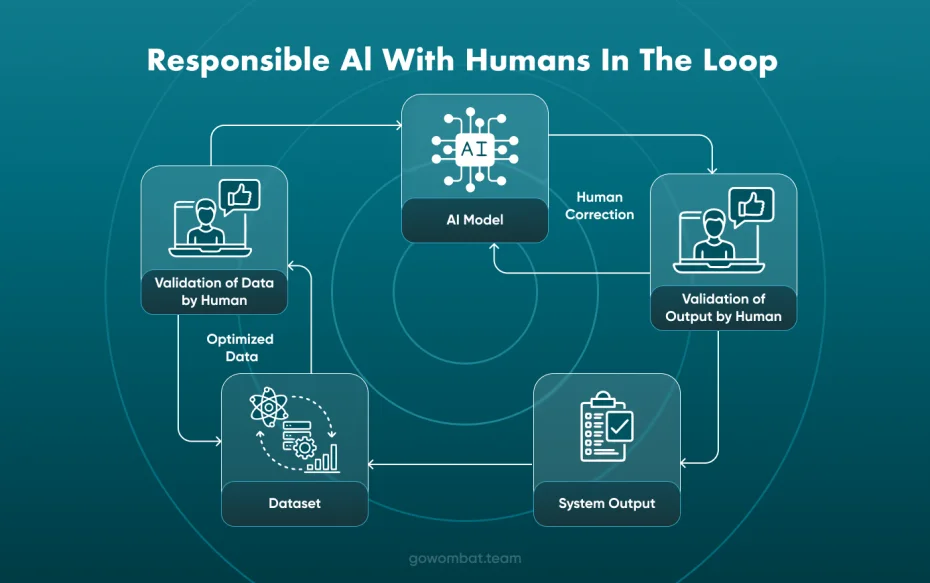
Human-in-the-loop is a design principle that embeds human judgment at defined points in an AI workflow. It does not mean that a human reviews every output. It means that the workflow has been deliberately designed to determine which outputs require human review, which can proceed autonomously, and what triggers escalation from one mode to the other.
The principle is frequently misapplied in two directions. Some organisations interpret it as requiring human sign-off on every AI output, which eliminates most of the operational value the system was built to deliver. Others treat it as a checkbox, adding a nominal review step that in practice receives no meaningful scrutiny. Neither approach constitutes genuine human-in-the-loop design.
Three Models of Human Involvement in AI Workflows
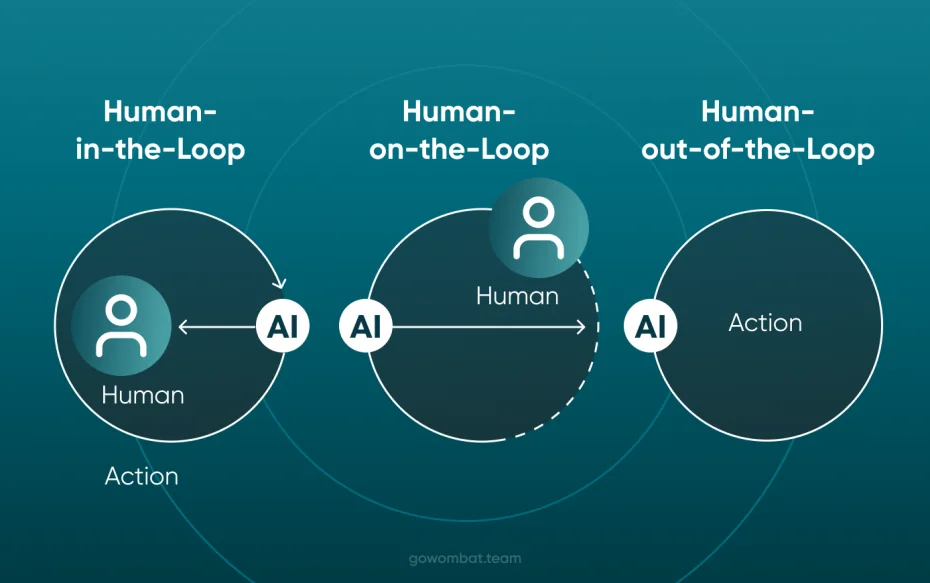
The appropriate model for human involvement depends on the stakes involved in each decision type:
- Human-in-the-loop
A human reviews and approves specific outputs before the system proceeds. Used for high-stakes, low-frequency decisions where errors are costly and reversible action is limited.
- Human-on-the-loop
The system operates autonomously, but a human monitors outputs and retains the ability to intervene. Used for medium-stakes decisions at higher volume where real-time review is impractical but oversight remains important.
- Human-out-of-the-loop
The system operates fully autonomously with no real-time human involvement. Appropriate only for low-stakes, fully reversible decisions where the cost of error is genuinely negligible.
Choosing the Right Model for the Right Context
Most enterprise AI deployments require a mix of all three models applied to different decision types within the same workflow. A customer service agent might handle routine queries entirely autonomously, escalate billing disputes to a human reviewer, and flag potential fraud for immediate human intervention.
The design work is in mapping each decision type to the appropriate model and building the escalation logic that moves between them reliably.
Where Do Autonomous AI Systems Fail Without Human Oversight?
The failure modes of autonomous AI systems without adequate oversight fall into two broad categories. The first is dramatic and visible: the system produces an obviously wrong output that is caught quickly and corrected. The second is gradual and invisible: the system produces subtly wrong outputs that fall within expected parameters, accumulate over time, and cause significant damage before anyone identifies the pattern.
The second category is the more dangerous one for enterprise deployments. A system that fails catastrophically is investigated. A system that drifts quietly in the wrong direction may not be examined until the consequences are already significant.
Agentic AI workflows introduce a third failure mode specific to multi-step autonomous processes. Each step in the workflow builds on the output of the previous step. An error introduced early compounds through subsequent steps, amplified rather than corrected by the system's own logic.
When Confidence and Accuracy Diverge
One of the more counterintuitive properties of large language model-based systems is that confidence and accuracy are not reliably correlated. A system can produce an output with apparent certainty that is factually wrong, contextually inappropriate, or based on a misreading of the input.
In a supervised setting, a human reviewer catches that divergence. In a fully autonomous setting, the confident but wrong output proceeds unchecked. Consider a financial services scenario in which an autonomous AI system for contract analysis begins systematically misclassifying a specific clause type that had been introduced in a recent regulatory update. The outputs looked normal. The confidence scores were high. The misclassification was only identified during a routine sample audit six weeks after it began. By that point, several hundred contracts had been processed on the basis of incorrect analysis.
How Waymo and Tesla Built Human Oversight Into Commercial Autonomous Fleets
The gap between nominal oversight and meaningful oversight has no cleaner real-world illustration than the divergent approaches Waymo and Tesla have taken with their autonomous vehicle fleets. Both companies have commercial autonomous ride operations, although their operational models differ materially in terms of deployment and level of autonomy. Both have disclosed, through letters submitted to US Senator Ed Markey's Senate investigation in early 2026, that humans remain embedded in their operations. The design choices they have made around that human involvement are radically different, and those differences carry direct lessons for any enterprise designing oversight into an autonomous AI system.
Waymo operates a Fleet Response Operations team that monitors vehicles remotely and provides guidance when the autonomous system encounters a situation it cannot resolve independently. The team works on an event-driven basis. The autonomous system requests assistance. A human reviews the situation and provides navigational guidance. Waymo has stated that its remote assistance personnel do not directly control or steer vehicles during on-road operations, instead providing guidance to the system, with only limited intervention capabilities in specific edge cases. They advise. The system acts. That distinction reflects a deliberate governance boundary: the human is in the loop, but the scope of human intervention is defined and bounded.
Tesla’s remote assistance operations, based in Austin and Palo Alto, go further in allowing direct low-speed control as a final escalation step. Its Remote Assistance Operators are authorised to take temporary direct control of the vehicle when all other intervention options have been exhausted, at speeds of up to ten miles per hour. That escalation mechanism exists precisely because the autonomous system cannot handle every situation it encounters. What both companies demonstrate, regardless of their different technical architectures, is that the most advanced commercial autonomous deployments today still rely on structured human oversight as part of the operational model. The question is not whether humans need to be in the loop. It is how that involvement is designed, scoped, and triggered.
How Should Human-in-the-Loop Be Designed Into AI Systems?
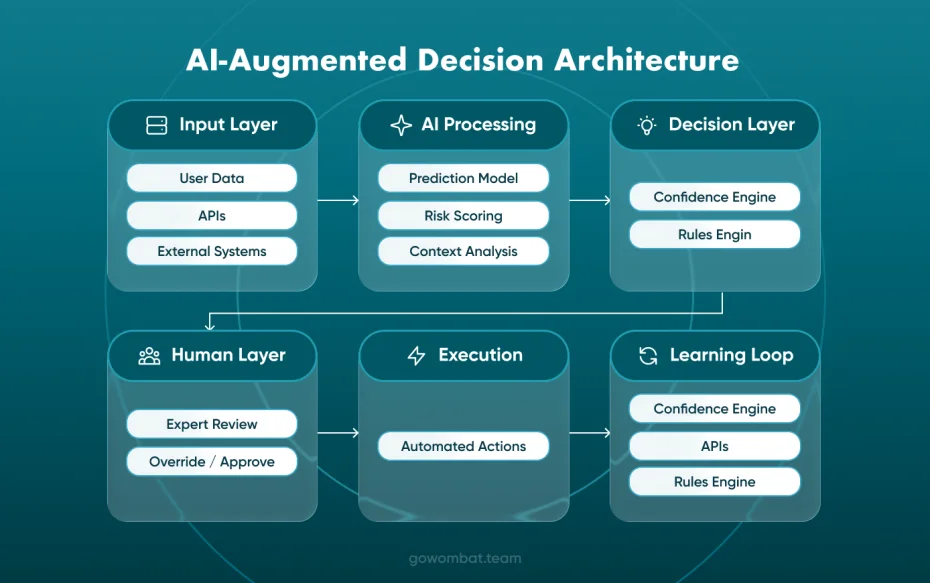
Effective human-in-the-loop design starts with a decision audit. Before designing oversight mechanisms, the team must understand what decisions the system is actually making, at what frequency, with what consequences, and with what reversibility. That audit produces the risk map that determines where human involvement is required, at what intensity, and in what form.
The core design elements of a well-structured human-in-the-loop architecture are:
- Decision classification
Every decision type the system makes is categorised by stakes, frequency, and reversibility
- Escalation criteria
Explicit rules that determine when the system escalates to a human rather than proceeding autonomously
- Intervention points
Defined moments in the workflow where human review is embedded as a structural requirement rather than an optional step
- Override mechanisms
Clear, accessible controls that allow humans to correct, redirect, or halt the system at any escalation point
- Audit trails
Complete records of what the system decided, on what basis, and what human actions were taken in response
What Meaningful Intervention Looks Like in Practice
Meaningful intervention is not the same as nominal review. A human reviewer who is presented with fifty AI outputs per hour and expected to approve or reject each within seconds is not providing meaningful oversight. They are providing the appearance of oversight while the system operates effectively autonomously.
Meaningful intervention requires that the reviewer has sufficient context to make a genuine judgement, sufficient time to exercise it, and sufficient authority to act on it. A procurement team that integrated a human-in-the-loop review stage for AI-generated supplier assessments initially found that reviewers were approving outputs without reading them, because the volume was too high and the interface too cumbersome. In one illustrative scenario, redesigning the escalation criteria to surface only genuinely ambiguous cases reduced the review queue by approximately seventy per cent and produced measurably better oversight quality from the remaining thirty per cent.
Designing Escalation Criteria That Actually Work
Escalation criteria that are too broad produce reviewer fatigue and nominal oversight. Criteria that are too narrow allow consequential errors to pass unchecked. The calibration requires empirical data: running the system in a monitored mode, observing where errors occur, and designing escalation rules that reliably catch the error categories that matter without flooding reviewers with low-risk outputs.
That calibration is not a one-time exercise. As the system's operating environment changes, as new edge cases emerge, and as the model itself is updated, escalation criteria must be reviewed and adjusted accordingly.
How Morgan Stanley Integrated Structured Human Review Into Its AI Rollout
The governance challenge that Morgan Stanley faced when deploying its RAG-powered assistant across 20,000 financial advisors is one that any enterprise deploying autonomous AI into a regulated workflow will recognise. The outputs of the system would directly inform client conversations, investment recommendations, and compliance-sensitive communications. Getting the oversight model wrong carried real professional and regulatory consequences.
Morgan Stanley addressed this by treating human review as an engineering requirement rather than a compliance afterthought. The team built a rigorous evaluation framework in collaboration with OpenAI, testing every AI use case against factuality, relevance, and hallucination rate benchmarks before deployment. Daily regression testing with a suite of sample questions was implemented to catch performance drift between model updates. All outputs were required to surface their source documents, so advisors reviewing AI-generated answers could verify the retrieval basis before acting on the result. The firm's Head of Firmwide AI Product and Architecture described the process as moving from being able to answer 7,000 questions reliably to handling any query across a corpus of 100,000 documents, with confidence that came not from trusting the model's output but from trusting the evaluation infrastructure built around it. That infrastructure is what enabled adoption at scale in a regulated environment, with public reporting indicating that over 98% of advisor teams actively use the system. The advisors adopted the tool because the governance layer gave them reason to trust what it produced.
What Do Regulators Expect From Human Oversight in AI?
Regulatory expectations around human oversight of autonomous AI systems have crystallised significantly over the past two years. The EU AI Act is among the most explicit frameworks, requiring that high-risk AI systems be designed so that natural persons can effectively oversee their operation, with these obligations applying from August 2026 for most systems. That requirement is not satisfied by a nominal review step. The Act specifies that oversight measures must be built into the system before it is placed on the market, not added retrospectively.
GDPR introduces related obligations for decisions based solely on automated processing that produce legal or similarly significant effects. Under Article 22, individuals have the right not to be subject to such decisions, and, where exceptions apply, must be provided with safeguards including the ability to obtain human intervention, express their point of view, and contest the outcome.
Moving From Regulatory Obligation to Engineering Principle
The risk of framing human-in-the-loop purely as a compliance requirement is that it encourages minimum-viable implementation: enough oversight to satisfy a regulator, not enough to produce genuinely trustworthy AI behaviour.
Responsible AI design treats human oversight as an engineering principle rather than a legal obligation. The question is not "what does the regulation require?" but "what level of human involvement makes this system reliable enough to deploy in this context?" The answer to the second question will typically exceed the answer to the first, and the gap between the two is where most AI governance failures originate.
The key current and upcoming obligations that enterprise teams operating in the EU should plan for are:
- EU AI Act requirements for high-risk systems, including documented oversight measures, operator instructions, and intervention mechanisms
- GDPR Article 22 provisions for automated decision-making affecting individuals
- Sector-specific requirements in regulated industries, including financial services, healthcare, and critical infrastructure
What Are the Limits of Human-in-the-Loop at Scale?
The most common objection to human-in-the-loop design is throughput. If the value of an autonomous AI system is its ability to operate at scale, embedding human review at every consequential decision point undermines that value. The objection is legitimate. It is also frequently used to justify oversight models that are inadequate rather than to drive better escalation design.
The throughput problem is real at the extremes. A system processing millions of decisions per day cannot route a meaningful proportion of them to human reviewers without either overwhelming the reviewers or slowing the system to the point where autonomy provides no benefit. The solution is not to remove human oversight but to design it more precisely.
How Leading Enterprise Teams Are Resolving the Tension
The approach that consistently produces the best outcomes is risk tiering combined with continuous monitoring. The logic is as follows:
- Decisions are classified by risk level based on stakes, reversibility, and historical error rates
- Low-risk decisions proceed autonomously with monitoring but no real-time human review
- Medium-risk decisions are sampled for human review on a defined schedule, with full review triggered by anomaly detection
- High-risk decisions are routed to human reviewers as a structural requirement before the system proceeds
This approach preserves the throughput advantage of autonomous AI systems for the majority of decisions while concentrating human oversight where it produces the most value. It also generates the performance data needed to continuously refine the risk classification, improving both the accuracy of escalation and the efficiency of the review process over time.
Final Thoughts
Human-in-the-loop design is not about limiting what autonomous AI systems can do. It is about ensuring that what they do can be trusted, corrected, and defended. Those are not constraints on capability. They are the conditions under which enterprise AI deployment becomes viable at scale.
The organisations that treat human oversight as an engineering discipline, designing escalation criteria empirically, calibrating review intensity to actual risk, and building audit infrastructure from the outset, will deploy autonomous AI systems that are more capable in practice than those built without it. Not because the oversight makes the AI smarter, but because it makes the overall system more reliable, more governable, and more resilient to the failure modes that autonomy inevitably introduces.
Responsible AI design is not a slogan. It is the architecture that separates enterprise AI systems that compound in value over time from those that accumulate liability. If you need any help with it, just give us a call!
Frequently Asked Questions
What is human-in-the-loop in AI systems?
Human-in-the-loop is a design approach that embeds human judgment at defined points in an AI workflow. Rather than requiring humans to review every output, it establishes clear criteria for which decisions proceed autonomously, which are escalated for human review, and what triggers movement between those modes. The goal is meaningful oversight at the points where it matters most, without eliminating the operational value of autonomy.
Why is human-in-the-loop important for autonomous AI systems?
Autonomous AI systems make consequential decisions at speed and scale. Without structured human oversight, errors can compound through multi-step workflows before they are detected, and subtle systematic failures may go unnoticed until significant damage has accumulated. Human-in-the-loop design creates the intervention points needed to catch those failures before they escalate, and the audit trails needed to investigate them when they do.
What does the EU AI Act require for human oversight?
The EU AI Act requires that high-risk AI systems be designed so that natural persons can effectively oversee their operation, understand their outputs, and intervene when necessary. This requirement must be satisfied at the design stage, before the system is deployed. Operators must be provided with appropriate instructions for oversight, and the system must include mechanisms that allow humans to override or halt its operation.
How do you design a human-in-the-loop without creating a bottleneck?
The key is risk tiering. Rather than applying the same level of human review to every decision, classify decisions by stakes, frequency, and reversibility, then calibrate the intensity of oversight accordingly. Low-risk decisions can proceed autonomously with monitoring. High-risk decisions require human sign-off. Medium-risk decisions can be sampled on a defined schedule. This approach concentrates human attention where it produces the most value without overwhelming reviewers with low-risk outputs.
Is human-in-the-loop the same as human on the loop?
No. Human-in-the-loop means a human reviews and approves specific outputs before the system proceeds. Human on the loop means the system operates autonomously while a human monitors outputs and retains the ability to intervene. The distinction matters for governance design: human-in-the-loop provides stronger oversight but limits throughput, while human-on-the-loop preserves speed but requires reliable anomaly detection to be effective.
Share and subscribe to our blog
Related articles
Agent as a Backend: Replacing REST Controllers With AI Agents That Reason
Web application architecture has always been built on strict predictability. A user clicks a button, the frontend sends an HTTP request, the backend handles the data through hardcoded if/else controllers, and returns a structured JSON resp…
How Can AI Agents Optimise Precision Agriculture Workflows?
Agriculture has always been a data driven industry. Soil type, rainfall patterns, crop growing cycles, pest pressure and market timing. All of this has been navigated by seasoned farmers with generational experience and seasonal instinct.…
How Can AI Agents Process Industrial IoT Data in Real Time?
Modern manufacturing plants generate extraordinary volumes of operational data. Sensors embedded in machinery, production lines, and logistics systems produce readings every fraction of a second: temperature, vibration, pressure, throughpu…

How can we help you ?