



CEO Role in a Tech Startup: Responsibilities and Skills

The CEO of a tech startup is the company's top executive, responsible for the overall vision, building the team, investor relations and the decisions that make or break the business. In an early-stage tech startup, the CEO is usually the founder, because the team is not yet large enough to split the roles.
Being a CEO is different in every phase. What a CEO does at pre-seed, with five employees, is very different from the job at Series B, when the business has grown enough to need a larger team.
The Two Types of Tech Startup CEO
Startup CEOs tend to fall into two profiles.
The first is the Visionary: a source of ideas who sets the direction, inspires employees to reach their goals and leads through beliefs and culture. The second is the Operator, who focuses on execution: development processes, quality assurance, resource management and continuous improvement.
Most startups need both. Early on, the visionary side dominates, because markets have to be found and investors convinced. As the company grows, execution is what separates a growing startup from a stagnant one. The best tech CEOs can switch between the two styles as circumstances demand, which is harder than it sounds.
Core CEO Responsibilities in a Tech Startup
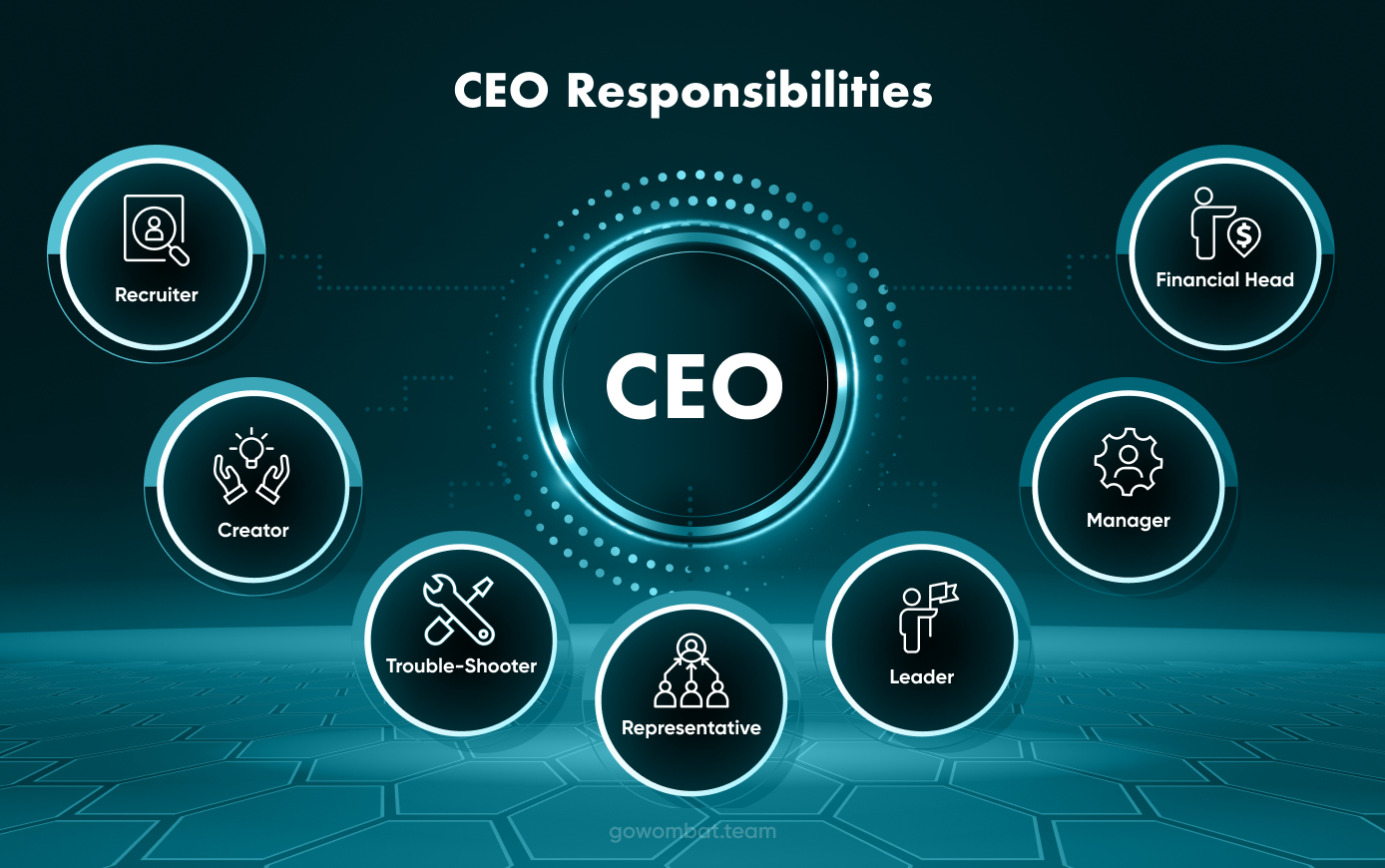
Setting Vision and Strategy
The CEO sets the course for the company: what the product should be, who it is for and how the company will win. They turn those decisions into a clear roadmap for the team. This is not a one-off task, because the market moves, competitors change tactics and users change too.
In a very early-stage company, this means the CEO owns the MVP development process personally.
Representing the Brand and Attracting Investors
As a startup CEO, you are the public face of the company: you talk to investors and the media, speak at conferences, keep your LinkedIn profile current and negotiate partnerships. Especially early on, people judge the business by how they judge you.
Fundraising is not a one-off task. For tech startups it comes in rounds (pre-seed, seed, Series A), and each time you have to sell the vision, back it with numbers and show investors that the team can deliver. The process takes longer than most first-time CEOs expect.
Building and Leading the Team
A startup is its people. The CEO defines the culture, sets hiring standards and makes sure the right people are in the right roles, which means taking an active part in early hires. As the business grows, managers need to be trained to make good hiring decisions.
Motivation depends largely on clarity. Teams perform better when they know the goal, how their work contributes to it and why decisions are made. Keeping that clarity every day is one of the hardest parts of the job.
Empathy matters as well: when people feel understood by their leader, they tend to take more initiative, communicate better and stay longer.
Managing Finances at the Top Level
The CEO ultimately owns the company’s financial well-being, even if the day-to-day work of running the finances falls to the CFO. Cash flow, burn rate, runway, and revenue forecasting are all ultimately the CEO’s responsibility. Not because the CEO necessarily does the work of creating the models, but because nobody else can make the trade-offs that these numbers ultimately demand.
Perhaps the most common cause of failure among early-stage companies is running out of cash. It’s almost never a surprise, as the warning signs are almost always apparent weeks or months in advance. A CEO who understands the company’s finances well enough to recognise these signs early on can act before the options are reduced to none.
Risk Management and Decision-Making
Startups are operating under real uncertainty. The CEO is called upon to make important decisions about product direction, partnerships, people, and pricing based on incomplete information and under time pressure.
Good risk management at the startup stage is less about formal processes than about a habit of asking: "What is the worst-case scenario here, and can we survive it?"
The CEO is also the person who is expected to absorb uncertainty, so the team does not have to. This is not usually included in job descriptions, but it is an important contributor to team performance.
Early-Stage Recruiting
For the first ten hires, the CEO is the recruiter. These people shape the culture and capabilities of everything that follows, so these decisions matter a great deal.
As the company grows, dedicated hiring managers take over most recruiting, but the CEO remains responsible for hiring senior leaders for the life of the company. These hires are expensive in every sense.
Recruiting now also means assessing how well candidates understand AI and work with AI tools.
The CEO–CTO Relationship: Why It Defines the Startup
In a tech startup, the relationship between the CEO and the CTO is arguably one of the most important relationships within the business. The CEO is responsible for deciding where the business is going. The CTO is responsible for deciding if the technology is capable of taking them there.
When this relationship is strong, there is a feedback loop that keeps the business strategy grounded in technical reality and the technical strategy grounded in commercial reality. When this relationship is broken, for whatever reason, it will manifest itself in all sorts of areas, such as missed deadlines, bad architecture decisions, and even team dynamics.
This does not mean that the CEO has to be a technologist, but they need enough understanding of the technical side to ask the right questions, make the right trade-offs and notice when the CTO's warnings are not getting enough attention.
Early-stage startups that have not yet hired a full-time CTO can close this gap with a fractional or outsourced CTO. Go Wombat works with startup founders in this role, providing the technical strategy, team management and architectural oversight of a CTO without the cost and commitment of a full-time hire. We also know what it means to hire a full-stack development company and how that works in practice.
New in 2025–2026: AI Strategy as a CEO Responsibility
A tech startup CEO in 2026 has a responsibility that did not exist five years ago: figuring out how the company should use AI and being accountable for those decisions.
This goes beyond buying SaaS tools with AI features. The CEO decides which parts of the product roadmap should use AI, where the company should build its own AI capabilities and where it should use third-party AI APIs, and what its stance is on AI-generated content in customer-facing products.
These are business decisions that combine product strategy, legal risk, brand and team skills, so the CEO has to own them.
The other dimension is the operational one. AI tools are changing the way startup teams work internally: from the coding and testing side for the engineers, through the content and personalisation side for the marketers, to the workflow and data analysis side for the operations people. A CEO who understands where AI tools can genuinely accelerate the business and where they can hurt the business is better positioned to make good investment decisions.
This does not require the CEO to be an AI engineer. It requires the CEO to be able to ask the right questions of the people who are. Go Wombat's AI services and solutions work includes helping startup leadership teams think through exactly these decisions.
Essential Skills Every Tech Startup CEO Needs
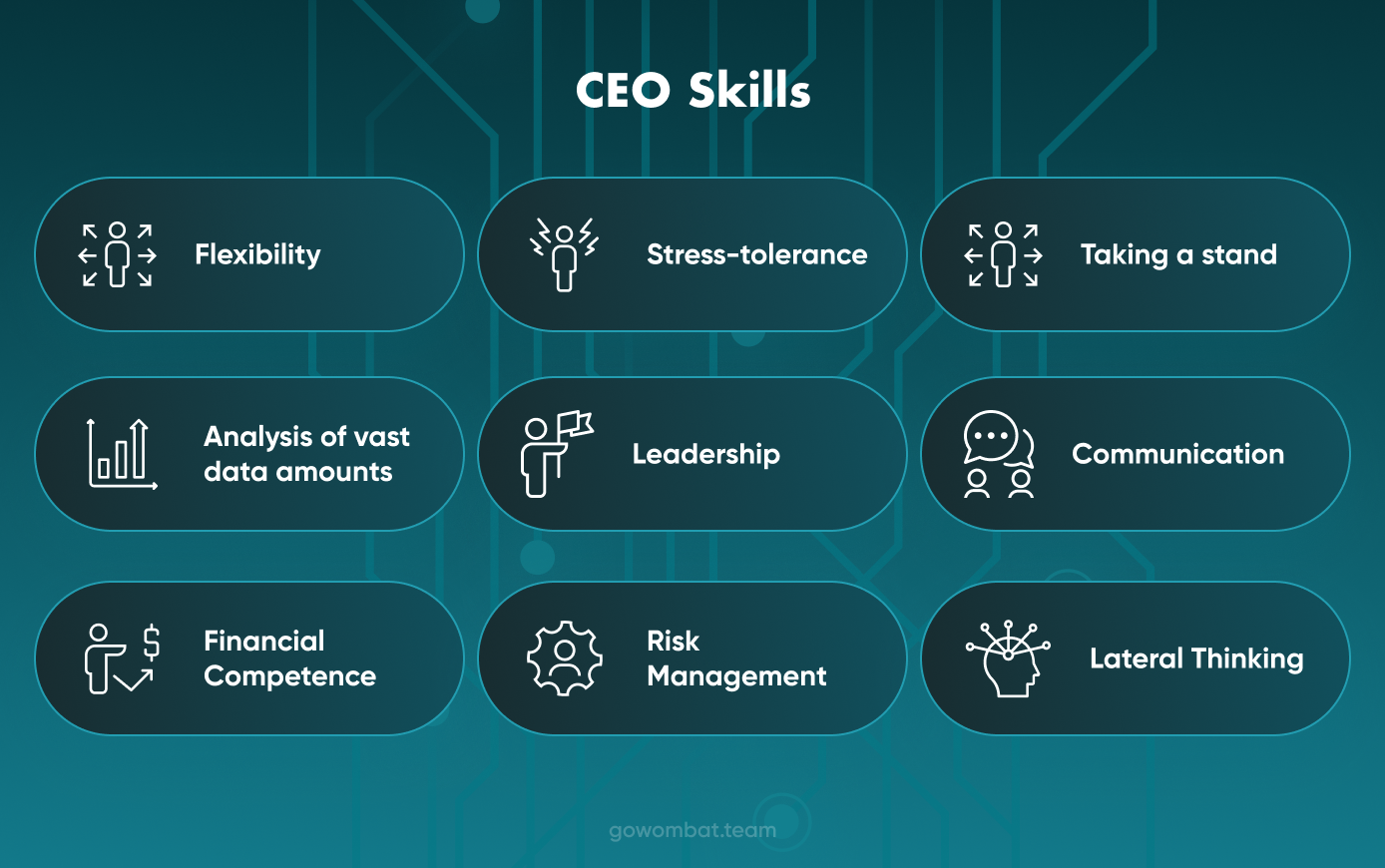
Responsibilities describe what the job requires. Skills describe what the person needs to bring.
Strategic Communication
A CEO constantly communicates with investors, with the team, with customers, with the media. The information may be different every time. The technique, however, is the same: clarity about what you know, transparency about what you don't know, and the ability to make the person you're talking to care about what you're saying.
Poor communication at CEO level often ends in misaligned teams, failed fundraising and lost customers, which makes communication one of the most valuable skills a startup CEO can develop.
Financial Literacy
The CEO does not need to be an accountant, but they need to understand the numbers well enough to notice when something is wrong and to make confident decisions about financial trade-offs. Unit economics, margins, runway and valuation mechanics come up in every conversation with investors.
Adaptability and Stress Tolerance
Startups seldom follow a straight-line path. What made sense in January may change entirely in March. The ability to adapt, to change course without losing the team's faith in the leader, is a much more valuable skill than sticking rigidly to the original plan.
Stress tolerance is a related but slightly different attribute. The CEO is a focal point for a disproportionate amount of the company's stress. The ability to remain calm under pressure and demonstrate that calmness to the team is a real competitive advantage.
Data-Informed Decision-Making
Modern startups produce a lot of data on user behaviour, product performance, marketing and team productivity. CEOs who can separate signal from noise and base decisions on data, not only on gut feeling, make better decisions.
This isn't the same as analysis paralysis; rather, it's about making it a habit to question yourself, "What does the data actually show, and is that consistent with what we believe?"
Lateral Thinking
Competitors copy successful features quickly, so the CEO has to keep testing new angles and encourage the team to challenge assumptions. Some of these ideas will fail; a few of the ones that succeed will define the company.
Empathy and People Leadership
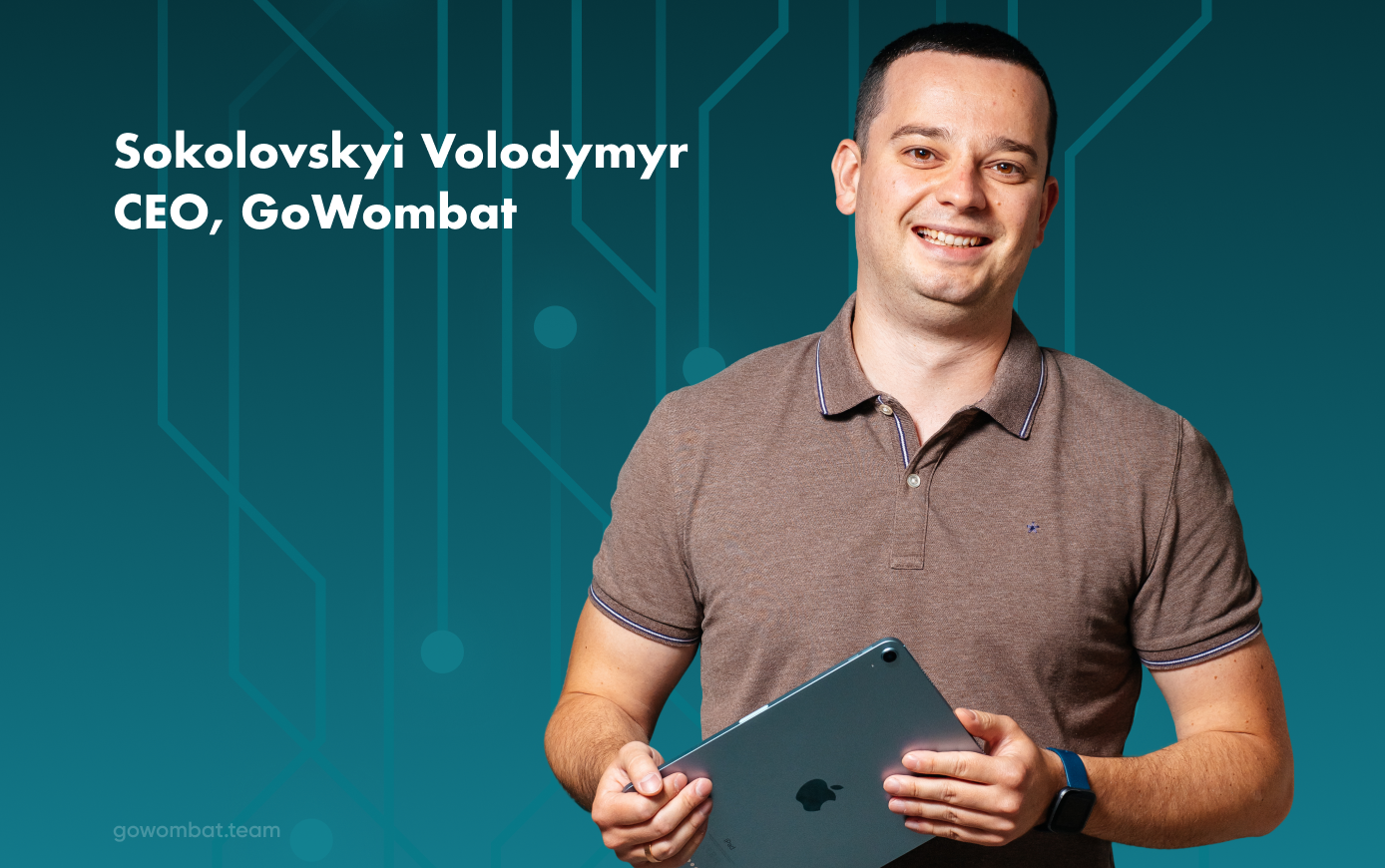
As Volodymyr Sokolovskyi, CEO at Go Wombat, himself says, "No matter what type of startup you are running, it is essential to stay positive and believe in what you are doing. It is half of the battle."
Positivity here is a deliberate choice, and it affects how people behave under pressure. A leader who believes in the work builds a team that believes in it too, and such a team finds a way through problems when others give up.
CEO vs Founder: Are They the Same Role?
Often, but not always. The distinction matters more as the business grows.
In the very early days, the founder and the CEO are usually the same person. The founder has the original vision, conviction, and network that got the business started. Being the CEO is an extension of that.
However, the tension arises when the scale increases. The characteristics that make a founder great, such as a tolerance for ambiguity, a laser-like focus on a particular problem, and a willingness to challenge the status quo, are not always the characteristics that make a great CEO of a 50-person business.
Some founders are naturally good at making that transition. Others may hire a professional CEO and take on a CTO, CPO, or Chairman role where their founding strengths remain key drivers for the company. Neither approach is better than the other. The answer depends entirely on the founder and the company.
What matters is that the question gets asked thoughtfully, rather than making assumptions that the founder should always be the CEO simply because they started the company.
Conclusion
CEOs in tech startups are broadly responsible for everything from strategy and leadership to finance, risk, communication, and, increasingly, AI governance. Nobody can be great at everything, and the skills needed for the CEO role change as the company progresses through its growth stages.
What does not change, however, is the CEO's ultimate responsibility for whether the company makes something worthwhile, makes it with the right people, and has the resources necessary to continue long enough to find out whether or not it works.
If you are a tech startup founder in need of seasoned technical expertise, whether an outsourced CTO, development team, or advice on how best to structure your product development, Go Wombat works with founders at this exact phase of development. Contact us to talk through what your startup needs.
Frequently Asked Questions
What are the main responsibilities of a CEO in a tech startup?
A tech startup's CEO is in charge of establishing the company's vision and strategy, assembling and managing the staff, maintaining relationships with stakeholders and investors, and monitoring the company's finances. A startup's CEO is also in charge of making strategic choices about personnel, products, and other matters, particularly in early-stage firms.
What is the difference between a CEO and a founder?
A founder starts the company; a CEO runs it. In most early-stage startups, one person does both. As the company grows, some founders stay on as CEO, while others move into more specialised positions where their original skills are most useful, such as CTO, CPO or a board seat.
Does a tech startup CEO need a technical background?
Not necessarily, but technical fluency is a big plus. A CEO doesn’t need to be a coder, but they need enough understanding of software development, infrastructure and AI tools to have a credible conversation with the technical leadership and make informed product decisions.
When should a startup hire a CTO instead of relying on the CEO for technical decisions?
As soon as possible. Once a product enters development, technical leadership can safeguard the architecture and the development team. In some cases, a full-time senior CTO position may not be feasible; however, a fractional or outsourced CTO can be a viable option.
What new responsibilities do startup CEOs have in 2025 and 2026?
AI strategy is now a key part of the CEO’s job. This includes decisions around where to put AI capabilities in the product, how customer data is used in the AI process, and how the team uses AI tools themselves. These are decisions that sit at the intersection of product, legal, and brand and therefore require a CEO’s judgment rather than a technical input.
What skills matter most for a first-time startup CEO?
The foundation is strategic communication, financial literacy and flexibility. Beyond that, what matters most is the ability to build trust quickly with co-founders, early team members and investors. Technical and data literacy are becoming more important as product decisions speed up and AI tools become widespread.
Share and subscribe to our blog
Related articles

10 Key Software Development Trends In 2022
The software development trends we expected to matter most in 2022, from automation and AI to blockchain and PWAs, and what they mean for custom software.

Five Business Automation Trends to look out for in 2022
Five technology trends for business process automation in 2022, taken from Gartner's list: cloud-native platforms, composable applications, hyperautomation, AI engineering and generative AI.

PHP vs Python
PHP vs Python: how the two backend languages compare on popularity, performance, frameworks, security and debugging.

How can we help you ?