



The 7 Principles of Software Testing: A Comprehensive Guide

-blogDetail-1200x800.webp)
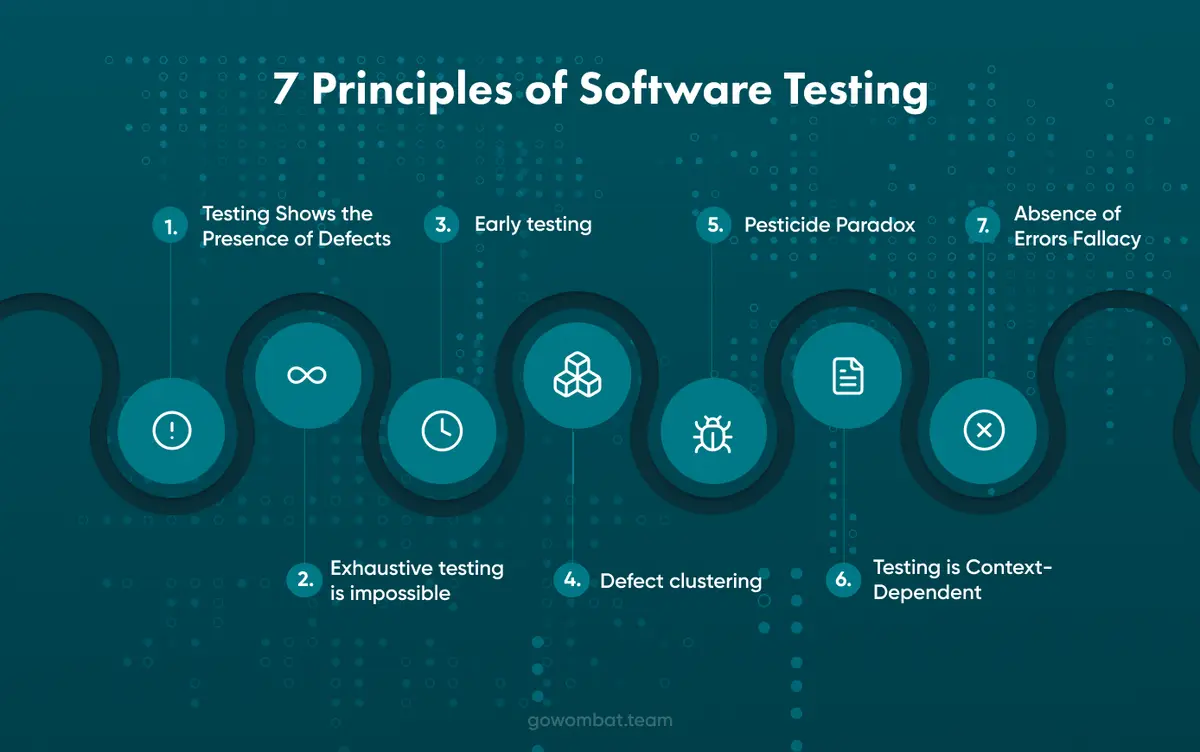
The 7 principles of software testing are basic guidelines that testers worked out over decades of real projects. The International Software Testing Qualifications Board (ISTQB) did not invent them: its Certified Tester Foundation Level syllabus describes seven principles that have been suggested over the years, and they are part of the Foundation Level qualification. Knowing them helps testers test smarter and understand the limits of what testing can achieve.
They apply to projects of any approach, domain and size.
Principle 1: Testing Shows the Presence of Defects, Not Their Absence
Testing finds problems; it cannot prove that a system has none. The difference matters more than it first seems.
If a set of tests passes, it means these particular tests found no problems, not that the software has none. Edge cases, unusual input combinations and environment-specific situations that were never tested can still hide defects. The chance of undiscovered problems is lower, but it is not zero.
This affects how test results should be reported. A good QA report does not say "the software is bug-free". It says something closer to: "with the defined test cases, which cover the main user paths, no significant problems were found." The second statement is true; the first is not.
Why it matters in practice: developers and stakeholders sometimes treat a clean test run as a green light. It is a conditional one. Accepting this leads to a more honest discussion of risk and release readiness, and to better decisions.
Testing cannot prove correctness. It can only reduce the probability of serious undiscovered defects.
That is why several layers of testing (unit, integration, system and acceptance) catch more defects than any single test run.
Principle 2: Exhaustive Testing Is Impossible
No project can test every combination of input, condition and user behaviour. There are far too many.
Take a simple login form with two fields. Once you count special characters, different encodings, extreme string lengths and concurrent session state, the possible input combinations run into the millions. A real application has hundreds of interacting factors across components, integrations and environments. You cannot test every combination; there are simply too many.
The practical answer is risk-based testing. Instead of aiming for complete coverage, prioritise the parts of the system that are most likely to fail, whose failure would hurt users most, and that are most complex or change most often.
Test design techniques help here. Equivalence partitioning covers each group of valid and invalid inputs with a representative value, and boundary value analysis targets the edges of input ranges, where failures are most likely. Both give good coverage with limited time and resources.
This principle is closely related to Principle 4: risk analysis shows where defects are most likely, and that is where testing should focus.
Principle 3: Early Testing Saves Time and Money
The later a defect is found, the more it costs to fix.
A defect in the requirements, found before any code is written, may take an hour to fix. The same defect found after the system has been built on that wrong requirement may take weeks and touch many parts of the system. The cost grows with each phase.
So testing should start at the requirements phase, not at the end of development. Reviewing requirements for ambiguities, checking designs for inconsistencies and running static analysis are all early testing. This is what "shift-left" means: moving quality activities to earlier phases of the development lifecycle.
Shift Left in Practice
In CI/CD pipelines, shift-left means automated tests run on every commit: unit tests take milliseconds, static analysis gives feedback before code review, and contract tests check API calls before integration.
The result is a fast feedback loop: developers see a problem minutes after introducing it, while the context is fresh and the fix is easy.
Finding the same problem in system testing three weeks later costs more and disrupts the whole team.
Principle 4: Defects Cluster Together
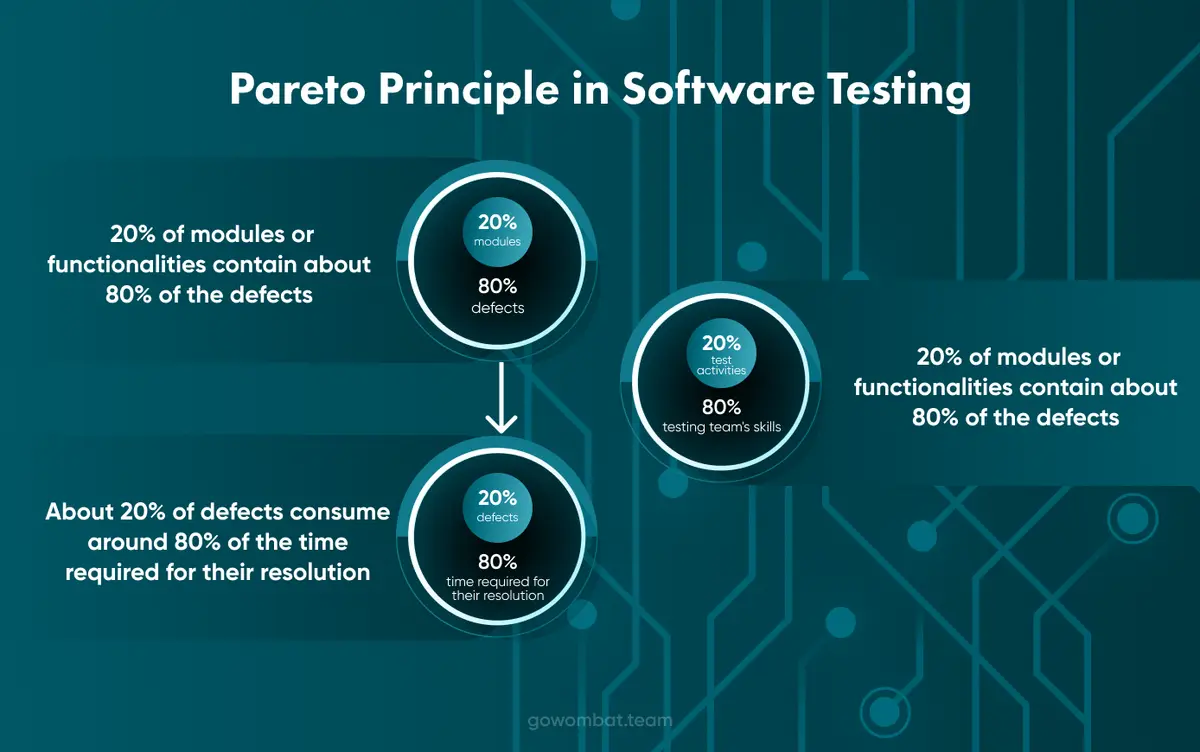
Defects are not spread evenly across a system. In most systems, a small number of modules or components contain most of the defects found in testing or in production.
The ISTQB syllabus calls this an illustration of the Pareto principle, the general 80/20 rule of thumb; the actual proportion varies from system to system. Modules that are complex, change often, have many dependencies or were built in a hurry tend to have more defects.
This changes how testing effort is allocated. Instead of spreading it evenly, the team uses defect history to predict where defects will cluster next, and gives those areas more test cases, more review and more exploratory testing.
For example, imagine a fintech app in which the interest rate calculation module has historically had more defects than any other. The testing team tracks this and, in each release cycle, gives that module three times the test coverage of the more stable ones.
Over the following months, this catches critical defects in the module before they reach production.
Allocating tests by defect data makes testing both more thorough and more efficient. It does not mean ignoring modules with a clean history, since any code change can introduce defects; it means the riskiest modules are never under-tested.
Principle 5: Tests Wear Out (the Pesticide Paradox)
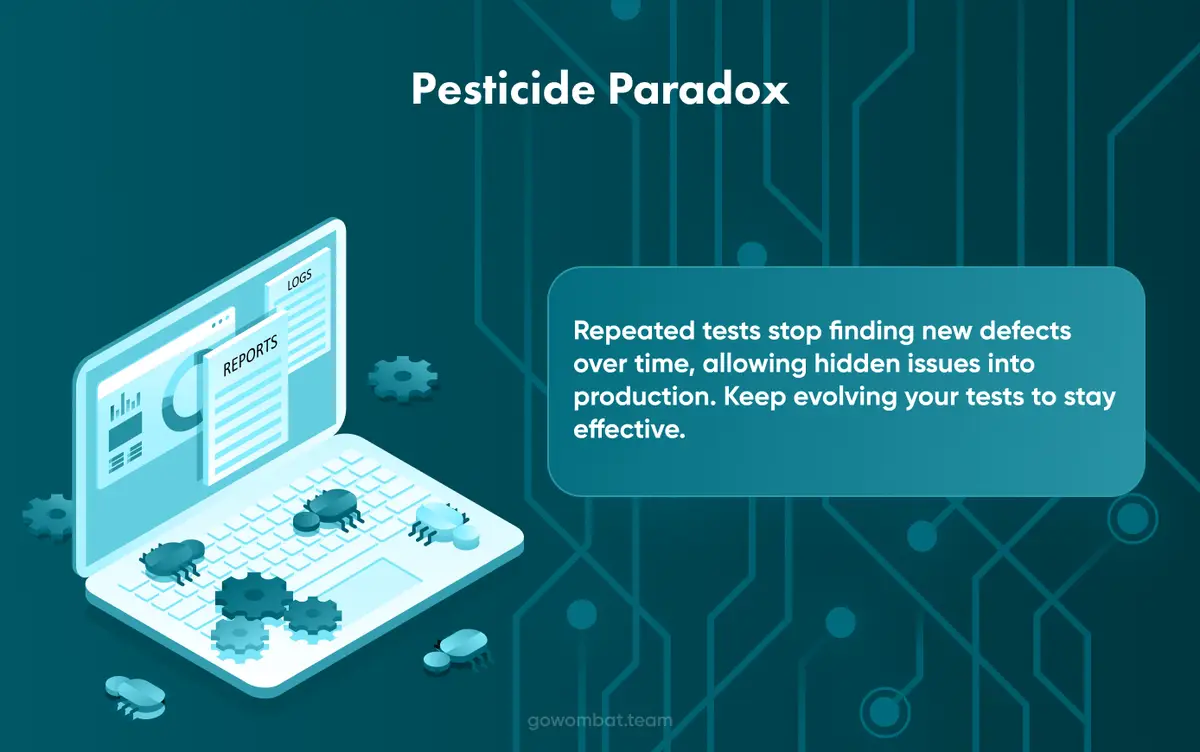
If the same tests are run again and again without change, they eventually stop finding new defects. The current ISTQB syllabus (CTFL v4.0) calls this principle "tests wear out"; earlier versions called it the pesticide paradox, a term from Boris Beizer. Beizer compared it to agriculture: insects exposed to the same pesticide over and over become resistant, and the pesticide stops working.
Tests behave the same way. When the code keeps changing and the tests do not, the tests only confirm what already worked. The results look healthy, but the confidence is misplaced.
Regression suites show this most clearly. A suite written to check the original functionality will not catch defects in new features, changed components or modified integrations.
How to counter it: treat test suites as living documents, and review and update them every sprint or release cycle. Write new test cases for recently changed areas and unexplored paths. Exploratory testing sessions, where a tester looks for unexpected behaviour without a script, often find defects that existing suites miss. Security, usability and performance testing catch defects that functional suites are not designed to detect.
Tools for maintaining automated regression tests help, but an out-of-date automated suite still wears out. The answer is better test design, not more automation.
Principle 6: Testing Is Context-Dependent
No single approach fits all software. Testing depends on the domain, risk profile, regulatory requirements and user expectations.
A consumer mobile app and a radiation therapy control system are both software, but they are not tested the same way. Their risk profiles, regulatory requirements and tolerance for failure are completely different.
Real-World Consequences of Ignoring Context
The Therac-25 radiation therapy machine failed for several reasons. One was that the safety features of earlier hardware versions were removed when software took over control, and there was not enough testing to replace them. Radiation overdoses led to the death of three patients.
The Mars Climate Orbiter was lost because of a mismatch between two teams: one used imperial units, the other metric. The trajectory was miscalculated, and the craft entered the Martian atmosphere and was destroyed. Testing had assumed that both sides used the same units.
Knight Capital Group lost more than $460 million in about 45 minutes because of a deployment error, according to the SEC. New code was not copied to one of its eight servers, and a repurposed flag reactivated Power Peg, an old trading function unused since 2003. Testing had not covered deploying to the live trading environment with that flag active.
In each case, testing did not match the context the system actually ran in.
In practice, an e-commerce application needs thorough security testing, accessibility testing and load testing for peak demand. A banking application needs integration testing with payment networks, validation of error handling in financial transactions, and latency testing under high concurrency. A logistics application needs resilience testing for patchy connectivity and third-party API failures.
Domain knowledge shapes the whole testing strategy: scope, depth, order and standards. A testing team that does not understand the domain cannot deliver real quality assurance.
Principle 7: Absence of Errors Is a Fallacy
Software can pass every test and still fail. It can also be technically correct and still fail its users. These are two different kinds of failure, and a testing strategy has to address both.
The first kind is easier to understand. No test suite covers every case: device configurations, unexpected input sequences and edge cases the requirements never anticipated can all make a well-tested product fail. No detected errors does not mean no errors.
The second kind is less intuitive but just as important. Software can be verified against every requirement in its specification and still fail, because the requirements were wrong, the user experience is too complex, or the workflow does not match how people really work. This is the difference between verification and validation. Verification checks that the software meets its specification. Validation checks that it meets users’ needs.
Comprehensive testing of a flawed specification results in technically correct software that nobody wants to use.
Testing is done for the user, not for the specification. If the specification is incomplete, ambiguous or wrong for the users, no amount of testing against it will produce a good product. Requirements review, user acceptance testing and usability testing address this problem, and they belong in every complete test strategy.
How the 7 Principles Work Together
The principles reinforce each other.
Early testing (Principle 3) makes defect detection (Principle 1) more effective because it finds defects when they are easiest to fix. Defect clustering (Principle 4) feeds risk-based testing, the practical answer to the impossibility of exhaustive testing (Principle 2). Tests wearing out (Principle 5) explains why a clean run is not evidence of quality, and the absence-of-errors fallacy (Principle 7) makes the same point from the user’s side. Context (Principle 6) ties them together, because every principle has to be applied to the reality of the system under test.
Conclusion
The seven principles come from decades of experience on real software projects, including failed ones. Applied together, they help teams find defects earlier, focus effort where the risk is and avoid reading too much into a clean test run.
If you need help building or strengthening a testing strategy, see Go Wombat's software testing services.
Frequently Asked Questions
What are the 7 principles of software testing according to ISTQB?
The seven principles in the ISTQB Foundation Level syllabus are: testing shows the presence of defects, not their absence; exhaustive testing is impossible; early testing saves time and money; defects cluster together; tests wear out (the pesticide paradox); testing is context-dependent; and absence of errors is a fallacy.
Why is exhaustive testing considered impossible?
Even a simple application has too many input combinations, environment variables and user behaviour patterns to test them all, and the number of possible states grows exponentially with complexity. The practical answer is risk-based testing.
What does shift left mean in the context of early testing?
"Shift left" means moving testing activities to earlier stages of the development lifecycle. Traditionally, testing was the last step before deployment. In a shift-left approach, requirements review, static analysis and automated testing happen throughout development. This reduces the cost and complexity of fixing bugs, which grow the later a bug is found.
What is the pesticide paradox, and how do you prevent it?
The pesticide paradox (called "tests wear out" in the current ISTQB syllabus) describes how a set of tests run repeatedly without change gradually stops finding new defects, because the software changes and the tests do not. To prevent it, review tests regularly, use exploratory testing and write new tests when new features are added.
Does passing all tests mean the software is ready for release?
Not necessarily. Passing all tests means no defects were detected under the tested conditions, which is significant but not the same as defect-free. It also does not guarantee that the software meets users’ expectations or solves the right problem. User acceptance testing and validation are also needed.
Why does context matter so much in software testing?
Each domain has a different risk profile, different regulations, and different expectations from the user. A testing approach suitable for a marketing website could be completely inadequate for medical device software or financial trading systems. Context defines what, how, and in which order testing should be done.
Share and subscribe to our blog
Related articles
-blogCardMobile-480x320.webp)
What Is Quality Assurance in Software Engineering?
What quality assurance in software engineering involves, how it differs from quality control and testing, when QA should start, and how AI is changing it.

What Is the Software Development Life Cycle (SDLC) in 2026?
The software development life cycle (SDLC) explained: the 7 phases, 6 common models, team roles, secure SDLC requirements and how AI is changing the process in 2026.

Why Is the Digital Twin of an Oil Refinery the Most Complex AI System You Will Ever Build?
Why a digital twin of an oil refinery is so hard to build: seven interdependent layers from physics simulation to control system integration, results from Cosmo Oil's refinery digital twin, a look at Honeywell's planned digital-twin work at the Dangote refinery, team and data prerequisites, and why projects fail.

How can we help you?

