




Computer vision development
We develop object and human detection for industrial spaces. Computer vision is one of the core technologies behind spatial computing.

AI Solutions & Services

Build

Secure & Comply

Design & Discovery
Not sure where to start with AI?
Check your readiness in a few minutes.
BIG 4 · SOLUTIONS-LED

Industry 4.0 & AgTech

AdTech & MarTech

Smart Cities & PropTech

SportsTech & Entertainment
Not sure where to start with AI?
Check your readiness in a few minutes.
 About Go WombatOur company, expertise and leadership
 CareersOpen roles and opportunities at Go Wombat
 Our CultureValues, collaboration and life at Go Wombat
 PartnershipTechnology and delivery partnerships
 Impact & SustainabilityOur social and environmental commitments
 Sustainability ReportOur sustainable development initiatives and annual report
Spatial computing development from Go Wombat: AR, VR, mixed reality, computer vision and visionOS apps that connect digital content to the physical world.
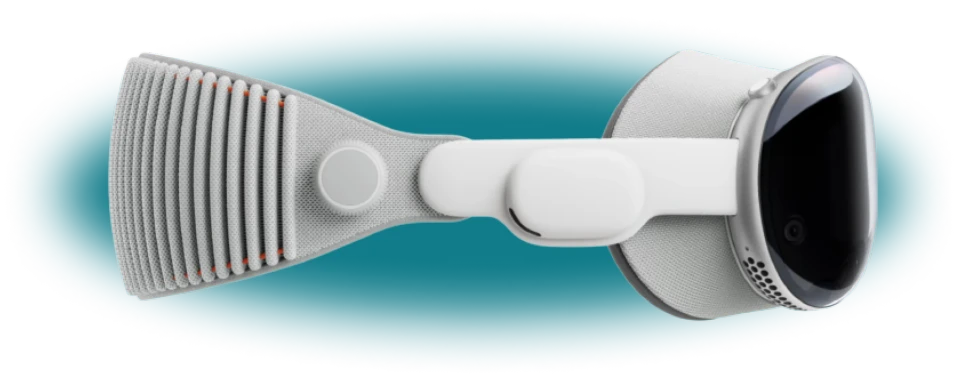
Discuss your spatial computing projectApple Vision Pro runs visionOS, with features such as 3D spatial photos and Spatial Audio. We build visionOS apps, and we also develop spatial computing solutions for other devices and platforms.
Spatial computing projects need the same engineering discipline as any other software: secure architecture, testing and long-term support. We bring 10+ years of custom software development to them.
Our case studies show the custom software we have built across industries.
We consult on spatial computing projects: we can help you introduce spatial computing glasses into your operations or plan the technical approach with your internal team.
Our visionOS developers can build a new app or game for Apple Vision Pro from scratch or adapt your existing app or game to visionOS. We develop SharePlay experiences and handle quality control through TestFlight.
The spatial computing services we offer:
We develop object and human detection for industrial spaces. Computer vision is one of the core technologies behind spatial computing.
AR lets your customers interact with your products, services or spaces from their own devices. You can also use it for remote training and real-time guidance of employees.
VR lets users see and walk around a virtual environment. Combined with spatial computing, it lets them interact with that environment naturally. We also build data visualisation and simulation in virtual spaces.
Mixed reality (MR) blends VR and AR. We build interactive experiences that combine real-world elements with virtual objects, for products, services and non-profit projects.
In spatial computing, location-based services (LBS) use the user's location to deliver extra services and content. For example, an app can show special content only to users in a specific place.
Our developers build algorithms that map the user's environment and place virtual content accurately in it, so people can interact with virtual elements as expected.
We combine spatial computing with speech commands and gesture recognition, so users can control your app with their voice or hands. This is useful in logistics and manufacturing facilities, where workers cannot always use a keyboard or touchscreen.
We develop data visualisation and simulation tools with a spatial dimension, so your team can see data in the context of physical space.
Beyond reviews, case studies and videos, customers can experience your brand directly in augmented, virtual or mixed reality. We build the spatial computing platform for it.
Spatial computing is a new technology, but we build it with the same process as any other software, from business analysis and planning through to support and maintenance.




01
02
What spatial computing can do for your business:
Build virtual prototypes of new products before making physical ones.
Engage users through VR, AR and MR experiences.
Uses include remote assistance for technicians, 3D product configurators and VR safety training.
Train staff in realistic VR and AR simulations.
Gain experience with spatial computing while the technology is still new.
Apple Vision Pro has been on sale in the US since 2 February 2024, and Apple now offers it with the M5 chip. We expect more spatial computing products and services to follow.
Spatial cloud computing, for example, can give emergency responders real-time data during disasters, and give urban and transport planners real-time data on population and traffic.
We follow these developments and advise you on which of them make sense for your business now.
Tell us when suits you and we will set up an introductory call on the channel you prefer.
Spatial computing is the set of methods for capturing, processing, using and interacting with 3D data, both computer-generated and captured from the real world.
The term appears to have originated in geographic information systems (GIS) around 1985 and was used in virtual reality research in the 1990s. In 2003, MIT researcher Simon Greenwold defined spatial computing in the human-computer interaction sense in his master's thesis. The first AR systems came earlier: Ivan Sutherland's see-through head-mounted display (1968) and Virtual Fixtures, built at the US Air Force's Armstrong Laboratory (1992).
Some of the biggest challenges with spatial computing development include:
Hardware power limitations
Difficulties with storing assets
Mitigating user discomfort and sickness during use
Tracking and calibrating objects and locations in real-time
Data privacy and security concerns
The Internet of Things (IoT) is everyday devices equipped with sensors and an internet connection. The two technologies complement each other: spatial computing can be built into IoT devices to extend what they can do.
Commonly found applications and games that use spatial computing include:
Google Maps
Pokémon GO
VR and AR headsets such as Apple Vision Pro

