



Business Analysis in Software Development: Full Guide


Business analysis in software development works out what the software must do before the team builds it. It uncovers risks early and makes the development life cycle easier to manage.
At Go Wombat, we pay careful attention to business analysis and risk management. This article covers what business analysis is, its benefits, its knowledge areas and the techniques our analysts use.
What business analysis is
The International Institute of Business Analysis (IIBA) defines business analysis in its BABOK Guide as the practice of enabling change in an organisation by defining needs and recommending solutions that deliver value to stakeholders. In software development, this means working out what the business needs and which requirements the software must meet.
Business analysts do this work. They analyse data and processes to identify requirements, assess business risks and the business model, document how the organisation works and recommend solutions that help it reach its objectives. The job calls for analytical thinking and attention to detail.
Why business analysis is vital in software development
Skipping business analysis means skipping three things every software project needs.
Elicitation of product requirements
Business analysts gather requirements for the software by working with clients, business stakeholders, project managers and developers. Well-collected requirements help developers build the right product.
Needs identification
Understanding what end users need helps business analysts spot risks early. End users are only one group of stakeholders: investors, managers and other stakeholders also have needs and expectations, and business analysis identifies them too.
Communication planning
Business analysts act as the link between clients and developers. They spend much of their time talking to everyone involved and plan how information will be shared. Without this work, requirements get lost between the client and the team, and the result becomes unpredictable.
If you need full-cycle development from scratch, tell us about your project.
Benefits of professional business analysis
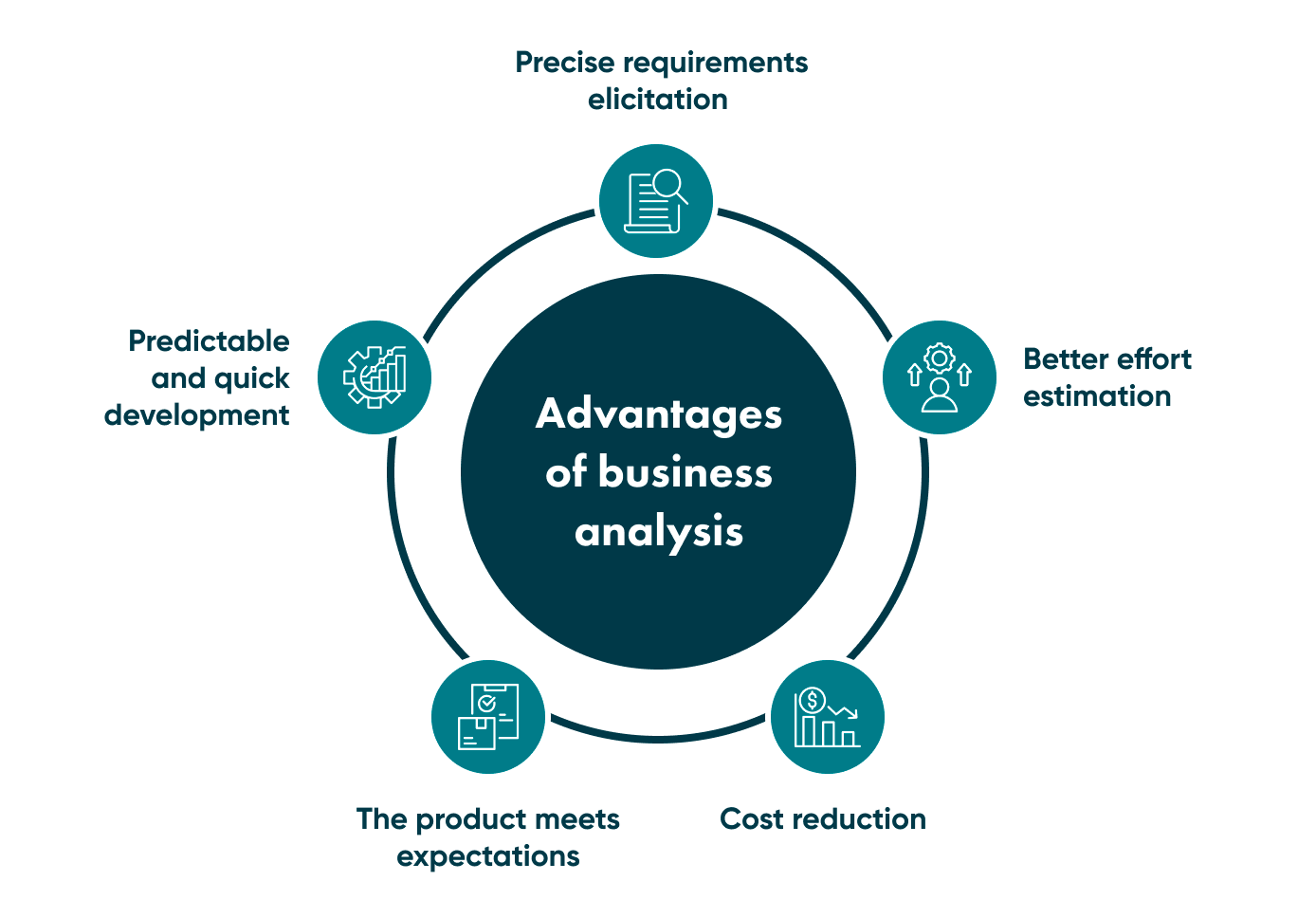
Precise requirements elicitation
The main benefit is a detailed set of requirements. Business analysts collect functional and non-functional requirements. Functional requirements, sometimes called behavioural requirements, describe what the software must do so that users can perform their tasks.
Non-functional requirements describe quality attributes, such as usability, integrity, efficiency and fault tolerance. A complete specification includes both types.
Better effort estimation
With clear requirements, it is much easier to estimate the effort the software will take and to draft the budget and project plan early in the development life cycle.
Cost reduction
Business analysis costs money up front but usually lowers the total cost. Without a precise specification, developers run into unexpected problems and late requirements, which extend development and raise the cost.
Predictable and quick development
With well-prepared documentation, everyone on the project knows what to do and what the result should be. Development moves faster, with fewer surprises.
The product meets expectations
Because the requirements reflect the details of the business, stakeholders get the product they paid for and users get the functions they need.
Knowledge areas of business analysis
The IIBA's BABOK Guide groups business analysis tasks into six knowledge areas: business analysis planning and monitoring, elicitation and collaboration, requirements life cycle management, strategy analysis, requirements analysis and design definition, and solution evaluation. They are groups of tasks, not sequential stages, and on a real project they overlap. Go Wombat's analysts follow this framework; the main areas are described below.
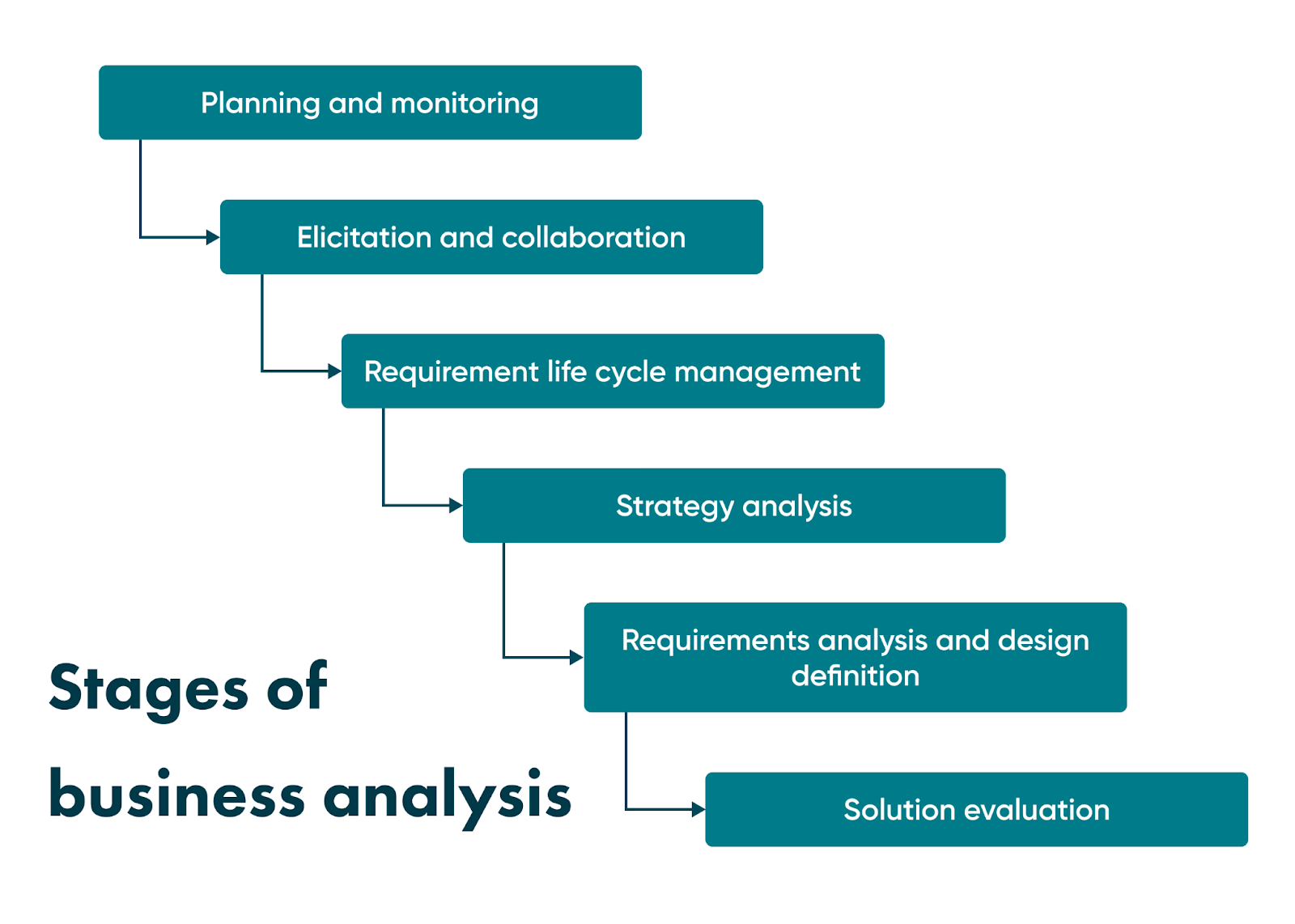
Planning and monitoring
This knowledge area covers organising and coordinating the work of business analysts and stakeholders.
Analysts plan the approach to business analysis, choose a methodology and schedule activities. The business analysis plan also describes how stakeholders and analysts will interact, which topics they will discuss and how communication can be improved.
Planning and monitoring make sure that decision makers have the information they need to keep the project moving.
Elicitation and collaboration
This knowledge area covers how business analysts get information from stakeholders and confirm that they have understood it correctly.
The information comes from stakeholders and other sources, for example through interviews and by studying how work is currently done.
Discovery phase
The discovery phase is not a BABOK knowledge area, but on our projects it runs alongside them. It is a detailed analysis of the future product: we define the product's characteristics and its business and technical requirements. For more detail, read our article about the discovery phase.
Requirements life cycle management
Here business analysts manage and maintain requirements and design information from inception to retirement, and keep business requirements, stakeholder needs and designs consistent with each other.
This includes controlling changes to requirements and tracing how each one is implemented and delivered, so the information stays available to the client later.
Strategy analysis
A strategy describes how an organisation will use its capabilities to reach its goals. Strategies exist for a whole company, a department, a product or a project.
In strategy analysis, analysts work with stakeholders to identify a business need of strategic or tactical importance, describe the current and desired future state, and define the change needed to get there.
After a detailed study of the market and the company, analysts can also help build a long-term competitive strategy.
Solution evaluation
Solution evaluation assesses how well a solution performs and what value it delivers. The BABOK Guide deliberately does not prescribe a methodology or an order for the knowledge areas, so this is not necessarily the last step. Analysts may recommend removing constraints that prevent a solution from delivering its full value.
Evaluation can start early: developers and designers build prototypes, test them with the first focus groups and improve the product based on the feedback. This catches shortcomings early, when they are cheaper to fix.
For a detailed estimate of your software, contact Go Wombat.
Business analysis techniques
Each knowledge area relies on specific techniques. The BABOK Guide describes around 50 of them; below are the ones our analysts at Go Wombat use.
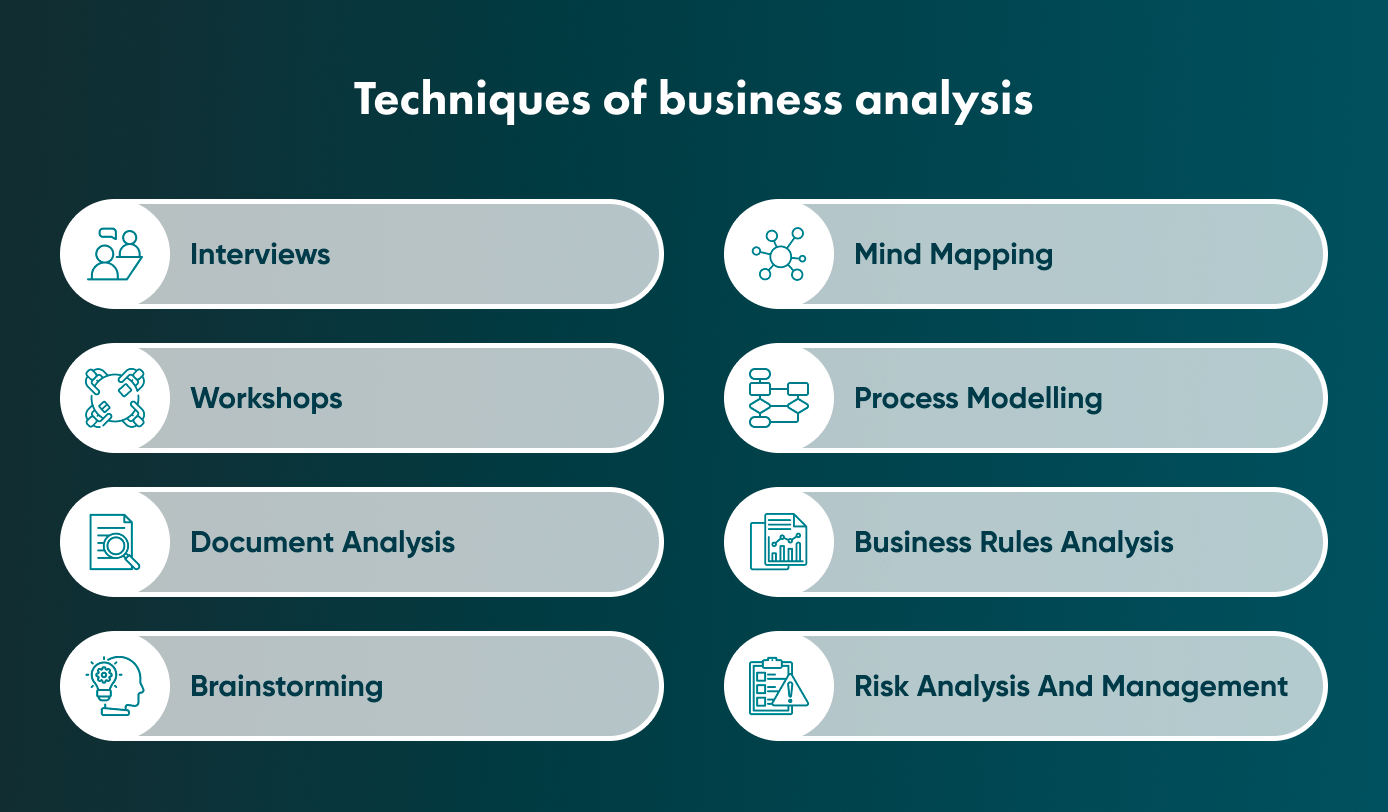
Interviews
Interviews with stakeholders provide the information needed for the business analysis plan and the strategy. They are also held after the analysis to assess how well it worked.
Workshops
We hold workshops where stakeholders get to know each other, build the analysis plan, identify possible solutions, manage changes, set priorities and bring hidden problems to the surface. Workshops are also used to review business analysis performance and generate ideas.
Document analysis
Our business analysts review the client's existing documentation to gather data for requirements and strategy analysis.
Brainstorming
Our analysts run brainstorming sessions with stakeholders to generate ideas and possible requirements for the future product.
Mind mapping
A mind map is a diagram that arranges tasks, ideas, images and other elements around a central subject. Analysts use mind maps to organise information about the project and work out detailed requirements.
Process modelling
A process model is a diagram that shows how work is carried out. We model clients' business processes to analyse them and decide on the approach to business analysis.
Business rules analysis
There are two types of business rules: definitional and behavioural. Business rules analysis is performed to elicit, express, validate, refine, and organise the rules that form business behaviour and guide business decision-making.
Risk analysis and management
Analysts identify the risks a software project may face and plan how to mitigate them. For more detail, read our article about risk management in software development.
Depending on the project, analysts may use other techniques as well.
Summing up
Go Wombat provides full-cycle software development, from concept to delivery, and business analysis is part of it.
If you have questions, let us know.
FAQ
What is business analysis and what is an example?
Business analysis is a set of tasks and techniques for defining what a business needs and recommending solutions. In software development, it links the development company and the client's stakeholders: analysts study the company's structure, policies and field of activity, and suggest how software can help it reach its goals.
A typical example is the analysis of functional and non-functional requirements. Functional analysis identifies the features the software needs to meet user needs.
Non-functional analysis defines the software's quality attributes, such as usability, performance and reliability.
What does a business analyst do?
A business analyst performs many tasks, but the main ones are:
- Elicit the client’s requirements and understand the problem the client wants to solve.
- Build the solution concept together with a team or independently.
- Turn the idea into a technical task with specific requirements for the future product. This process requires the use of many methodologies (techniques).
- Detail each requirement in the form of a spec.
- Communicate with all stakeholders throughout the project.
What are some different types of business analysis?
There is no standard classification of business analysis types (the BABOK Guide does not define one), but analysis can focus on different things:
Functional analysis studies how the current system works and what customers expect from it.
Process analysis studies the steps and workflow of a business process.
Organisational analysis looks at the corporate culture and how well it fits customer needs and market conditions.
Share and subscribe to our blog
Related articles

What Is the Software Development Life Cycle (SDLC) in 2026?
The software development life cycle (SDLC) explained: the 7 phases, 6 common models, team roles, secure SDLC requirements and how AI is changing the process in 2026.

Project Discovery Phase in Software Development
What a discovery phase is, when you need one, who takes part, what it delivers, and what happens when a software project skips it.

Why Is the Digital Twin of an Oil Refinery the Most Complex AI System You Will Ever Build?
Why a digital twin of an oil refinery is so hard to build: seven interdependent layers from physics simulation to control system integration, results from Cosmo Oil's refinery digital twin, a look at Honeywell's planned digital-twin work at the Dangote refinery, team and data prerequisites, and why projects fail.

How can we help you?

