



Can AI Orchestration Replace AgriTech Manual Workflows?

Most sizeable agri-food businesses I work with have automated something. Often it’s a forecast script the planning team built years ago, sometimes a yield model the agronomy team has come to trust, or a procurement portal that pings the warehouse on Tuesdays. What rarely gets automated is the work that sits between those tools: manual handoffs, spreadsheet reconciliations, phone calls to suppliers, and the person in operations stitching it all together before the next planting decision. AI orchestration coordinates predictive models, IoT signals, ERP transactions, supplier APIs and human approvals into one decision flow, so a supply chain stops behaving like thirty disconnected systems. The rest of this piece looks at where orchestration replaces manual work in agritech today, what it changes on the ground, and what leaders should sort out before deploying it.
Why AI Orchestration Matters for Modern AgriTech Supply Chains
Automating single tasks is no longer enough. The agri-food chain has plenty of tools, but people still do the work between them, and that is where most of the cost, delay and compliance risk now sit.
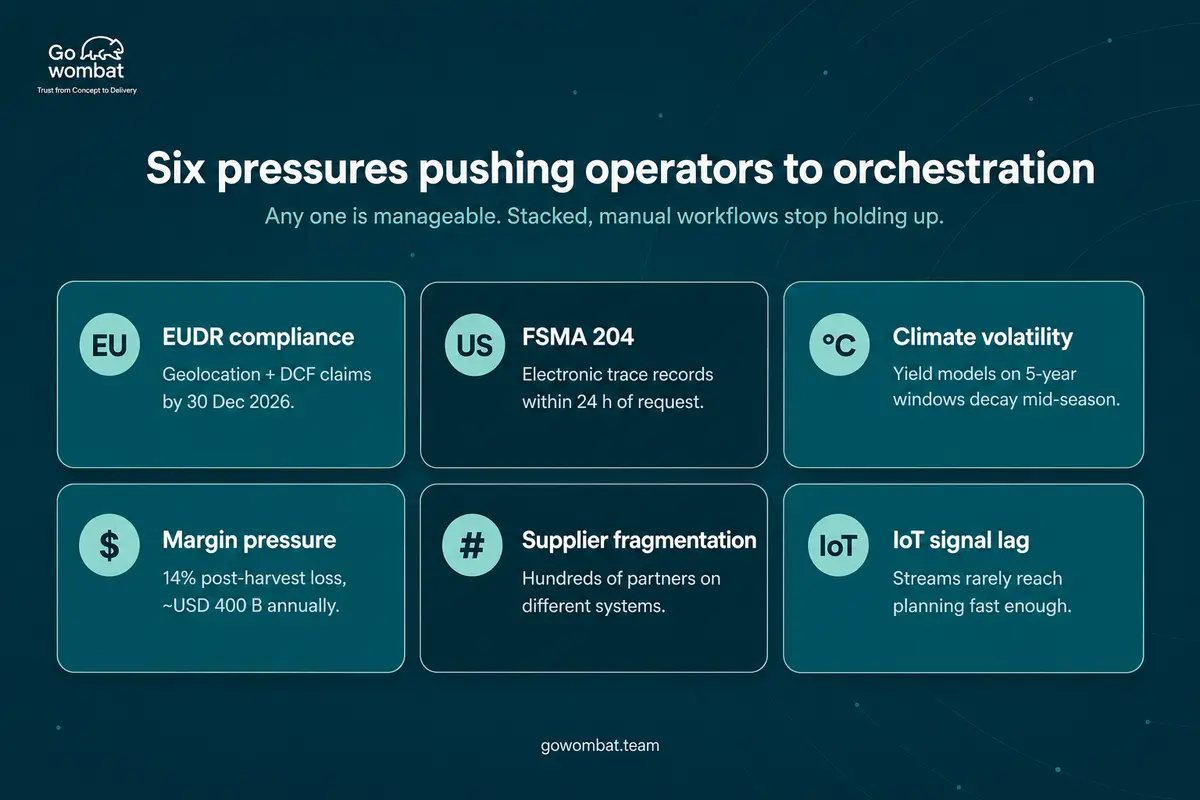
A handful of pressures are pushing agritech operators toward orchestration, and they tend to stack rather than appear one at a time.
Compliance gets tougher every year. The EU Deforestation Regulation requires geolocation data and verifiable deforestation-free claims for cattle, cocoa, coffee, oil palm, rubber, soya, and wood by 30 December 2026. FSMA 204 goes further on the US side: once its compliance date arrives on 20 July 2028, covered entities will need to produce electronic, sortable traceability records within 24 hours of an FDA request for items on its Food Traceability List. Then climate volatility comes in. Yield models trained on a five-year window decay quickly once weather patterns drift, and replanning increasingly has to happen mid-season rather than after harvest. Margins keep tightening, too. According to FAO data, 13.3% of food was lost between harvest and retail in 2023, and an earlier FAO estimate put the value of these losses at roughly USD 400 billion a year, so even partial recovery changes the unit economics. The supplier base keeps fragmenting in parallel. A mid-sized food processor will usually deal with hundreds of smallholders, traders, and logistics partners, each on different systems with different formats and reporting cadences. And finally, there’s the IoT layer that no one quite knows what to do with. Sensors stream constantly, but the signal rarely reaches the planning or procurement layer in time to be useful.
Take any one of those in isolation, and a clever script handles it. Stack them, and orchestration becomes the only realistic way to keep the supply chain coherent.
Common orchestration patterns in agritech today
When I look at production deployments, the architecture tends to look surprisingly similar across operators. Predictive yield and demand models feed into ERP planning runs. Edge ingestion brings in IoT and satellite data with stream processing on top. Supplier APIs come in through middleware or iPaaS. ERP-to-WMS handoffs sit on event-driven workflows. And traceability plus compliance reporting all rest on a unified data layer.
The returns come from treating those blocks as a single system rather than five overlapping projects. That is also where business process automation pays off most.
How AI Orchestration Replaces Manual Workflows
Manual workflows survive in agri-food for a simple reason: the proposed alternative is usually another disconnected tool, so people keep their spreadsheets. Orchestration is different because it replaces the manual steps with one governed pipeline instead of adding another tool.
What is AI orchestration, and how does it differ from automation?
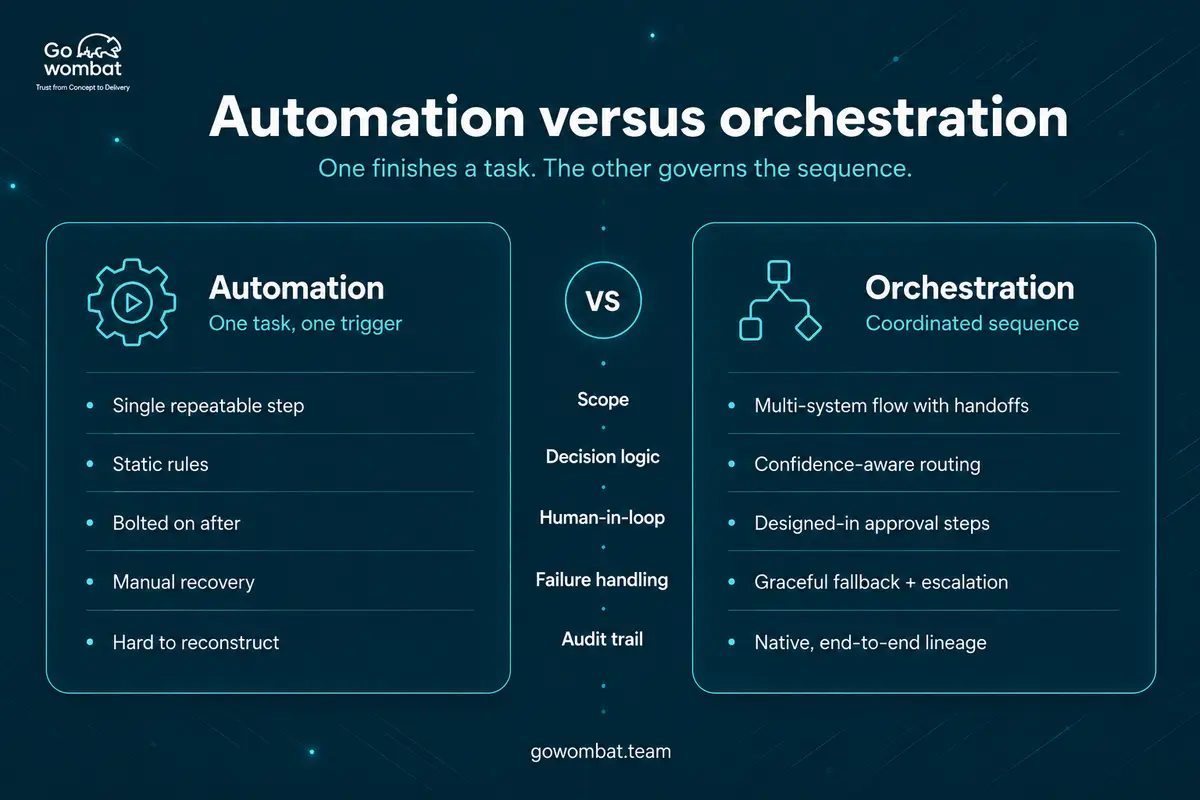
When clients ask me to define it in one sentence, my working answer is this. AI orchestration is the coordination of multiple AI models, data sources, business systems, and human decision points into a single executable workflow. Automation finishes a task. Orchestration takes care of the sequence. It decides which model to call when, routes outputs into downstream systems, and escalates exceptions to a human reviewer.
The contrast is easiest to see with a familiar example. A traditional automation runs a forecasting script every Monday morning, and that’s the end of its job. An orchestrated version runs the forecast, checks confidence scores, calls a weather model when confidence drops, reconciles the result against current inventory in the ERP, drafts a procurement order, and waits for a buyer’s approval before it touches the supplier API.
That sequence used to live in email threads and the planner’s head. Built as one orchestrated workflow with enterprise AI services, it gets a clear owner and an audit trail at every step.
How orchestration reshapes the field-to-fork pipeline
Three live deployments make the pattern concrete, each from a different part of the chain.
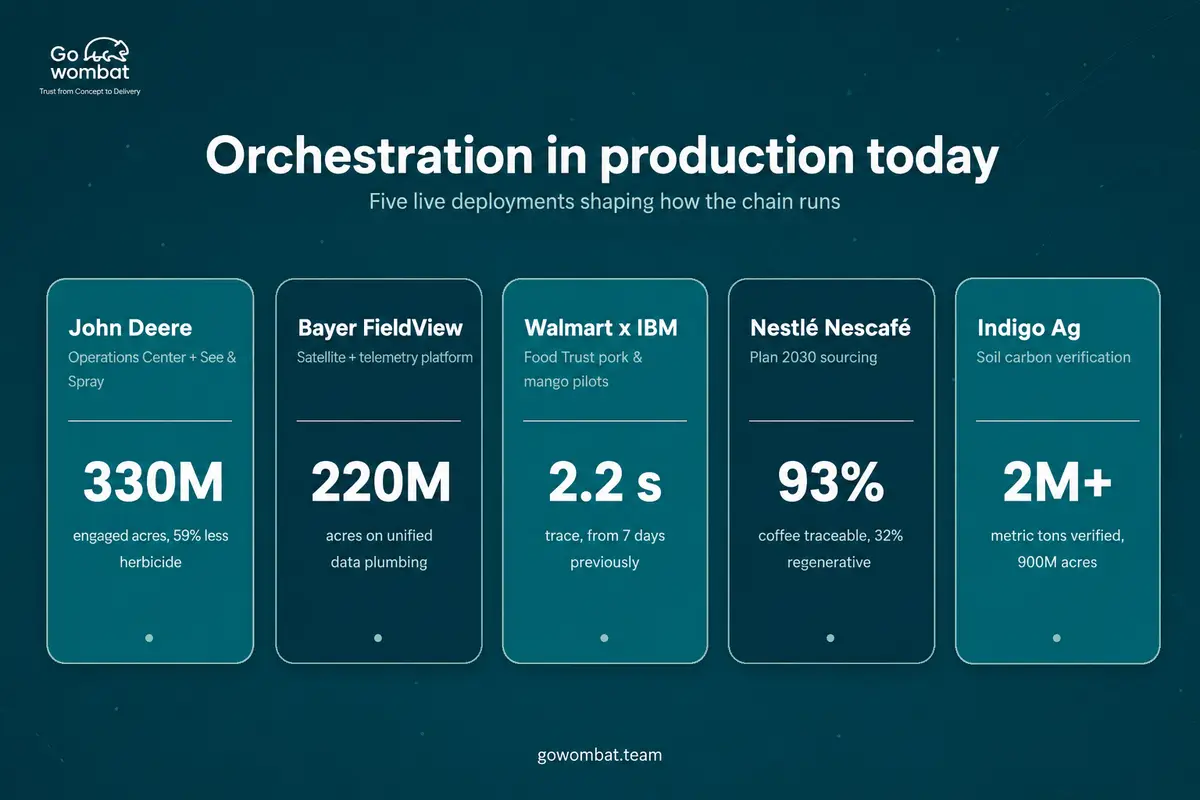
Start with John Deere. Their Operations Centre already covers more than 500 million engaged acres and is the coordination layer behind the company's autonomous and semi-autonomous machinery. See & Spray, the herbicide-targeting system that came out of the 2017 Blue River Technology acquisition, saved farmers an estimated 8 million gallons of herbicide mix in 2024 across more than 1 million acres, with an average 59% reduction. The vision model runs on boom-mounted cameras. Routing, prescription delivery, and the data flow back to a farmer’s records all sit in the Operations Centre. None of it gets re-keyed.
Bayer Climate FieldView is the same idea, further upstream. It pulls satellite imagery, weather, machinery telemetry, and field-level inputs onto a platform that now covers more than 220 million acres globally, making it one of the largest commercial deployments of agricultural data orchestration in production. In 2023, Bayer adopted Microsoft's Azure Data Manager for Agriculture as a cloud foundation for FieldView's weather, satellite, and connector data pipelines, on the logic that unified data plumbing has to come before anything else works. Microsoft retired that service, which was still in preview, on 1 September 2025.
Cargill applies the same thinking to R&D. The company frames its AI push around speed of learning rather than launch dates. As Renee Boerefijn, Senior Director of R&D at Cargill, told AgFunderNews in March 2026, "Speed is no longer about being first to market. It's about learning faster, scaling responsibly and reducing risk in an increasingly complex system." In Cargill's R&D, that means AI across one continuous flow, from early consumer insight through formulation, scale-up, and operational execution.
How Does Unified Agri Data Power AI Orchestration?
Orchestration fails when the data underneath it is fragmented. In a typical agri-food estate, data lives across ERPs, farm management systems, telematics platforms, supplier portals, weather feeds, sensor brokers, and compliance databases. Most of those systems never talk to each other directly, and yet they all touch the same physical product.
A unified data layer (a cloud lakehouse, or a domain-specific data platform) gives the orchestration engine something coherent to act on. In practice, this delivers:
- One identity per supplier, plot, and SKU
- Reliable joining of yield, input, weather, and outcome data
- Real-time access for inference, not batch overnight refreshes
- Reusable feature pipelines across forecasting, traceability, and ESG reporting
- Audit-grade lineage that answers regulator queries quickly
Walmart's pilots with IBM, announced in October 2016 and run in 2016–2017, before IBM launched Food Trust commercially in 2018, are still the example most people reach for when explaining why this matters. In the pork and mango pilots, the time required to trace a mango shipment fell from seven days to 2.2 seconds, and the network reached more than 25 products from five suppliers, covering produce, meat, dairy, and multi-ingredient items. The blockchain layer attracted the headlines, but in operational terms the lift came from the shared data model underneath it.
Coffee shows a similar dynamic. Nestlé’s Nescafé Plan 2030 report records 93% of its coffee as Responsibly Sourced, with 32% sourced through regenerative agriculture in 2024. Numbers like those are only possible when farmer-level data, certification records, and shipment information all flow into one verifiable view. A spreadsheet workflow does not sustain that volume.
Once the data foundation is in place, BI and data visualisation stop being a reporting layer and turn into the operating view that the team checks every morning.
Where Does AI Orchestration Fit Across the AgriTech Supply Chain?
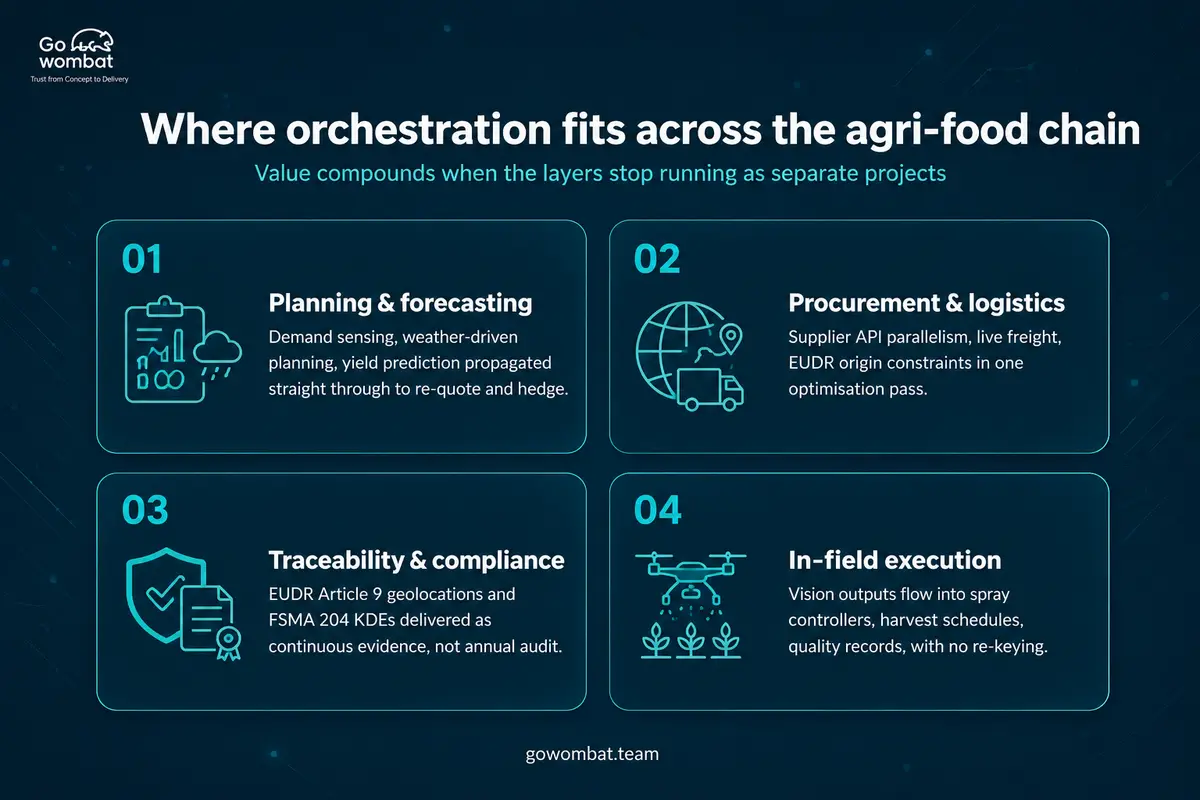
There isn’t one obvious starting point. The value compounds when orchestration bridges layers that were previously run as separate projects.
Planning and forecasting
Demand sensing, weather-driven replanning, and yield prediction all feed into sales-and-operations planning. Where orchestration is in place, an updated yield estimate is no longer a number on a slide. It propagates straight through to a re-quote with the carrier and a revised hedge with the trader, without anyone re-keying anything.
Procurement and logistics
Supplier API orchestration is what finally retires the email-and-spreadsheet RFQ loop. A multi-origin processor can call dozens of suppliers in parallel, pull live freight rates, and run an optimisation that respects EUDR origin constraints in the same pass. At that point, logistics software development is about connecting the whole chain rather than building a separate module.
Traceability and compliance
EUDR Article 9 wants named geolocations, supplier identity, and verifiable deforestation-free claims for every shipment of covered commodities. FSMA 204, on the US side, wants Key Data Elements tied to Critical Tracking Events for items on the Food Traceability List, delivered in electronic, sortable format within 24 hours of a request. Read together, the two rules turn traceability into a continuous orchestration problem rather than an annual audit exercise.
In-field execution
Autonomous and semi-autonomous machinery, drone scouting, and prescription delivery all rely on the orchestration layer to turn a model output into something that happens on the ground. Computer vision software for weed detection, fruit grading, and disease identification only delivers measurable value when its outputs flow into spray controllers, harvest schedules, and quality records without anyone re-keying.
How Real-Time Signals and Multi-Agent Systems Strengthen Decisions
Picture a mid-size grain operator in the Midlands. They have telemetry coming off the combine harvesters, weather data from a regional service, and freight quotes coming through a broker. None of those feeds talks to the ERP. That gap is where orchestration helps: agents read all the signals and act on them in near real time.
IoT-driven orchestration
Edge sensors stream soil moisture, microclimate, fuel consumption, and equipment health. The orchestration layer applies rules and models to work out what matters now, what can wait, and what needs a human eye. Stream processing on the cloud side feeds the same data into longer-horizon planning models, so the same signal informs both today’s decisions and next season’s.
Digital twins for agri operations
Digital twin orchestration lets operators simulate the consequences of a decision before they commit to it. A digital twin of a grain elevator, for instance, can model the impact of rerouting a shipment under a new weather forecast, surfacing the financial and operational implications side by side. Cargill is publicly building AI capability across this kind of physical-digital coordination, and the academic research based on digital twin orchestration in agriculture is now substantial enough to inform real designs.
Agentic workflows for procurement and risk
Multi-agent systems split a complex decision across specialised agents. One agent negotiates with suppliers. Another reconciles the inventory. A third checks compliance. A fourth escalates exceptions. Indigo Ag does this kind of distributed coordination at scale. According to Indigo's February 2026 announcement, its programmes have covered more than 8 million acres in 28 US states since 2018, and it uses remote sensing and mobile tools to verify soil carbon outcomes. By the fifth credit issuance, the platform had passed 2 million metric tons of verified soil carbon impact. Behind that headline sits an orchestration stack joining remote sensing, agronomic data submission, and buyer-facing dMRV, backed by machine learning services tuned to the agronomic domain.
AI Orchestration and Supply Chain Resilience
Resilience in agri-food is a procurement question, a compliance question, and an operational question rolled into one. Orchestration turns it into something operations teams can run day to day.
How orchestration reduces loss and waste
When more than 13% of food is lost between harvest and retail, even partial recovery is real money. With orchestration in place, the gap between a sensor reading and a corrective action shrinks. A temperature drift in the cold chain triggers a routing change rather than a write-off. Unilever's deforestation-free palm oil sourcing reached 96.8% by the end of 2025, covering more than 20 million hectares across Indonesia and Malaysia, with over 55,000 smallholders mapped through polygon data. That depth of monitoring isn’t something a manual due diligence team can produce, however well-resourced.
Modelling ROI for agritech orchestration
McKinsey puts the prize at USD 100 billion on the farm and USD 150 billion at the enterprise level once analytical and generative AI are integrated across the sector. In our experience working with agri-food clients, the measurable wins land in a familiar pattern. Cycle time from forecast to procurement decision shortens. Audit and compliance costs drop because continuous evidence beats periodic clean-up. Yield lifts when intervention happens earlier in the season. Working capital releases through better inventory and supplier orchestration. Waste and quality claims fall.
These outcomes hold up under financial scrutiny when orchestration is wired into the ERP backbone rather than bolted on as a parallel system.
What Challenges and Risks Should AgriTech Leaders Prepare For?
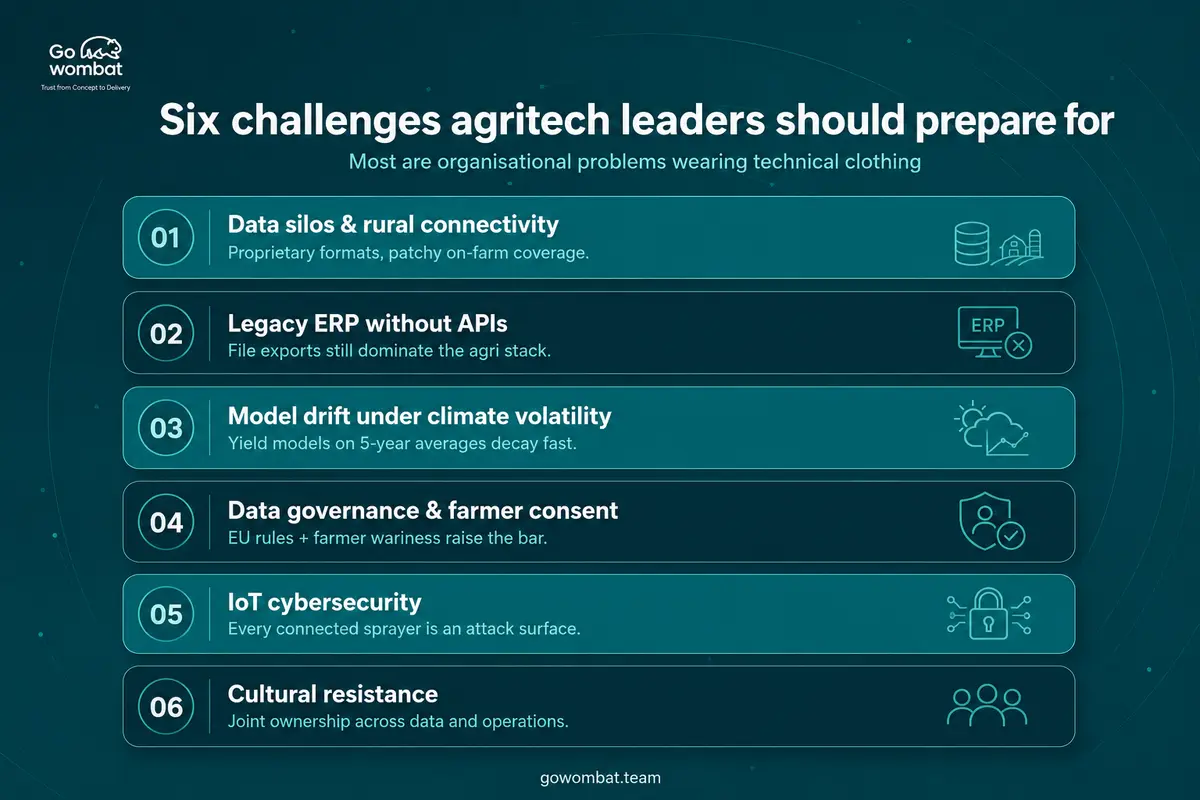
There is no fast win here. Orchestration tends to expose every gap in the data and operating model that automation managed to hide. Six issues show up over and over in real deployments.
Data silos and rural connectivity come first. On-farm data often sits in proprietary formats, and cellular coverage is patchy precisely where it is needed most. The work to close those gaps is unglamorous groundwork that has to happen before anything clever can sit on top.
Then there’s legacy ERP and farm software without APIs. A surprising amount of agri-food software still relies on file exports. Middleware can usually bridge them, but the integration cost is real, recurring, and easy to underestimate at the pitch stage.
Model drift under climate volatility is a third recurring theme. Yield and demand models built on five-year averages decay quickly when weather patterns shift. Any serious orchestration design has to include monitoring, retraining schedules, and a graceful fallback for when a model loses confidence.
Data governance and farmer consent matter more than people expect. EU rules on personal and commercial data, combined with farmers' wariness about who profits from field data, set a high bar for transparency that simply did not exist a decade ago.
Fifth, cybersecurity in IoT-heavy environments. A connected sprayer is, by definition, an attack surface. Identity, segmentation, and update discipline have to be designed in from day one rather than retrofitted later.
The last one is cultural resistance. If the data team owns the dashboards and operations owns the tractors, orchestration stays a slide deck. Real adoption needs joint ownership across functions, and that is a leadership decision before it is a technical one.
In our experience, most of these are organisational problems in technical disguise: fix ownership first, then the tooling.
Strategic Insights
The leading examples have one thing in common, and it is not scale. Deere, Bayer, Cargill, Indigo, Nestlé, and Unilever all treat orchestration as infrastructure that runs in the background rather than as a headline feature. Mid-market operators don’t need to match those acreage numbers to benefit from the same approach. What they need is a unified data layer, two or three high-value workflows that genuinely warrant orchestration, and the discipline to measure outcomes that justify each next investment.
Compliance deadlines have been set, and margin pressure is unlikely to ease. Operators that build the orchestration layer first will find the regulatory transition less expensive than those that wait.
FAQ
What is AI orchestration in the context of agritech?
AI orchestration coordinates predictive models, IoT data, ERP transactions, supplier APIs, and human approvals into one decision flow across the agri-food supply chain. Rather than running tools in isolation, orchestration sequences them so a yield forecast can trigger a procurement order, a compliance check, and a logistics update with full audit lineage attached to every step.
How is AI orchestration different from traditional supply chain automation?
Automation typically covers one repeatable task, whether that’s a script, a job, or a rule. Orchestration governs the entire sequence across systems and decides what to call next based on data, confidence, or business rules. In agri-food, the practical shift is from ’the forecast ran on Monday’ to ’the forecast ran, escalated under weather risk, updated procurement, and logged the change for EUDR reporting in the same flow’.
Which parts of an agri-food supply chain benefit most from orchestration first?
Traceability and compliance, procurement, and demand forecasting usually deliver the earliest measurable gains. EUDR and FSMA 204, on their own, justify continuous data orchestration. Procurement workflows respond well because supplier APIs and freight quotes are highly routinised. Forecasting benefits because the downstream actions are unambiguous: order, hedge, plant.
Do smaller agri-businesses need AI orchestration, or is it only for large producers?
Smaller operators often benefit disproportionately. They lack the headcount to absorb manual reconciliation between systems, yet they face the same compliance rules as larger players. A workable starting point is usually a unified data layer, one orchestrated workflow such as traceability, and a measurable outcome before any further scaling.
How long does an AI orchestration rollout take in an agritech company?
A focused first phase typically runs three to six months, with data unification on one domain, orchestration of one or two workflows, and a defensible ROI case. Broader rollout across planning, procurement, and compliance usually takes 12 to 24 months, depending on the legacy estate, supplier readiness, and the regulatory footprint involved.
Share and subscribe to our blog
Related articles

How Can AI Agents Optimise Precision Agriculture Workflows?
How AI agents fit into precision agriculture workflows: crop monitoring, irrigation, variable rate application and autonomous machinery, plus the data and connectivity problems to solve first.

How to Integrate AI Responsibly for Sustainable Digital Transformation
How to integrate AI responsibly: assign governance roles, govern your data, monitor models and reduce the environmental footprint of AI.

How Predictive Logistics, AI, and IoT Build More Resilient Supply Chains
How predictive AI and IoT help logistics and manufacturing companies forecast demand, spot supply chain risks early and plan around disruptions.

How can we help you?

