



How to Integrate AI Responsibly for Sustainable Digital Transformation

To integrate AI responsibly, an organisation builds transparency, fairness, accountability and compliance into every stage of an AI system’s life. A governance framework gives each model an owner, a risk level and a monitoring process. Without one, you take on ethical, legal and operational risks you cannot see. If your organisation is pursuing digital transformation, governance has to be in place before the first model reaches customers.
Why Responsible AI Governance Matters
AI technologies are moving fast into factories and warehouses, banks, hospitals, airports and even sports arenas, and the risks grow with them. Governance has moved from theory to practice: in PwC’s 2025 Responsible AI survey of 310 US business leaders, 61% said their organisations are already at the strategic or embedded stage of Responsible AI, and 58% said it improves ROI and efficiency. Regulators are adding pressure as well.
Look, global oversight of responsible AI practices is ramping up, and it’s not only about GDPR now. The EU AI Act sets binding rules for AI systems. ISO/IEC 42001 is a voluntary standard for AI management systems that organisations can certify against. In the UK, the AI Security Institute (called the AI Safety Institute until February 2025) researches AI risks but is a government research body, not a regulator. Companies have to show how they classify AI systems by risk, how they make decisions, how they protect data and monitor models, and how they keep those models under control.
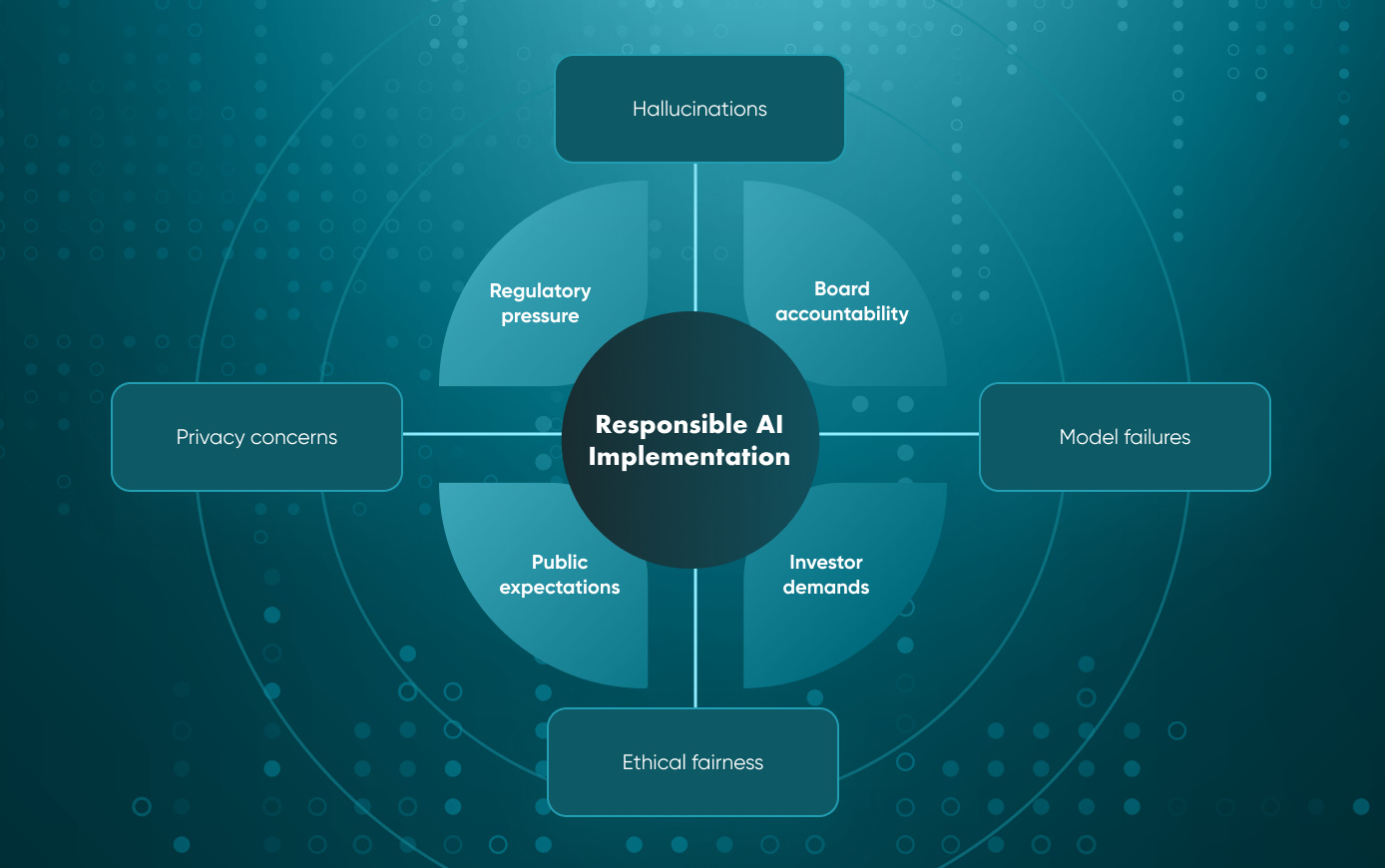
Key Forces Driving Responsible AI Implementation
Several pressures are pushing companies to formalise AI governance:
- AI rules are tightening in the EU, UK and US.
- Boards are increasingly held accountable for AI risks.
- Customers care more about their data privacy and whether AI treats them fairly.
- Investors want evidence that companies consider sustainability and social impact.
- A single faulty algorithm, or a model that starts “hallucinating”, can do real damage.
Good governance keeps companies within the law and makes sure their AI systems work reliably and safely.
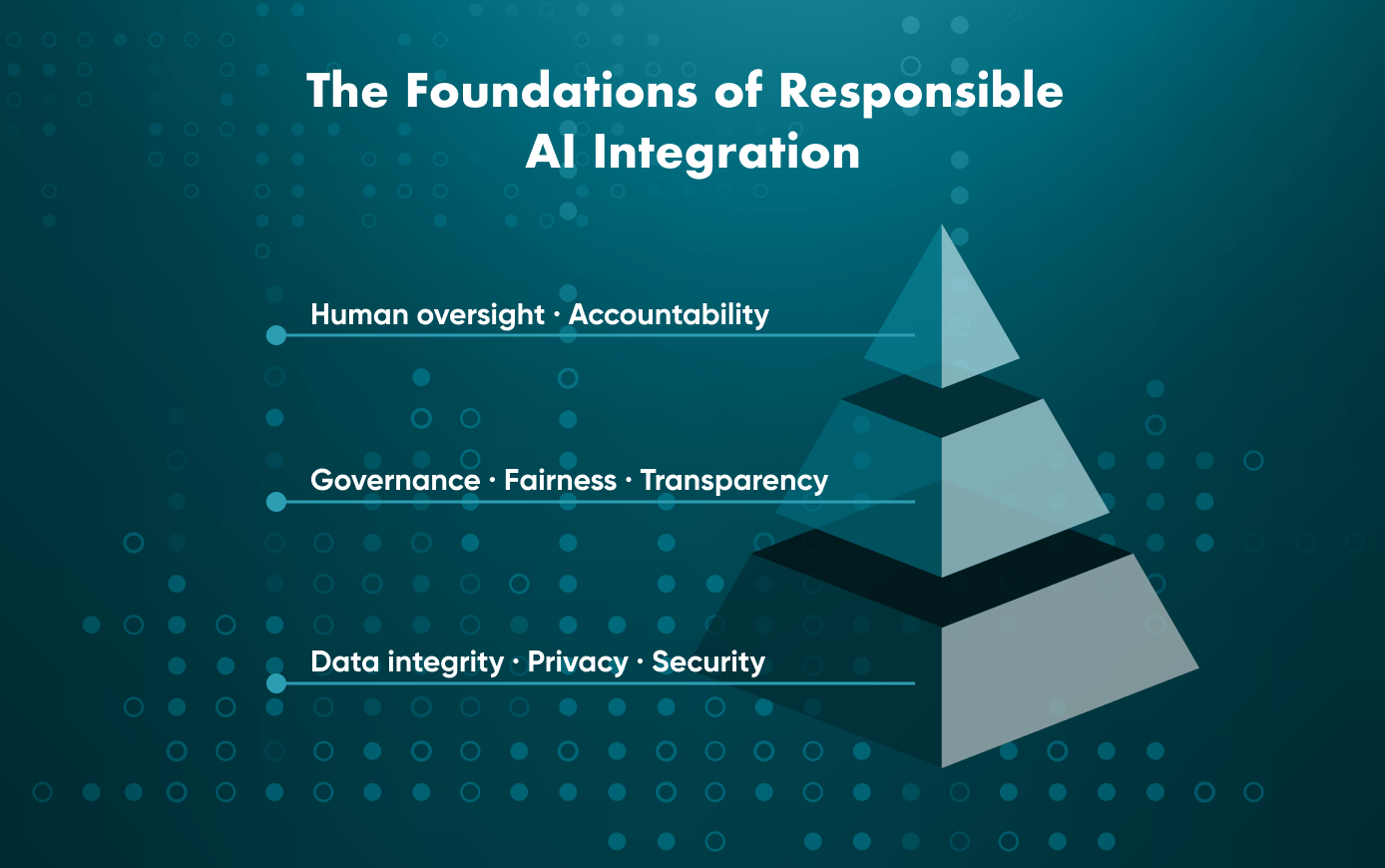
The Foundations of Responsible AI Integration
What Does Responsible AI Mean in Practice?
Responsible AI development combines values, methods and controls that keep AI systems ethical, lawful and transparent. Common themes across frameworks include:
- Fairness: no discrimination, and fair treatment and outcomes for everyone.
- Transparency: the model’s decision-making is traceable, recorded and understandable.
- Accountability: responsibility for decisions and controls is clearly assigned.
- Privacy and security: data is protected and individuals’ rights are safeguarded.
- Sustainability: environmental impact is reduced across the AI lifecycle.
These themes appear in widely used principles, standards and laws, including:
- OECD AI Principles
- UNESCO AI Ethics Recommendation
- ISO/IEC 42001 (AI Management Systems Standard)
- The EU AI Act, which sets requirements for high-risk systems
Using them as a reference helps companies that operate in several countries apply one consistent standard.
What Is an AI Governance Framework?
An AI governance framework is the set of rules, roles and controls an organisation uses to run its AI systems. It defines what is allowed, who is responsible for what, and how accuracy and transparency are checked. When it works, decisions are documented, risks are flagged early and everyone knows their responsibilities.
It has four core parts:
- Policy and ethics: the ground rules for what is acceptable and what is off-limits.
- Data management: knowing where data comes from, having permission to use it and being able to trace it.
- Risk assessment, control and monitoring: finding technical and ethical risks before they cause harm.
- Accountability structures: who makes decisions and who answers for them.
Structured governance improves reliability, reduces operational risk and builds stakeholder trust. It matters most where AI decisions affect safety, finance, healthcare, public services or customers.
Building an AI Governance Framework: Step-by-Step
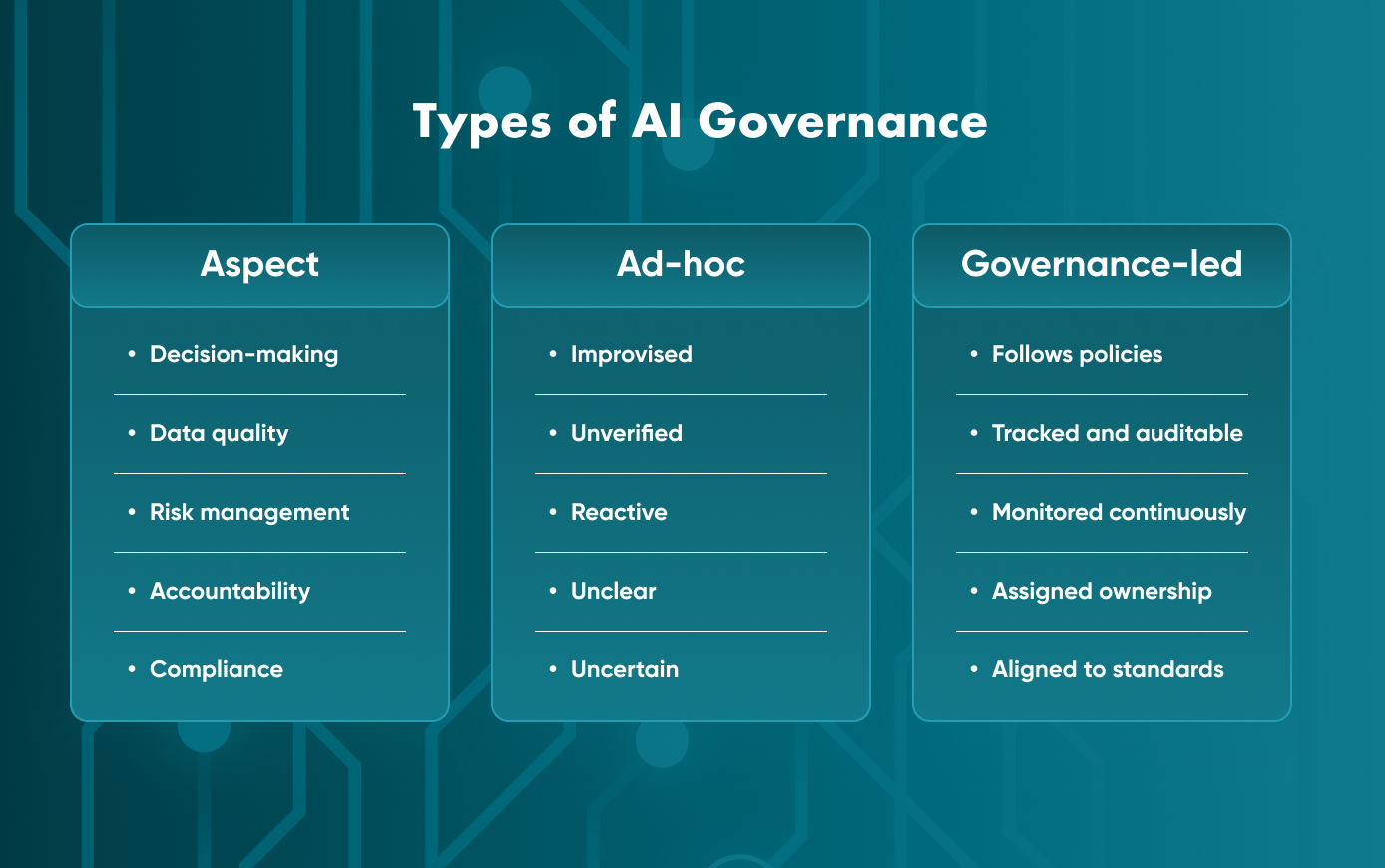
1. Establish AI Policy and Leadership Oversight
Governance starts with a named owner: an AI Governance Lead, a Responsible AI Officer or an ethics board.
Next, write down your ethical principles, such as fairness, transparency, safety and human oversight.
Align them with company goals and with the regulations that apply to you.
Without visible support from leadership, governance turns into paperwork that nobody reads.
2. Create Data Governance and Transparency Practices
Every AI model depends on its data. Poor-quality or biased data produces unsafe and non-compliant results.
Companies need to set up:
- Data lineage - understanding data origin and its changes through time.
- Consent and privacy controls - guaranteeing that data is gathered and used in a lawful way.
- Bias audits - checking datasets for demographic or structural bias.
- Clear documentation - having proper metadata and data quality standards.
Standards and regulations set strict documentation requirements for the datasets used to train high-risk AI systems. Without data governance, companies risk non-compliance and lose the trust of customers and partners.
3. Implement Risk and Model Monitoring Controls
AI systems drift over time, so they need regular checks that they are still accurate, fair, safe and aligned with business goals.
Well-governed organisations put these controls in place:
- Model cards: short documents describing a model’s intended use, limitations and results.
- Explanation tools: SHAP for feature impact visualisation, LIME for local interpretable explanations
- Bias detection tools: IBM AIF360, Fairlearn (an open-source, community-driven project)
- Drift detection tools: Fiddler, Arize AI, Evidently
- Automated alerts for performance degradation, safety risks and outliers.
- Security measures: vulnerability testing, adversarial robustness testing and misuse prevention.
Controls should be documented and repeatable, so teams apply them the same way every time.
4. Embed Sustainability in the AI Lifecycle
Regulators, ESG officers and customers increasingly ask about the environmental impact of AI. Sustainable AI, or Green AI, aims to reduce carbon footprint, energy use and wasted compute.
Key sustainability measures
Efficient Model Selection
Development teams should:
- Use smaller, task-specific models
- Fine-tune existing models instead of retraining from scratch
- Optimise architectures with pruning, quantisation or distillation
Depending on the model and workload, these methods can cut energy use considerably.
Optimising Training and Deployment
- Schedule training for hours when more low-carbon energy is on the grid, if your cloud provider supports it
- Use autoscaling to keep GPUs/TPUs busy and avoid idle capacity
- Cache the results of repeated inference requests
- Select cloud regions that run on renewable energy
Measuring Carbon Impact
Tools such as CodeCarbon and cloud providers’ carbon dashboards let teams measure the emissions from model training and inference. That turns the environmental footprint into a KPI that technical and non-technical stakeholders can track.
AI Lifecycle Thinking
Across the whole AI lifecycle, teams can:
- Reuse the same models for different tasks
- Minimise retraining cycles
- Store data and models efficiently
- Retire models that are no longer in use
Challenges and Trade-Offs in Responsible AI
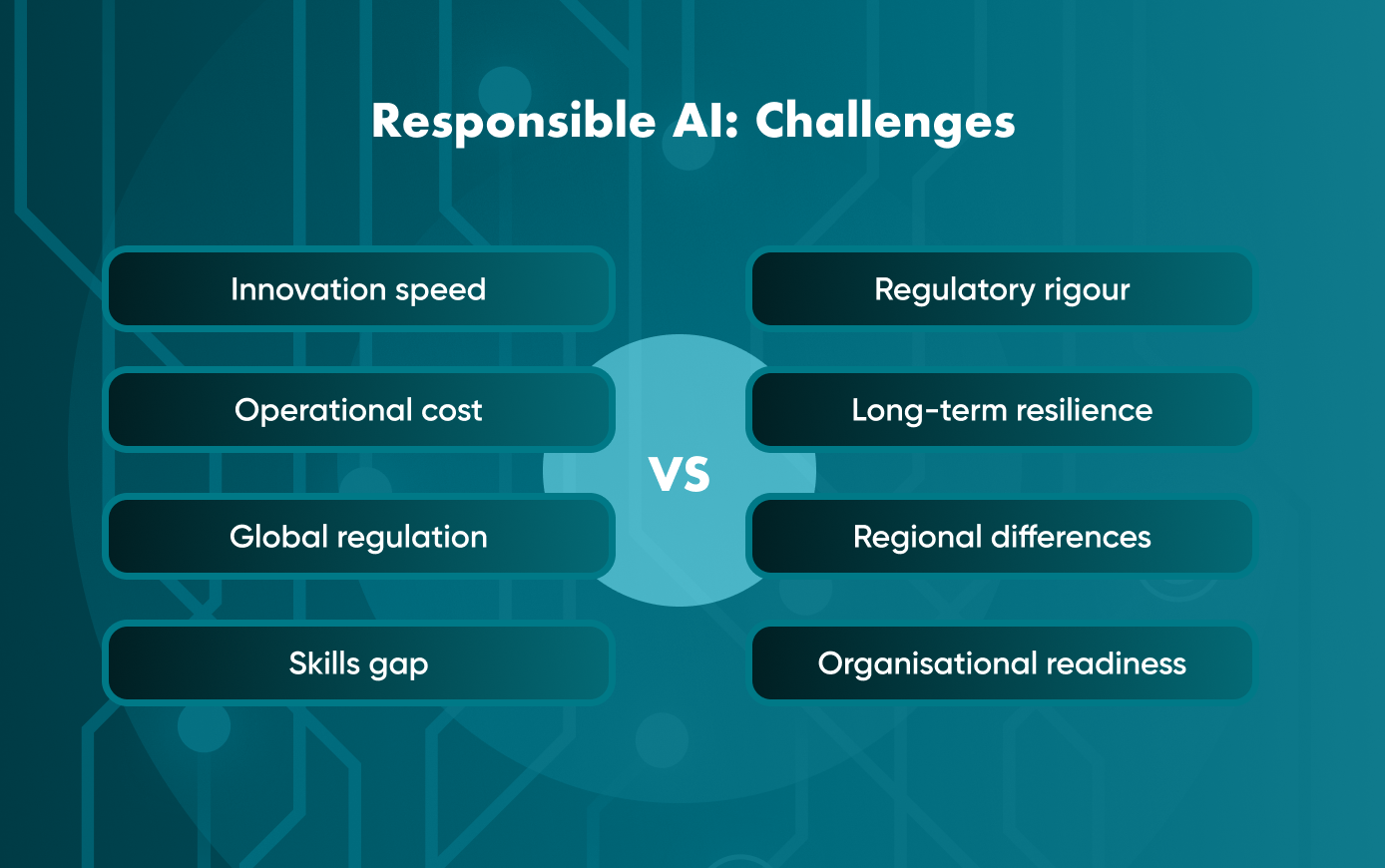
Adding governance to advanced systems such as generative AI raises cultural, operational and financial questions. Common trade-offs include:
Innovation speed vs regulatory rigour
Governance adds control points, which can look like a brake on deployment. Teams avoid this by building governance checks into their normal delivery process, for example into the sprint definition of done, so that reviews do not block releases.
Operational cost vs long-term resilience
Fairness testing, monitoring tools and sustainability practices cost money, but they help avoid expensive failures and regulatory fines.
Global regulation vs regional differences
Companies operating in the EU, UK, US and APAC face different requirements from different authorities. One map of those requirements, kept up to date, avoids duplicated work.
Skills gap and organisational readiness
In a March 2024 Deloitte survey of 100 C-suite executives, only 49% said their organisations already had guidelines or policies on the ethical use of AI; another 37% were still getting ready to roll them out. Many teams also lack the skills to put governance into practice.
How Should Companies Organise AI Governance?
Governance also needs an organisational structure. Which model fits depends on the sector, AI maturity and regulatory exposure:
Centralised AI ethics committee - a single governing body reviews, approves, and monitors high-risk AI decisions. Best suited for fintech, healthcare, and logistics.
Hub-and-spoke model - a central ethics board defines policies while trained AI champions embed governance within product and engineering teams. Suits large enterprises and manufacturing.
Model risk management - formal validation, documentation, risk scoring, and audit trails applied before deployment and throughout the AI lifecycle. Commonly used in banking and insurance.
Clinical AI governance - focuses on safety, explainability, human oversight, and regulatory compliance for medical AI. Essential in healthcare.
Operational safety governance - aligns AI governance with robotics, automation, digital twins, and predictive maintenance to reduce operational and worker-safety risks. Relevant for manufacturing and supply chains.
Conclusions
- Responsible AI is a requirement for any organisation that wants to use AI at scale.
- Digital transformation that lasts needs governance, ethics and sustainability built in from the start.
If you need help setting up a responsible AI governance framework, contact us.
FAQ
What does it mean to integrate AI responsibly?
It means integrating AI systems, agents and tools and running them with ethics, law and sustainability in mind, so that their results can be trusted.
Why do we need AI governance for digital transformation?
Governance catches problems such as bias, regulatory breaches and system failures early, and keeps AI transparent, accountable and aligned with business goals.
How do companies stay in line with the EU AI Act?
Document your data and the choices you make with your models. Sort your AI systems by how risky they are. Set up monitoring, and make sure you have clear oversight.
What are the main principles behind responsible AI?
Fairness, transparency, accountability, explainability, privacy, security, and sustainability.
Do governance frameworks slow down innovation?
Not when they are designed well. They reduce rework, improve quality and build trust with customers and regulators.
Share and subscribe to our blog
Related articles

6 GDPR Compliance Principles You Need to Master
Organisations may face serious financial, legal, and reputational risk if they do not comprehend and implement GDPR compliance principles. GDPR requirements adherence is a board level concern rather than just legal, technical and organisat…

Business IT: Exploring AR, VR and MR Technologies
What AR, VR and MR are, how they differ, what hardware they need, and the challenges of using immersive technologies in business.

Why Is the Digital Twin of an Oil Refinery the Most Complex AI System You Will Ever Build?
Why a digital twin of an oil refinery is so hard to build: seven interdependent layers from physics simulation to control system integration, results from Cosmo Oil's refinery digital twin, a look at Honeywell's planned digital-twin work at the Dangote refinery, team and data prerequisites, and why projects fail.

How can we help you ?

