



How Predictive Logistics, AI, and IoT Build More Resilient Supply Chains

Supply chains are regularly disrupted by events such as pandemics and extreme weather.
Predictive logistics, built on AI forecasting and IoT data, lets companies see these risks earlier and act before a disruption hits rather than after.
Why Predictive AI and IoT Matter in Modern Supply Chains
Predictive analytics uses past sales, supplier performance and market data to forecast what comes next. It can also take in weather and news feeds to flag likely delays before they affect your plans. Predictive logistics software turns this analysis into day-to-day planning decisions.
None of this works without good data and people who know how to use it. Poor data produces false alarms. With reliable data and a capable team, costs fall and decisions come faster: in 2021, McKinsey reported that early adopters of AI-enabled supply chain management had improved logistics costs by 15% compared with slower-moving competitors. Predictive AI projects also need to target the problems that matter most to the business.
Connecting IoT sensors to cloud analytics also ties scattered systems together and gives a live view of the whole supply chain, which speeds up decisions.
How Predictive AI Makes Supply Chains Smarter
What Is Predictive AI?
Predictive AI applies machine learning to historical and live data to forecast what happens next. Where generative AI creates content, predictive AI forecasts outcomes, which makes it especially useful in supply chains.
Typical inputs include:
- Sales and order history, to identify seasonal patterns.
- Market and pricing data, to anticipate shifts in demand.
- IoT and GPS signals, to detect transport delays or equipment that is about to fail.
- External factors such as weather or sudden trade restrictions.
Unlike static forecasts, these models are retrained as new data comes in, so their accuracy can improve with each planning cycle.
How Does Predictive AI Handle Demand and Inventory?
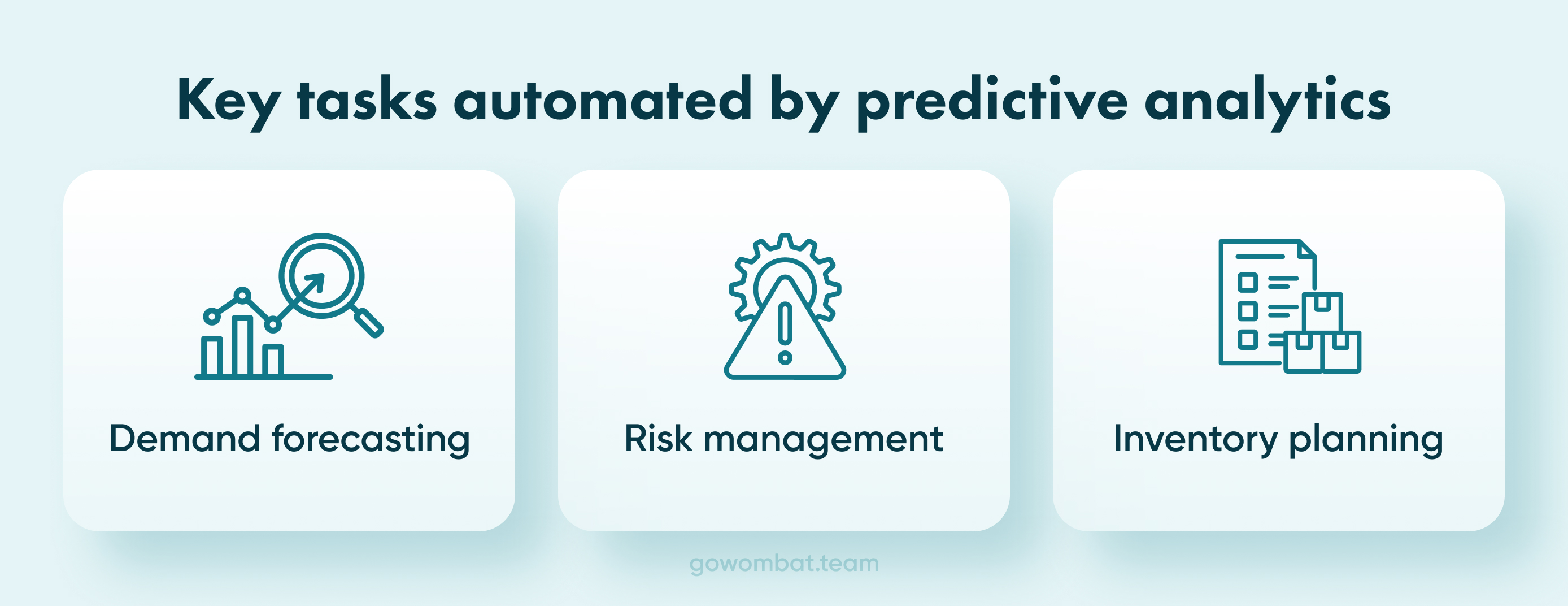
Predictive AI combines data from many sources to support decisions in three areas:
1. Demand Forecasting
- Models use historical sales, promotions, seasonal patterns and even social media activity to predict customer demand.
- McKinsey (2022) reports that AI-driven forecasting can reduce forecasting errors by 20–50% and cut lost sales by up to 65%.
- Amazon uses demand forecasting to anticipate peaks and move inventory closer to customers.
2. Risk Management
- AI combines IoT sensor data with weather, traffic and shipping information to detect risks early.
- If a storm is forecast near a port, the system can suggest rerouting shipments or adjusting production in advance.
- Real-time analytics helps companies avoid bottlenecks, and predictive maintenance flags unusual sensor readings so equipment is repaired before it fails.
3. Inventory Management and Planning
- AI monitors stock levels and adjusts reorder points and safety stock as conditions change, reducing both stockouts and overstock.
- Some global retailers already link warehouse sensors to AI forecasts to track inventory in real time.
- This reduces waste, frees up working capital and keeps products in stock.
Why Use Predictive AI - and What Gets in the Way?
AI brings clear benefits to logistics, but it is not plug-and-play. It needs reliable systems, good data and teams ready to work with it.
Benefits:
- Accuracy: models learn patterns from historical data and leave less room for human error.
- Efficiency: routine analysis is automated, which frees up planners' time.
- Agility: risks in the logistics network are spotted early, so companies can respond sooner.
- Profit: better forecasts mean fewer lost sales, more satisfied customers and lower costs.
- Savings: more efficient warehouse operations and shipping reduce transport costs.
Obstacles:
- Integration: connecting AI to legacy ERP systems is difficult.
- Data quality: poor or missing data distorts the results.
- Technology: many companies still lack real-time analytics.
- Culture: teams have to trust the model's output, which is often the hardest part.
How IoT Gives Supply Chains Real-Time Visibility
What Kinds of IoT Devices Are Used?
In logistics, IoT means connected devices that monitor goods, machines and environments in real time.
Common examples:
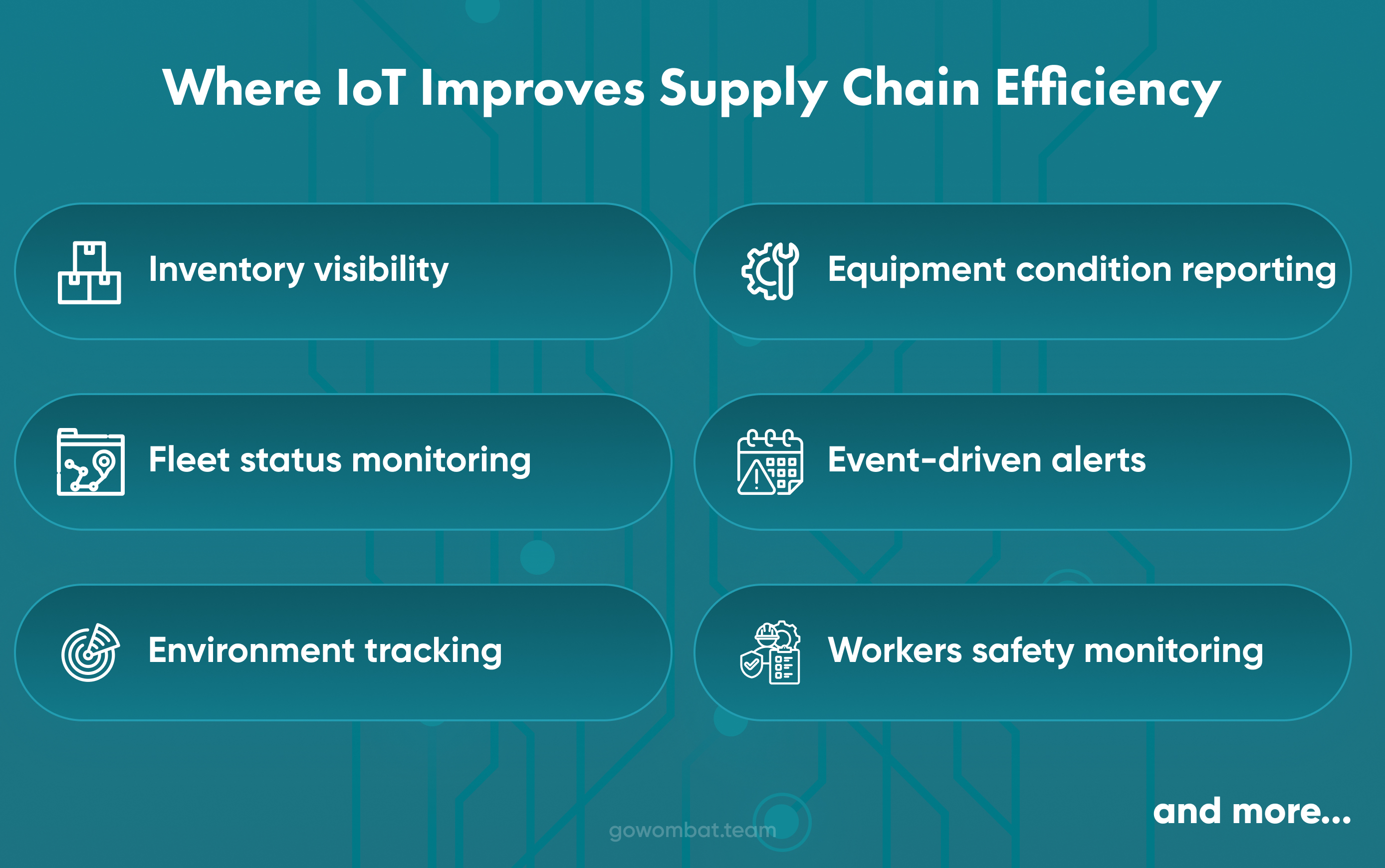
- Asset trackers and GPS sensors on trucks and vans, tracking routes.
- RFID tags or Bluetooth beacons on pallets and products, tracking shipments.
- Environmental sensors in warehouses and containers, measuring things like temperature, humidity, and shock.
- Sensors on conveyor belts, forklifts, and assembly lines, watching equipment health.
- Wearables, such as smart helmets or wristbands, that help keep workers safe.
Depending on range and how often they send data, these devices connect over 4G/5G, LoRaWAN, NB-IoT, Wi-Fi or Bluetooth.
IoT Analytics counted 21.1 billion connected devices in 2025, up 14% year on year. For logistics, that means more detailed data at every step of the chain.
How Does IoT Boost Operational Efficiency?
IoT streams live data into management systems, which lets supply chains anticipate problems instead of only reacting to them.
In practice:
1. Real-time visibility
Companies such as DHL and Amazon fit their warehouses with sensors that track inventory automatically, so stock locations are always known.
2. Instant alerts
GPS and telematics alert teams to delays or breakdowns, so they can switch to a better delivery route quickly.
3. Smarter routes, less fuel
Route optimisation based on IoT data cuts fuel consumption, which saves money and lowers emissions.
4. Smart production
In manufacturing, sensors on machines report uptime, output quality and energy use, so teams can fix issues before breakdowns and plan production on real data.
5. End-to-end transparency
Live updates from IoT devices and cloud data show the state of the whole supply chain as it happens.
What Challenges Come with IoT?
IoT also brings challenges:
1. Security risks
Every connected device is another target for attackers. You need encryption, strict access controls and continuous network monitoring.
2. Integration with legacy systems
Without the right APIs or standards, connecting new devices to legacy software can create data silos.
3. Big upfront costs
Sensors and network infrastructure require significant upfront investment.
4. Talent shortage
Many companies lack IT and data specialists with IoT experience.
5. Trusting the data
Not every team is ready to base logistics planning on automated readings; some managers want proof before they trust the numbers.
How AI and IoT Team Up to Make Supply Chains Stronger
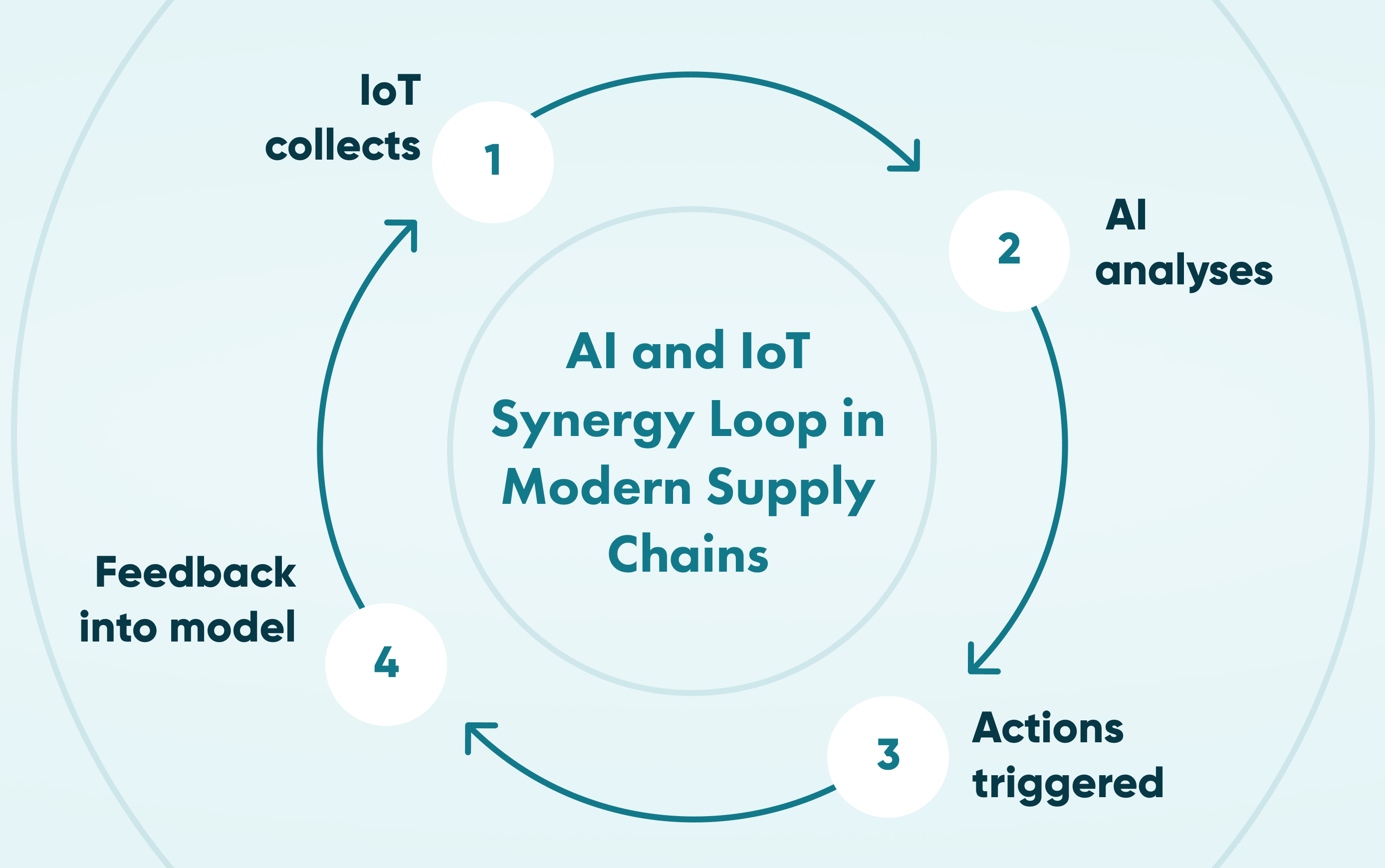
AI solutions and IoT are most useful together: IoT sensors supply the data, and predictive models turn it into decisions, such as rerouting a truck when a port closes.
The combination works in three steps:
1. Constant data collection
IoT sensors monitor equipment, vehicles and environmental conditions around the clock.
2. Real-time analysis
AI models process this data to forecast demand, identify risks and adjust inventory in real time.
3. Automatic action
Model outputs trigger responses such as rerouting trucks, rescheduling maintenance or increasing production.
The same data also gives insight into customer behaviour and supplier performance. Examples:
- Factory machines send live production data to AI models that adjust next week's output plan.
- Trucks with GPS and telematics feed data to AI models that reroute deliveries when there is a delay or bad weather.
- Predictive maintenance uses sensor alerts to schedule repairs before equipment fails, which reduces costly downtime.
When a disruption does hit, predictive logistics helps companies switch to backup suppliers and adjust plans quickly.
Key Considerations for Predictive Logistics Implementation
1. Establish strong governance practices
Clear oversight of how predictive logistics systems are used in planning, optimisation and execution helps planners trust the technology and keep control of cost-critical processes.
2. Prioritise data ethics and compliance
When machine learning influences staffing, delivery times or customer-facing decisions, businesses need safeguards that protect customers and operations.
3. Perform scenario and stress testing
Test how models behave during market swings and simulated disruptions. This limits the cost of inaccurate forecasts and prepares teams for real events.
4. Assess vendor reliability and long-term fit
Choose technology partners whose products can scale with your predictive logistics needs, to avoid integration bottlenecks later.
5. Plan for workforce impact and skills development
Machine learning tools change how supply chain planners work, so plan training to help teams use them well.
6. Strengthen cultural adoption early
Predictive systems only deliver results when people understand and trust the processes behind them. Involve the teams that will use them from the start.
7. Evaluate digital twin readiness
Digital twins need high-quality data and solid system integration. Built correctly, they help plan resources, control costs and improve logistics performance.
8. Measure scalability and long-term ROI
Estimate how the system will scale as the business grows, and track its return in operating costs and delivery times.
9. Ensure the solution integrates across core processes
Predictive systems should connect to inventory, transport and workforce planning. Feed forecasts through APIs into the WMS and TMS your planners already use, rather than into a separate dashboard.
How to Get Started with Predictive AI and IoT: A Practical Checklist
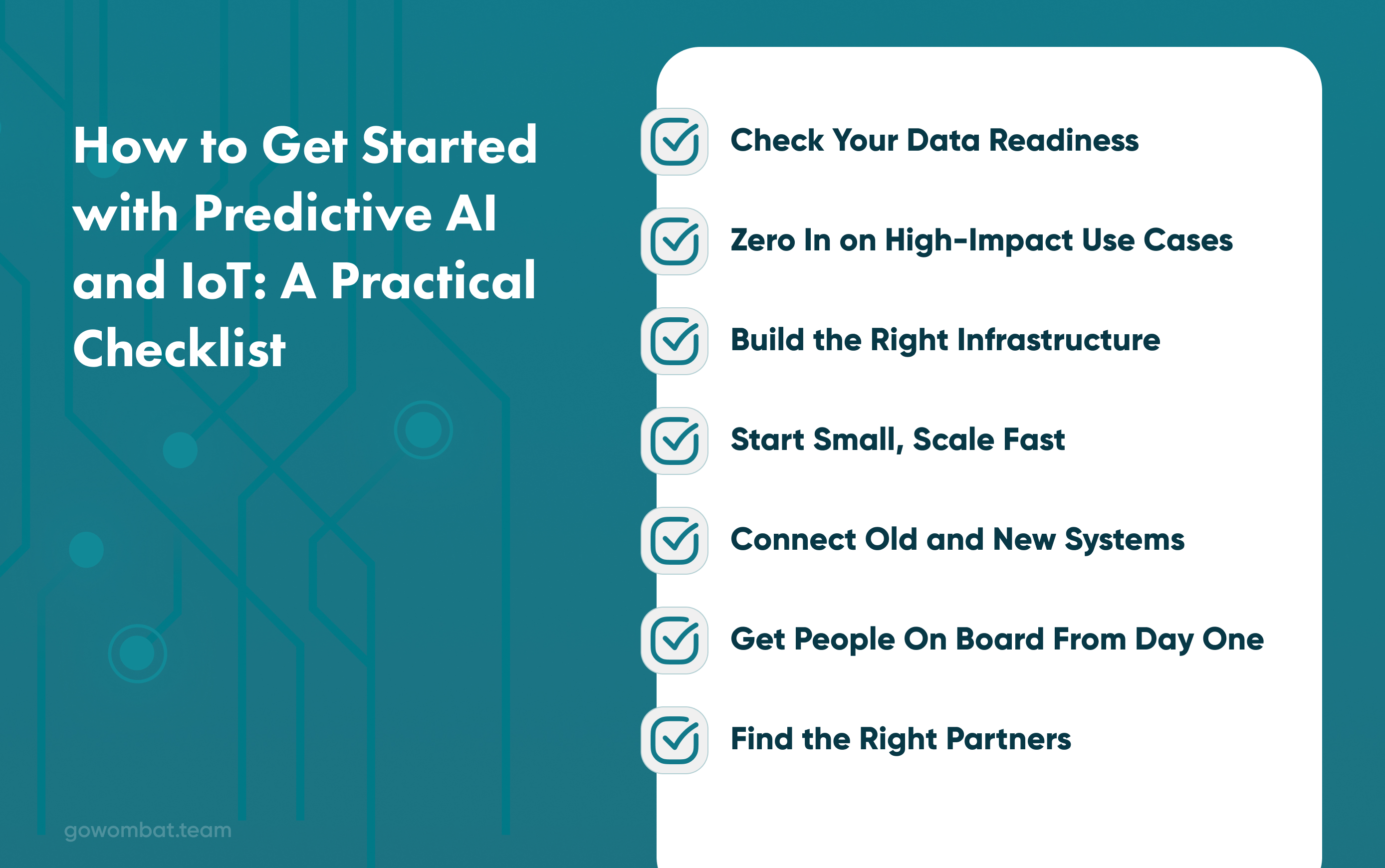
Predictive AI and IoT only work in supply chain management with careful planning, clean data and a team that is ready for them. Start small and expand what works:
1. Check Your Data Readiness
Bring your data sources together under one data model so everyone works from the same trusted data, and upgrade legacy systems where needed.
2. Zero In on High-Impact Use Cases
Pick one problem with a clear cost, such as demand forecasting, route optimisation or predictive maintenance, and choose something you can measure and improve quickly.
3. Build the Right Infrastructure
Set up a data platform, in the cloud or at the edge, that connects your sensors, trackers and databases, with data governance and regular cleanup.
4. Start Small, Scale Fast
Run a pilot, prove its business value, then roll it out more widely.
5. Connect Old and New Systems
Don't replace all your systems at once. Use middleware or APIs to connect new IoT tools to your existing ERP or WMS.
6. Get People On Board From Day One
Supply chain optimisation needs people who understand and trust the new tools. Managers should use AI forecasts to inform decisions, not to replace human judgement.
7. Find the Right Partners
Choose solutions that make it easy to share data with suppliers and trading partners in real time.
Conclusion and Main Takeaways
With predictive AI and IoT, companies work from real-time updates and forecasts instead of reacting after the fact.
Combining sensor data with analytics helps them spot shifts in demand, market conditions and potential disruptions; McKinsey (2022) reports that AI-driven forecasting can reduce forecasting errors by 20–50%. To discuss a predictive logistics project, see how Go Wombat can help.
FAQs
How does predictive AI make supply chains stronger?
Predictive AI uses past sales, inventory, weather and market data to forecast demand and spot risks. Companies can then adjust orders, line up alternative suppliers and reroute shipments before stockouts or delays occur.
What does IoT do for supply chains?
IoT devices such as GPS trackers and temperature sensors show where shipments are and what condition they are in, so problems like a delayed truck or a temperature spike are caught as they happen.
How do you get started with predictive AI and IoT?
Start by getting your data in order: digitise orders, inventory and supplier information. Choose one or two use cases, such as demand forecasting or asset tracking. Pilot IoT sensors in one area, run a simple predictive model and build on what you learn. A development partner can speed this up.
Why is real-time data such a big deal for supply chains?
Real-time data shows problems such as traffic jams, delays or quality issues as soon as they appear. AI models go further by forecasting what comes next and suggesting fixes before small problems grow, so contingency plans are ready in time.
What challenges come with adopting these technologies?
The main ones are data quality, integration with legacy systems, cost control, security of connected devices, and getting teams to trust AI output. Plan carefully, pilot before scaling, and bring in data specialists when needed.
Share and subscribe to our blog
Related articles

How Is Big Data Transforming Logistics in 2026?
How logistics companies use big data in 2026: the four types of analytics, the main benefits, and real deployments from UPS, Amazon, DHL and others.

AI in Supply Chain and Logistics: How It Transforms Industry
How AI is used in supply chain and logistics: forecasting, route optimisation, warehouse automation, inventory, predictive maintenance and quality control, plus the challenges of adopting it.

Native vs Cross-Platform Mobile Development: How to Choose in 2026
Compare native, Flutter and React Native development to find the right approach for your mobile product based on performance, cost, speed and scalability.

How can we help you ?

