



How Can AI Agents Optimise Precision Agriculture Workflows?

Farmers have always worked with data: soil type, rainfall, crop cycles, pest pressure and market timing, managed through experience and seasonal instinct.
What has changed is the amount of data. Satellite imagery, soil sensors, drone feeds, weather APIs and connected machinery produce more data per hectare than a human team can process in real time.
Most farms already collect enough data; the gap is turning it into a decision before the spray or irrigation window closes.
AI agents built into precision agriculture workflows close that gap. They extend agronomic expertise by reasoning across data streams that would otherwise be processed too late to act on. This article explains how that works in practice, for AgriTech founders and digital agriculture teams.
What Is Precision Farming AI and What Problems Does It Actually Solve?

Precision farming AI refers to the application of artificial intelligence to site-specific crop management. It uses data from sensors, satellites, drones, and connected machinery to make decisions at the level of individual field zones rather than entire farms.
The core promise is straightforward: apply the right input, at the right place, at the right time. Less water where soil moisture is adequate. More fertiliser where deficiency maps show it is needed. Earlier intervention where disease pressure is building in a specific corner of a field.
In practice, this has proved harder than vendors suggested a decade ago. Data collection improved quickly, but decision-making did not keep pace: farmers got dashboards full of readings and little help interpreting them.
Traditional precision farming tools collected and displayed data. AI agents also interpret it and act on it, closing the loop between observation and intervention.
From Reactive to Predictive: The Shift in Agricultural Decision-Making
Precision farming AI moves farm management from reactive to predictive. A farmer who gets a soil moisture reading at the end of the week is responding to conditions that have already happened. An AI agent that monitors the same sensor continuously and cross-references weather forecasts and crop growth models can predict conditions 48 hours ahead.
Over a growing season, that difference in timing adds up. Earlier interventions are cheaper and more effective, yield losses caught at emergence can still be recovered, and wasted inputs are spotted before application rather than written off.
How Do AI Agents Fit Into a Precision Agriculture Workflow?
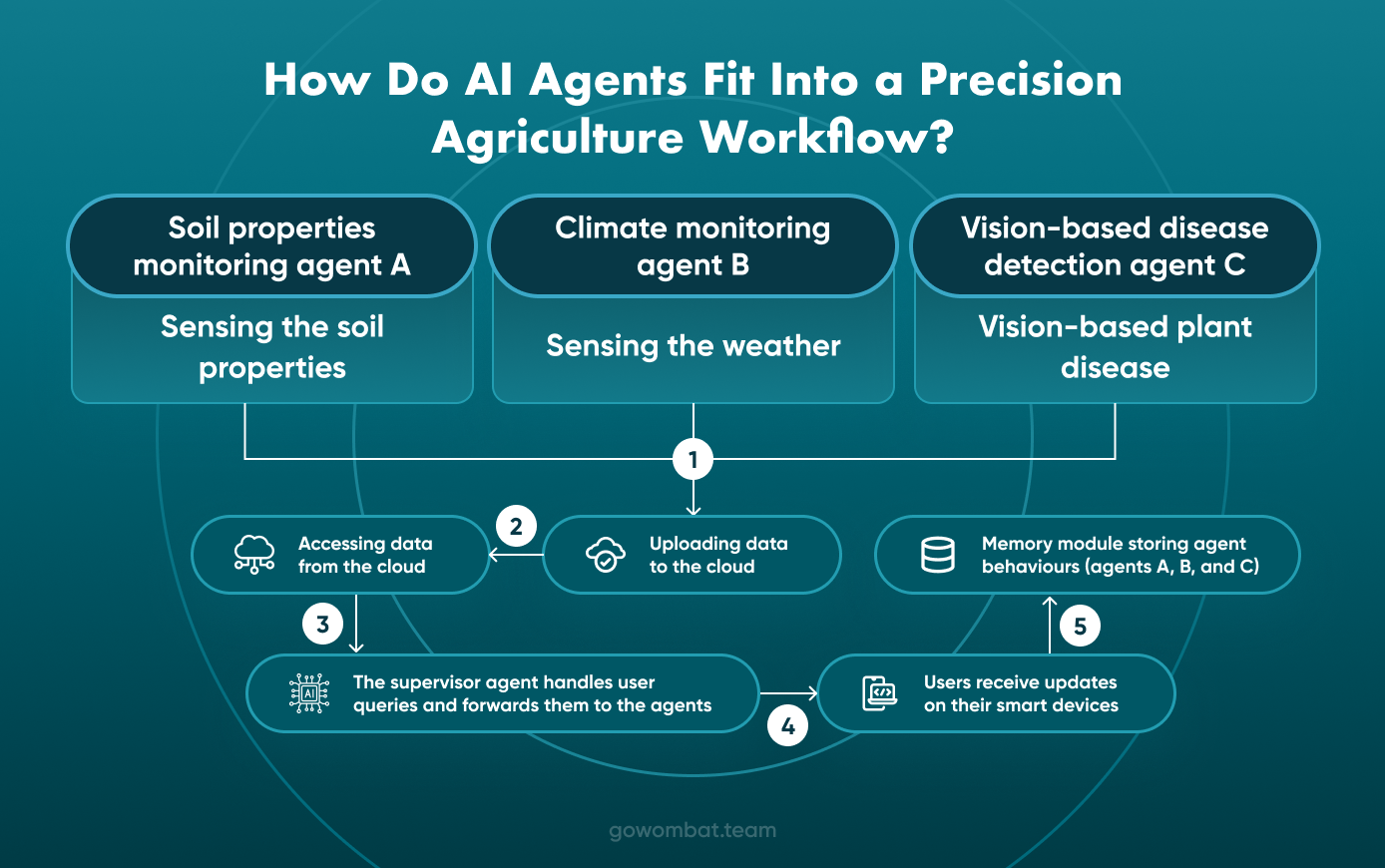
In agriculture, an AI agent is software that senses its environment through connected data sources, makes decisions based on the goals it has been given, and acts by issuing recommendations, triggering automated systems or alerting operators. The architecture is similar to industrial deployments, but the data sources, decision horizons and physical outputs are specific to farming.
For example, one agent might monitor soil sensor readings across field zones, ingest satellite vegetation indices updated as often as daily, pull local weather forecasts and compare the current crop growth stage with historical yield models. From that combined picture, it makes decisions or recommends immediate actions to a farm manager or AgriTech platform.
The agronomist stays in charge; the agent gives them analytical coverage that was not possible at scale before.
Perception, Reasoning, and Action on the Field
The perception layer is where data enters the system. Soil sensors, drone imagery, satellite feeds, weather stations, and machinery telematics all contribute to an agent's operational picture. The quality and consistency of this data determine the quality of every decision downstream.
Reasoning is where the agent applies models, trained on historical yield data, agronomic research, and farm-specific records, to interpret what the incoming data means. A drop in vegetation index in a specific field zone might indicate drought stress, nutrient deficiency, or early disease. The reasoning layer determines which, based on the full context of available signals.
Action is where the value is realised. Depending on how deeply it is integrated, an agent might generate a variable rate application prescription, trigger an irrigation zone, dispatch a drone for closer inspection, or alert an agronomist with a prioritised recommendation.
How Agricultural Data Analytics Feeds Agent Decision-Making
AI agents are only as good as the data infrastructure beneath them. Agricultural data analytics covers collecting, cleaning, normalising and structuring farm data, and it decides whether an agent's outputs can be trusted.
Many early AgriTech deployments struggled here. Sensor data arrives in inconsistent formats, historical records live in spreadsheets or paper logs, and cloud cover leaves gaps in satellite imagery. Without a data layer that handles these problems, agent reasoning becomes unreliable when conditions are most complex and accurate decisions matter most.
Build that data foundation before you deploy AI models; it determines whether the system scales.
Where Can AI Agents in Agriculture Deliver Results?
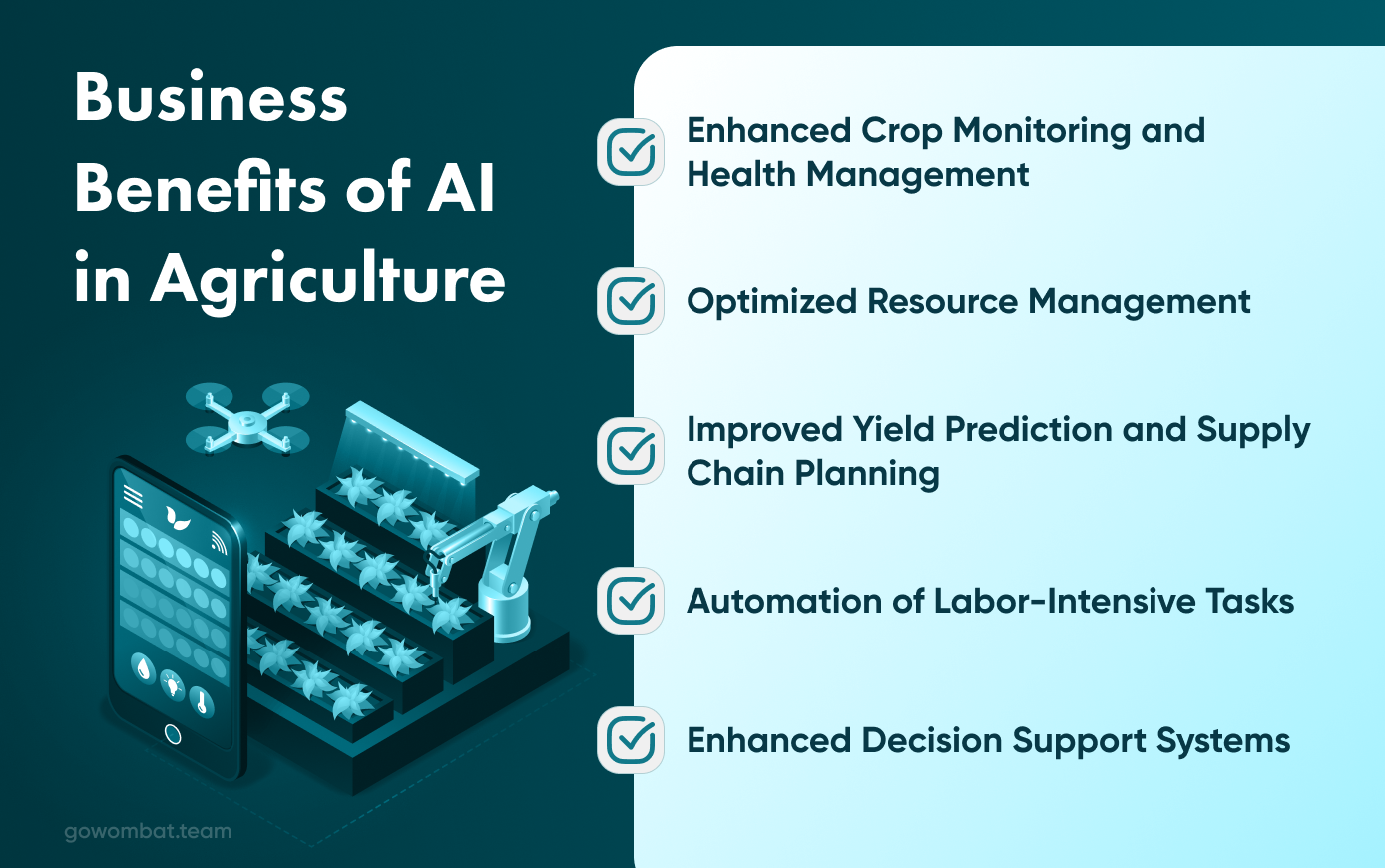
The main areas are crop monitoring, irrigation management, pest detection and yield forecasting. The two scenarios below are illustrative, not named client projects.
Crop Monitoring AI and Early Threat Detection
Crop monitoring AI uses computer vision and anomaly detection on images from satellites, drones, and field cameras to find signs of stress, disease, and pest activity at a resolution and frequency that manual scouting can't match on a large scale.
Timing is what matters. The cost of treating a fungal disease that is caught early on is much lower than the cost of treating the same disease that is caught when it is spreading. Pest pressure that is reported before population thresholds are crossed allows for targeted treatment instead of blanket treatment. In every case, crop monitoring AI moves the detection window forward. Earlier detection tends to lower input costs and preserve more recoverable yield.
The Field That Flagged Its Own Problem
Consider an illustrative scenario: a cereal producer with thousands of hectares across several sites relies on weekly field scouting to find crop stress and disease. Coverage is incomplete, and five to seven days pass between spotting a problem and acting on it. The producer adds a crop monitoring AI agent that runs daily satellite imagery through an anomaly detection model. At around 3–4 m per pixel, that imagery cannot show individual Septoria lesions on leaves, but it can flag field zones where the crop is under stress, and the agent combines those flags with a disease risk model. Agronomists go to specific GPS coordinates and confirm the problem with leaf-level checks or drone imagery instead of scouting whole fields. Fungicide goes where it is needed, and the gap between detection and treatment shrinks.
AI-Driven Irrigation and Resource Optimisation
Water is one of the most constrained resources in modern agriculture. Traditional irrigation runs on fixed timers or simple threshold triggers, which often leads to overwatering, underwatering or waste when the weather is unpredictable. AI-driven irrigation pulls data from soil moisture sensors, weather forecasts and crop growth models to decide when and how much water each plot needs. It holds back when rain is forecast, adjusts flow based on root zone feedback and treats each section of a field separately.
The difference from rule-based irrigation is how many factors the agent weighs. When moisture drops below a threshold, a basic system starts watering. An agent checks the same reading against the crop's growth stage, the rain forecast for the next three days and how well the local soil retains moisture, and only then decides to irrigate, delay or adjust flow.
When the System Knew It Would Rain
Consider a smaller, illustrative example: a vegetable grower waters his plots by hand on an adviser's recommendations. Rainfall varies between neighbouring plots, so some soil stays wet while other areas dry out, and the crop grows unevenly. He installs an irrigation controller that combines soil-probe readings with a weather-forecast feed and skips watering when rain is due. Over the summer, each plot uses less water, soil moisture stays more stable, and by autumn the rows are more even than before.
What Role Do Autonomous Farming Systems Play in Precision Agriculture?
Autonomous farming systems (robotic field vehicles, drone fleets and automated machinery) are the physical layer that turns AI agent decisions into actions in the field. Much of the near-term value lies in integrating that physical layer with the agents that direct it.
An AI agent that identifies a weed pressure hotspot in satellite imagery is far more useful when it can send an autonomous weeding robot to that zone without human coordination. A yield prediction model that forecasts an early harvest in one field block becomes operationally useful when it can adjust machinery scheduling and logistics automatically.
Variable rate technology, the ability to vary input application rates across a field according to prescription maps, is one of the most established mechanisms through which AI recommendations translate into physical outcomes. AI agents generate the prescriptions. Autonomous or GPS-guided machinery executes them. The human role shifts from operational execution to oversight and exception management.
The machinery for autonomous farming already exists in major agricultural markets such as North America, much of Europe and parts of Asia-Pacific. What has often been missing is an intelligence layer that can direct it zone by zone and in time. Precision farming AI provides that layer.
What Are the Real Challenges of Deploying AI in Agriculture?
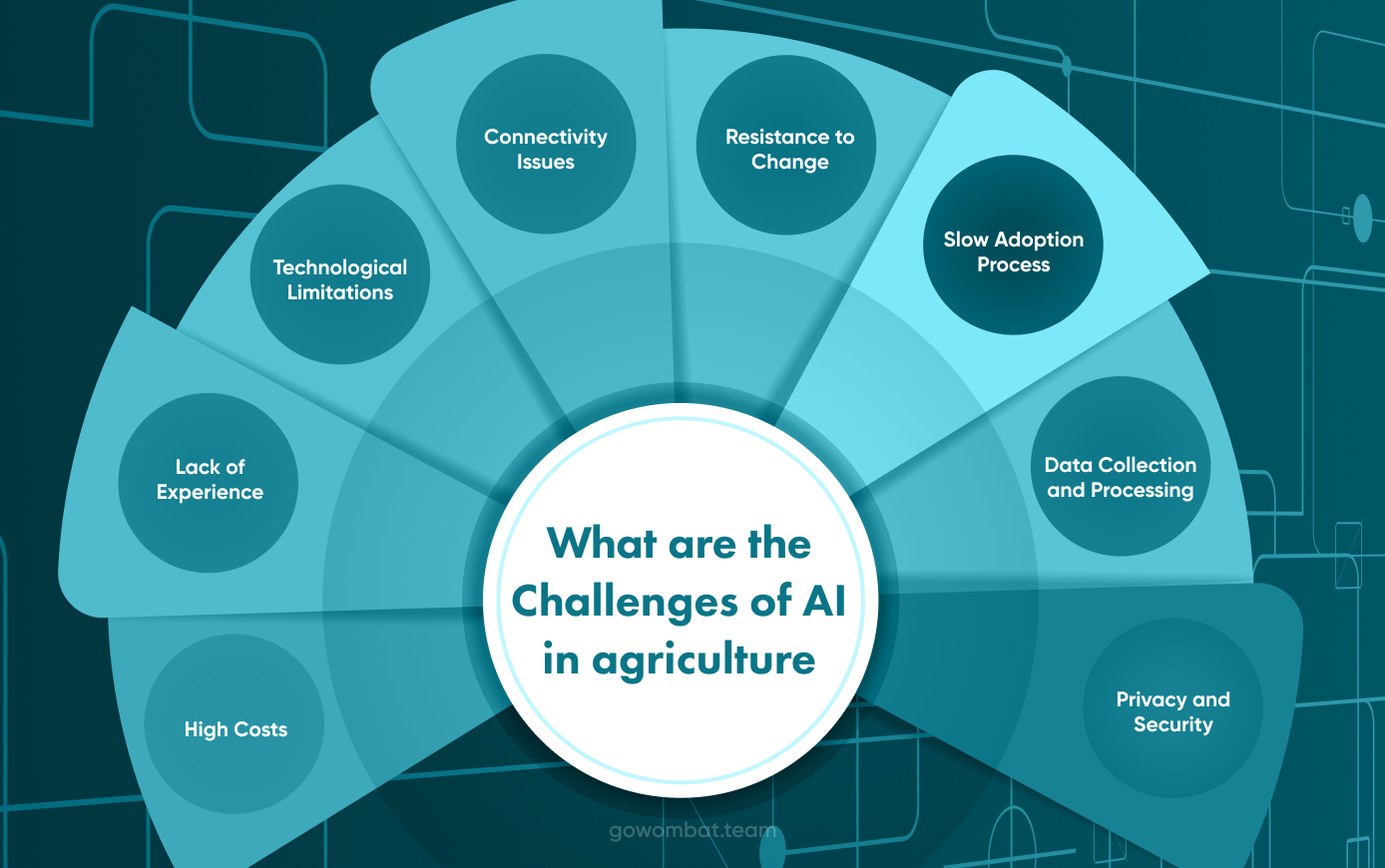
AI in agriculture has deployment challenges specific to the industry, and teams coming from a technology background often underestimate them.
Connectivity is the first constraint. Rural areas often have limited or unreliable internet access, so an agent that depends on continuous cloud connectivity will fail where it is most needed. The architecture has to work with intermittent connectivity, using edge processing and reliable data synchronisation.
Data quality and availability present a structural challenge that takes time to resolve. Many farms lack historical records in usable digital formats. Sensor networks are incomplete. Satellite imagery has gaps. Building the data foundation for reliable AI reasoning may require one or more full growing seasons of instrumented data collection before model performance reaches operational standards.
Agronomic variability adds a layer of complexity that technology teams sometimes overlook. Agricultural systems are inherently seasonal, geographically specific, and sensitive to conditions that are difficult to model fully. An AI agent trained on data from one region may perform poorly in another with different soil types, microclimate patterns, or crop varieties. Model localisation and continuous retraining are operational requirements, not one-time tasks.
Finally, adoption within farming operations requires careful change management. Precision farming AI systems that generate outputs farmers do not understand or trust will be ignored. Building interpretable, transparent agent outputs and investing in the agronomic expertise to validate recommendations before full autonomy is extended is as important as the technical architecture.
How Should AgriTech Leaders Build Toward an AI-Ready Farming Stack?
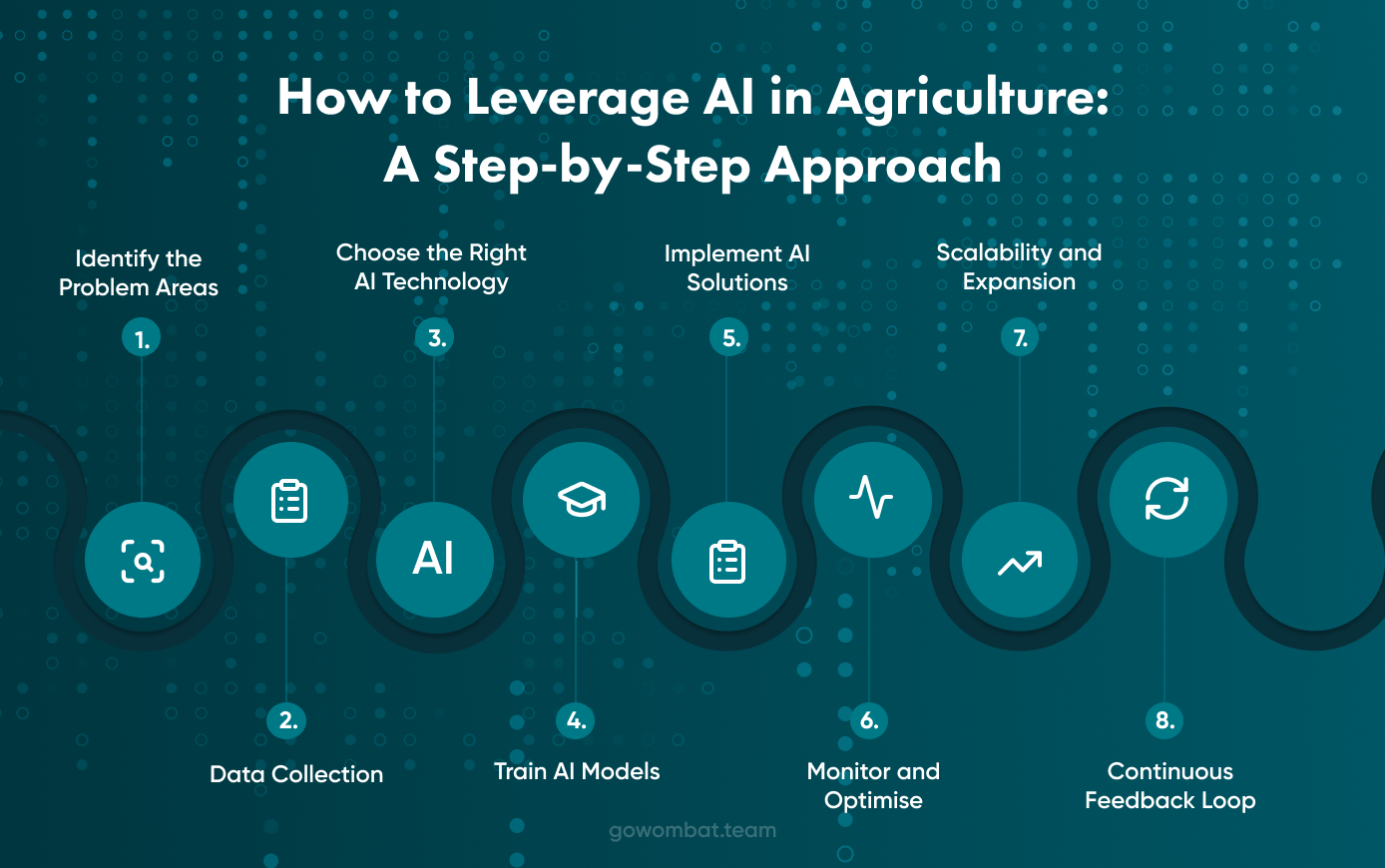
Treat data infrastructure as a product, not a one-off requirement.
That means investing in sensor coverage, data normalisation and digitising old records before using AI models, and building data pipelines that cope with patchy connectivity, seasonal data gaps and sources that don't match.
On that foundation, start with a focused first deployment rather than a broad platform rollout. Choose one important workflow, such as irrigation, crop monitoring or yield prediction, and build an agent that works reliably and produces measurable results there. Validate it across a full growing season, then expand.
For AgriTech platforms adding AI agents to existing products, early architectural decisions determine how well the product scales. Agent design, data pipelines and model retraining need to be built for the farm environment rather than adapted from industrial or enterprise templates. Go Wombat's engineering teams work with AgriTech founders on agent architectures for agricultural data and operating conditions. We start with the data layer, and custom AI agent development for agriculture follows from there.
Final Thoughts
The main challenges are connectivity, data quality, agronomic variability and adoption, and each needs deliberate engineering and domain expertise.
Where to start: build the data foundation first, deploy a focused agent on one high-value workflow, and validate it across a full growing season before scaling.
Frequently Asked Questions
What is precision farming AI, and how does it differ from traditional farm management software?
Traditional farm management software records and displays operational data for people to review. Precision farming AI adds a reasoning and action layer: it analyses data streams continuously and generates decisions or recommendations without waiting for manual input. The difference is real-time or predictive decision support instead of retrospective reporting.
How do AI agents improve crop monitoring compared to manual scouting?
AI agents process satellite imagery, drone feeds and field sensor data continuously, across large or multi-site operations that manual scouting cannot cover in full. They detect signs of crop stress, disease and pest activity earlier, giving agronomists more time to intervene at lower cost, and they send scouts to specific locations instead of whole fields.
What data sources do AI agents use in precision agriculture?
The most common inputs are soil moisture and nutrient sensors, satellite-derived vegetation indices, drone and field camera imagery, weather forecast APIs, machinery telematics, and historical yield records. Agricultural data analytics normalises these sources into a consistent format that AI agents can reason across. The breadth and quality of available data directly determine the reliability of agent outputs.
What is variable rate technology, and how do AI agents use it?
Variable rate technology allows agricultural machinery to vary the rate of input application across a field according to a digital prescription map. AI agents generate those prescription maps by analysing field variability data and determining the optimal input rate for each zone. This combination of AI-driven prescription generation and variable rate application delivery is one of the most established mechanisms for translating AI recommendations into measurable resource savings.
How should an AgriTech company start integrating AI agents into its platform?
The starting point is data infrastructure. Before any AI development begins, the platform needs reliable, normalised data flows from the agricultural environments it serves. From there, the most effective approach is to identify one high-value workflow, deploy a focused AI agent against it, and validate performance across a full growing season before expanding scope. Building for agricultural data realities from the start, including intermittent connectivity and seasonal gaps, prevents the architectural rework that typically slows broader deployment.
Share and subscribe to our blog
Related articles
-blogCardMobile-480x320.webp)
Agent as a Backend: Replacing REST Controllers With AI Agents That Reason
Agent as a Backend (AaaB) replaces or augments hardcoded REST controllers with AI agents that reason about each request. Components, boundaries, security and costs.

How Can AI Agents Process Industrial IoT Data in Real Time?
How AI agents process industrial IoT data in real time: where inference should run (edge, on-premise or cloud), predictive maintenance, quality inspection and the hardest deployment challenges.
Why Is the Digital Twin of an Oil Refinery the Most Complex AI System You Will Ever Build?
Why a digital twin of an oil refinery is so hard to build: seven interdependent layers from physics simulation to control system integration, results from Cosmo Oil's refinery digital twin, a look at Honeywell's planned digital-twin work at the Dangote refinery, team and data prerequisites, and why projects fail.

How can we help you ?

