



What Is the Bus Factor of a Vibe-Coded Project?

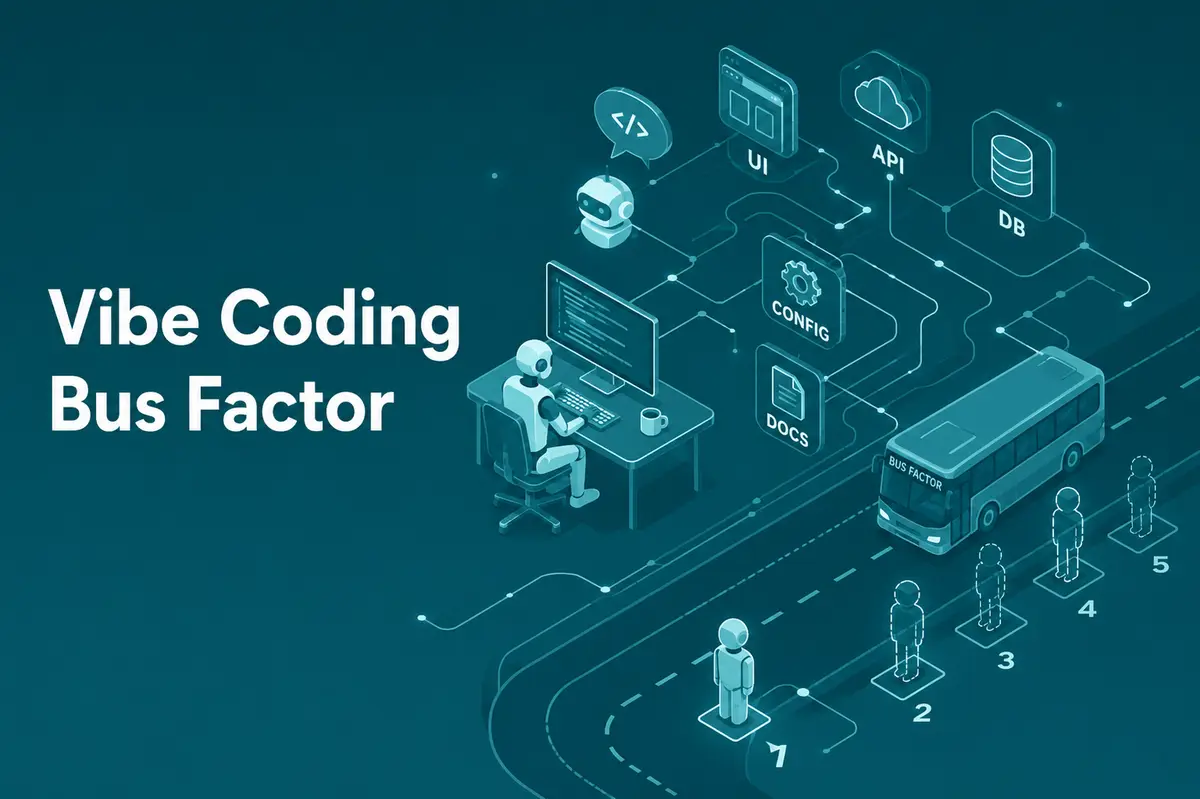
What the bus factor actually measures
The bus factor asks how many team members could leave before a project stops moving. In practice it measures knowledge distribution: how much of the project's operational context lives in one person's head rather than in shared systems, documentation, and team understanding.
In software delivery, bus factor is usually a knowledge problem rather than a headcount problem. Teams replace people. They cannot easily replace the mental context a departing engineer carried: which modules are fragile, which fixes were applied under pressure and never revisited, which architectural decisions were made in a late generation session and never written down.
Key person risk in software development has always existed. Vibe coding concentrates it faster.
Why AI-assisted development concentrates knowledge faster
When a developer drives an AI generation session, they hold the context: the prompts, the decisions made during the back-and-forth with the model, the edge cases they chose to handle and the ones they deferred. The output often arrives faster than anyone else on the team can absorb it.
Code review in a vibe-coded build needs explicit process controls to stay meaningful. Without them, reviews tend to be high-level rather than granular, because the volume of generated code outpaces what a second engineer can assess in a normal sprint cycle. Faros AI's AI Engineering Report 2026, drawn from the telemetry of some 22,000 developers, found that high AI adoption was associated with a 51.3% increase in average pull request size. Larger PRs are harder to review thoroughly, and the knowledge gap grows with every sprint.
The engineer who drove the generation sessions becomes the only one who fully understands what was built and why, because the generation context was never formally shared.
Consider a team with a primary backend engineer driving the AI sessions alongside frontend and DevOps colleagues. Two weeks before go-live, the backend engineer is unavailable. The frontend engineer can read the code. They cannot necessarily modify complex integration logic safely, because they were never part of the generation decisions that shaped it. The DevOps engineer can keep the infrastructure running. They cannot tell you whether a last-minute configuration change will interact with a module built the previous week.
With only the backend engineer able to change the integration logic safely, the bus factor is 1, whatever the size of the team.
Traditional development with a single core developer carries the same risk. What changes with vibe coding is pace. Knowledge concentrates faster when one engineer drives large generation sessions. The gap between when it works and when anyone else can maintain it arrives earlier in the delivery cycle.
What the data from a real AI-assisted delivery shows
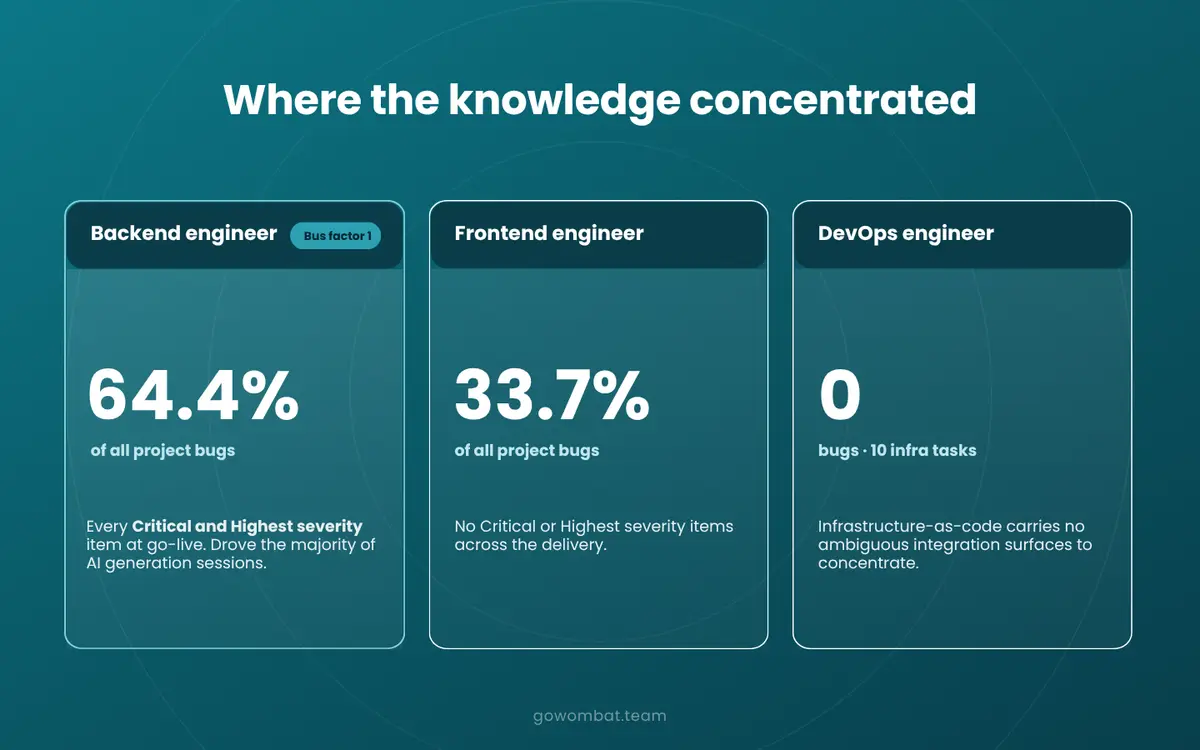
Across a 20-week AI-assisted B2B SaaS delivery our team tracked end to end, a clear concentration pattern emerged. The backend engineer, who drove the majority of the generation sessions, carried 64.4% of all project bugs, including every item marked Critical and Highest severity at go-live. The frontend engineer carried 33.7%, with no Critical or Highest severity items. The DevOps engineer carried zero bugs across ten infrastructure tasks. The remaining 1.9% were not assigned to any of the three.
The 64.4% backend figure shows where knowledge is concentrated. Individual fixes go through standard verification: QA validates each one against documented acceptance criteria before it reaches pre-production. That process works. What it cannot replace is architectural understanding. When an unexpected interaction surfaces in production (one that passed QA because it only appears under a specific production configuration), the engineer who drove the generation sessions is the one who knows which design decisions are relevant, which edge cases were explicitly handled during development, and where the codebase is most sensitive to change. That knowledge does not sit in the ticket descriptions or the test results. It sits in the generation history that only one person has.
The DevOps figure stands out. Infrastructure-as-code does not produce this concentration pattern because it does not carry the same ambiguous integration surfaces. A Terraform module either provisions correctly or it does not. Application code, particularly in areas with complex state management, requires contextual understanding that does not transfer through a read-through alone.
Veracode's 2025 GenAI Code Security Report, which tested more than 100 AI models, found that 45% of AI-generated code samples introduced OWASP Top 10 vulnerabilities. Our delivery data shows where that risk tends to hide: in the integration between modules rather than in any individual file. The individual modules pass review. The seams between them require a different kind of attention.
The traceability gap that compounds the risk
In the delivery above, 68.3% of the 101 bugs raised had no explicit parent task link in the project management system. Some of these reflect genuine cross-module issues or edge cases that do not map cleanly to a single feature. In pre-production projects, formal resolution timestamps often sit in status transitions rather than dedicated fields. Neither of these is unusual.
Together, they mean that if the engineer who held the generation context had left after go-live, the team inheriting the codebase would have needed to reconstruct the fix logic for those 69 unlinked issues from the tracker alone, without the mental model the original developer carried.
The workflow was not wrong, but it needs structures that record what each generation session produced.
How AI tooling changes the equation
The tools that accelerate knowledge concentration can also spread that knowledge back across the team.
GitHub Copilot can generate a pull request summary on request: a prose overview of the changes followed by a bulleted list of key changes, linked to the affected files. The feature is not available on Copilot Free. When a second engineer reviews an AI-generated module, they start from a summary of the changes rather than a wall of unfamiliar code. It does not replace a full knowledge transfer, but it is a real step towards one.
CodeRabbit, now installed on more than six million repositories, goes further. It posts a structured walkthrough at the top of every pull request, summarising the changes and estimating review effort, and for pull requests that change how components interact it adds sequence diagrams showing how the change fits into the codebase. A second engineer reviewing with that context understands the module's role in the system, not just its internal logic. The knowledge that previously lived only in the author's head gets partially externalised with every review cycle.
Our approach at Go Wombat builds these tools into the delivery workflow from sprint one. AI-generated PR summaries reduce the review burden. AI-assisted code review surfaces integration issues earlier. Automated module documentation captures the decisions the generation session produced. None of this removes the need for a second engineer to read and understand the output, but it makes that review feasible at the pace of vibe coding.
Teams that adopt AI-assisted development for speed alone, without governance tooling, make the knowledge concentration problem worse. Teams that combine the two have a better chance of reaching go-live with a bus factor above 1.
Five practices that reduce bus factor without slowing delivery
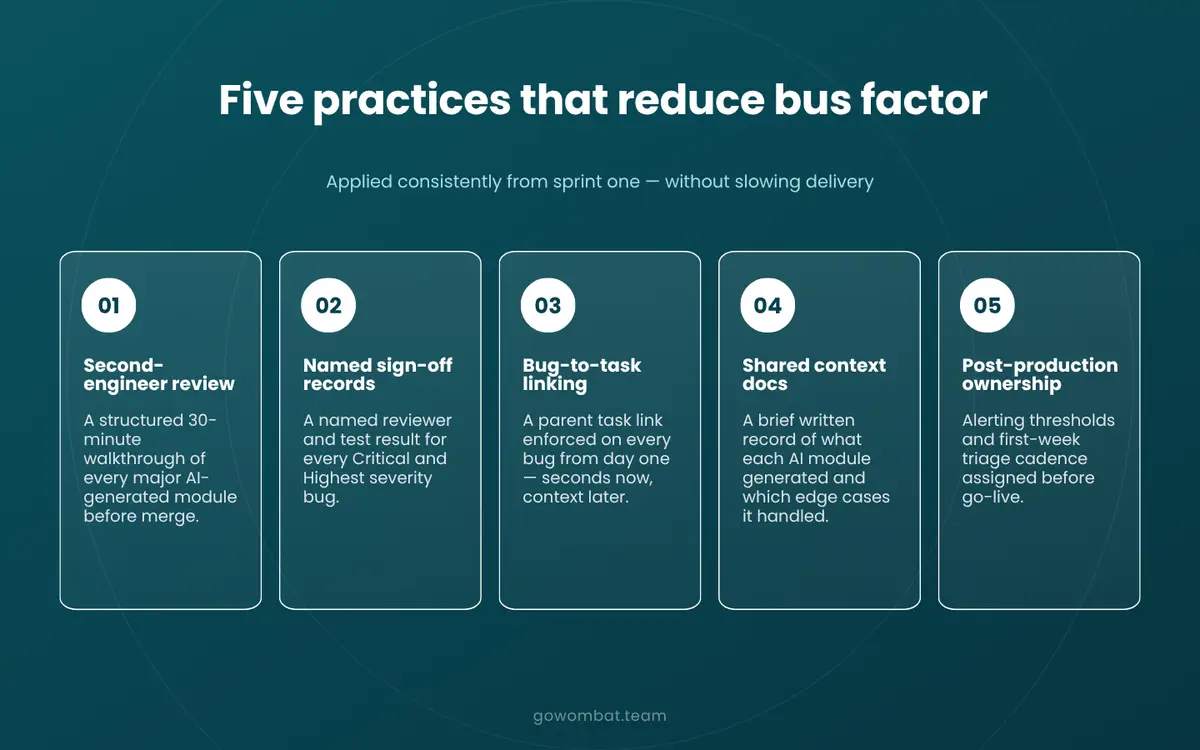
None of the following requires significant process overhead. All five require consistent application from sprint one.
1. Mandatory second-engineer review before any major AI-generated module is merged
This is not a line-by-line audit of every commit but a structured session in which a second team member reads the AI-generated PR summary, walks through the architectural diagram, and asks the questions the original developer took for granted. Thirty minutes per module. This is where the knowledge gets shared.
2. Named sign-off records for every Critical and Highest severity bug
A status label signals readiness. It does not replace a named reviewer, a regression test result, or a production environment confirmation. The record exists so that any engineer on the team can reconstruct what was checked and why.
3. Bug-to-task linking is enforced from day one
Requiring a parent task link on every bug costs seconds per issue and pays back when context needs to be reconstructed under pressure. The 68.3% unlinked figure from our delivery came from a workflow that never required the link, not from negligence.
4. Shared context documentation for AI-generated modules
The model's output is not self-documenting. A brief written record of what was generated, which decisions were made, and which edge cases were handled reduces the bus factor before it becomes a risk event. AI documentation tools make this faster than it sounds.
5. Post-production ownership defined before go-live
Error logging thresholds, alerting rules, and a first-week triage cadence should be assigned before deployment. Consider pairing this with a structured IT support and maintenance arrangement so that monitoring and incident response are in place from day one in production.
What should leaders ask before go-live?
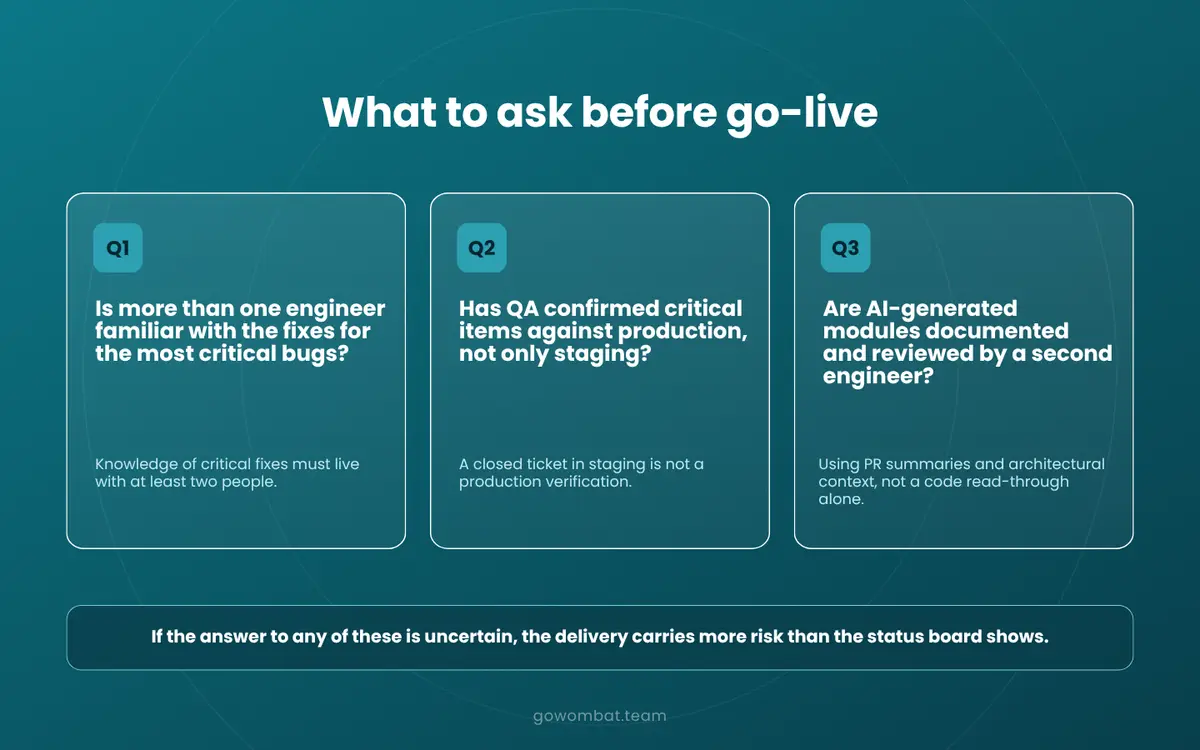
The bus factor is a governance question: when AI writes the code, who understands it?
For a CTO or Head of Engineering assessing a vibe-coded build, three questions cover the essential ground. First, is there more than one engineer familiar with fixes for the most critical bugs? Second: has the QA lead confirmed that critical items have been verified against the production environment, not only closed in staging? Third: are AI-generated modules documented, and has a second engineer reviewed them using PR summaries and architectural context?
If the answer to any of these is uncertain, the delivery carries more risk than the status board shows.
Google's 2025 DORA research found that AI adoption now lifts delivery throughput but still harms delivery stability. Its AI Capabilities Model names seven practices, among them strong version control, working in small batches and AI-accessible internal data, that amplify AI's positive impact on team and organisational performance. Teams whose AI-assisted projects hold up in production use AI to review and document what they built, not only to write code faster.
Get in touch with Go Wombat to discuss your AI-assisted delivery.
Frequently asked questions
What is the bus factor in software development?
The bus factor measures how many team members could be removed before a project cannot continue. It is primarily a knowledge metric rather than a headcount one. A team of eight with a bus factor of 1 is more fragile than a team of three with a bus factor of 2, because the risk lies in where the knowledge lives, not in how many people are present. In software delivery, the goal is to ensure that critical knowledge about how a system was built and why is distributed across at least two people at all times.
Does vibe coding increase key person risk?
Not inherently, but it concentrates the risk faster than traditional development. AI generation sessions produce large volumes of code driven by one engineer, who retains the mental context for the output. Without deliberate governance, a shared understanding of the codebase does not develop on its own, and the single-point dependency often becomes visible only shortly before go-live.
How do you reduce bus factor in an AI-assisted project?
Five practices help: mandatory second-engineer review before major AI-generated modules are merged; named sign-off records for all Critical and Highest severity bugs; bug-to-task linking enforced from sprint one; shared context documentation for AI-generated modules; and post-production ownership defined before go-live. Pairing these with software testing services and AI tooling, such as automated PR summaries, makes the governance sustainable at the pace vibe coding operates.
What AI tools help distribute knowledge in vibe-coded projects?
GitHub Copilot's pull request summaries give reviewers a structured overview of the changes without a full code walkthrough. CodeRabbit posts a walkthrough with a change summary on every PR, and adds sequence diagrams to PRs that change how components interact. AI-assisted documentation tools capture module-level decisions that generation sessions produce but rarely write down. Used together, these tools externalise knowledge that would otherwise stay with the author.
What should a CTO check before going live on a vibe-coded build?
Three checks cover the critical ground. First: is there more than one engineer familiar with the fixes for the most critical bugs? Second: has the QA lead confirmed production-environment verification, not only staging sign-off? Third: are AI-generated modules documented and reviewed by a second engineer with access to PR summaries and architectural context? If any of these answers is uncertain, the delivery carries more bus factor risk than it should.
Can AI-assisted development be delivered safely with a small team?
Yes. The evidence from our delivery is that a small team using AI assistance can ship production-grade custom software with managed risk, provided governance structures are in place from sprint one. The development model is different. The quality bar does not have to be. What matters is knowledge distribution: who can maintain each module, who reviewed each critical fix, and what documentation exists for the decisions the AI sessions produced.
Share and subscribe to our blog
Related articles
-blogCardMobile-480x300.webp)
Is Vibe Coding Bad for Software Quality?
Does vibe coding produce software that holds up in production? We looked at bug rates, defect density and QA outcomes from one AI-assisted B2B SaaS delivery.
-blogCardMobile-480x320.webp)
Agent as a Backend: Replacing REST Controllers With AI Agents That Reason
Agent as a Backend (AaaB) replaces or augments hardcoded REST controllers with AI agents that reason about each request. Components, boundaries, security and costs.
-blogCardMobile-480x320.webp)
The 7 Principles of Software Testing: A Comprehensive Guide
The seven principles of software testing described in the ISTQB Foundation Level syllabus, with real-world examples of what happens when teams ignore them.

How can we help you ?