



Monolith vs Microservices: Which to Choose for Your Business


Monolith vs microservices architecture is one of the first technical decisions in any software project. Even if an internal team or a development partner does the build, the business owner should understand the choice, because it affects cost, release speed and how the product can scale.
This article explains what each architecture is, its pros and cons, and when to use it.
Monolithic systems: What are they?
A monolith is a single deployable unit: all modules share one codebase and one release cycle.
The name comes from the Greek monolithos, "made of one stone". In software it means one indivisible block.
Because the whole application is built and deployed as one artefact, even a small change means rebuilding and redeploying all of it. As a monolith grows, this makes it harder to update and maintain.
In the early stages of a project, the same property is an advantage: deployment and code management are simple, and the first release comes sooner.
Microservices architecture defined
In a microservices architecture, each business capability runs as a separate service with its own deployment cycle and, usually, its own database.
Services are small and communicate with one another through technology-neutral protocols such as HTTP, gRPC or message queues.
Online marketplaces are a typical example.
The product catalogue, user ratings, chat and reviews can each be a separate microservice, working independently within one platform.
Microservices give more flexibility than a monolith, but they are also more complex to build and run.
To discuss a microservices-based application, contact us.
Pros and cons of monolithic architecture
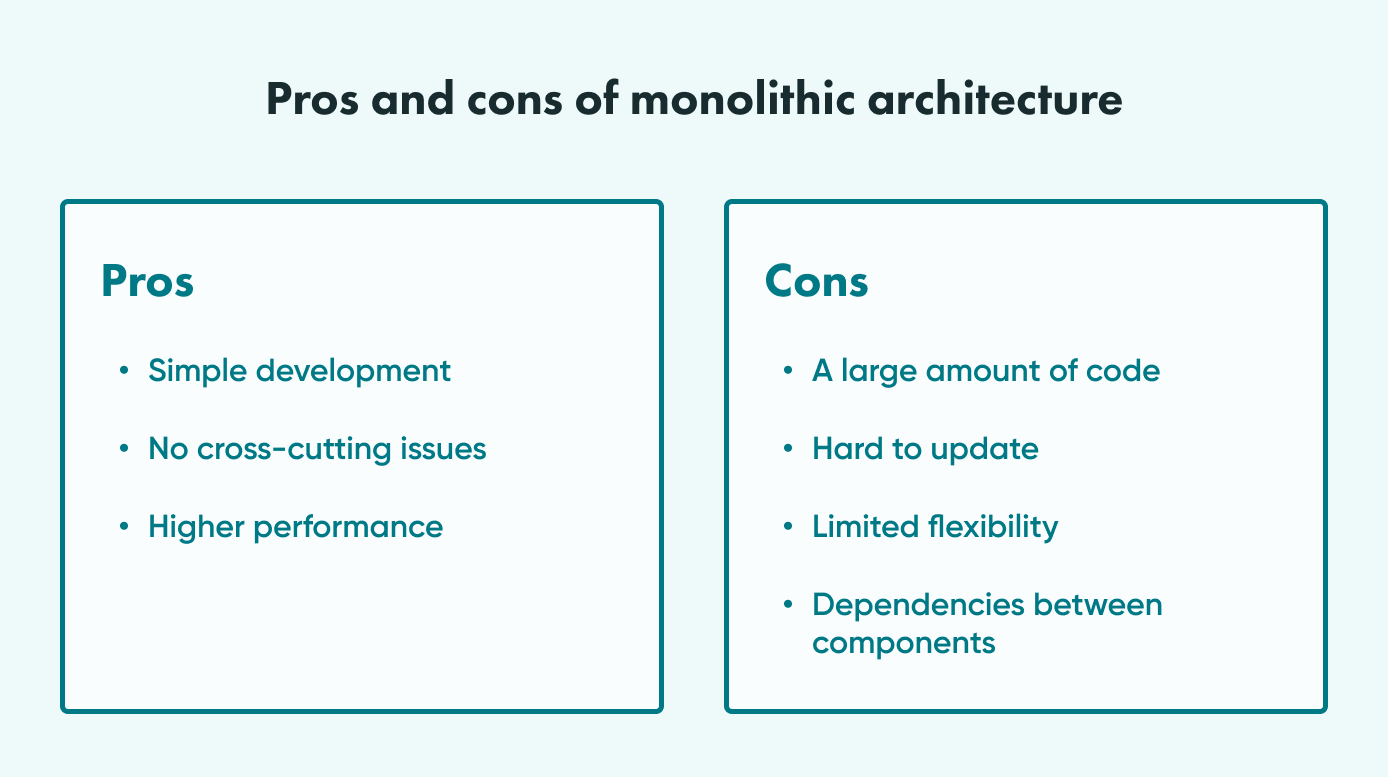
Benefits of monolithic architecture
Simple development
With a monolith, all development happens in one codebase, so libraries and frameworks are shared and easy to integrate.
Changes that touch several components are made in one place rather than across separate services.
Simpler cross-cutting concerns
Every app has concerns that cut across components, such as logging, rate limiting and audit trails.
A monolith still needs all of them, but they are easier to centralise because everything runs in one codebase and one application.
Faster calls between components
Components of a monolith call each other in-process rather than over the network, so operations that involve several components are usually faster than in microservices.
Drawbacks of monolithic applications
A large amount of code
As the product grows, the single codebase grows with it, which makes long-term maintenance harder.
Hard to update
Adding a feature to a large monolith can be slow, because every change has to be built, tested and deployed together with the rest of the application.
In a tightly coupled codebase, a new feature can require changes across many modules, which makes it more expensive and time-consuming than in a modular structure.
Limited flexibility
The whole application uses one technology stack, so adopting a new framework or language usually affects the entire codebase.
Bug fixes and updates also go out as a release of the whole application, which makes a large monolith harder to change.
Dependencies between components
Running as one process is good for performance, but it also means the components depend on each other.
A bug in one part, such as a memory leak, can slow down or stop the entire application.
The pros and cons of microservices architecture
Advantages of microservices
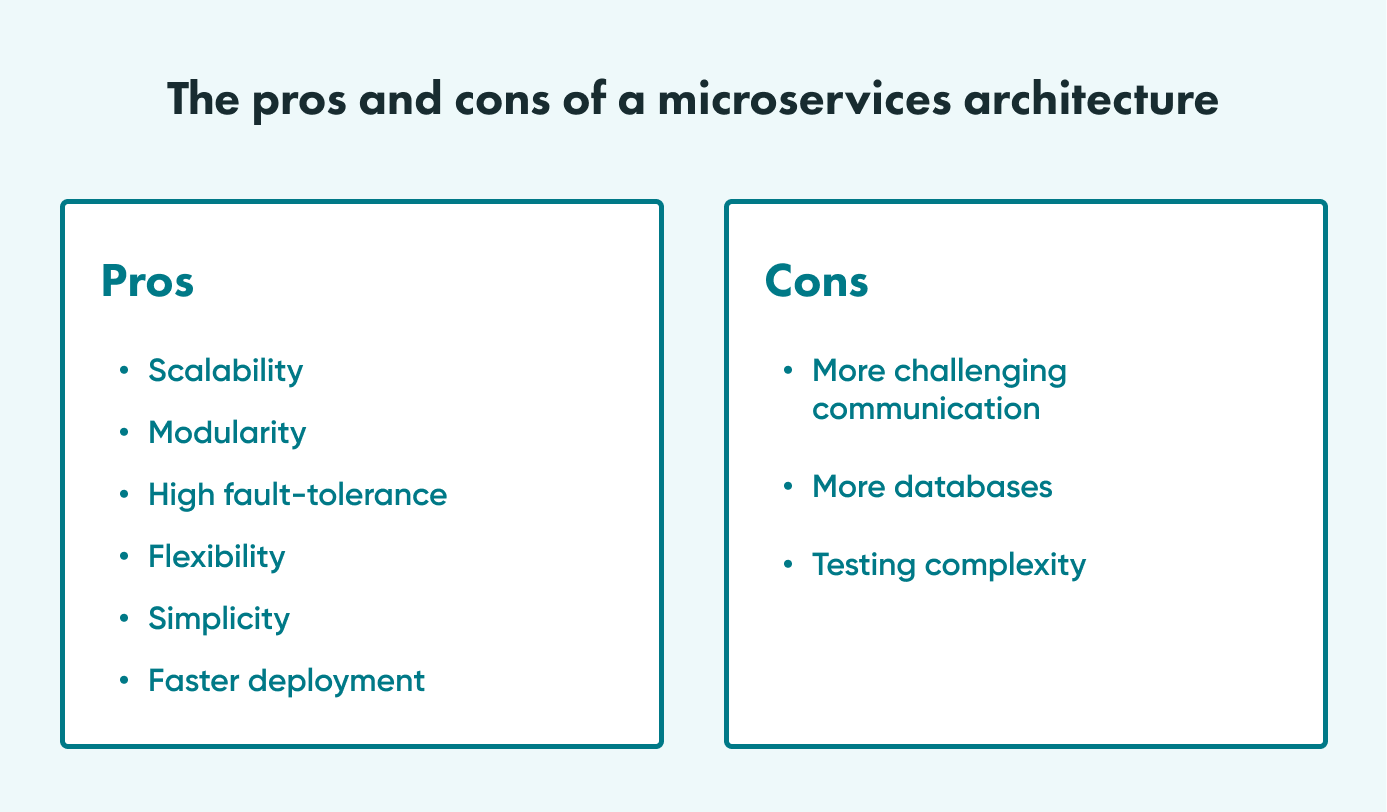
Scalability
Each service can be scaled, updated and extended on its own, according to demand.
The rest of the system stays as it is.
Modularity
In a microservices architecture, an application is divided into a collection of loosely coupled and independently deployable services, each responsible for a specific business capability.
Each service has a smaller codebase focused on one business capability, which makes it easier to understand, update, test and debug.
High fault-tolerance
If one service fails, the rest of the application can keep working, provided the other services are designed to handle that failure.
Flexibility
Individual services can be changed quickly, and each can use the technology that suits it best.
If a release fails, only that service needs to be rolled back, so each update carries less risk.
Smaller codebases
Each service is a small, separate codebase, so it is easier to understand, change and fix than one large application. The system as a whole, however, is more complex (see the drawbacks below).
Faster deployment
Services can be deployed independently, which supports shorter release cycles: a team can ship its service as often as needed without waiting for a release of the whole application.
Cons of a microservices architecture
Microservices have drawbacks too.
More challenging communication
Services are isolated, so developers have to build reliable communication between them.
The more services exchange requests and responses, the more complex that communication becomes, including the handling of timeouts and partial failures.
Testing complexity
QA engineers have to test each service on its own and then check that it communicates correctly with the other services.
Network overhead
Calls between services go over the network, so operations that span several services can be slower than the same operations inside a monolith. This does not lower the overall performance ceiling, because each service can be scaled horizontally on its own.
Why should complex applications be built using microservices architecture?
Microservices are more complex, but separate teams can build and release different services in parallel.
A microservices application usually costs more, but it is also more adaptable.
Horizontal scaling is a good example. Take an online store.
In the high season, some of its services need more server capacity. After the peak, that capacity can be turned off or used elsewhere.
A monolith can also scale horizontally, by running several copies behind a load balancer. But each copy runs the whole application, so you cannot add capacity only to the parts under load.
With microservices, you scale only the services that need it.
Is it possible to migrate from monolithic to microservices?
Yes. Migration is usually gradual: following the Strangler Fig pattern described by Martin Fowler, new services are built alongside the monolith and take over its functions one at a time, so the system does not have to be rewritten all at once.
Migration still takes time and resources. If you already know you need a complex, high-load application that must scale, starting with microservices can save that work later.
There is also a third option: a hybrid architecture.
Hybrid architectures
A hybrid is a compromise: the core functionality is a monolith, and additional features are built as microservices.
B2B and B2C companies often choose this option. It combines the stability of a monolith with the flexibility of microservices and reduces the drawbacks of each.
We can build or extend this kind of architecture at any stage of a project. Reach out to us if you have questions.
Microservices and containers
Containers are often used with microservices. A container is an isolated process that shares the host operating system's kernel; unlike a virtual machine, it does not include a full guest operating system.
Microservices are not the same as containers, but they are often packaged with containerisation tools such as Docker, containerd or Podman and run by orchestrators such as Kubernetes or Nomad.
A container packages a service with its dependencies, so it runs the same way on a laptop, a test server or in the cloud and can be moved between environments easily.
Get a detailed estimate for your monolithic or microservices application.
Monolith vs microservices: When to use them
As a rule of thumb, microservices suit complex apps whose parts need to scale or change independently, while a monolith suits simpler software and early-stage products.
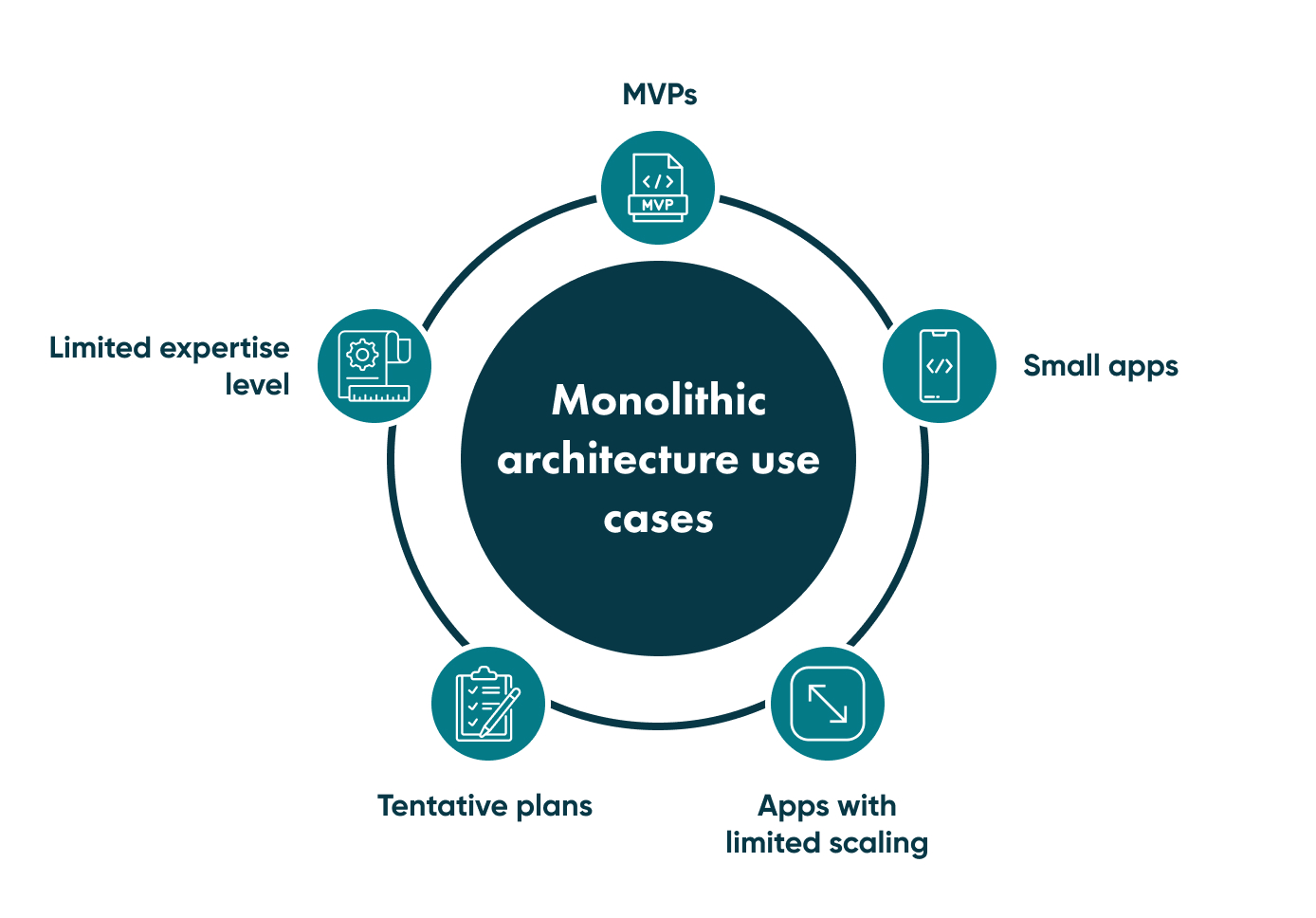
MVPs
Monolithic architecture suits a minimum viable product (MVP).
A monolith lets you build the MVP quickly, release it and gather user feedback on its strengths and weaknesses.
For ways to cut costs further, see our detailed article on reducing MVP development costs.
Small apps
For small, straightforward apps a monolith is usually the better choice: development is faster, and an app with a few functions does not need separate services.
Apps with limited scaling
If your app will not need to scale much, a monolith is probably the better choice.
It is simpler to deploy, monitor and manage than a set of services.
Tentative plans
If you do not yet know how the application will grow, you can start with a hybrid architecture based on a monolith.
The core functionality is a monolith, and new features can be built as microservices.
Limited expertise level
Microservices need a more experienced team than a monolith, and such teams are harder to hire. A monolith can be built by a less experienced team.
Microservices use cases
Microservices are worth considering in the following cases.
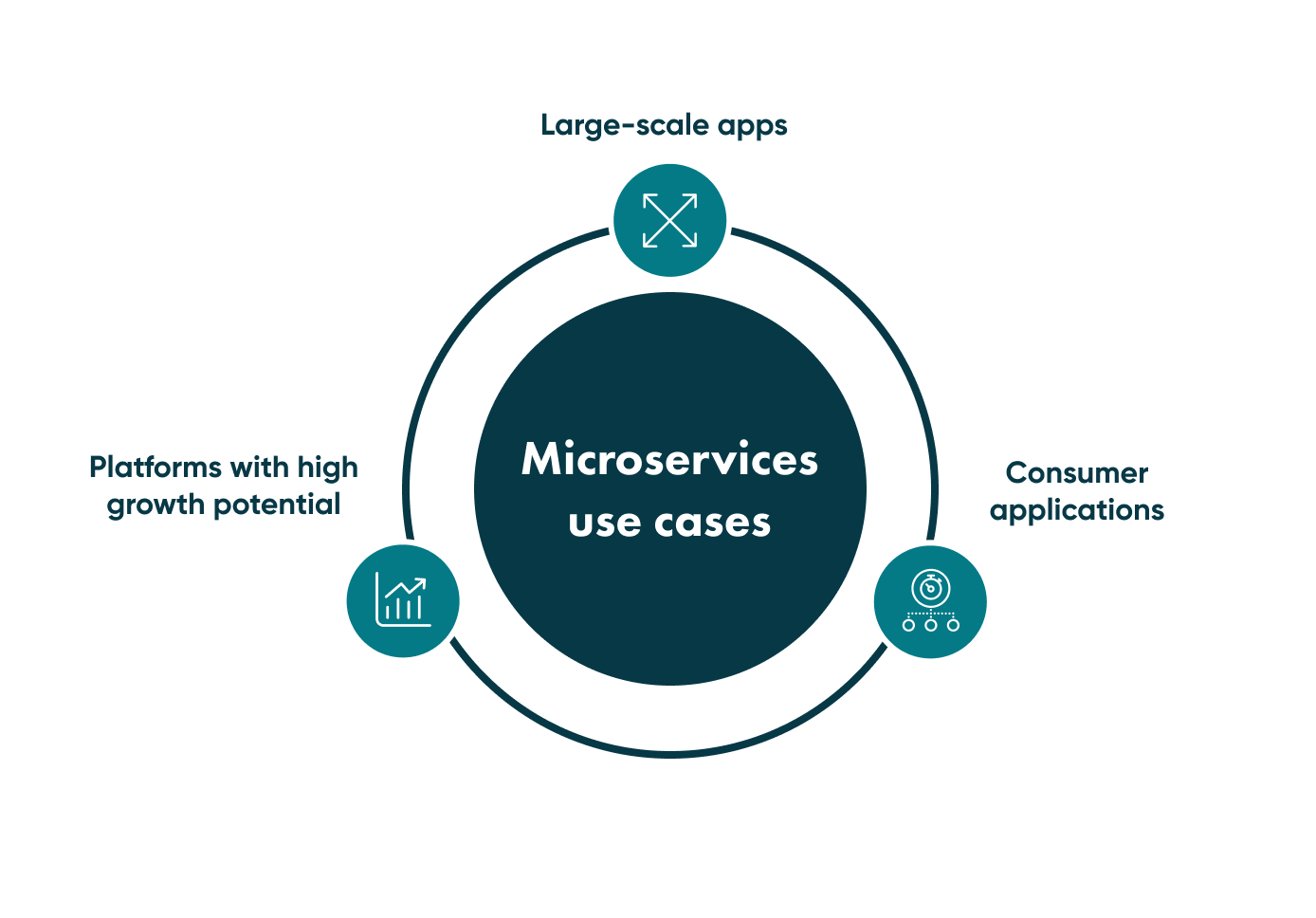
Large-scale applications
Microservices make it easier to scale and change a large, complex application, but they are not the only option. Shopify's engineering team describes its codebase as one of the largest Ruby on Rails codebases in existence, and the company chose to evolve it into a modular monolith.
Platforms with high growth potential
For products expected to grow fast, microservices let teams add new services and technologies without touching the rest of the system.
Consumer applications
Microservices also suit B2C (business-to-consumer) applications such as mobile apps, e-commerce platforms, social media platforms and on-demand service apps.
B2C applications often have variable, high traffic. Microservices let individual components scale independently: if the payment service is under heavy load, it can be scaled up without affecting other services.
B2C apps also need to change quickly as user demands change. With microservices, each team can choose the technology or programming language that best suits its service.
Summary: which architecture to choose
Microservices suit large, resource-intensive applications whose parts need to scale or change independently. They do not make an app more secure by themselves: each service adds network interfaces and needs service-to-service authentication and authorisation, which OWASP treats as a separate set of security challenges.
A monolith suits simpler apps, MVPs and products with limited scaling needs.
A monolith is usually cheaper to build. Microservices cost more up front but can save money later if the app needs to scale.
The choice also depends on your team: microservices need engineers with experience in distributed systems.
To discuss the architecture for your product, book a consultation.
Share and subscribe to our blog
Related articles

How to Reduce MVP Development Costs
How an MVP lets you test demand before a full build, and practical ways to reduce MVP development costs: a proof of concept, fewer features, low-code, one platform first and simple UX.

Why Is the Digital Twin of an Oil Refinery the Most Complex AI System You Will Ever Build?
Why a digital twin of an oil refinery is so hard to build: seven interdependent layers from physics simulation to control system integration, results from Cosmo Oil's refinery digital twin, a look at Honeywell's planned digital-twin work at the Dangote refinery, team and data prerequisites, and why projects fail.

How RAG Helps AdTech Platforms Reduce Campaign Data Hallucinations
RAG helps AdTech platforms reduce AI hallucinations by grounding outputs in real campaign data, making reporting, attribution and recommendations more accurate and auditable.

How can we help you?

