



How RAG Helps AdTech Platforms Reduce Campaign Data Hallucinations

The campaign report lands in the weekly review. Click-through rates are up, cost-per-acquisition is holding steady, and the attribution model shows three channels performing above target. Everyone in the room nods. Then someone asks: “Which of those numbers actually came from last week’s data?”
Nobody can answer.
Retrieval-augmented generation (RAG) addresses this problem: a large language model answering questions from its training weights instead of your actual campaign data. AdTech platforms have spent years building data pipelines, but the AI layer on top of them often ignores those pipelines.
What retrieval-augmented generation is
Retrieval-augmented generation connects a large language model to an external knowledge source at inference time, so the model answers from retrieved, current data instead of relying only on what it learned in training.
The architecture was formalised in a 2020 paper by Patrick Lewis and colleagues, "Retrieval-Augmented Generation for Knowledge-Intensive NLP Tasks," which combined a pre-trained seq2seq model with a dense retrieval index over Wikipedia. It set new state-of-the-art results on three open-domain question-answering tasks, outperforming both parametric-only models and task-specific retrieve-and-extract systems, and produced more specific and factual text than a parametric-only baseline.
If an LLM answers questions about campaign data, it needs retrieval; without it, reports can contain invented numbers. For teams building AI services and solutions on LLMs, RAG is therefore a core requirement.
Why AdTech platforms are especially vulnerable to hallucination
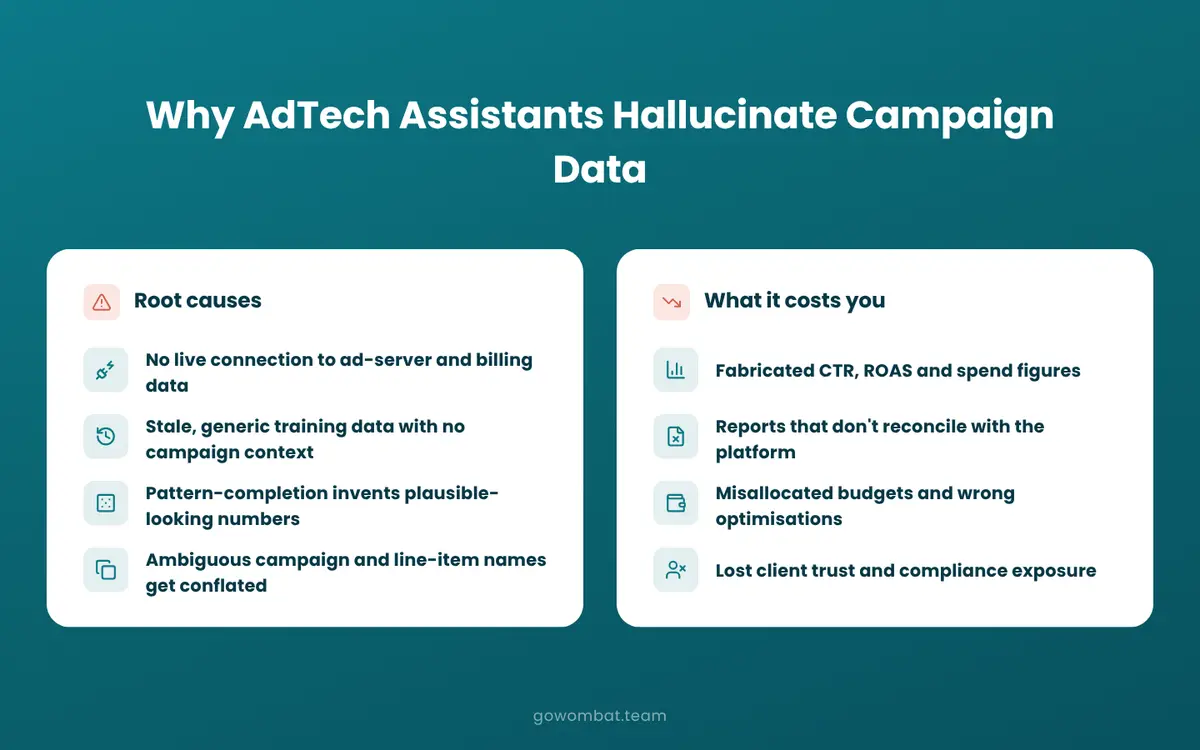
LLMs hallucinate campaign data because your campaign data is not in their training set.
A general-purpose LLM has never seen your bid logs. Your attribution events were not part of its pre-training corpus. It has no idea that your DSP renegotiated inventory agreements in March, or that your creative rotation changed mid-flight on a key campaign. When someone queries an LLM-powered analytics tool about campaign performance, the model does what it was trained to do: it produces a plausible, fluent answer, which is not the same as an accurate one. In AdTech that gap is expensive.
The AdTech industry is especially exposed because the stakes and data volumes are high. A misreported ROAS figure shapes budget allocation and creative strategy, and in programmatic environments it feeds straight back into automated bidding, so one wrong number leads to more.
Signs your AdTech platform may be hallucinating:
- AI-generated performance summaries that cannot be reconciled with raw log data
- Attribution models that assign credit to channels with no traceable event data
- LLM responses that cite specific metrics without pulling from a live data source
- Audience segment descriptions that do not match the segments currently defined in your DMP
- Bid recommendation outputs that contradict current inventory pricing conditions
According to the IAB’s State of Data 2025 report, 61% of the 500+ buy-side and sell-side professionals surveyed cite concerns about AI accuracy and transparency as a significant or critical challenge to adoption.
Our overview of AdTech platforms explains what they do and where AI fits in.
The data your AdTech platform runs on, and why LLMs can’t handle it alone
AdTech data is a poor fit for static model training: it is high-frequency, constantly updated and proprietary, so it changes faster than any training cycle and belongs only to your platform.
A RAG knowledge base can ground an AdTech LLM in:
- Campaign performance metrics: impressions, clicks, conversions, ROAS, CPM, CPC, updated in near real-time
- Attribution logs: multi-touch attribution events, cross-channel conversion paths, view-through and click-through windows
- Audience segment definitions: first-party cohorts, lookalike parameters, contextual targeting criteria, consent flags
- Bid data: real-time bid responses, floor prices, win rates, private marketplace deal terms under OpenRTB protocol
- Creative performance records: by variant, placement, device, and audience, including fatigue signals
- Compliance and consent records: GDPR processing bases, consent string states, data retention schedules under IAB Tech Lab standards
None of this data is in an LLM’s weights, yet it is the data your platform runs on. Hallucination starts in the gap between what the model knows and what your data contains.
Left alone, an LLM fills that gap with inference, and the inference is often plausible, which is what makes it dangerous. A confidently wrong attribution figure is harder to catch than a broken query: it reads fine, the numbers are in the right range, and someone acts on it.
Business intelligence and data visualisation tooling can surface discrepancies after the fact. RAG reduces how many reach the output in the first place, but it does not eliminate them: in a 2024 study, Stanford researchers found that RAG-based legal research tools from LexisNexis and Thomson Reuters still hallucinated in 17% to 33% of responses.
How a RAG pipeline works inside an AdTech platform
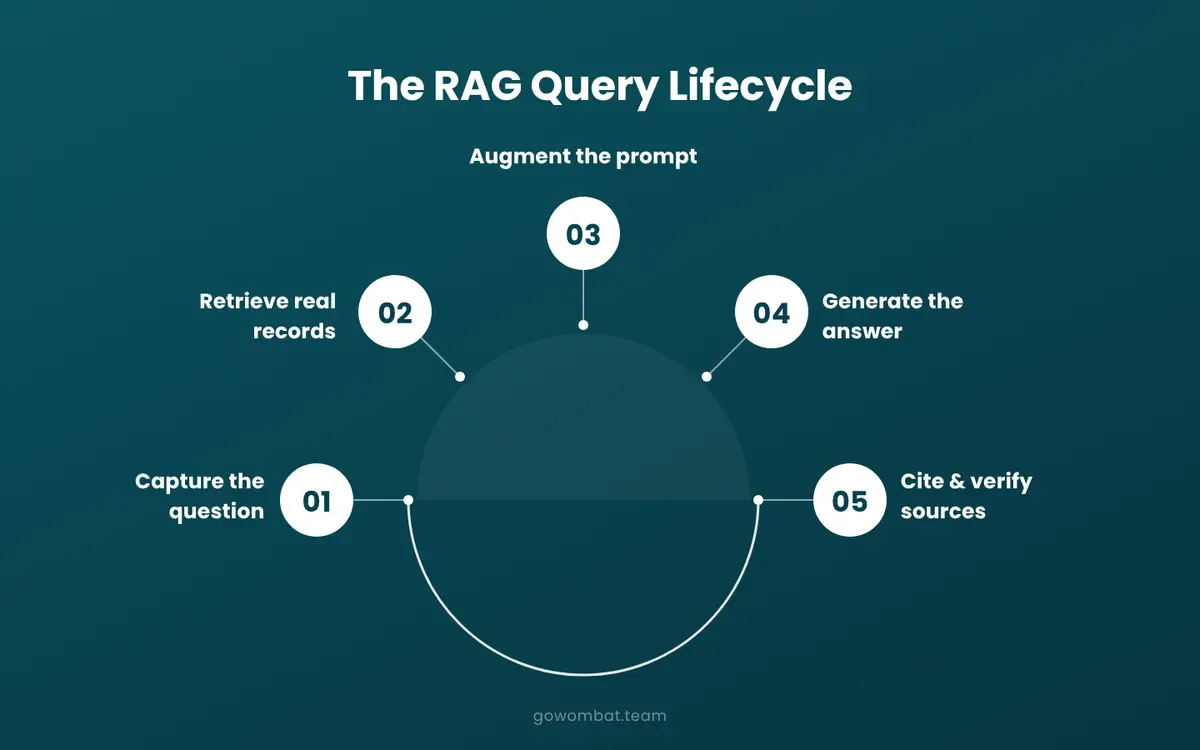
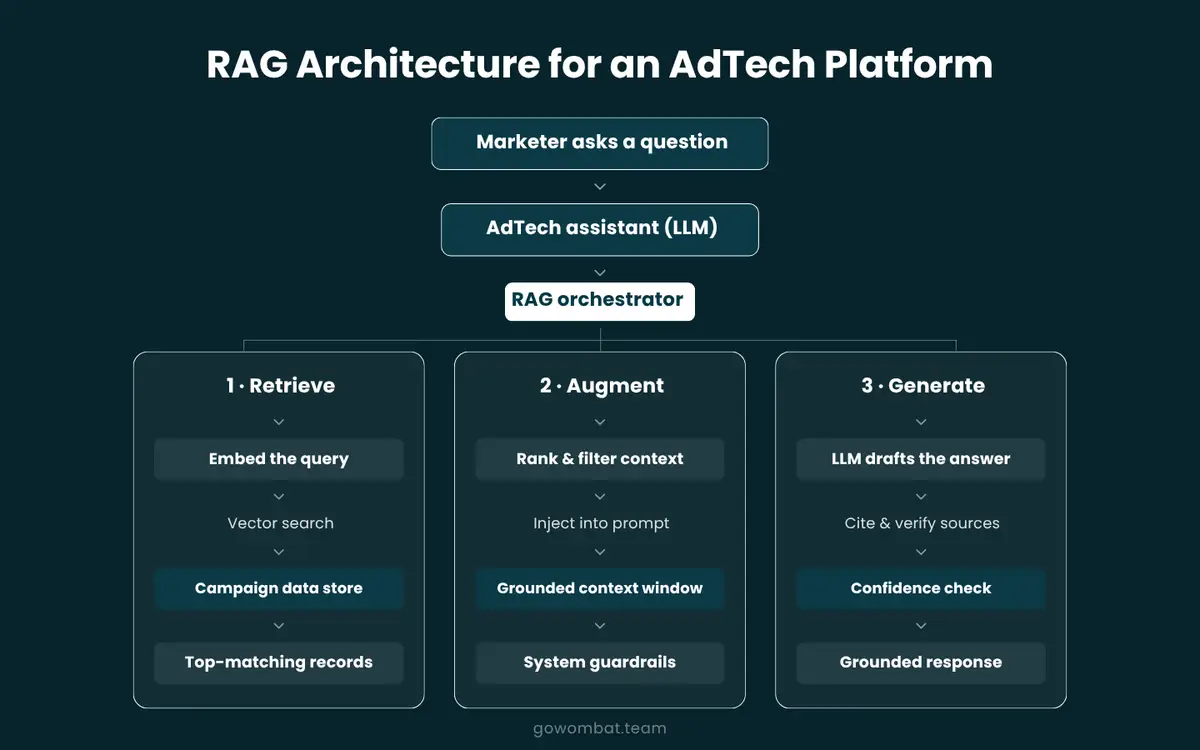
A RAG pipeline is a sequence of steps between the user’s query and the model’s response, and it is only as reliable as its weakest step.
Step 1: Ingest and index your data sources
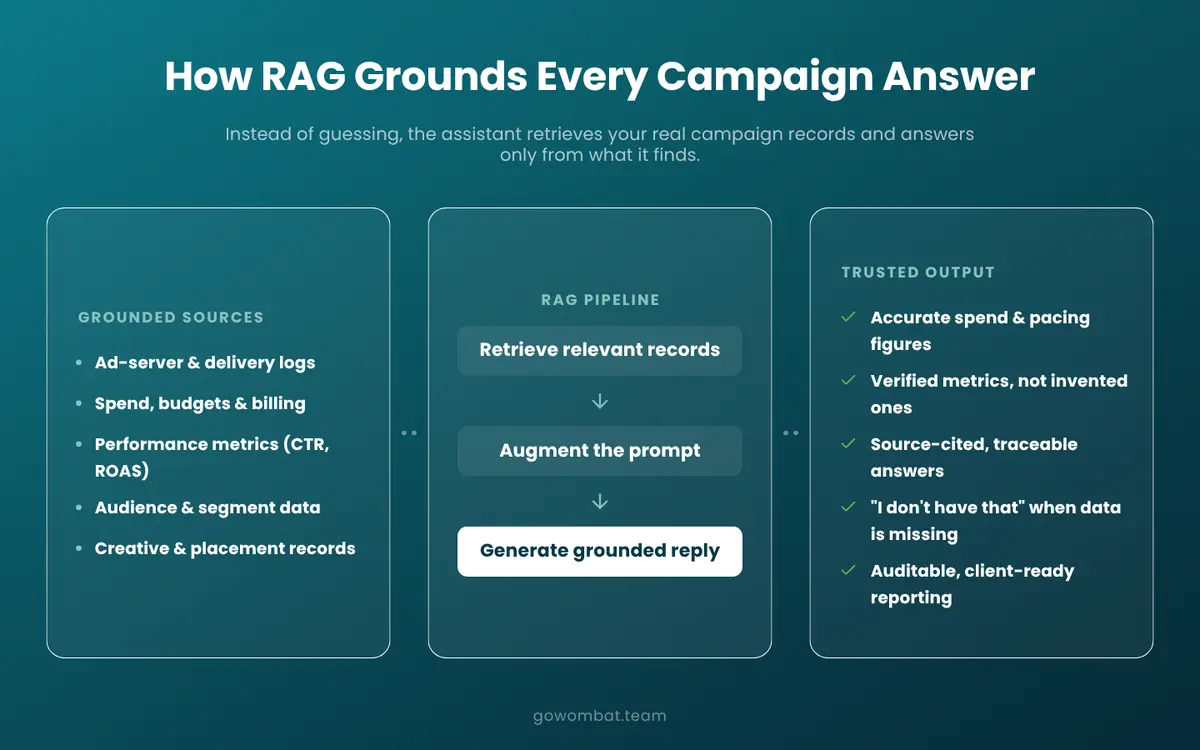
Campaign logs, attribution data, audience definitions, and compliance records are chunked and embedded as vector representations. These vectors are stored in a dedicated vector database. Tools like Pinecone and Weaviate are purpose-built for this, and the choice between them usually comes down to query latency requirements and existing infrastructure.
Step 2: Receive the query
A user asks something like: “What drove the spike in CPA on the Nordic campaign last Thursday?” The query is converted into a vector embedding with the same model that indexed the data. If ingestion and retrieval use different embedding models, semantic search becomes unreliable.
Step 3: Retrieve the relevant chunks
The system runs a semantic search across the vector store and pulls only the chunks the query needs, such as bid logs, creative rotation records and audience segment data from the relevant date range.
Step 4: Augment the prompt
The retrieved chunks are added to the LLM’s context window alongside the original query, so the model works from actual data rather than training priors alone.
Step 5: Generate a grounded response
The LLM generates its answer from the retrieved evidence. Citations can be surfaced alongside the response, making the output auditable, which matters for both internal review and regulatory compliance.
Orchestration frameworks like LangChain and LlamaIndex handle the plumbing between these steps. According to the Vertex AI release notes, Google made Vertex AI RAG Engine generally available in December 2024 as a fully managed service for enterprise RAG pipelines.
Use case | Data source | Retrieval method | Outcome |
Campaign performance Q&A | Real-time metrics store | Dense vector search | Grounded ROAS, CPA, CTR answers |
Audience segment analysis | DMP segment definitions | Hybrid semantic + keyword | Accurate cohort descriptions |
Attribution reporting | Event logs, conversion paths | Time-filtered vector search | Correct multi-touch attribution |
Bid strategy recommendations | Inventory pricing, win rates | Structured + semantic retrieval | Recommendations based on actual market conditions |
Compliance audit response | Consent records, data schedules | Keyword + metadata filter | Defensible, auditable outputs |
Machine learning services provide the modelling foundation; RAG supplies the data pipeline that makes those models more reliable in production.
What hallucinated campaign data costs
A February 2026 report by NP Digital found that 47.1% of marketers encounter AI inaccuracies several times a week, and 36.5% say hallucinated or incorrect AI content has gone live publicly. In brand copy that is embarrassing; in campaign reporting it costs money.
Here is how it can happen. A mid-size demand-side platform runs AI-generated weekly performance summaries for a portfolio of retail clients. The reports show stable ROAS across three campaigns. What the system’s LLM did not have access to: updated bid log data from the past nine days. So it extrapolated from training-period averages, which looked reasonable. Two of the three campaigns had been running at a loss for eleven days before a manual audit caught the discrepancy, by which point the retargeting budget had compounded the problem with each automated bid cycle (illustrative scenario, not a real client).
Failures like this do not always trigger obvious errors.
ChatGPT integration services built without RAG grounding can cause exactly this problem: the interface looks right and the answers read fluently, but the numbers behind them are invented.
For background, see our article on marketing automation trends.
Data precision came before RAG in AdTech
Go Wombat built and maintains 4D, a contextual advertising platform for Silverbullet. 4D matches ads to content across display, video, and in-app environments using privacy-first contextual signals, with no third-party cookies and no cross-site tracking. Work on it started in July 2019, before RAG existed as a named architecture, and the platform doesn't run on RAG or an LLM today. What it shows is older than that debate: a mismatch between the content a publisher registers and the context the ad system acts on is a placement error, and it costs brand safety, campaign performance, and client trust. AdTech needed that precision long before anyone was grounding a language model in retrieved data.
IDFree, a cookieless targeting platform Go Wombat started building in 2020, makes the same point from a different angle. It processes large volumes of audience data under GDPR and CCPA rules without third-party cookies, calculating targeting in real time across more than 500 options. Like 4D, it predates RAG and has no RAG or LLM component in its stack. Both projects are evidence that wrong data gets expensive fast in AdTech, independent of whether a language model is anywhere near the pipeline.
Other data-intensive platforms have the same requirement. Remarks, a real estate listing and communications platform Go Wombat built for the US market, manages property disclosures, buyer tracking and real-time agent communications, where a misattributed data point carries legal and commercial weight. What Remarks, 4D and IDFree have in common is not the industry but the stakes: when decisions carry commercial or legal weight, any AI layer on top needs to work from real data.
Go Wombat has also built the pattern this article describes. For an enterprise client in sustainability and environmental services (anonymised under NDA), the team built a proposal and quoting assistant that runs retrieval over the company’s own historical proposals before drafting anything new. It cut quote turnaround by 50 to 75 per cent and manual documentation work by 30 to 50 per cent, and it keeps the model’s drafts tied to what the business has actually proposed before.
The regulatory pressure behind grounding
The EU AI Act has no blanket category for AdTech. "Limited risk" is industry shorthand, not a formal tier written into the law; the mechanism that actually applies is Article 50, and it sets transparency duties for specific situations: systems that interact directly with people, AI-generated or manipulated content such as deepfakes, and emotion-recognition or biometric-categorisation systems outside contexts like schools or workplaces. Most ad-targeting and bidding logic doesn't appear on the Act's high-risk list at all; Annex III targets high-stakes uses such as biometrics, critical infrastructure, education, employment, credit scoring, law enforcement and migration, not campaign optimisation. But if a platform offers an AI system that generates ad creative or copy, Article 50(2) requires those outputs to be marked in a machine-readable, detectable way, and Article 50(4) adds visible disclosure duties for deepfake imagery, audio or video. Article 50 applies from 2 August 2026, but providers of generative AI systems placed on the market before that date have until 2 December 2026 to comply with Article 50(2), under Article 111 as added by the Digital Omnibus. These duties apply on top of any other risk-tier obligations the system already carries, not instead of them. A grounded, retrievable evidence chain makes them easier to meet and to defend.
The IAB has approached the same gap through industry standards. In June 2025, the IAB Tech Lab proposed an LLM Content Ingest API initiative: a framework to let publishers control, and be paid for, how LLMs and AI agents access their content, and to give brands more say over how they are represented in AI outputs. The IAB itself followed in January 2026 with the industry's first AI Transparency and Disclosure Framework for advertising.
Industry bodies are starting to set rules for how LLMs use and represent advertising content.
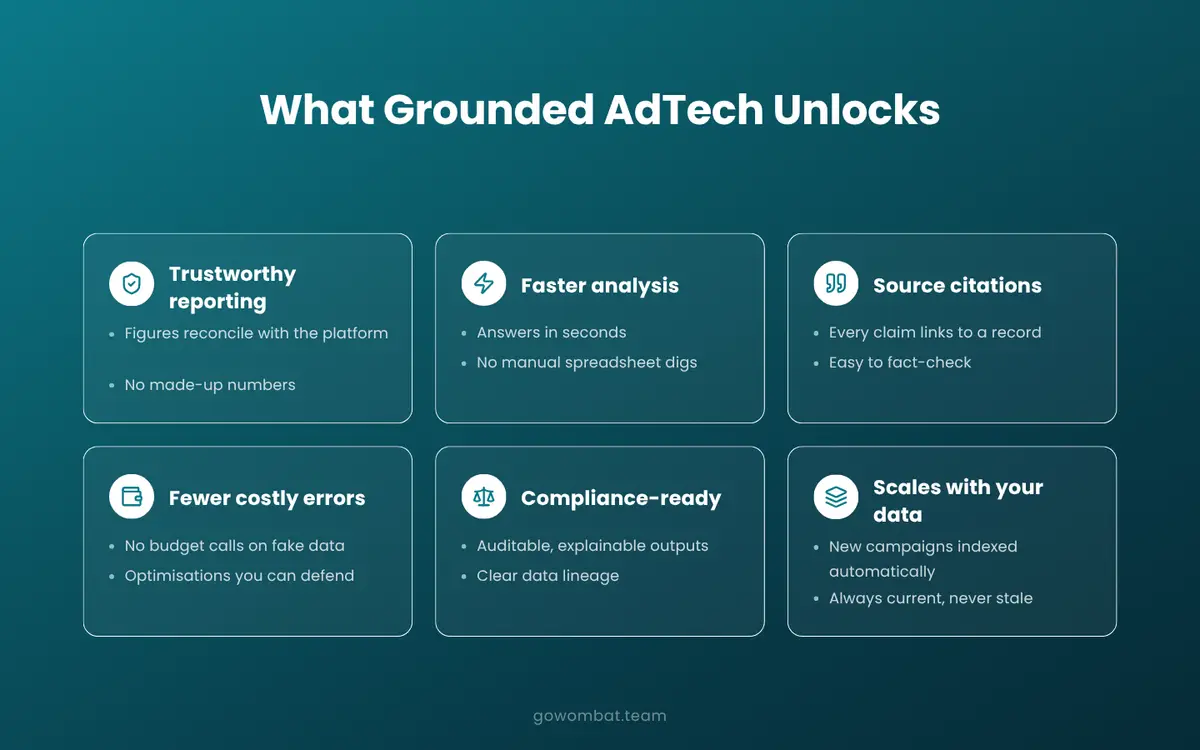
RAG helps make AI outputs in AdTech auditable, which will matter more as scrutiny increases.
Healthcare AI and supply chain AI face the same need for grounding, for the same reason: wrong outputs are costly.
The same applies in the real estate industry: PropTech platforms handling property data, valuation models and transaction records face disclosure and audit requirements that push AI towards retrievable, verifiable outputs. The future of chatbots in marketing, and of Martech more broadly, points the same way: systems that can show their working hold up better under scrutiny.
What leaders should act on now
Most AdTech teams already use AI. The question is whether it works from your data or from assumptions about what your data probably looks like.
RAG is a practical way to make it work from your data. It is not a silver bullet: vector databases need maintenance, retrieval pipelines need tuning, and the quality of the knowledge base determines the quality of the output.
Three things worth doing now: audit which AI outputs in your platform currently have no retrieval mechanism behind them; identify the highest-risk hallucination surfaces (attribution reporting and bid recommendation outputs are usually the first to cause damage); and scope a RAG implementation against one of those surfaces before extending it to the rest of the stack.
Frequently asked questions
What is retrieval-augmented generation and how does it differ from fine-tuning?
RAG connects a language model to an external data source at response time, so the output is grounded in retrieved evidence rather than training memory. Fine-tuning bakes domain knowledge into the model’s weights during a separate training process; it is expensive, requires significant labelled data, and goes stale as your data changes. RAG sidesteps that problem because the knowledge base sits outside the model and can be updated continuously. For campaign data that changes daily, this matters a great deal.
Can RAG work with real-time bidding data in a programmatic advertising platform?
Yes, but the implementation requires careful scoping. Real-time bidding data volumes are high, and latency budgets are tight; a RAG pipeline sitting in the live bid response path would not meet most DSP latency requirements. The practical approach is to use RAG for analytical and reporting layers, where response time is measured in seconds rather than milliseconds, and to index bid log data into the vector store on a rolling basis. That is where the value is anyway: strategy and reporting, not the bid moment itself.
What types of data should an AdTech platform store in a RAG knowledge base?
Start with the data your LLM layer would otherwise have no access to and that directly influences accuracy: campaign performance metrics, audience segment definitions, attribution event logs, creative performance records by variant and placement, and compliance documentation such as consent records and retention schedules. Bid log data and inventory pricing add value for strategy and reporting use cases. Index what your users are actually asking about. The answer varies by platform.
How does RAG reduce hallucination in AI-generated campaign reports?
By giving the model retrieved evidence to work from instead of training priors alone. When a user queries campaign performance, the RAG system pulls the relevant data chunks from your metrics store and adds them to the model’s context before generation. This reduces hallucination but does not remove it: models can still misquote or mix up retrieved sources, so RAG outputs need evaluation and citation checks.
Is RAG suitable for small or mid-size AdTech platforms, or only enterprise?
RAG scales down as well as up. A mid-size DSP or publisher platform with a well-defined knowledge base can implement a functional RAG system using open-source orchestration frameworks like LangChain or LlamaIndex alongside a managed vector database. The main constraint is data quality: retrieval output is only as good as what has been indexed.
What does a RAG implementation project typically involve and how long does it take?
A scoped RAG implementation for a single AdTech use case typically covers knowledge base design, data ingestion and chunking, embedding pipeline setup, retrieval layer configuration, and integration with the existing platform interface. A focused first build on a bounded use case can reach production in eight to twelve weeks, depending on data complexity and existing infrastructure. A discovery phase session is usually the right starting point; it surfaces the data architecture questions early, before they become implementation problems.
Share and subscribe to our blog
Related articles

What Is MarTech? A Complete Guide to Marketing Technology in 2026
What MarTech is, how it differs from adtech, the main categories of marketing technology tools, and what changed in the MarTech landscape in 2026.

How Can a RAG Agent Handle ISO, GDPR and EU AI Act?
How a RAG-powered agent helps compliance teams find and cross-reference documentation across ISO standards, GDPR and the EU AI Act, and where its limits are.

What is AdTech? A look at its influence on industries
What AdTech is, its main platforms (ad exchanges, ad networks, ad servers, DSPs and SSPs), trends and the privacy issues it raises.

How can we help you ?