



Why Generative AI Is the Next Step in CRM Automation


Generative AI is turning CRM systems into more than just a digital filing cabinet. Now, it’s an active partner - one that predicts what customers will do next, creates personalised content on the fly, and takes care of repetitive tasks automatically. Companies want to connect with customers faster and on a bigger scale, and generative AI CRM gets them there. Artificial intelligence brings a level of precision, speed, and flexibility that older CRM tools just can’t offer.
Why This Shift Matters Now
Companies in Europe and around the world aren’t sticking to old-school CRM tools anymore. People want fast, personalised service, and they want it everywhere - email, chat, phone, you name it. Teams just can’t keep up by hand. That is why natural language processing, virtual assistants, predictive analytics, machine learning algorithms and AI sales assistants come in handy. And if we're talking about AI-powered tools for customer relationship management systems, generative artificial intelligence is one of the best options.
Right now, about 72% of organisations already use AI implementation in the way they interact with customers. Still, only 47% of customers feel happy with the old CRM experience. In the EU, businesses say they’re stuck because their data is scattered and they don’t have enough resources to fix it.
This is where generative AI changes the game. It’s not just a fancy extra - AI agents are rewiring how CRMs work. Instead of waiting around for data, AI tools dig in, pull out insights, and actually take action. That’s a big leap from how things used to be.
How Generative AI Changes the Foundations of CRM Automation
How Does Generative AI Extend CRM Beyond Rule-Based Automation?
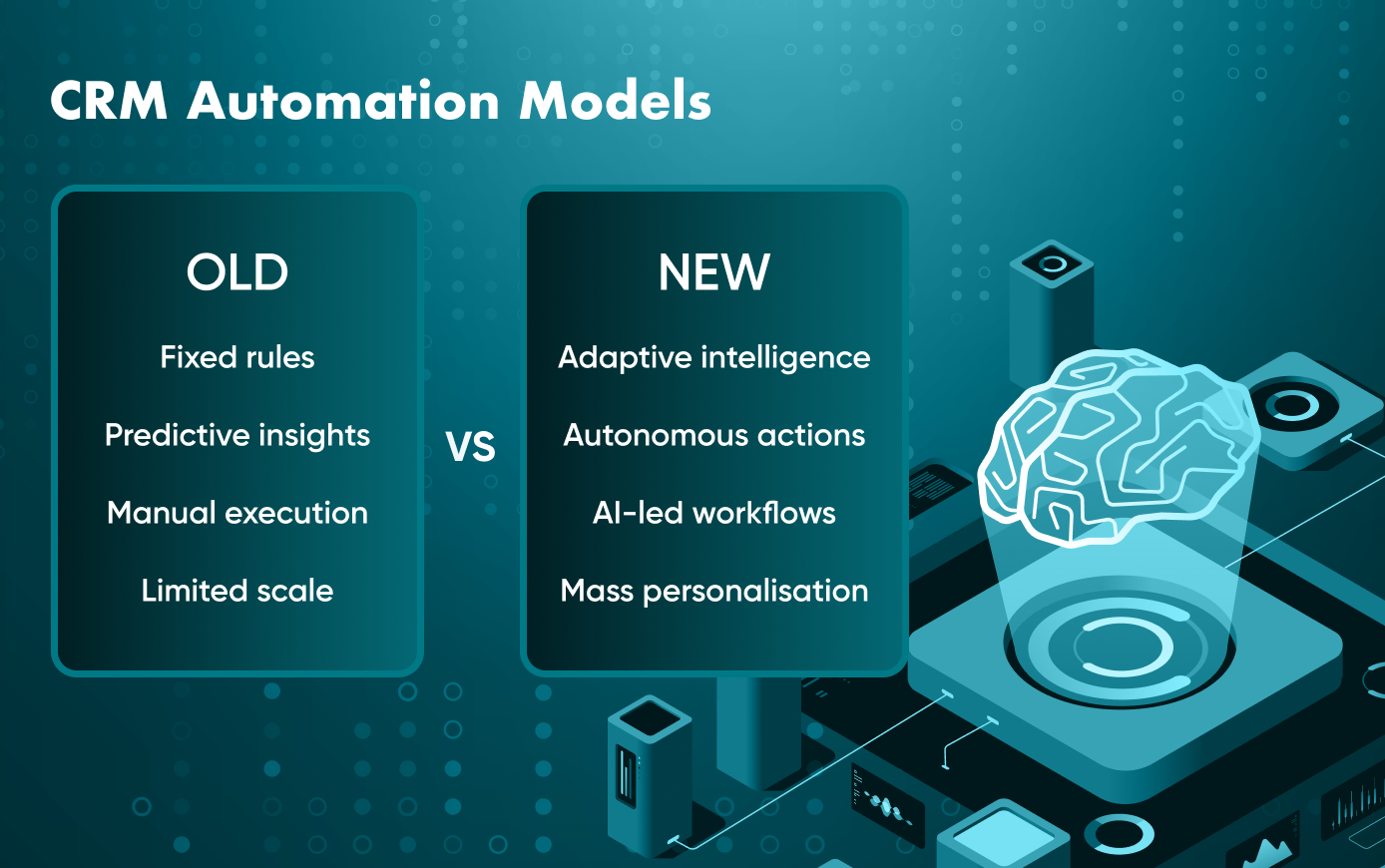
CRM automation used to be simple and pretty rigid. You’d set up rules like, “If a customer clicks an email, send a follow-up.” Not bad, but it only got you so far.
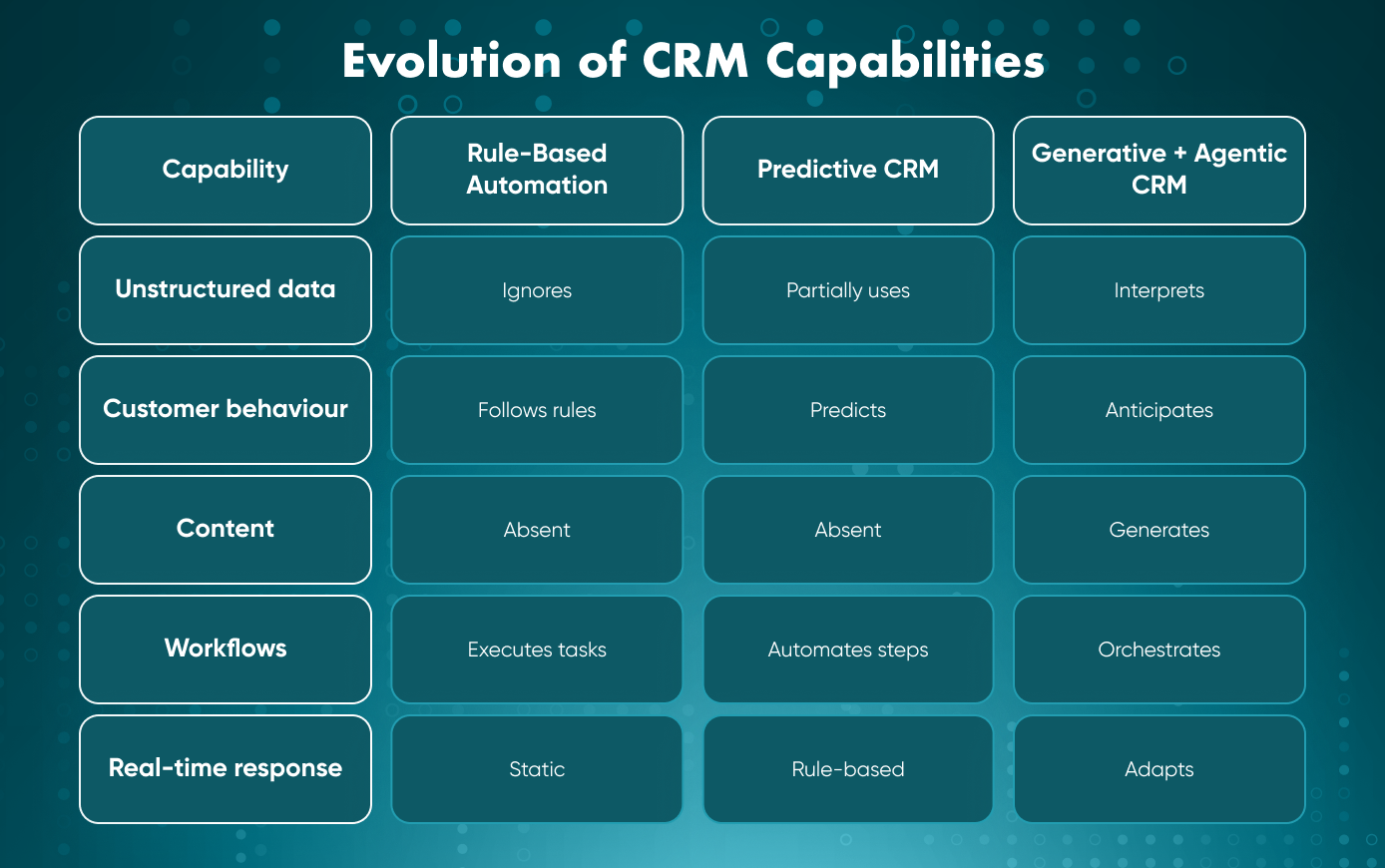
Now, AI tools and machine learning change the whole game. LLMs - think of them as brainy language engines - can sift through all sorts of stuff: emails, support tickets, customer feedback, business operations' notes, even call transcripts. Then they spit out decisions, conduct sentiment analysis, anticipate customer needs, write summaries, create content, or build out entire customer journeys without human intervention.
Take Salesforce Einstein GPT, for example. Picture a sales rep opening a lead. Instead of digging through half a year’s worth of sales and service teams' notes on customer behaviour, Einstein GPT instantly pulls together a sharp summary and even whips up a personalised follow-up email that sounds like you’ve actually been paying attention to customer queries. What used to take up 20 minutes? Now, done in seconds.
The point is, teams move faster. The CRM finally becomes more than a database. It actually helps you make decisions.
What Makes Generative Models Uniquely Suited for CRM?
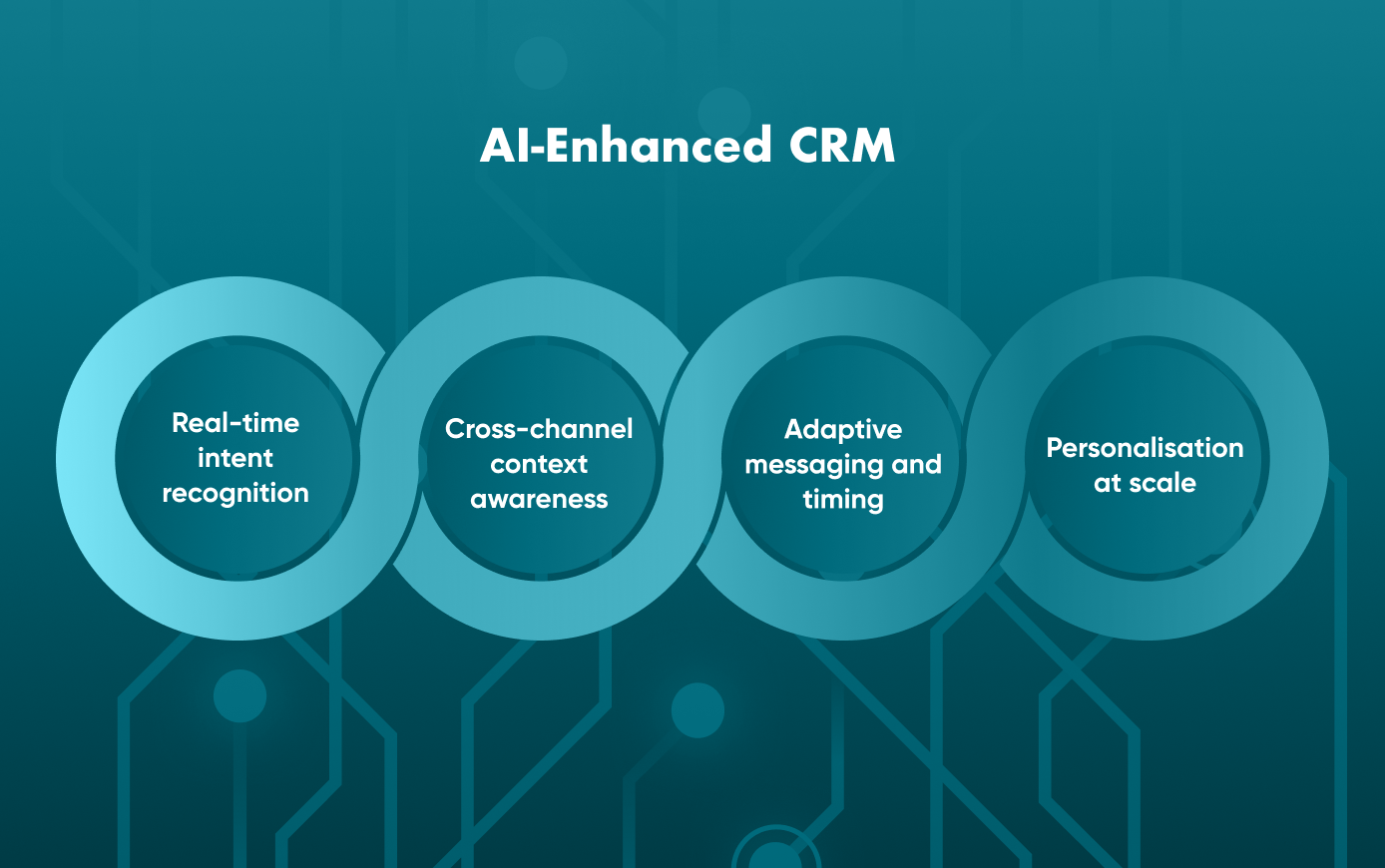
We are used to AI tools that can automate routine tasks, but generative AI CRM solutions also have the ability to:
- Understand context across multiple channels
- Generate communication that sounds human
- Predict customer intent in real time
- Adapt workflows without the need for predefined rules
- Be able to personalise thousands of unique customer journeys
So, a small team can perform at the level of a big company in terms of customer experience.
How Organisations Use Generative AI Across CRM Functions
How Does AI Improve Marketing, Sales, and CX Automation?
AI Marketing Automation
With generative AI CRM, marketers, sales reps and customer service teams can now easily personalise their customer communications as the creations take care of:
- one-to-one emails
- social media content fine-tuned to segment behaviour
- real-time product descriptions
- copywriting variants for quick A/B testing
- personalised content pieces from standardised texts
Sephora: AI-Powered Personalised Recommendations
Sephora employs AI to deliver the best-fitting product recommendations based on browsing history, review understanding, and previous purchases, therefore converting more and retaining customers.
Sales Automation
Generative AI drastically improves the sales processes at different stages of the sales funnel:
- Lead generation by behaviour tracking
- Creation of personalised outreach
- Automatic capturing of summaries during meetings
- “Next best action” suggestions
- Real-time overcoming of objections to proposals
Microsoft Dynamics 365 Copilot: Intelligent Sales Enablement
One example is Copilot. Copilot takes in when a sales talk happens, finds the main points, discovers support from competitors, and writes follow-up letters without input.
Customer Support Transformation
Efficient and AI-powered customer support services lead to:
- Instant answers through generative chatbots
- Sentiment recognition in talks
- On-the-fly complaint categorisation
- Escalation prevention
- Generating knowledge base articles
Lufthansa: AI-Driven Client Support
In the crowded periods of travelling, Lufthansa utilises AI to respond to about 70% of the most frequently asked inquiries from customers, only sending the requests that need emotional escalation.
Which Industries and Businesses Benefit Most from AI-Enhanced CRM?
B2B SaaS: Cutting Churn and Speeding Up Product Adoption
AI gives SaaS companies a clearer picture of what users are doing and lets them step in before customers lose interest. Here’s how teams use it:
- Spotting which accounts are on the verge of churning by watching for drops in usage
- Setting up automated onboarding that actually matches each user’s job and goals
- Figuring out which features keep people around for the long haul
- Auto-summarising customer success calls fast, so teams know what helps with renewals
All of this lets SaaS teams support more customers without needing to hire a ton of new people.
Manufacturing: Upgrading Service and After-Sales Support
Manufacturers juggle complicated service needs, spare parts, and big networks of contractors. AI-enhanced CRM tools help by:
- Predicting how many service tickets will come in and assigning teams before things pile up
- Sending out maintenance reminders triggered by sensor or IoT data
- Sorting incoming support cases by how urgent or important they are
- Auto-writing service reports for technicians, right after their visits
These tools cut downtime and keep customers happier in busy industrial settings.
Fintech: Better Risk Detection and Personalised Financial Journeys
Fintech companies lean on AI to dig into huge piles of transaction data and customer habits. They use it to:
- Catch suspicious transactions as they happen
- Suggest personalised financial advice based on how customers spend
- Automate risk scoring and review KYC data quickly
- Draft responses to customer disputes that check all the compliance boxes
This makes every CRM interaction safer, quicker, and more tuned to each customer.
Healthcare: Smoother Patient Engagement and Less Paperwork
Doctors and nurses deal with endless admin work. AI in CRM helps by:
- Building automatic follow-up routines after appointments
- Drafting patient summaries from past visits and messages
- Spotting which patients are likely to miss appointments and sending reminders
- Using chatbots to sort patient requests before they hit a staff member’s inbox
These changes let medical teams spend more time on care, not forms.
Retail & E-commerce: Personalised Shopping at Scale
Retailers have to keep up with changing customer tastes. AI-powered CRM helps by:
- Recommending products on the fly based on what shoppers browse
- Tweaking offers in real time, depending on price sensitivity or what’s in stock
- Building custom lookbooks or bundles from past buys
- Flagging customers who have the highest lifetime value
The result? Shopping just feels easier and more personal - plus, more people actually buy.
What Are Agentic CRM Workflows and Why Are They the Future?
How do agentic workflows transform CRM from insights to actions?
Agentic workflows take CRM a step further. Instead of just helping you analyse customer data, AI agents now roll up their sleeves and get things done. AI systems don’t just spot patterns - they act on them. Here’s how it works: AI breaks down complicated processes into simple tasks, handles those tasks on its own, talks to other agents when needed, jumps between systems like CRM, email, or booking platforms, and learns as it goes. So, you get insights and real action based on customer information, automated workflows and company needs, all in one go.
What business value do agentic systems unlock?
So, what do AI technology and agentic systems actually bring to the table for businesses? For starters, they speed things up - a lot. McKinsey says review cycles can shrink by anywhere from 20% to 60%. They enhance customer interactions, as personalisation gets sharper too, so people actually get what fits them best. Teams don’t have to deal with as much busywork, which keeps overhead costs down. And maybe the coolest part? Anyone can tap into automation just by using plain language without the need to learn what natural language processing (NLP) is or how it works. No more workflow automation gatekeeping - just say what you need, give it historical data, and the AI-powered CRM systems get it done.
What Are the Limitations, Risks, and Constraints?
What challenges slow adoption today?
Here’s what’s getting in the way of AI tools right now:
1. Data quality
Almost half of EU businesses say their biggest headache is messy or old CRM data. Without clean info, AI just can’t do its job right.
2. Legacy systems
A lot of companies still run on old software. These platforms don’t play well with new AI tools, and upgrades get expensive fast.
3. Hallucinations
Sometimes AI just makes stuff up or gets overly confident about the wrong answer. That’s a real problem.
4. Change management
Let’s face it - people worry about losing their jobs to AI, or they just don’t know how to use it yet. That slows everything down.
What governance and compliance concerns matter most in the EU?
When it comes to governance and compliance in the EU, a few things stand out. First, you’ve got to stick to GDPR rules. The new EU AI Act brings its own set of obligations, so there’s that. People also expect transparency and want to see clear records of how decisions get made. Traceability matters. Bias is a big deal, too—nobody wants their AI systems making unfair calls. And honestly, having humans involved in the decision loop is non-negotiable.
So, how do you handle all this? Set up AI Quality Gates to catch issues early. Keep detailed audit logs—don’t leave a paper trail to chance. Retrieval-augmented generation helps you track and verify information as you go. Data needs to stay in its own lane, so enforce segmentation policies. And make sure your teams actually know how to keep an eye on these systems. Training is key.
As a Conclusion
Generative AI takes CRM and the whole customer experience to the next level. It’s not just about storing real-time customer data collection, deploying AI personalisation or predicting future sales trends anymore - it’s about making smart decisions that actually move the needle.
With AI, marketing, sales, and support teams get a serious upgrade. We’re talking about hyper-personalised customer experiences and smoother, faster workflows for lead qualifications, data management, and forecasting customer behaviour. Now, there’s agentic CRM. This is where things get even more interesting: systems that don’t just follow orders of sales and service teams, but actually think and act on their own. To really get the most out of this shift, organisations need to get their data entry in shape, set up solid governance, bring in AI copilots, and make sure their teams have the right skills.
One thing’s clear - generative AI isn’t here to replace people on the front lines. It’s here to make them better, helping them deliver personalisation, speed, and smart insights on a whole new level.
FAQs
How is generative AI different from traditional CRM automation?
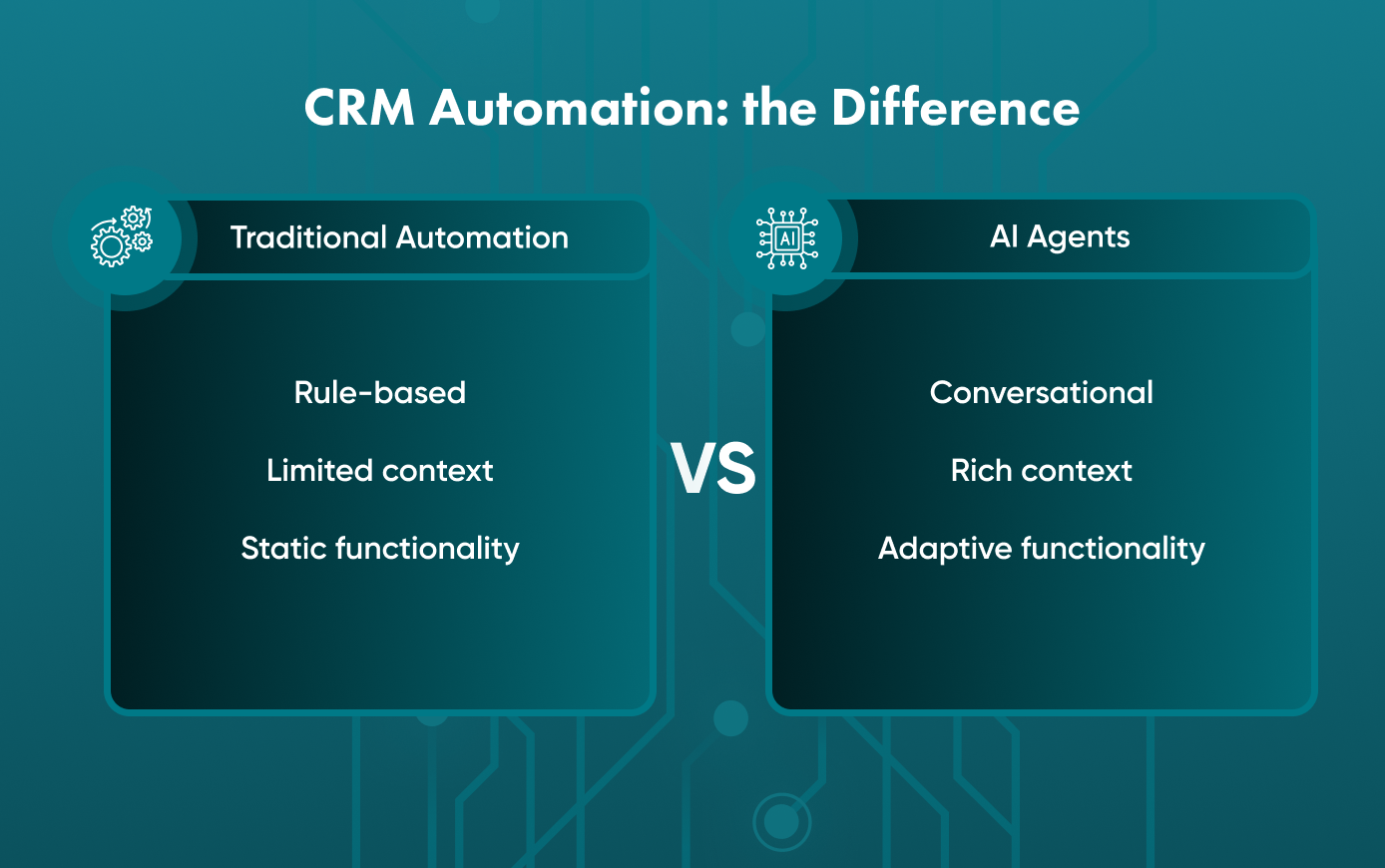
Traditional CRM automation sticks to set rules. Generative AI, on the other hand, reads the situation, predicts what people might do, and takes personalised action across different channels to augment customer retention, engagement, loyalty and provide actionable insights.
Which CRM tasks can generative AI automate right now?
It can draft emails, score leads, respond to tickets, summarise calls, surface deal insights, create personalised customer journeys, and handle reporting, all to boost customer engagement and satisfaction.
Why do companies have a hard time using AI in CRM?
A few reasons - bad data, old systems, the risk of AI making things up, not enough skilled people, and weak oversight. And also prejudice and insufficient knowledge of AI CRM software capabilities. We're used to AI-powered chatbots, but what about AI tools for personalised marketing campaigns, cost savings and revenue growth? AI-powered CRM can do more than just automate tasks and analyse historical data.
When will autonomous CRM really take off?
Analysts expect it to go mainstream somewhere between 2027 and 2029, but some companies are already testing out agent-like workflows.
What data makes AI-driven CRM automation better?
Things like behavioural signals of user preferences, personalised communications, sales data, customer satisfaction scores, CRM field data, communication logs, product usage stats, clear event tagging, and even social media posts all help.
Share and subscribe to our blog
Related articles

The Benefits of CRM Systems for Your Business
In the fast paced world of business, companies that can connect with their customers on a personal level and create long lasting relationships are the ones that thrive. This is where a customer relationship management (CRM) system comes in…

7 Reasons To Use a Customer Relationship Management (CRM) System
Why you cannot afford not to use CRM For many years, a good customer relationship management system was a pen and a piece of paper tucked in a salesman’s pocket, only to be replaced by digital records in an excel file. Eventually, a dedica…

AI in MarTech: A New Era of Intelligent Marketing Solutions
Introduction Artificial intelligence (AI) has shifted from being a futuristic concept to becoming a core enabler of marketing success. Nearly 90% of marketers now use AI to automate workflows, analyse large scale data, and personalise cust…

How can we help you ?