



How Is AI Transforming Marketing Technology in 2026?

AI stopped being a MarTech side project years ago. Most marketing teams now run on it, even the ones that would not describe it that way.
Three in four marketers have adopted AI in some form, according to Salesforce's 2026 State of Marketing report, which surveyed nearly 4,500 marketing decision-makers across four regions. Adoption is still mostly shallow: many teams use AI to send the same generic campaign faster rather than a personalised one. Precedence Research puts the global marketing technology market at $669.14 billion in 2026, on track for $3.29 trillion by 2035.
The difference between teams that get results from AI and those that just run it faster usually comes down to two things: unified customer data, and AI that is given a goal rather than a task list. This article covers the technologies behind that shift, what changes in practice, and what to check before committing budget to a custom AI-powered solution.
What Is AI in MarTech?
AI in MarTech means machine learning, natural language processing and related technologies built into the marketing stack itself rather than bolted on afterwards. It ranges from predictive lead scoring inside a CRM to an agent that drafts and launches a campaign with little human input. In 2026 the important distinction is between AI that assists a workflow and AI that runs one on its own.
The Strategic Role of AI in MarTech
AI is now used at almost every stage of marketing, from planning to the message a customer receives. Its main jobs are:
- Automating the routine work: campaign scheduling, social posting, and first-line support.
- Reading customer data closely enough to spot behavioural patterns worth targeting.
- Running predictive analytics, so a decision lands ahead of a trend rather than after it.
- Personalising in real time across email, web and in-app touchpoints, as well as at the point of sale.
None of this is new. What has changed is how deep personalisation goes and how fast a team can act on it once its data is in order.
Real-world example: Amazon
Amazon's recommendation engine is the reference case most marketers know. An often-cited McKinsey estimate, circulating since 2013, puts recommendations at roughly 35% of Amazon's revenue. Amazon has never confirmed the figure, but the mechanism, matching behaviour to product suggestions at scale, is still the clearest illustration of what AI personalisation can do for revenue.
Real-world example: Starbucks Deep Brew
Starbucks' Deep Brew platform analyses order history, weather and local events to tailor recommendations. Green Dot Assist, a barista assistant built on Microsoft Azure OpenAI, was piloted in 35 stores, with a rollout across the US and Canada planned for fiscal 2026. Mobile Order & Pay accounted for 31% of transactions at Starbucks' company-operated US stores at the end of 2023, according to GeekWire, although Starbucks does not attribute that share to Deep Brew.
The 2026 shift: agentic AI in marketing
The newer development is agents that carry out an action instead of only recommending it. Salesforce reports that Rawlings achieved 75% faster campaign creation after adopting Agentforce Marketing, an agentic layer that builds segments, drafts content, and launches campaigns while a marketer sets the goal. “The scope of our personalisation has exploded,” said Rawlings' Matt Patston. That is the practical difference from automation: agents pursue a goal and adjust as they go, rather than following a fixed workflow.
Key AI Technologies Powering Modern Marketing
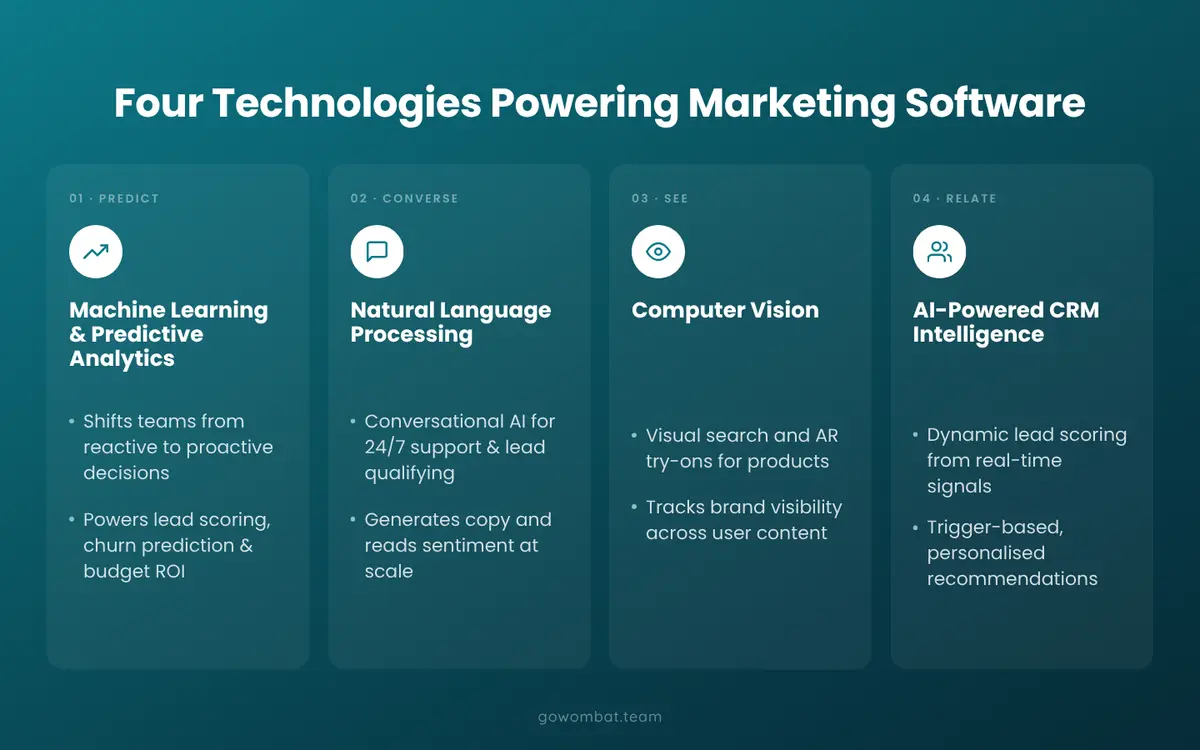
AI in MarTech is a stack of related technologies rather than one tool.
1. Machine learning and predictive analytics
Machine learning models trained on historical data predict which leads are likely to convert, a customer's probable lifetime value and which channel is likely to deliver the best return next quarter. The model is updated as new data arrives, which is what separates predictive analytics from a static dashboard.
2. Natural language processing
NLP lets software read, interpret and generate human language, which is most of what marketing works with. Conversational AI handles FAQs and lead qualification around the clock. Generative AI tools draft copy and product descriptions quickly, but the output still needs an editor. Sentiment analysis tracks reviews and social mentions to flag shifts in brand perception early.
3. Computer vision
Computer vision lets software interpret images and video. Retail teams use it for visual search, augmented reality try-ons and tracking brand visibility in user-generated content. It also tags and organises creative asset libraries automatically, work that used to mean sorting thousands of images by hand.
4. AI-powered CRM intelligence
Customer relationship management platforms now do more than log past interactions. AI-enabled CRM software scores leads dynamically, suggests trigger-based campaigns based on where a contact is in their journey and recommends content across channels. Some use NLP to route support tickets or suggest a reply to an agent in real time.
5. Agentic AI and autonomous campaign agents
AI agents for marketing automation now handle entire workflows rather than single tasks: building a segment, drafting content, choosing a channel and launching, with a human reviewing outcomes instead of approving every step. In June 2025, PepsiCo announced it was deploying Salesforce's Agentforce at scale, one of the first major food and beverage companies to do so. The difference from traditional automation is autonomy: a rule-based workflow executes a fixed sequence, while an agent pursues a goal and adapts its own sequence to get there.
Benefits of Adopting AI in Marketing Technology
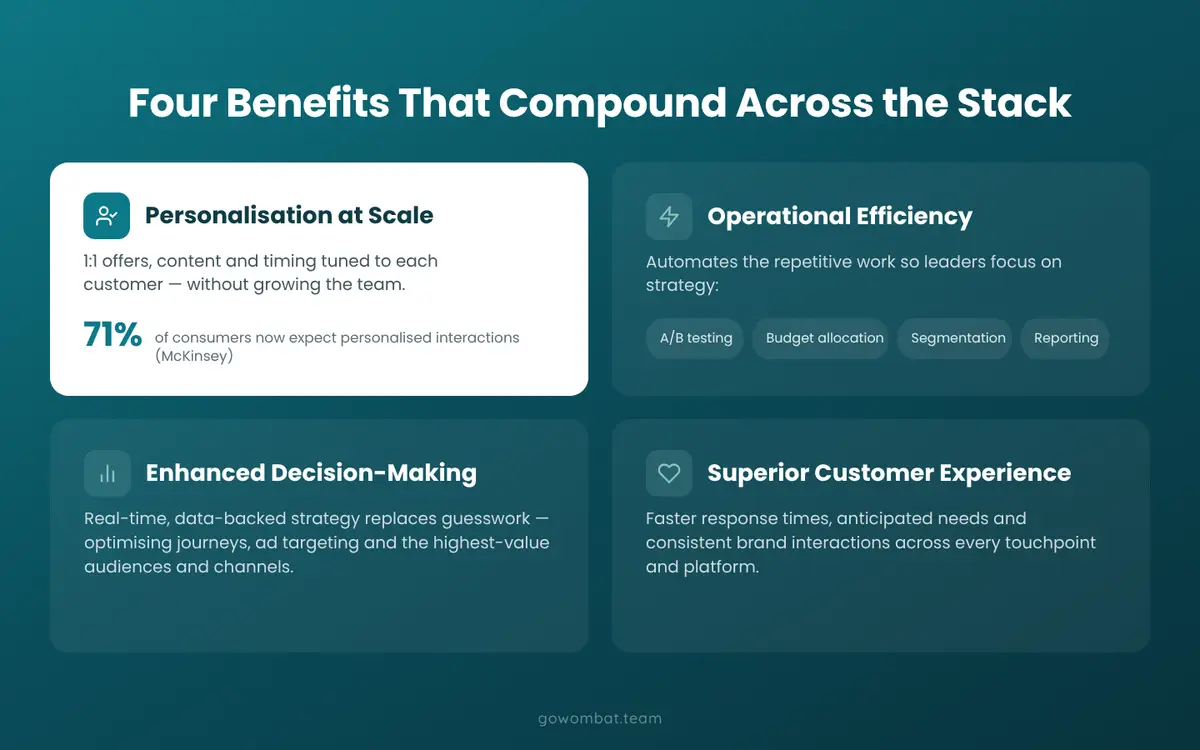
1. Personalisation at scale
AI enables one-to-one marketing without needing a bigger team, tailoring offers, content, and timing to individual behaviour. The gap between ambition and delivery is still wide. Salesforce's 2026 research found 78% of marketers need more personalised content than their teams can produce, and 75% are turning to AI to close that gap. Even so, 98% report hitting some barrier to personalisation, and disconnected data is consistently the biggest one.
2. Operational efficiency
AI automates much of the work in A/B testing, budget allocation, segmentation and reporting, so senior marketers spend less time on campaign administration and more on strategy and creative work. The value usually comes from that reallocated time rather than from the automation itself.
3. Enhanced decision-making
Instead of guessing which audience or channel will perform, teams can see which customer journeys need attention, where ad spend underperforms and which segments carry disproportionate value. A person still makes the decision; AI removes some of the guesswork.
4. Answer engine visibility and customer experience
Half of Google searches now feature AI summaries, according to Salesforce's 2026 State of Marketing report, and 85% of marketers say AI is reshaping their SEO strategy. Answer Engine Optimisation (AEO) means structuring content so that AI systems can quote it directly. AI also improves customer experience in more familiar ways: faster responses, anticipating needs and more consistent interactions across channels.
Challenges and Considerations
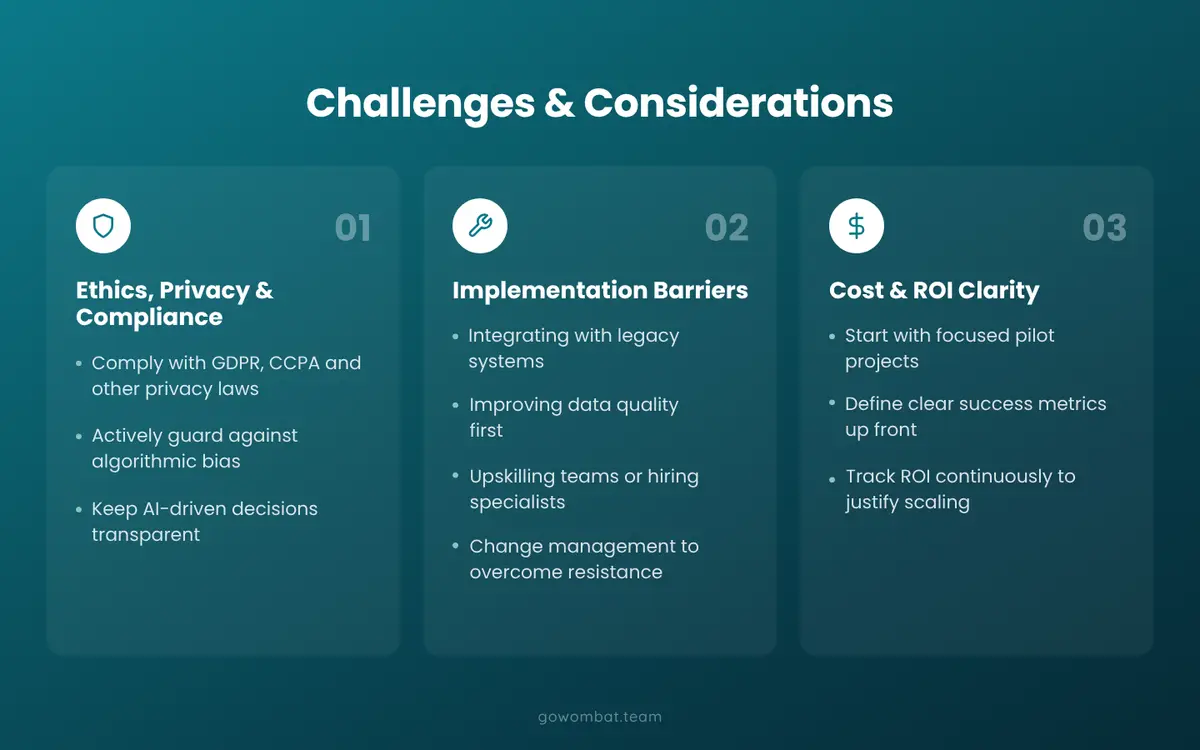
1. Ethics, privacy, and compliance
Deploying AI responsibly still means complying with GDPR, CCPA, and the wider patchwork of privacy law, avoiding algorithmic bias, and keeping AI-driven decisions explainable. The picture shifted in 2026: under the EU's AI Act Digital Omnibus, agreed in May 2026, obligations for most high-risk, use-based AI systems were pushed back from August 2026 to December 2027, giving MarTech teams more runway than the original timeline allowed. GDPR compliance consulting is still worth doing early rather than as an afterthought.
2. Implementation barriers
Adopting AI usually means integrating with legacy systems, improving data quality, and either upskilling staff or hiring AI specialists. Data is still the main obstacle. Salesforce's 2026 survey found that only 58% of marketers have complete access to service data and 51% to commerce data. Silos like these keep AI personalisation shallow, however good the model is.
3. Cost and ROI clarity
AI adoption is rarely cheap upfront. A focused pilot, success criteria agreed before building anything and continuous ROI tracking make it far more likely that a project scales instead of being shelved after the first budget review.
Best Practices for Successful AI Integration
- Define measurable objectives. Prioritise a small number of high-impact use cases, such as churn reduction or lead scoring, rather than automating everything at once.
- Audit and prepare your data. Centralise and clean the datasets your models depend on. Teams often underestimate this step, and Salesforce's 2026 data points to disconnected data as the biggest barrier to personalisation.
- Start small, then scale deliberately. A short discovery phase before enterprise-wide deployment tends to save more time than it costs.
- Train your team. People need to interpret AI output critically rather than trust it by default.
- Build a feedback loop. Monitor model performance and business impact together, and retire a use case that is not delivering.
Go Wombat's Approach to AI-Driven Marketing Solutions
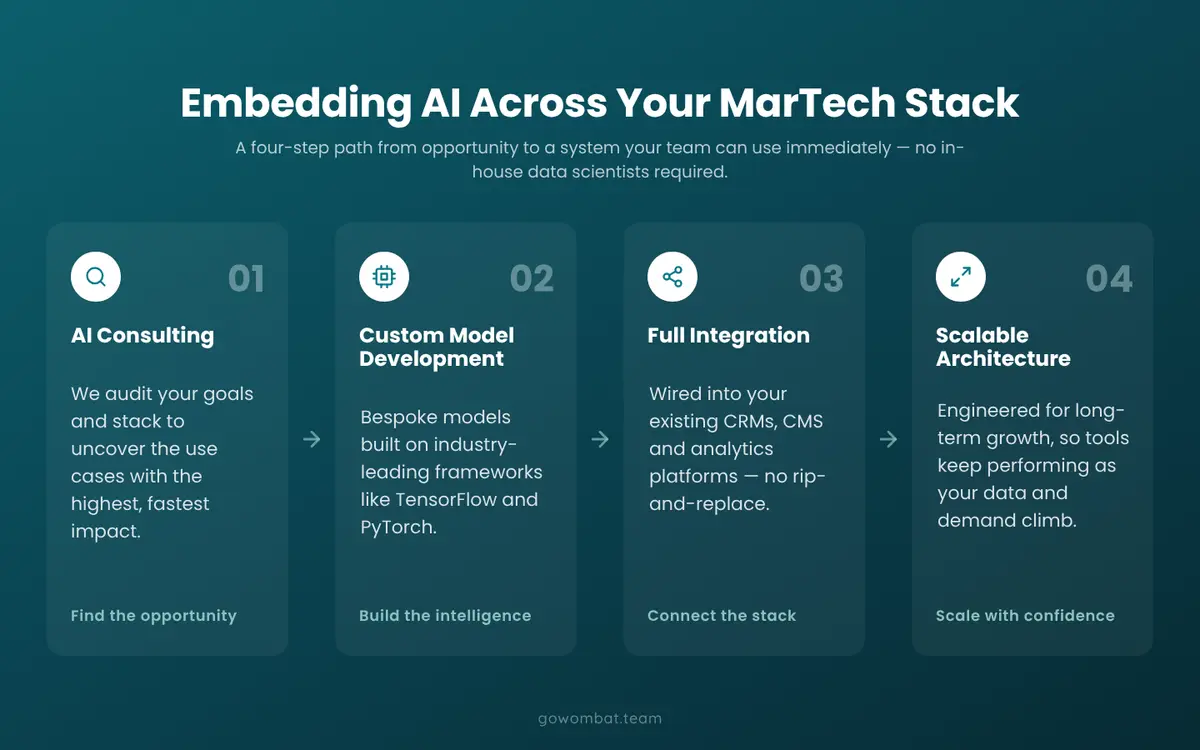
We design and build bespoke AI solutions for MarTech teams that need something closer to their actual stack than a generic platform allows. That covers AI consulting to identify realistic use cases, custom model development with frameworks such as TensorFlow and PyTorch, and integration with the CRMs, CMS, and analytics tools already in place.
We have built predictive analytics platforms, recommendation systems, conversational AI integrations and BI dashboards for clients without an in-house data science team. The aim is a system your marketing team can run day to day without a specialist.
If your stack is ready for workflow automation or a custom AI layer, start with a scoping conversation. That is where our AdTech and MarTech projects usually begin.
Key Takeaways
AI in MarTech is no longer a differentiator on its own; most competitors already use it.
Three things are worth carrying forward:
- Personalisation still depends on data quality more than model sophistication.
- Agentic AI is the main new development in 2026.
- Answer Engine Optimisation now matters alongside traditional SEO.
The practical question for MarTech teams is which parts of the stack to build custom and which to buy off the shelf. A technology partner with integration experience can help answer it quickly.
Frequently Asked Questions
What is AI in MarTech?
AI in MarTech means machine learning, natural language processing, and related technologies built directly into marketing software rather than added as a bolt-on. It covers predictive lead scoring, generative content tools, AI-enhanced CRM, and autonomous agents that plan and execute campaigns with limited human input.
Which AI marketing tools are worth prioritising in 2026?
Start with whatever addresses your biggest data gap, usually a unified CRM or CDP, since most AI marketing tools underperform without clean, connected customer data. Predictive analytics and AI-enhanced CRM tend to deliver faster, more measurable returns than generative content tools alone.
What is the difference between AI marketing automation and agentic AI?
Automation executes a fixed, rule-based sequence: if a customer does X, send Y. Agentic AI is given a goal, such as recovering a declining conversion rate, and decides its own sequence of actions as new signals arrive, with more oversight needed on guardrails, not less.
Does AI personalisation actually improve marketing ROI?
It can, mostly when the underlying data is unified. Salesforce's 2026 research found that marketers with unified data are 42% more likely to respond to customers promptly and 60% more likely to use AI agents.
What are the compliance risks of using AI in marketing?
GDPR and CCPA obligations apply to AI-driven personalisation like any other data processing. The EU AI Act's high-risk obligations for most marketing-relevant systems were deferred to December 2027 under the 2026 Digital Omnibus agreement, though transparency rules for AI-generated content stay on a near-term schedule.
How should a MarTech team start adopting AI without overhauling everything?
Run a short, scoped discovery phase against one high-impact use case, such as churn prediction or lead scoring, before committing budget to a platform-wide rollout.
Share and subscribe to our blog
Related articles

AI in Healthcare: A Revolution for the Medical Industry
Where AI is used in healthcare today: the main types of AI, their benefits, use cases from diagnostics to drug development, and the problems that remain.

AI in Oil and Gas: The Technology Revolutionising the Industry
How AI is used in oil and gas: the benefits, applications from defect detection to exploration, and the technologies used alongside it.

The Future of Chatbots for Marketing: How AI is Changing the Industry
How AI chatbots for marketing work, where they help (support, lead qualification, sales, feedback) and where they still fall short.

How can we help you ?