



AI in Healthcare: A Revolution for the Medical Industry


AI in healthcare means software that can recognise speech and text, analyse data, learn from examples and support decisions. Hospitals, physicians and patients already use it in diagnostics, drug development, patient monitoring and administration.
What is AI in healthcare?
Artificial intelligence is not one technology but a branch of computer science that covers many techniques.
In healthcare, these techniques are used to store, analyse and process large sets of patient data and to help doctors make diagnoses and plan treatment.
AI is also used in drug development, patient monitoring and care delivery. The longer-term goal is to spot disease early enough to prevent it rather than treat its symptoms.
Medical imaging is a good example. X-ray, MRI and CT scans contain a lot of detail that is hard to evaluate, even for experienced specialists.
Doctors also have to account for disease subtypes, biomarkers and genomic data, which makes diagnosis more complex.
AI models can highlight findings on a scan that are easy for the human eye to miss, so the specialist can review them.
Types of artificial intelligence in healthcare
AI is a collection of technologies. A 2019 review by Davenport and Kalakota lists five categories relevant to healthcare: machine learning, natural language processing (NLP), rule-based expert systems, physical robots and robotic process automation (RPA). Three of them are covered below.
Machine learning
Machine learning fits statistical models to data, so software learns a task from examples rather than from hand-written rules.
In healthcare, its most common use is precision medicine: predicting which treatment is likely to work for a patient based on their history and other attributes.
Neural networks
Neural networks are a more complex form of machine learning, loosely modelled on how nerve cells connect in a living organism. In healthcare they are used for computer vision, data analysis and object recognition.
Deep learning
Deep learning uses neural networks with many layers. It is the technology used to analyse scans and other images in which the relevant features are hard to spot.
Natural language processing (NLP)
Natural language processing lets software work with human speech and text. A voice assistant that understands a spoken command and carries it out is an everyday example.
Modern NLP is built on machine learning. In healthcare it is used to create, interpret and classify clinical documentation.
NLP systems can also transcribe conversations with patients, power chatbots and analyse clinical notes.
Robotic process automation (RPA)
Despite the name, RPA has nothing to do with physical robots. It uses software bots that follow business rules and workflows. RPA is not AI by itself, although it is often combined with AI tools.
Healthcare facilities use RPA to automate routine administrative tasks.
Typical examples are updating patient records and billing. Combined with AI, RPA is also used for document processing and round-the-clock customer service.
If you plan to build an AI-based healthcare app, contact Go Wombat.
Benefits of AI in healthcare
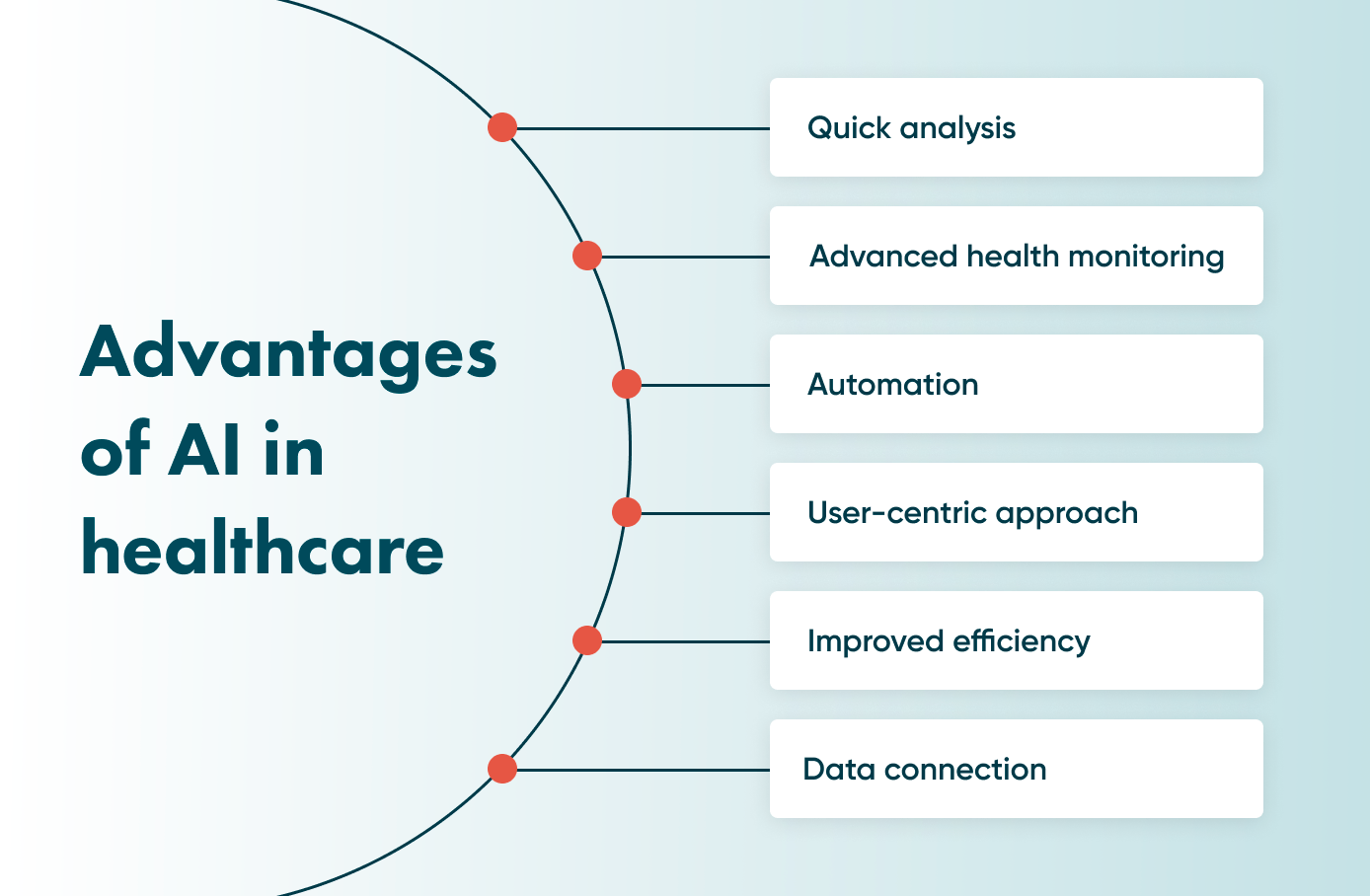
Fast analysis
AI algorithms analyse medical records, clinical studies and genetic information much faster than people can. Specialists get a condensed view of the data to support their diagnosis.
Automation
Automation takes routine, repetitive tasks off staff.
Researchers can spend more time on work that needs human judgement, administrators on running the facility, and physicians on patient care.
Advanced health monitoring
Medical wearables let patients track their health. AI-based software on the device turns sensor readings into health statistics.
Physicians can monitor patients remotely and act when the readings require it.
Patient-centric approach
Faster service and better-supported diagnoses can increase patient satisfaction and trust in your specialists.
Improved efficiency
Patterns that AI finds in operational data help healthcare organisations plan workflows, use staff and equipment more efficiently and manage their finances.
Data connection
Healthcare data is often fragmented and stored in different formats. Well-built machine learning solutions can link these sources and give specialists a more complete picture.
AI applications in healthcare
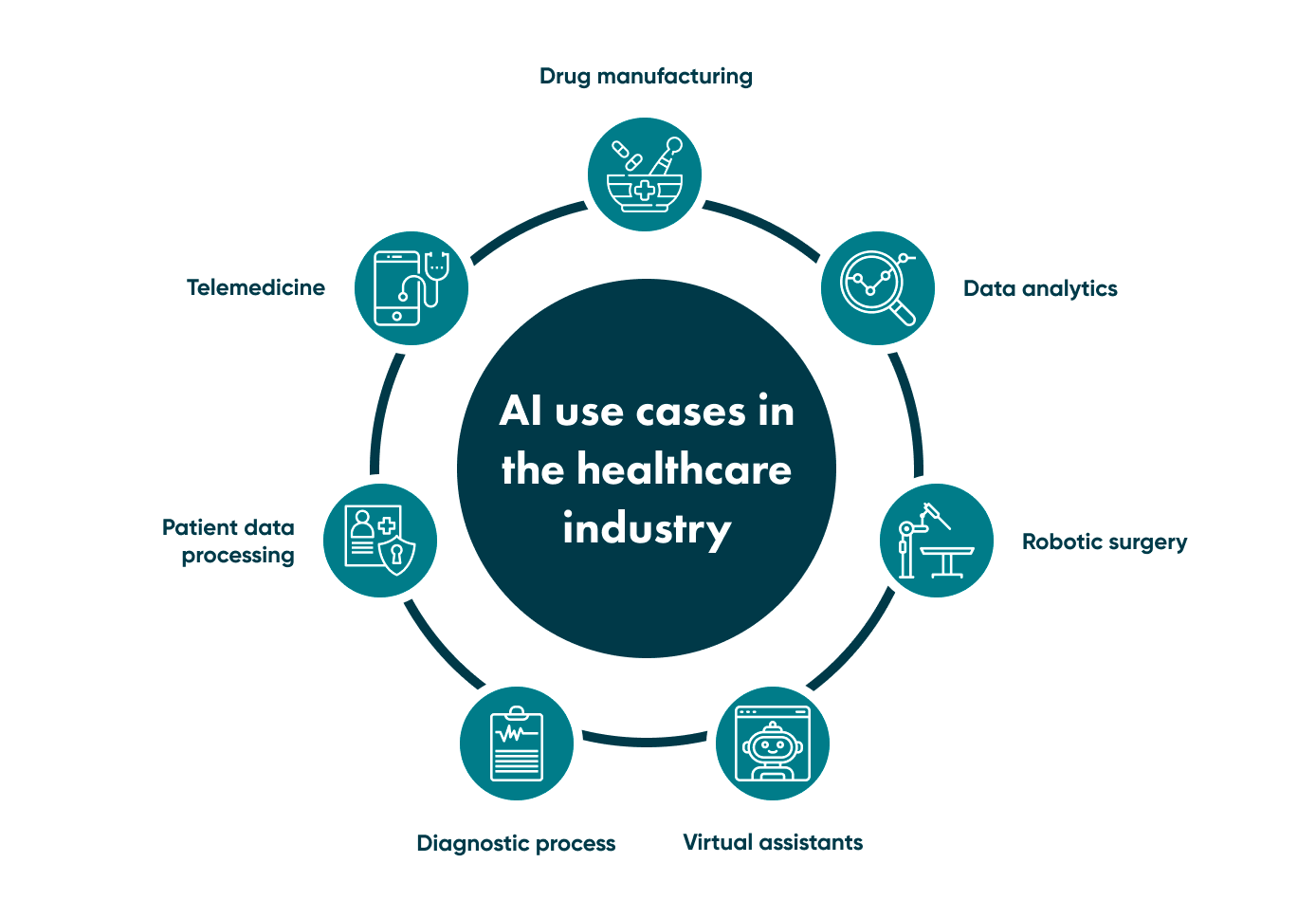
Drug development
Developing a drug or vaccine and running clinical trials is slow and expensive.
AI can shorten the early stages by analysing the molecular structures of existing medicines and proposing new candidate molecules that match set parameters.
According to the US Congressional Budget Office, developing a new drug often takes a decade or more, and average R&D spending per new drug ranges from less than $1 billion to more than $2 billion, including the cost of failed projects. AI can speed up parts of this process.
Researchers hope these methods will help find cures for diseases such as HIV/AIDS, multiple sclerosis, Alzheimer's disease and inoperable cancers.
Data analytics
AI analyses large volumes of data from electronic health records, lab results and other sources. It builds a picture of a patient's condition, and predictive models suggest possible treatment plans.
Predictive analytics can also find patterns that affect public health by combining data from EHR systems with environmental data such as air quality, drinking water and sewage analysis.
Robotic surgery
In robot-assisted surgery, the surgeon works the instruments through a robotic system with an integrated camera. The robot does not operate on its own: according to the FDA, these systems cannot perform surgery without direct human control.
3D models of a patient's anatomy built with AI help surgeons plan the operation more precisely and avoid complications.
Virtual assistants
Medical virtual assistants can monitor a patient's health and call for help in an emergency.
They can also tell patients about their condition, treatment and appointment schedule.
Assistants answer questions, book appointments and help patients work out which specialist to contact about their symptoms.
Diagnosis
AI diagnostic tools analyse medical images and lab results.
When a specialist runs a scan through such a tool, it can highlight features the specialist might miss.
Deep learning models can also compare an image with the patient's earlier scans and flag small changes.
This helps physicians make a more accurate diagnosis.
IBM Watson for Oncology was an early, high-profile attempt at AI-supported diagnosis and treatment planning. Davenport and Kalakota's 2019 review describes how hard it proved to train for specific cancers and to integrate into clinical practice. IBM sold its Watson Health business to Francisco Partners in 2022, and it now operates as Merative.
Patient data processing
Besides diagnosis and treatment, physicians spend time issuing statements, filling in medical records and doing other paperwork.
Many patient records and studies still exist only on paper. AI tools can digitise, structure and store them.
AI can also help with administration, document management and finance.
Time saved on paperwork can go to complex cases, research and professional development.
Telemedicine
Remote consultations became essential during the COVID-19 pandemic and are still widely used. Many appointments do not need an in-person visit, especially for patients who live far from the hospital or practice.
With telemedicine software, doctors can discuss symptoms, give recommendations in real time and, over video, see the patient's general condition.
Telemedicine platforms can also use AI to process what patients report about their symptoms and route them to the right specialist straight away.
If you want to add AI to your healthcare software, contact us to learn more.
Challenges of AI in healthcare
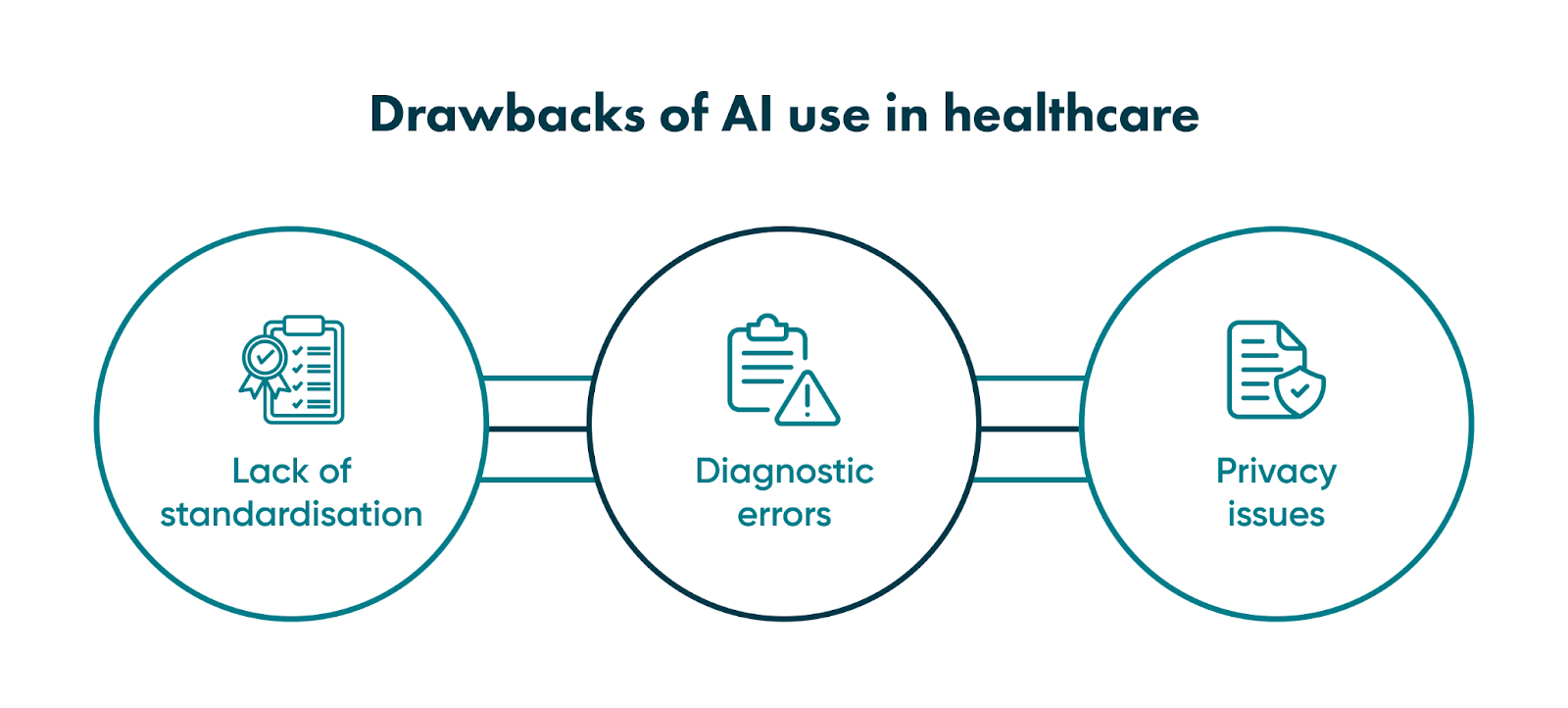
AI in healthcare still faces three practical problems: a lack of data standards, diagnostic errors and privacy requirements.
Lack of standardisation
There is still no unified standard for collecting and analysing the datasets that healthcare AI tools use.
Because many vendors build AI software in different ways, results are hard to compare and models are hard to improve across systems.
One practical answer is a modular solution with good documentation, which you can extend as your facility's needs change.
Diagnostic errors
AI can improve diagnostic accuracy, but it still makes mistakes.
Treating its output as always correct can lead to misdiagnosis, so AI solutions must be built and tested carefully, with clinicians reviewing their results.
Privacy issues
All applications that collect and store personal data must comply with local regulations. For example, in the US, HIPAA regulations oblige all healthcare software owners to follow privacy rules. Otherwise, the institutions may receive sizable fines.
In the EU, medical facilities have to comply with GDPR rules. Thus, if you create a healthcare application, you must ensure it will comply with local privacy regulations. We recommend you read our article about HIPAA and GDPR to learn more.
Conclusion
Building and integrating AI software for healthcare takes an experienced development team.
At Go Wombat, our developers work with a range of Python-based AI technologies.
Python is flexible and stable, and its many libraries and frameworks speed up AI development.
This article explains why we consider Python the best language for AI and ML.
Contact Go Wombat to discuss your AI healthcare project.
Artificial intelligence (AI) in healthcare FAQ
How is AI being used in healthcare?
AI is used in drug development, medical data analytics, robot-assisted surgery, diagnostics, virtual assistants and telemedicine.
It also reduces physicians' workload by automating routine administrative tasks.
What is the impact of AI in healthcare?
AI can make diagnoses more accurate, speed up parts of drug development and free physicians' time for patients, all of which can improve care outcomes.
Predictive analytics can also help prevent disease by finding risk patterns in patients' lab results and other data.
What are the main types of AI and their applications in healthcare?
A 2019 review by Davenport and Kalakota lists five categories of AI relevant to healthcare: machine learning, natural language processing, rule-based expert systems, physical robots and robotic process automation. RPA itself is rule-based, but it is often combined with AI.
Machine learning, including neural networks and deep learning, analyses patient data and medical images. NLP powers voice assistants and processes clinical documentation. Rule-based expert systems support clinical decisions, physical robots assist in surgery, and RPA automates repetitive administrative tasks.
Share and subscribe to our blog
Related articles

Python - The Best Programming Language for AI and ML
Why Python suits AI and machine learning: readable code, mature libraries, portability and a large community, with examples from fintech, transport, healthcare and our own projects.

A Comprehensive Guide to EHR System Development
What an EHR system is, how it differs from an EMR, its benefits and must-have features, and the steps to build a custom EHR for your practice.

Why Is the Digital Twin of an Oil Refinery the Most Complex AI System You Will Ever Build?
Why a digital twin of an oil refinery is so hard to build: seven interdependent layers from physics simulation to control system integration, results from Cosmo Oil's refinery digital twin, a look at Honeywell's planned digital-twin work at the Dangote refinery, team and data prerequisites, and why projects fail.

How can we help you ?

