



Cybersecurity Risk Management: What It Is and How to Use It


Any business that operates online carries cyber risk. This article explains what cybersecurity risk management is, what it gives a business and how to apply it.
In cybersecurity risk management, security specialists analyse your business to identify risks to its goals and assets, then build a plan for dealing with each threat.
What is cybersecurity risk management?
A cybersecurity risk is a potential threat to a company's assets, reputation or income. Attackers usually try to steal money, data or technology.
These attacks happen in a digital environment, but they affect the whole company, not only IT. That is why cyber risk belongs in the same measurement, tracking and mitigation system as other business risks.
Cybersecurity risk management is a repeating cycle of risk identification, assessment and mitigation. It shows where the security system is vulnerable and what it will cost to fix each weakness.
Its purpose is to protect the company's sensitive and valuable information, and that starts with a detailed analysis of possible vulnerabilities.
Much of the analysis can be automated. The results go into a risk register that records each vulnerability, the likelihood of the threat being realised and the assets at risk.
To build software with security in mind, contact Go Wombat.
What does cybersecurity risk management do?
A cybersecurity risk management programme lets your company:
- Build a risk map of the company.
- List current threats to information security.
- List the vulnerabilities that could be used to carry out those threats.
- List the protection measures.
- Define the scope of the assessment and collect information about current business processes.
- Draw up a threat model for each company asset.
- Run an automated security risk assessment with security experts involved.
- Develop a risk treatment plan and monitor its implementation and the effect of the protective measures.
- Let employees run quick assessments of their own business processes.
The advantages of risk management in cybersecurity
A cybersecurity risk management policy brings six main benefits.
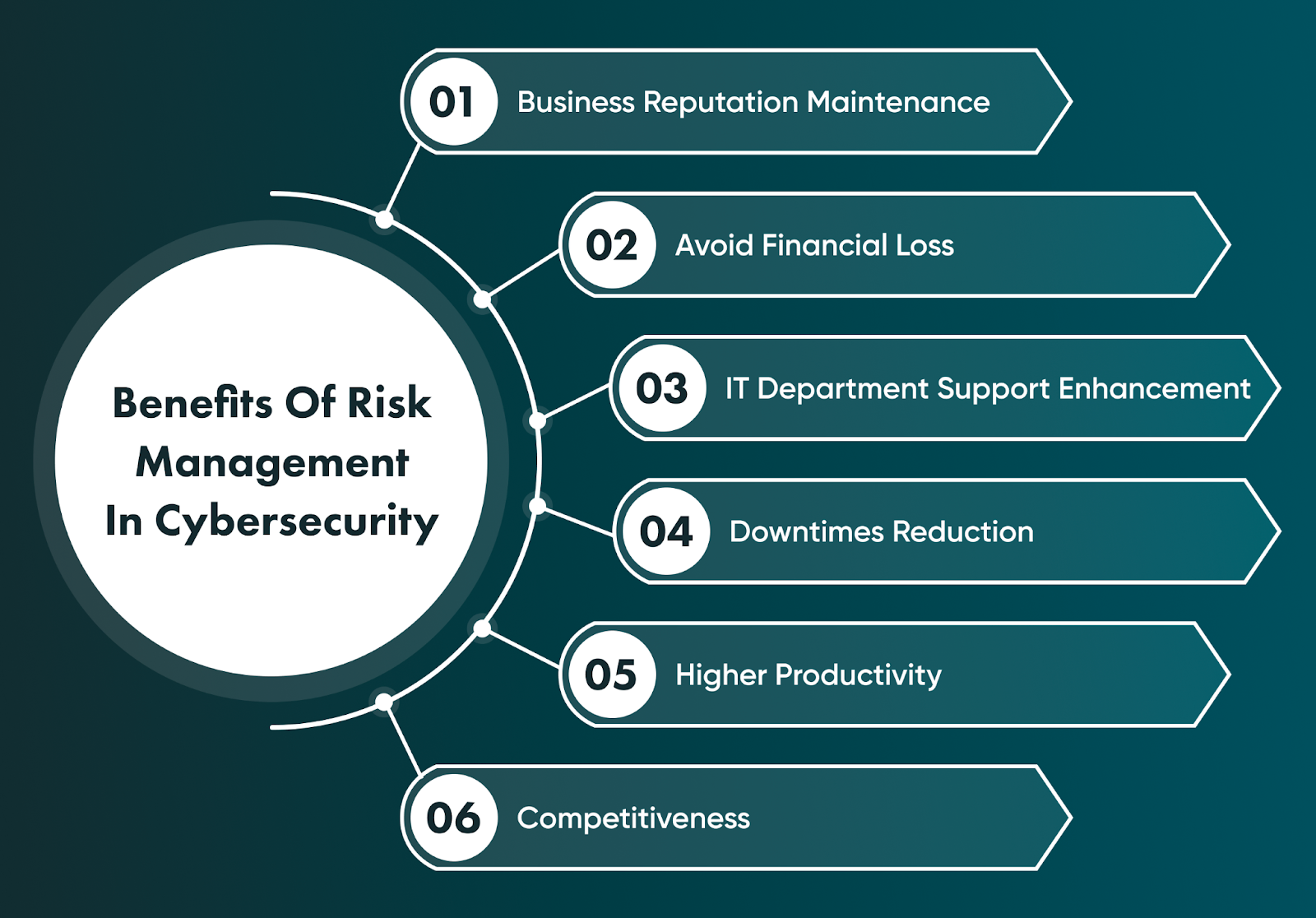
Business reputation maintenance
A major data breach can cost a company its customers, because its reputation rests on their trust. With a risk management plan, you are prepared when an attack happens.
Avoid financial loss
IBM's Cost of a Data Breach Report 2026 puts the global average cost of a data breach at $4.99 million, a record high. In addition, remember that a data breach is connected with data privacy laws compliance, so your business will also need to pay fines for the violation.
IT department support enhancement
With a risk management plan, your IT team knows what to do during an attack, and employees are trained to protect internal systems and company resources.
Downtimes reduction
A breach forces the company to stop and deal with the consequences. While that happens, the business earns less and employees are pulled away from their work. A risk management plan shortens this downtime and reduces its cost.
Higher productivity
A breach can expose your employees' data as well as your customers' and partners', and dealing with the fallout takes time away from their work.
Competitiveness
A company that manages its cybersecurity risks is better placed than competitors who ignore them, and it can show customers that it takes security seriously.
The cybersecurity risk management process: step-by-step
The exact steps depend on your business, but most cyber risk management programmes follow these five.
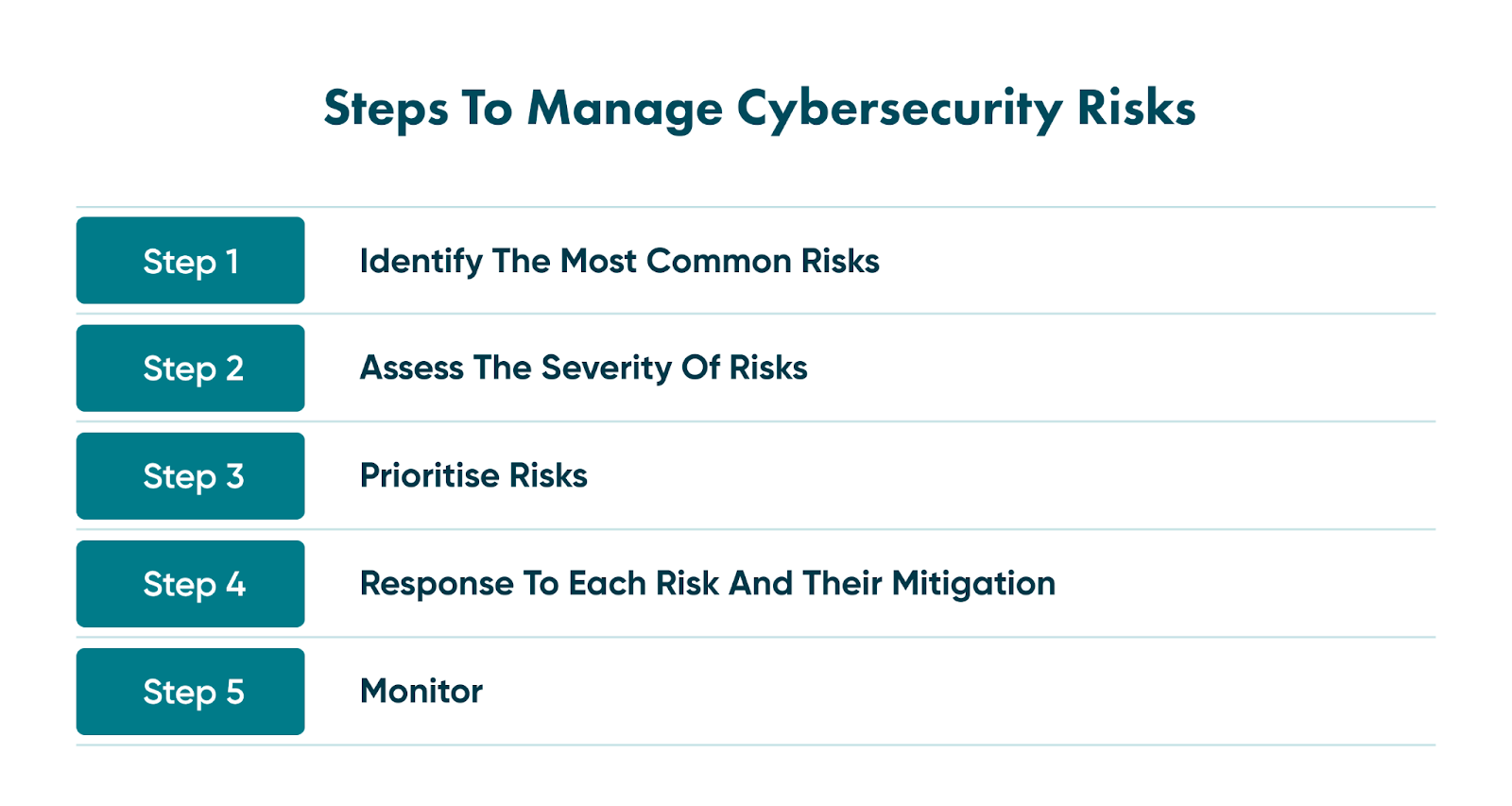
1) Identify the most common risks
We describe the most common cyber risks in our article about cybersecurity. The first step is to identify your vulnerabilities and the threats that could exploit them.
2) Assess the severity of risks
For each risk, analyse how the threat could harm your business processes and what impact it would have.
3) Risk prioritisation
Rank the risks by severity so that the most dangerous ones get attention first.
4) Response to each risk and their mitigation
Decide how to respond to each risk: reduce its likelihood, accept it if it falls within your risk acceptance criteria, or eliminate it. The incident response plan is described below.
5) Monitoring
Risk management does not end. Your IT team needs to keep monitoring risks and track regulatory changes and changes in the technology the company uses.
Frameworks for cybersecurity risk management
Compliance frameworks set out requirements and practices for managing cyber risk. Four widely used ones are:
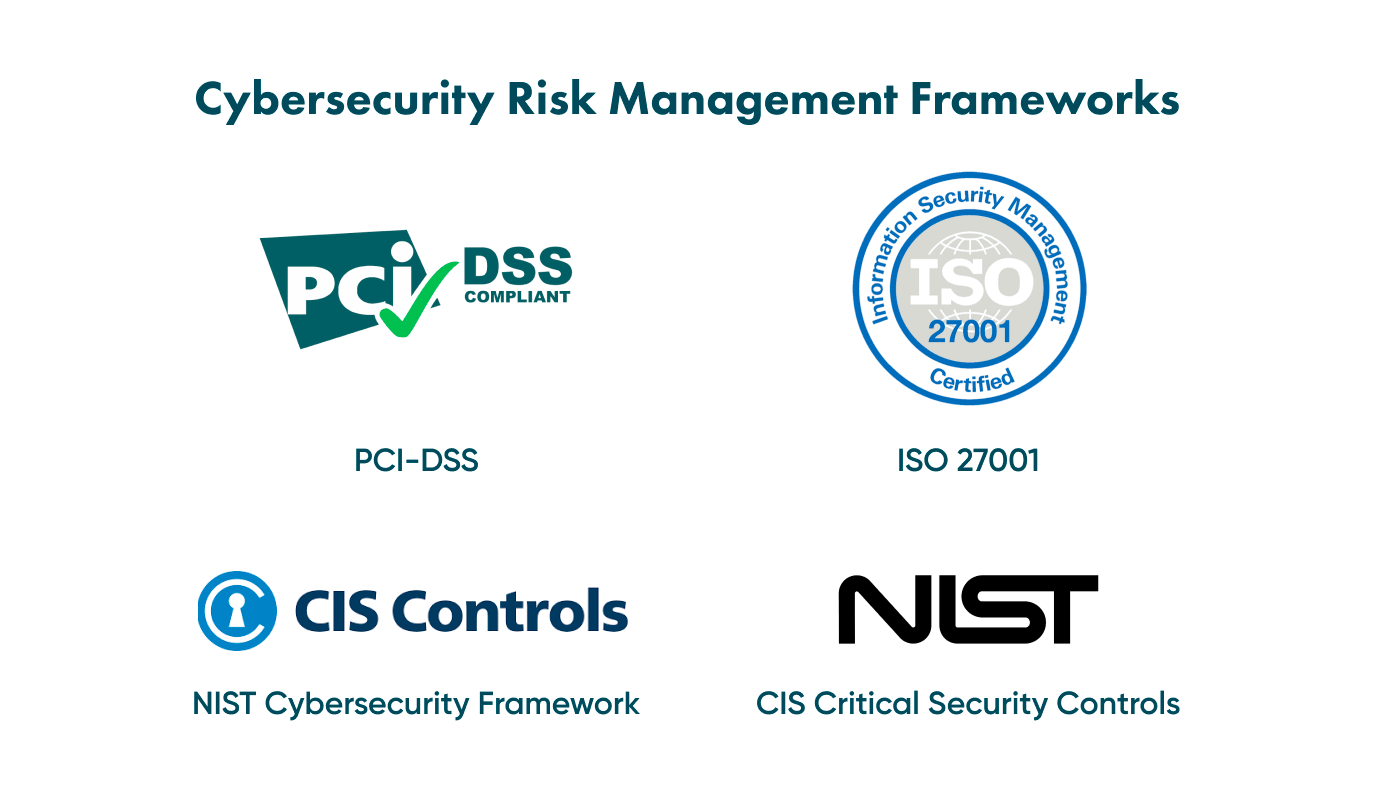
PCI-DSS
The Payment Card Industry Data Security Standard (PCI DSS) is an information security standard for every organisation that handles payment card transactions. It sets the requirements for protecting cardholder data.
ISO/IEC 27001
An international standard that sets the requirements for an information security management system (ISMS). ISO/IEC 27001 certification shows partners and customers that your ISMS meets those requirements.
NIST cybersecurity framework
The NIST Cybersecurity Framework was first published in 2014 with a focus on critical infrastructure. Version 2.0, released in February 2024, is designed for organisations of any size and sector and helps them manage and reduce cyber risk.
CIS critical security controls
The Center for Internet Security (CIS) publishes a set of recommended actions that protect networks from cyber attacks and reduce the risk of data breaches and corporate espionage.
For a consultation on securing your software, contact us.
Ways to enhance your cybersecurity risk management program
Beyond the steps above, three practices strengthen a risk management programme.
Advanced encryption
Encryption converts data into ciphertext that cannot be read without a key. Algorithms are either symmetric, such as AES, or asymmetric, such as RSA and ECC. Use current algorithms for sensitive data: NIST disallowed Triple DES (TDEA) for encryption after 31 December 2023.
Data redaction
Redaction hides the sensitive parts of a document or dataset before it is shared, so third parties see only data that cannot be misused.
Limited role-based access
Inside the company, give access to sensitive information only to employees whose job requires it. This reduces exposure and simplifies risk management.
The cybersecurity risk management plan: the response to risks
No security system stops every attack, so you need a response plan that sets out what to do when one succeeds. It covers these steps.
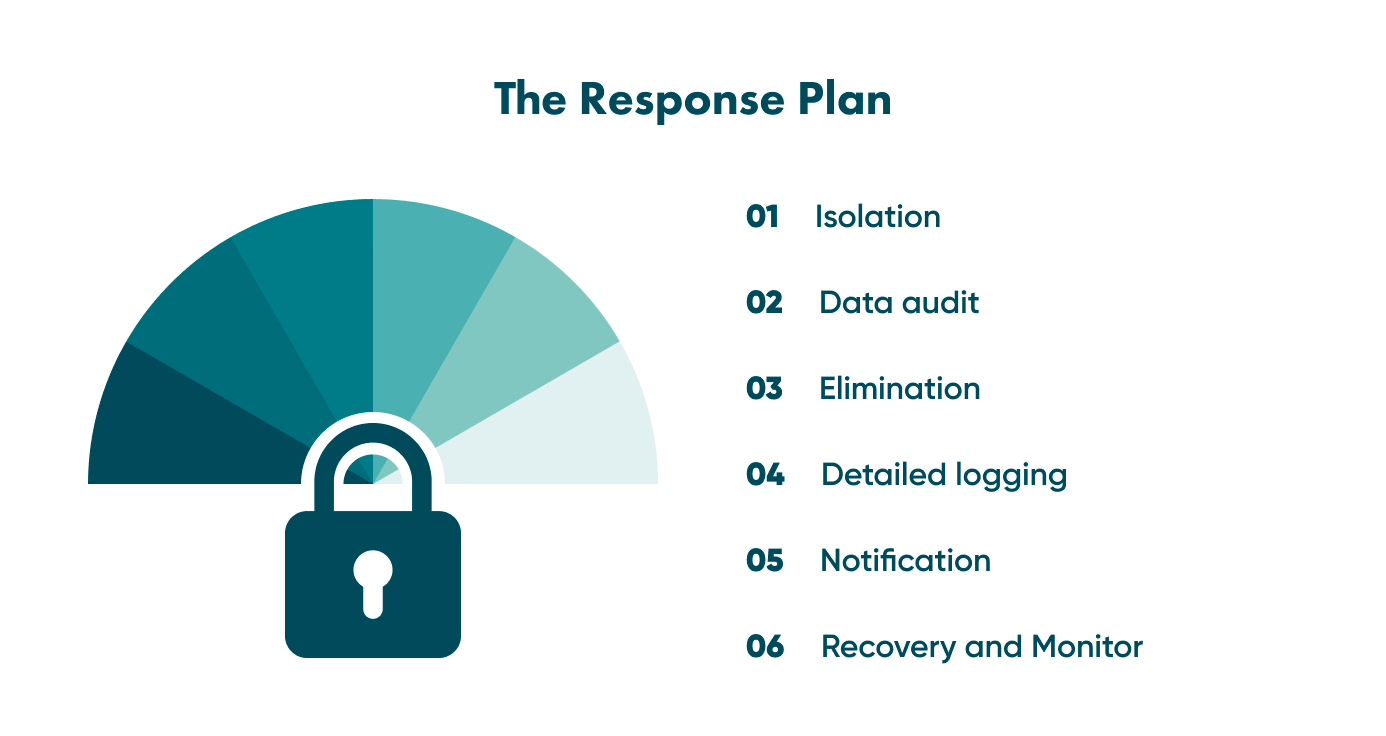
Isolation. You need to isolate the systems and software that were attacked to avoid spreading the threat.
Data audit. Check the sensitive data to find out how much of it was affected and what risks follow.
Elimination. Remove infected files and, if necessary, replace the affected software or hardware.
Detailed logging. Log the details of the attack and your response, so the next incident is handled better.
Notification. You must notify your partners or customers about a data breach within the set period, especially when your business complies with the GDPR. For example, under the GDPR, you must notify customers about a data breach within 72 hours. Thus, you won’t be fined and can start applying recovery measures.
Recovery and monitoring. Restore lost data from backups, deal with the other consequences of the attack and keep monitoring to prevent a repeat.
Taking action
Go Wombat has a Chief Information Security Officer who oversees the protection of your software and digital assets.
We are ISO 27001-certified.
To discuss the security of your project, contact Go Wombat.
FAQ
What is risk management in cyber security?
It is the process of identifying, assessing and mitigating the security risks to your business, so that you are prepared for cyber threats.
How do you conduct risk management in cyber security?
Determine the value of your information, identify and prioritise assets, identify threats and vulnerabilities, assess the risks and develop a response plan. The details vary from case to case.
Why is cybersecurity risk management important?
Without it, your business has no plan for dealing with cyber threats, and an attack is more likely to cause serious financial and reputational damage.
What are the 3 steps of security risk assessment?
The three steps are:
- Identify the risks and your vulnerabilities
- Assess how severe each risk is
- Prioritise these risks to determine which are the most dangerous
Share and subscribe to our blog
Related articles

The Importance of Cybersecurity
Why cybersecurity matters for businesses, the most common types of cyberattacks, and practical steps to protect your company against them.

The Importance of Cybersecurity for SMEs
Why hackers target small and medium-sized businesses, the most common threats, and practical steps to improve cybersecurity for SMEs.

Cloud Data Security: Protecting Sensitive Data
What cloud data security covers in private, public and hybrid clouds, why the Capital One, Uber and Accenture incidents happened, and the controls that prevent them.

How can we help you ?

