



Cloud Data Security: Protecting Sensitive Data

Moving corporate data to the cloud gives organisations flexibility, scalability and cost efficiency, and it supports remote work, real-time collaboration and faster product development. It also brings new risks, and cloud data security is how you manage them.
Relying on cloud providers creates new security and compliance problems: access to sensitive data is distributed, responsibility is shared with the provider, third-party integrations multiply, and regulatory pressure keeps growing.
A single misconfigured storage bucket or leaked credential can expose customer data, as the cases below show.
What Cloud Data Security Means in Practice

Cloud data security combines technology, data governance and operational processes to protect data that is stored, processed and transmitted in the cloud. The goal is to keep that data confidential, intact and available while meeting regulatory and contractual obligations.
In practice, it relies on:
- identity and access management;
- data encryption and key management;
- continuous monitoring, logging, and alerting;
- incident detection and response;
- business continuity and backup planning.
Cloud application security is part of this: it protects workloads and data from unauthorised access and supports compliance with regulatory requirements.
Data migration projects need particular care. Large volumes of sensitive data move between cloud environments, which raises the risk of misconfiguration and human error. If the organisation is based in the EU, this phase entails strict adherence to the General Data Protection Regulation (GDPR) and a clear definition of accountability for data protection duties.
Types of Cloud Environments and Their Security Implications
Security needs depend on the cloud model. Private, public and hybrid clouds divide responsibilities and risks differently, at both the technical and the organisational level.
Private Cloud
A private cloud is used by a single organisation and shares no physical or virtual resources with other tenants.
Key features are:
- complete control over cloud infrastructure and security configurations;
- better flexibility to handle compliance-driven workloads;
- more responsibility for maintenance, monitoring, and incident response.
Private clouds are typically the choice for companies in highly regulated sectors or those handling very sensitive intellectual property.
Public Cloud
In NIST's definition, a public cloud is provisioned for open use by the general public. The provider can offer infrastructure (IaaS), platforms (PaaS) or software (SaaS) as a service. Customers share the underlying resources but are logically isolated from each other.
In this model:
- the provider ensures the security of the infrastructure;
- the organisation is responsible for securing data, applications, identities, and configurations;
- security features scale with your needs, but they require proper governance.
Public cloud providers offer strong built-in security tools, but they only protect you if the platform is configured well and checked regularly.
Hybrid Cloud
A hybrid cloud combines private and public cloud infrastructure, sometimes together with on-premises systems, to balance control and scalability.
Hybrid cloud solutions allow:
- retention of sensitive data in controlled environments;
- elastic scaling of workloads using public cloud resources;
- optimisation of cost and performance.
The cost is complexity: security controls have to be coordinated across environments, which makes a clear cloud data security strategy essential.
Why Cloud Data Security Is Critical for Business Operations
Besides preventing attacks, cloud data security supports business continuity, regulatory compliance and growth.
The main business benefits:
- lower cost of infrastructure and security operations due to shared provider investments;
- improved threat detection through behaviour and anomaly analysis;
- high availability and resilience for remote working teams and customer-facing systems;
- centralised visibility over data stored, applications, and users;
- security controls which can be scaled up as the organisation grows;
- automatic protection against common network- and transport-layer DDoS attacks (for example, AWS Shield Standard); application-layer attacks need a web application firewall or a paid service such as AWS Shield Advanced.
Operational and Regulatory Impact of Missing Cloud Data Security
Cloud security failures usually come from misconfiguration and weak governance, not from vulnerabilities in the cloud platforms. In the Capital One breach, excessive permissions and a misconfigured cloud firewall let the attacker reach sensitive data. At Uber, credentials left in an unsecured public repository exposed cloud systems. Accenture exposed data through unprotected cloud storage. Investigations into these cases pointed to the same root causes: missing access controls, insufficient monitoring and unclear accountability.
Key Elements of Cloud Data Protection

A secure cloud environment needs measures at both the technical and the organisational level.
Security Controls
Cloud providers should offer built-in controls against threats such as unauthorised access, data loss and lateral movement. These controls must be configurable and auditable, and you need to enforce them consistently across workloads.
Authentication and Identity Management
In the cloud, identity is the main security boundary. Strict identity and access management keeps sensitive data limited to authorised users and systems.
Essential practices:
- multi-factor authentication;
- single sign-on;
- role-based access control;
- regular access reviews.
Encryption Across All Data States
Encrypt cloud data in all three states:
- at rest, when data is inactive;
- in transit, when data is being transferred;
- in use, when data is being processed.
With zero-knowledge (client-side) encryption, data is encrypted before it is uploaded and only the customer holds the keys, so the cloud provider cannot read it.
Behavioural and Predictive Analysis
Some cloud platforms use machine learning to analyse user and system behaviour. This helps spot compromised accounts, insider threats and attack vectors early, before an incident escalates.
Regulatory Compliance
Compliance should be an ongoing process, and cloud environments must facilitate this, for instance, with GDPR and other applicable regulations such as CCPA, HIPAA, or FINRA. Furthermore, organisations should also conduct regular reviews of their configurations and internal procedures to ensure compliance.
Compatibility and User Experience
Security controls should not slow down business applications or get in users' way. When they do, people find workarounds, and the workarounds increase risk.
Security Management Systems and Standards in Cloud Environments
Enterprise security depends on governance frameworks that work together. Separate technical measures are not enough on their own.
An Information Security Management System (ISMS) is the set of policies and processes an organisation uses to identify, treat, monitor and continually improve how it handles security risks, including in the cloud. It makes security consistent, assigns responsibility and keeps the organisation audit-ready.
A Privacy Information Management System (PIMS) is primarily aimed at the protection of personal data and is utilised, among other things, for locating the flow of data, evaluating privacy risks, and being accountable under the GDPR. In this way, companies can gain a higher level of trust from customers and regulators.
Aligning with standards from the International Organization for Standardization (ISO) gives you a widely recognised reference point for your security maturity. ISO-aligned practices also help in procurement, regulatory assessments and partner due diligence, even where certification is not required.
Remote Work and Cloud Security Best Practices
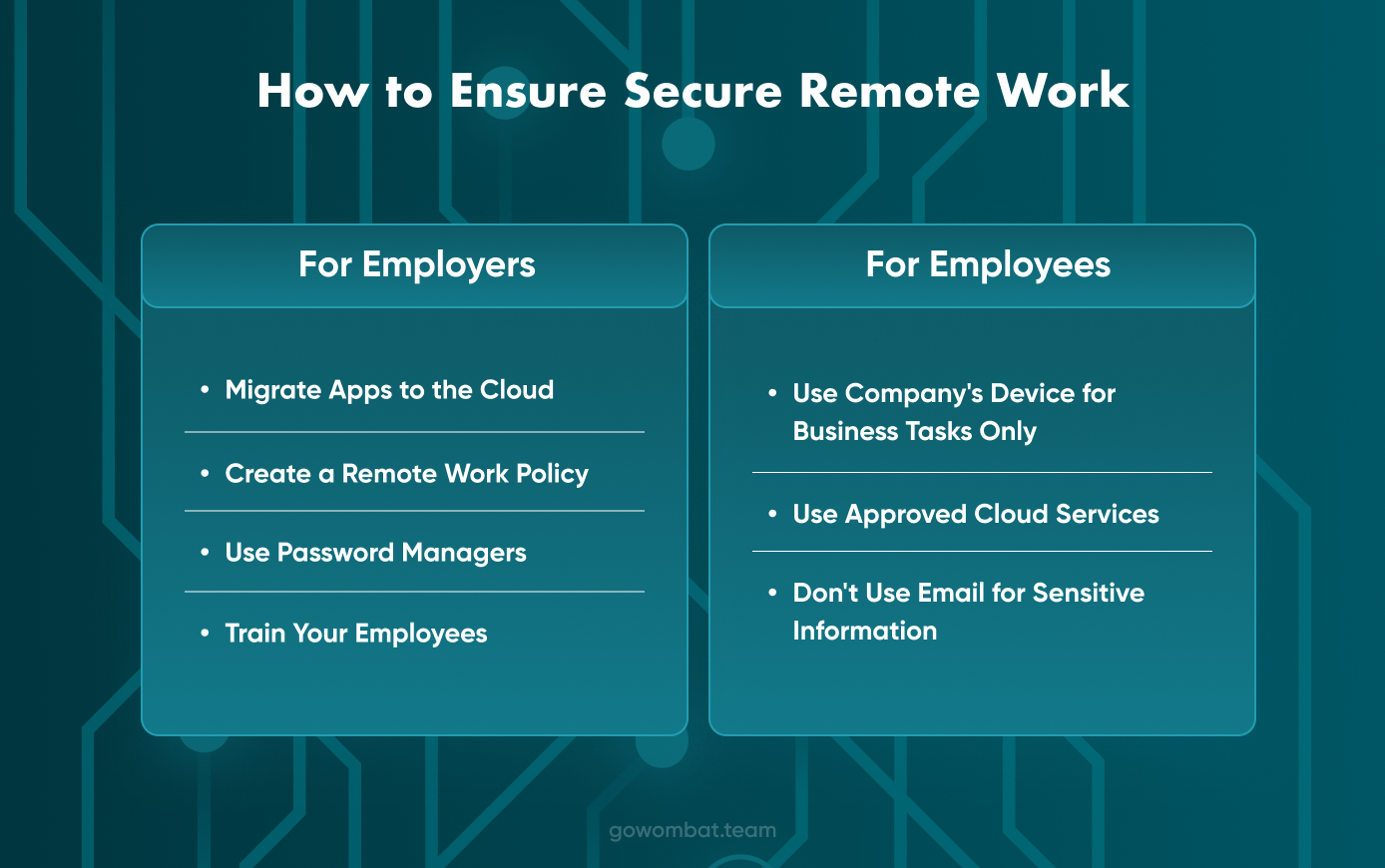
Remote and hybrid work increase reliance on the cloud and expand the attack surface, so your cloud security strategy has to account for them.
Data security best practices:
- Run security assessments when you move business applications to the cloud.
- Set up a formal remote work security policy that covers access, data handling and incident response.
- Use password vaults and multi-factor authentication.
- Train employees regularly in security awareness and incident response.
- Manage and secure endpoint devices, including personal devices used for work (BYOD).
- Allow only approved cloud services.
- Do not share sensitive data by email.
How Go Wombat Approaches Cloud Data Security
Go Wombat builds cloud-based systems with security and compliance designed into the architecture, development and operations. That means secure cloud design, governance aligned with ISO 27001 (Go Wombat is ISO 27001-certified), and continuous monitoring throughout the system's lifecycle.
Security leadership stays involved throughout delivery, so controls are implemented correctly and kept up to date as systems change.
Conclusion
Cloud data security is not a single tool or a one-time setting. It is governance, secure architecture and continuous monitoring, aligned with your regulatory requirements and business goals.
In regulated sectors, continuous configuration checks through cloud security posture management (CSPM) help you stay compliant without slowing down releases.
Frequently Asked Questions About Cloud Data Security
What is cloud data security in enterprise environments?
Enterprise cloud data security combines technical controls, governance frameworks and compliance processes to protect cloud data and keep it auditable and compliant with regulations.
Who is responsible for cloud data security?
Responsibility is shared. Cloud providers secure the infrastructure; organisations are responsible for protecting their data, access management, configurations and compliance obligations.
Is public cloud secure enough for regulated industries?
Yes, with the right governance. Public cloud platforms have strong security capabilities, but organisations in regulated industries must add strict access controls, monitoring, encryption and governance processes.
How does cloud data security support GDPR compliance?
A cloud data security solution protects organisations' sensitive data, manages access control, helps identify data breaches, and facilitates accountability through logging, reporting, and documented processes.
Do organisations need ISO certification for cloud security?
Certification is not always mandatory, but following ISO-based practices builds trust, keeps you audit-ready and helps in enterprise procurement.
How often should cloud security be reviewed?
Monitor it continuously, and run a formal review after significant system changes, regulatory updates or security incidents.
Share and subscribe to our blog
Related articles

The Importance of Cybersecurity
Why cybersecurity matters for businesses, the most common types of cyberattacks, and practical steps to protect your company against them.

How to Properly Use Serverless Technologies and AWS Lambda
Why AWS Lambda suits small, independent functions, with a Python example that invokes Lambda functions concurrently to fetch crypto exchange rates via CCXT.

What Are Website Cookie Policies and Why You Need Them
P roviding a fast yet secure Web service can be a challenge. Here is a valuable insight into the cookies that help do just that. The trust of users towards your website is built on transparency. Therefore, users need to know how your websi…

What is AdTech? A look at its influence on industries
What AdTech is, its main platforms (ad exchanges, ad networks, ad servers, DSPs and SSPs), trends and the privacy issues it raises.

What Role Does Big Data Play in Software Development?
What Big Data is, its main types and analytics methods, and how it helps software teams decide what to build, test features and manage risk.

Continuous Security Monitoring (CSM)
What continuous security monitoring (CSM) is, what it can track, the NIST principles behind it, and how to start implementing it.

How can we help you ?

