



Top Cybersecurity Threats in 2023: How to Protect Your Software


Cybersecurity Ventures forecast that the global cost of cybercrime would reach $10.5 trillion a year by 2025.
Whatever the exact figure, the risk of damage from a cyberattack is high for any business. This article covers the main types of threats and the practices that protect against them.
What is a cybersecurity threat?
A cybersecurity threat is any activity that can compromise your systems, networks or data. Many threats come from criminals targeting one person in your team or the whole organisation.
Their goals include damaging networks, stealing data or other assets, and extorting money.
Common threats include malware, social engineering, man-in-the-middle (MitM) attacks, DDoS attacks and SQL injections. We cover each of them below.
Attackers can be individual hackers, criminal groups or malicious insiders.
Threats can also be grouped by origin: natural or human.
- Natural threats are disasters like floods, hurricanes, fires, and similar events outside of human control.
- Artificial threats come directly from humans, and they can be intentional or unintentional.
Unintentional threats come from carelessness and mistakes. For example, an employee installs software they don’t need for their job, and it damages the system or leads to data theft. Intentional threats are deliberate attacks, which can lead to financial loss and theft of intellectual property.
Why is cybersecurity or protection from cyberattacks important?
Cybersecurity measures protect confidential information, such as medical data, intellectual property and government information, from theft and misuse.
Anything stored online should be protected by several layers of security.
Individuals and large companies alike store data in cloud services.
Even large cloud services such as AWS and Google Drive face threats such as:
- New forms of attacks that feature innovative technologies
- Lack of cybersecurity knowledge at the employee level
- Outdated online security best practices
Companies and organisations are the main targets, and attackers can go after any part of your infrastructure, including cloud services.
Ask our cybersecurity specialists for help.
Sources and types of cyberthreats
Before looking at specific threats, it helps to know where attacks come from and which weak points they exploit.
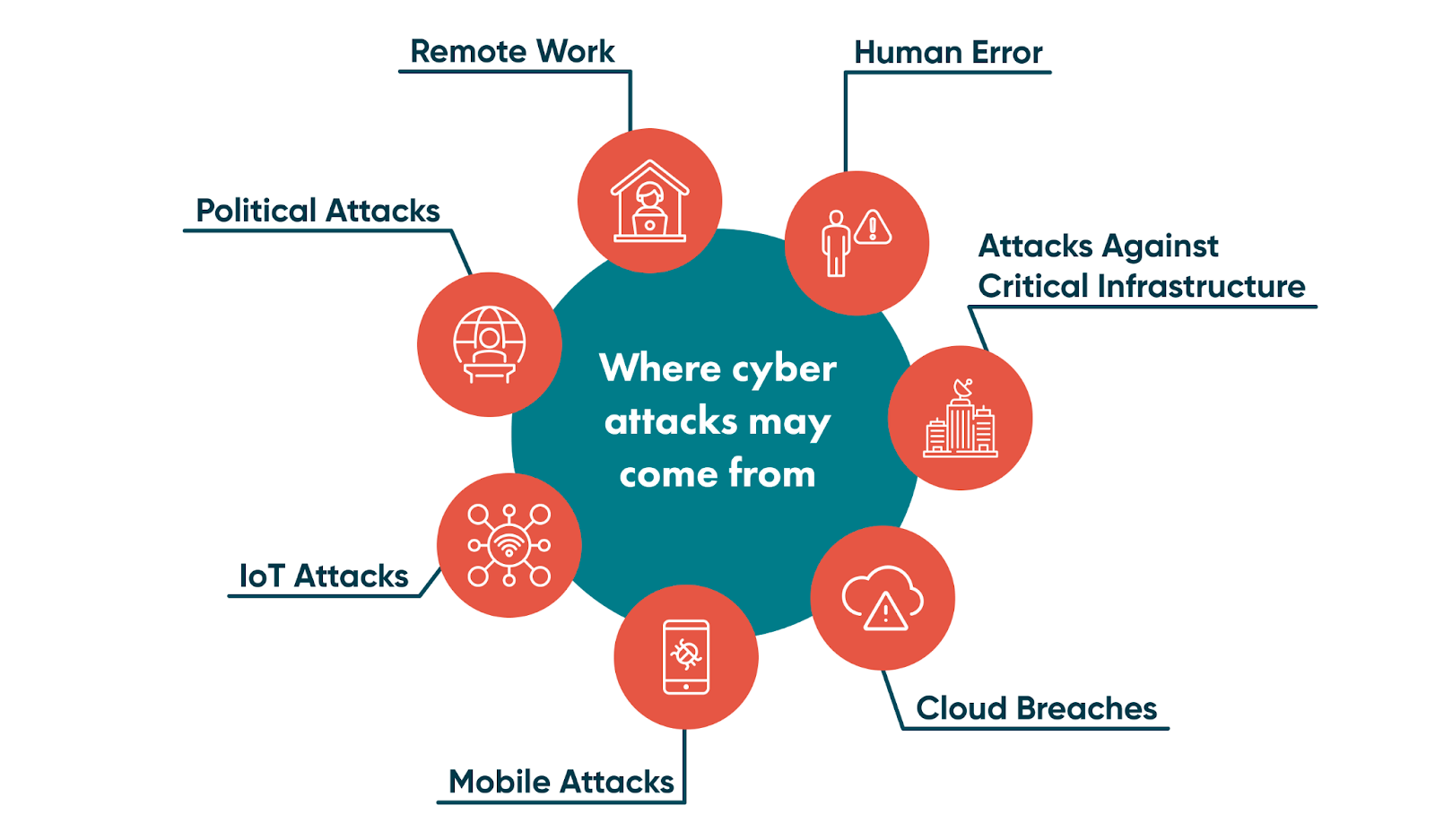
Cloud breaches
Cloud storage is not secure by default: its security depends on how you configure it and on which parts of security the provider is responsible for and which you are.
Mobile attacks
People keep a lot of confidential information on their phones, which makes mobile devices a common target for fraud.
Users should think about mobile device security and use tested antivirus software.
IoT attacks
The Internet of Things (IoT) is the network of smart devices connected to the internet, from smart refrigerators to smart luggage.
If one device in the network is breached, the attacker can use it to reach the rest.
IoT devices need the same security practices as any other part of your network.
Political campaigns through social media and similar channels
Some cyberattacks are driven by political agendas.
In 2023, more attacks will have political motives, partly because of Russia’s invasion of Ukraine and the ensuing war.
Cyberwarfare between states may also intensify, so countries need to protect their critical infrastructure.
Remote collaborators
Remote work has always carried security risks, and in 2023 it will remain one of the biggest challenges for security teams.
It is harder for companies to secure employees’ devices when they work remotely, and attackers know it.
Ransomware, phishing and social engineering attacks are likely to grow with remote work, so companies need to adjust their security policies.
Top cybersecurity threats and challenges in 2023
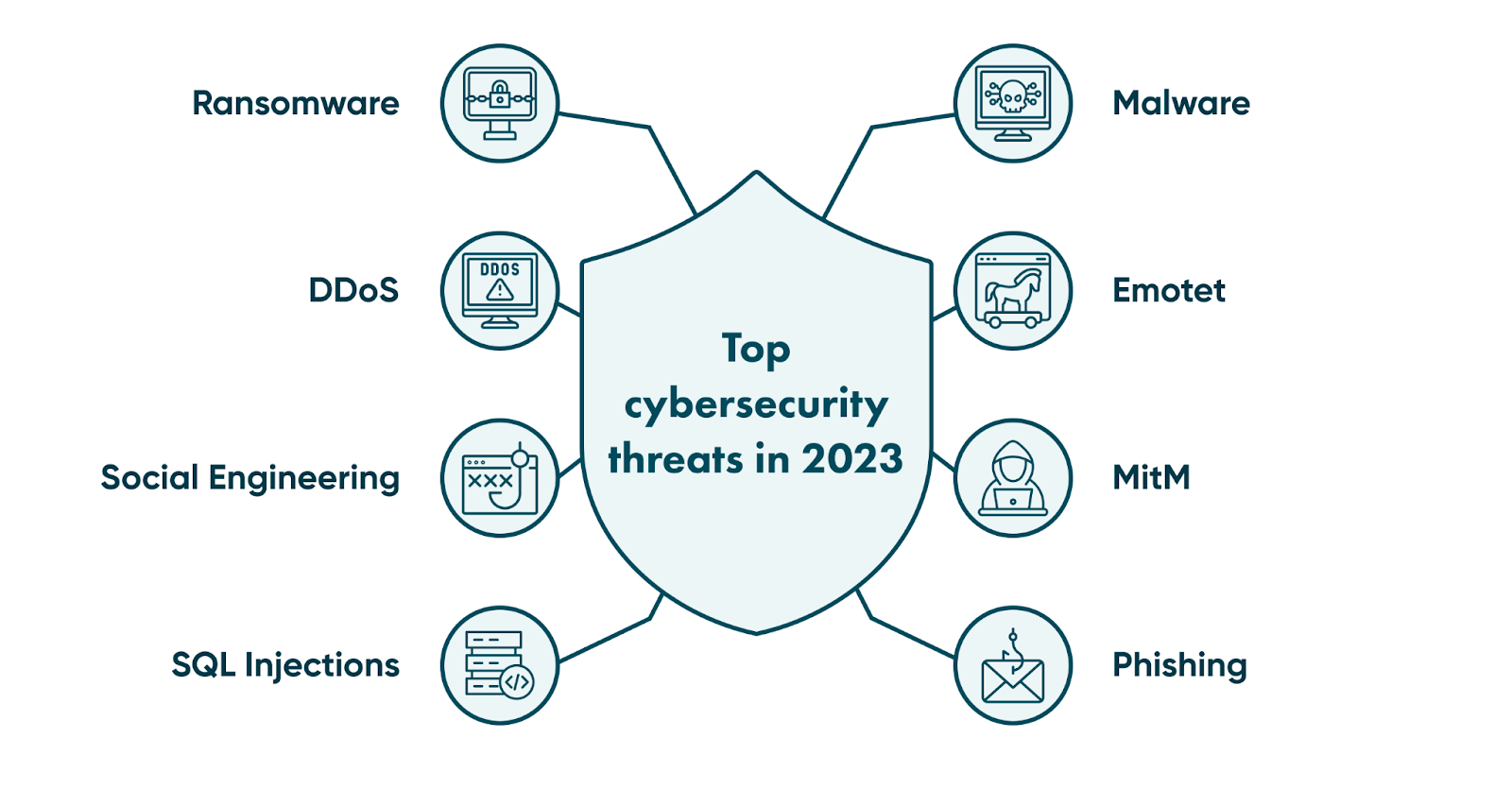
Malware
Malware is malicious software that can damage your systems and internal network or make them unusable.
Different types of malware include:
- Spyware: collects sensitive information on your device without your consent
- Ransomware: blocks your valuable files and demands a ransom for decryption
- Viruses and worms: these can be programmed to have various negative effects
Emotet
Emotet is a trojan that Europol once called the world’s most dangerous malware.
It spread mainly through emails with infected Word documents and gave attackers remote access to data on infected devices. Europol and its partners disrupted Emotet’s infrastructure in January 2021. It returned briefly between 2021 and 2023, but since 2022 Microsoft Office has blocked macros in files from the internet by default, which makes this delivery method much less effective.
Emotet could evade antivirus software and spread to every device on a local network.
DDoS
DDoS stands for distributed denial of service. The attack floods a network or website with requests from many sources until it cannot respond to legitimate users.
Even though it’s a well-known type of attack, DDoS is still among the biggest cyberthreats companies will face in 2023.
MitM
In a man-in-the-middle (MitM) attack, the attacker places themselves between two parties that are communicating, for example a user on an insecure Wi-Fi network and a website, and can read or change the data passing between them. This lets them impersonate each party to the other.
Attackers can also steal credentials this way and use them later without being detected.
SQL injections
In an SQL injection, attackers put SQL code into input data that an application passes to its database, and the database executes it as part of a query.
This lets them change the application’s SQL queries to read hidden data or run their own commands on the database.
Phishing
Phishing is a set of techniques for tricking users into sharing confidential information.
Attackers send fraudulent emails or text messages, posing as bank employees, friends, family members or others.
The message usually asks the user to click a link and enter sensitive information on a website. The website is a fake copy of a real one, designed to collect the information without arousing suspicion.
Whatever the user enters goes straight to the attackers.
Social engineering
Phishing is a type of social engineering. In simple terms, this type of attack uses manipulation techniques to extract information from users.
Some attackers also try to get users to do something, such as transfer money to a bank account. The methods vary, but usually the attacker poses as a known personal or business contact making an ordinary request.
Schedule a consultation with Go Wombat to review how your data is protected.
Best practices to protect your organisation from cybersecurity threats and vulnerabilities
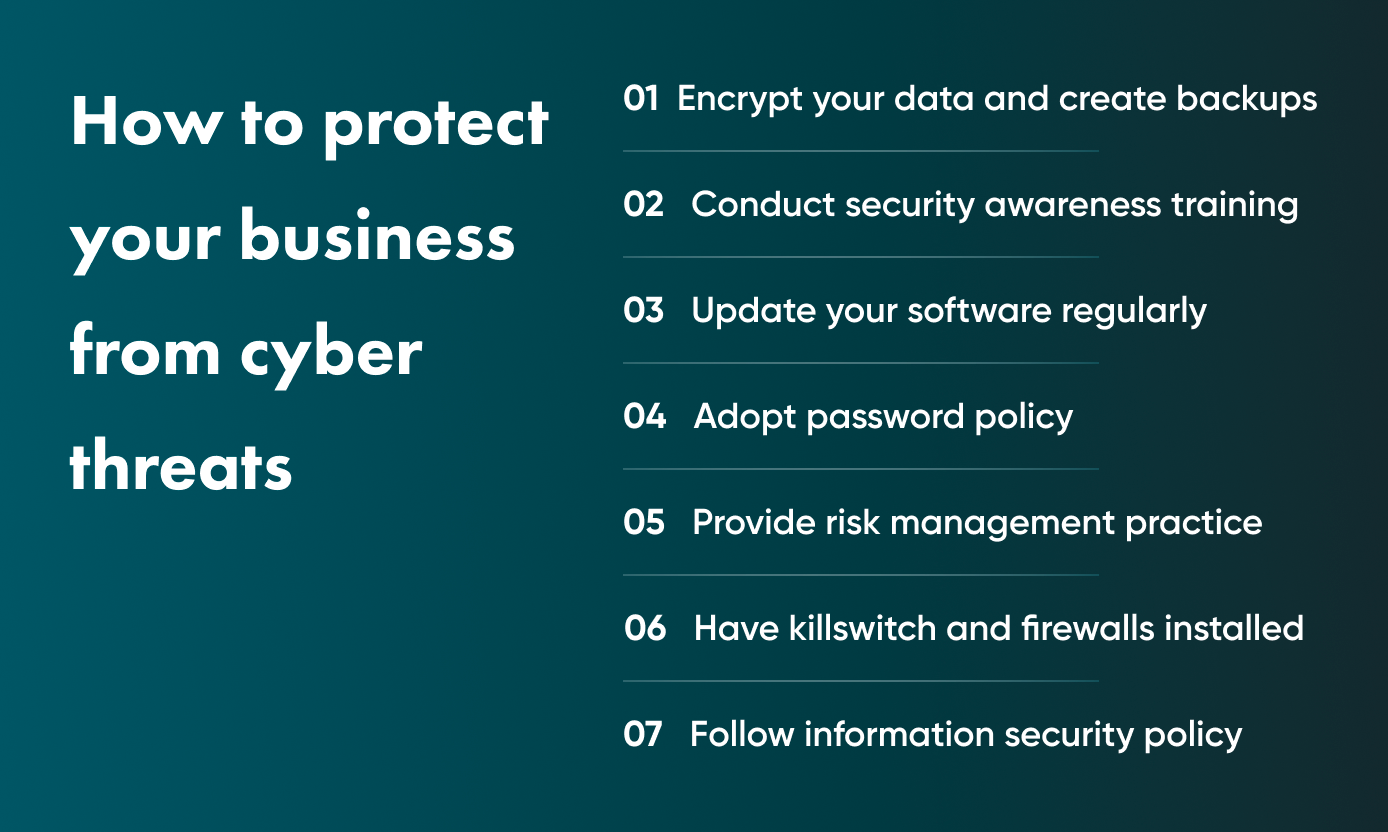
Data encryption and backups
Encrypt all sensitive data.
Even if unauthorised people access encrypted information, they won’t be able to read it without the right key.
Encryption software helps you apply and monitor encryption consistently.
Also create backups. If an attack destroys your data, a recent system-wide backup lets you restore critical data quickly, so update your backups regularly.
Security awareness training
Phishing and social engineering, described above, both exploit human error.
Training your staff reduces the chances of a breach caused by a mistake.
After security-awareness training, employees know how to spot suspicious emails, what attacks exist and how to prevent them.
Software updates
Set up patch management that installs system and software updates automatically.
Outdated software has known vulnerabilities that attackers can use to get to your data.
Password policy
Weak and stolen passwords cause many breaches. According to the Verizon 2017 Data Breach Investigations Report, 81% of hacking-related breaches involved stolen or weak passwords.
Require strong passwords and multifactor authentication (MFA) for all employees. MFA asks users for two or more verification factors before granting access.
Your systems should store passwords as salted hashes (for example with Argon2id, bcrypt or PBKDF2), never in plain text or in reversible encryption. A password manager, which keeps passwords encrypted, helps employees use strong, unique passwords.
Risk management practice
Risk management prepares your network and business for attacks and helps you deal with the consequences of a breach.
Read our guide to the cybersecurity risk management process.
Killswitch and firewalls
A killswitch is a reactive protection measure: when suspicious activity is detected, your IT team shuts down all activity on the affected systems.
Specialists can then trace the attackers’ actions and find out how they tried to get in.
Firewalls monitor network traffic, block or flag suspicious activity and alert your IT specialists so they can respond quickly.
Information security policy
An information security policy sets out how to respond to data breaches and other security incidents.
It may consist of:
- Disaster recovery: describes what occurs when a cybersecurity attack is identified and what employees should do next
- Access control: protocol dictating that sensitive information must be limited to specific specialists who need the data to perform their duties
- Security testing: a regular testing system to identify all vulnerabilities in the system and test them against current and future threats
Conclusion
Go Wombat is ISO 27001-certified and has a certified chief information security officer (CISO) who can help you.
Tell us about your project and we will discuss how to make it as secure as possible.
FAQ
What are cybersecurity threats?
Any activity that can compromise your systems, networks or data. Threats usually come from criminals targeting one person in your team or the whole organisation.
What are the top cybersecurity threats?
The main threats covered in this article are:
- Malware
- Ransomware (a subset of malware)
- Phishing
- Social engineering
- SQL injections
- DDoS
- MitM
- Emotet
- Cloud vulnerabilities
What is the #1 cybersecurity threat today?
There is no single answer: many threats can cause serious data breaches.
Malware and phishing are two of the biggest.
Share and subscribe to our blog
Related articles

The Importance of Cybersecurity
Why cybersecurity matters for businesses, the most common types of cyberattacks, and practical steps to protect your company against them.

The Importance of Cybersecurity for SMEs
Why hackers target small and medium-sized businesses, the most common threats, and practical steps to improve cybersecurity for SMEs.

Cybersecurity Risk Management: What It Is and How to Use It
Cybersecurity risk management explained: what it covers, what it gives a business, a five-step process, the main frameworks and how to respond to a breach.

How can we help you ?