



AI in Oil and Gas: The Technology Revolutionising the Industry


It is increasingly common to find AI in oil and gas software. Operators use machine learning and related tools in exploration, production and distribution to reduce downtime and costs and to improve safety.
The impact of AI on the oil and gas industry
According to a 2020 ResearchAndMarkets report published on Business Wire, the AI in oil and gas market was worth 2 billion USD in 2019 and was expected to reach 3.81 billion USD by 2025. ResearchAndMarkets' 2025 update values the market at 3.54 billion USD in 2025 and forecasts 6.4 billion USD by 2030.
Oil and gas companies use AI and machine learning to analyse and interpret data and to forecast trends and production peaks.
AI is often deployed together with the internet of things (IoT) and cloud computing.
The industry has historically lacked staff with AI expertise, so companies often need outside specialists to build tools, train staff and integrate AI into daily operations.
Benefits of AI

Downtime reduction
AI models can spot early signs of equipment failure. Moving from reactive to preventive maintenance reduces downtime and lost production.
Optimisation
Optimising the performance of a large number of wells is time-consuming and usually relies on rules of thumb rather than accurate evaluation.
Combining physics-based models with ML lets operators review well performance continuously and tune operating parameters for every well.
Accurate production estimation
Much of a well's production is still allocated back to it from sales or tank levels, using well-test data that is often out of date and does not reflect actual production.
AI models can estimate production per well more precisely, which helps assess reserves and prioritise field resources.
Decision-making shift
AI can help optimise the whole value chain by adjusting operations to get the most out of each asset.
For example, AI can analyse sensor data to detect and locate a methane leak so that crews can repair it quickly. In the EU this is also a legal duty: Regulation (EU) 2024/1787 requires detected leaks to be repaired immediately or as soon as possible and bans venting except in emergencies and a few narrow cases.
Upgraded logistics management
Oil and gas logistics are complex, with many nodes and decision points from wellhead to customer.
AI helps plan and run transport and coordinates the operations of all parties so that shipping takes less time.
Data analysis
Oil and gas companies often run facilities in many locations. AI-based data platforms bring the data from all sites into one place.
This helps them to monitor and manage all plants remotely.
Some records are incomplete or exist only on paper, so they have to be digitised and checked before use.
AI tools can digitise records and automate data analysis, which helps identify equipment faults and pipeline defects.
Contact Go Wombat to discuss the software your oil and gas business needs.
AI applications in the oil and gas industry
Defect detection
One challenge is spotting faulty pipe threading. Defects found late are expensive, and a flawed component or pipe that goes into service can cause serious damage.
Computer vision can inspect threads and other parts during production and flag defects before they reach the field.
Safety compliance
Workers at oil and gas sites must follow strict safety rules, such as wearing personal protective equipment.
Breaking these rules puts people at risk and can lead to heavy fines.
A computer vision system can monitor a site and check that workers follow safety procedures. An AI model analyses the camera footage and sends an alert when it detects a deviation.
Maintenance cost reduction
Extraction sites depend on pipelines to carry oil and gas to processing and storage facilities.
Environmental conditions damage these pipelines over time. Corrosion can deform the material, wear down threading and weaken the pipe.
Left unchecked, it can cause failures that stop production.
IoT sensors combined with AI models can detect signs of corrosion, estimate how likely it is to develop and alert pipeline operators.
Crews can then carry out maintenance before a failure, which costs less than emergency repairs.
Data analytics for better decisions
Oil and gas companies generate large amounts of operational data and need analytics tools to make use of it.
Manual analysis is slow and expensive, and people cannot keep up with the volume of data a site produces every day.
Big data applications with AI collect, aggregate and segment this data, find inconsistencies and support predictions and decisions.
AI models analyse data from plant sensors and machinery, as well as geoscience data, in real time and suggest actions.
This gives specialists a clearer view of operations, helps them improve efficiency and reduces the risk of failures.
Assistance with chatbots
Field operators can use chatbots and virtual agents, and voice control makes them more practical.
Operators move around the site and need their hands free, so voice commands let them ask questions and get status reports without stopping work.
A chatbot can pull real-time data from several systems, call for help and look up instructions in the internal knowledge base.
For example, an operator facing a machine failure can ask the chatbot how to fix it.
Exploration activities
Traditional exploration is expensive, slow and less precise than specialists would like.
One option is autonomous AI-powered robots for deep exploration work.
Seismic surveys send waves into the ground from sources such as vibroseis trucks or air guns and record the reflections with geophones or hydrophones. Processing algorithms then turn that data into images of the subsurface. Drones are used for aerial surveys and site monitoring.
Together, this data makes exploration more accurate and reduces risk to people.
Geological assessment
AI tools analyse seismic and other geophysical data to find signs of hydrocarbons faster and locate oil and gas deposits more accurately.
Security and asset protection
Oil and gas pipelines and other related infrastructure are vulnerable to theft and even acts of terrorism.
A single incident can destroy infrastructure and put lives at risk, so sites need reliable security systems.
AI-based video surveillance and intrusion detection systems monitor sites and detect potential threats.
When they detect one, security staff get an alert and can respond quickly.
If you need a team to build oil and gas software, hire Go Wombat.
Additional technologies used with AI for oil and gas
AI in oil and gas is usually combined with other technologies.

Big data analytics
Big data analytics and AI are used to build estimation and prediction models that show how production changes over time.
They help optimise upstream, midstream and downstream operations.
Internet of things
The internet of things (IoT) is a network of connected physical devices. In oil and gas, IoT sensors collect real-time data on seismic activity, temperature and pressure, which predictive models use to improve efficiency and safety.
They are used to monitor rigs, refineries, pipelines and wells.
Machine learning
Machine learning, a subset of AI, helps optimise well design, find problems in underperforming wells, improve reservoir models and enable predictive maintenance.
Natural language processing (NLP)
NLP lets voice assistants understand commands and questions from field operators and other specialists and answer them.
It can also extract structured information from reports and other text, which gives planners another source of data for well and reservoir planning.
Moving forward
Before adopting AI, define your company's requirements and find the areas where AI is likely to help.
You will also need to decide which business processes AI will change and set up the IT infrastructure to run AI-based solutions.
Go Wombat can help with the digital transformation of your oil and gas business and build software that fits your needs.
Contact us to discuss your project.
FAQ
How is AI transforming the oil and gas industry?
AI monitors equipment and sites, which makes operations more reliable and safer.
It also automates routine procedures, reducing human error and the risk of failures, and supports decisions with data analytics.
What technologies will we have in the future for the oil and gas industry?
AI and its subsets, such as machine learning, deep learning and natural language processing, are already used in the oil and gas industry.
Big data and the internet of things are often combined with AI.
How is AI used in the oil and gas industry?
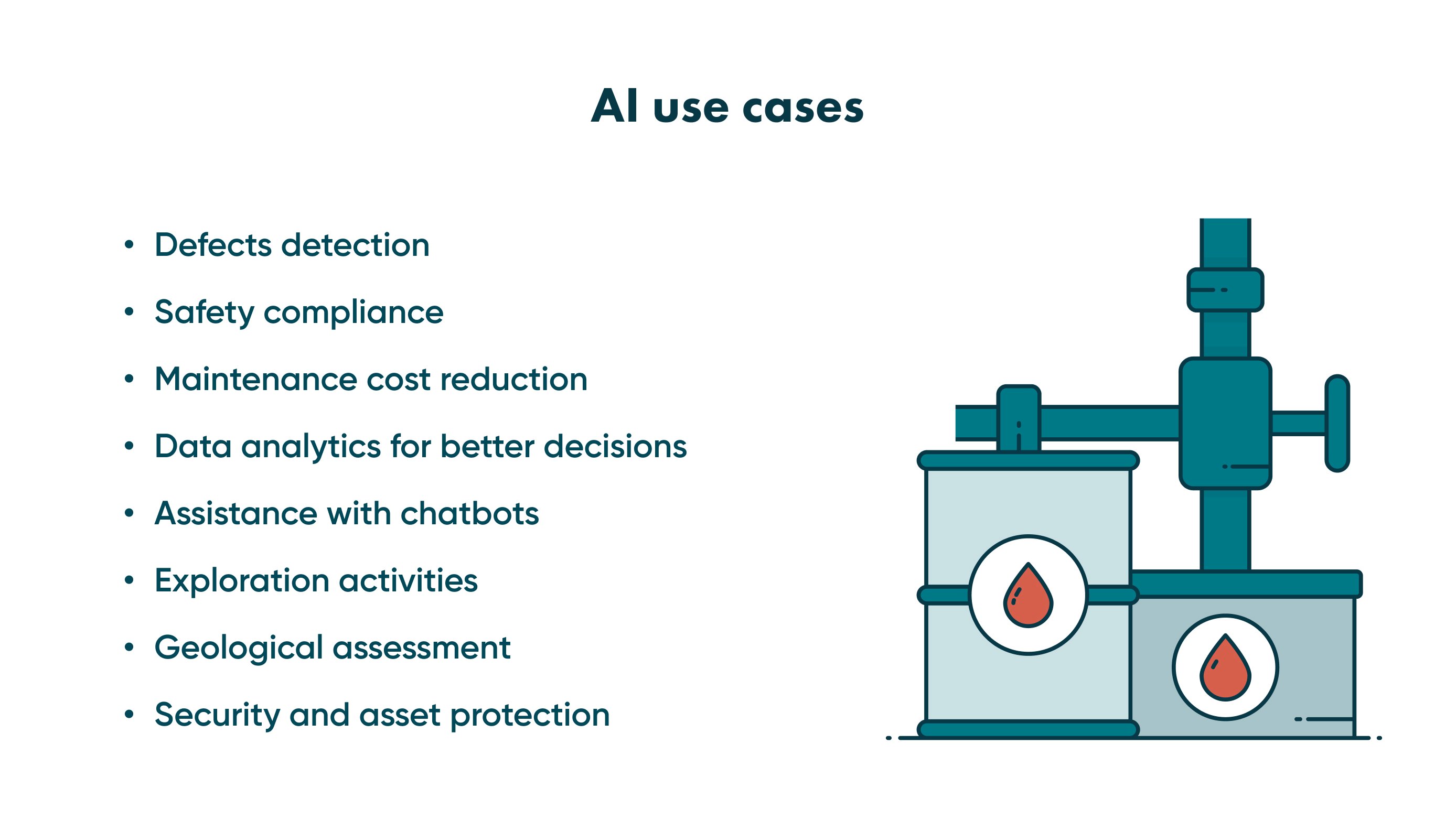
This article covers eight use cases: defect detection, safety compliance, maintenance cost reduction, data analytics for better decisions, voice-enabled chatbots, exploration, geological assessment, and security and asset protection.
Share and subscribe to our blog
Related articles

Big Data - A brief introduction and The Top 5 Applications
A short introduction to big data: the data lifecycle, the three Vs, the main challenges and how five industries use it.

AI in Supply Chain and Logistics: How It Transforms Industry
How AI is used in supply chain and logistics: forecasting, route optimisation, warehouse automation, inventory, predictive maintenance and quality control, plus the challenges of adopting it.

How To Secure A SCADA System
How to secure a SCADA system: its structure and benefits, the threats it faces, and the steps to protect it, from asset mapping to access control and audits.

Cloud Data Security: Protecting Sensitive Data
What cloud data security covers in private, public and hybrid clouds, why the Capital One, Uber and Accenture incidents happened, and the controls that prevent them.

How can we help you ?