



The Future of Chatbots for Marketing: How AI is Changing the Industry


Marketing teams use artificial intelligence (AI) for customer engagement, data analysis and decision-making, from chatbots to personalised recommendations.
Below: how chatbots for marketing work, where they help, the trends we expected in 2023 and the problems chatbots still have.
A bit about chatbots to start
Chatbots are programs that hold a conversation with users. Businesses use them to automate customer service and keep customers engaged.
Early chatbots followed fixed scripts. AI-based chatbots can interpret questions written in natural language and handle more complex requests.
What does AI do for marketing?
AI for marketing means applying artificial intelligence to tasks such as customer segmentation, targeting, personalisation, content creation, campaign optimisation and data analysis.
In digital marketing, this usually means machine learning models that process large amounts of data and find patterns you can act on.
For example, a model can group customers by behaviour and preferences, so each group gets its own messages and offers.
Common AI marketing tools include chatbots for customer service and predictive analytics for forecasting customer behaviour and campaign performance.
For a wider overview, read our article about marketing technology.
To use AI in other types of software, get a detailed consultation from Go Wombat.
The role of AI in marketing chatbots
AI lets a chatbot hold a more natural conversation and give personalised answers. It does this in several ways:
Natural language processing (NLP)
NLP models parse what the user writes, so the chatbot can interpret free-form questions instead of offering only fixed buttons.
Machine learning (ML)
Conversation logs show where the chatbot answered badly. Teams can use them to retrain the model, so answers improve over time.
Personalisation
With access to user data, a chatbot can tailor answers and recommendations to each user's behaviour and preferences.
Multi-channel support
One chatbot can run on a website, in messaging apps and on social media, so users get the same answers wherever they ask.
Contextual understanding
A chatbot can take context into account: the user's location, earlier conversations and other data. This makes its answers more relevant.
Sentiment analysis
Sentiment analysis tells whether a message sounds angry, confused or satisfied. The chatbot can then adjust its tone or pass the conversation to a person.
Chatbot benefits in marketing
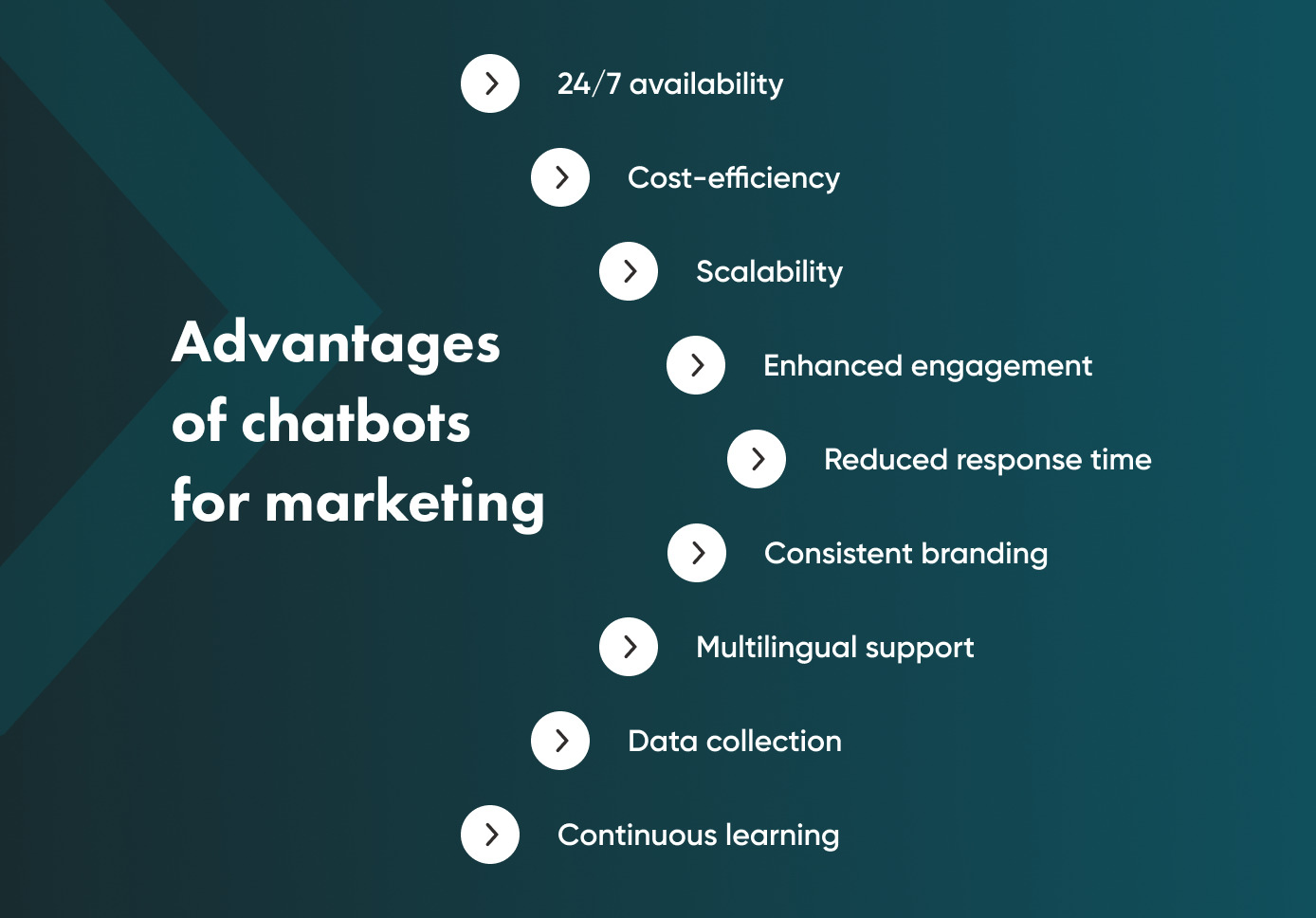
24/7 availability
A chatbot can answer customers at any hour, including outside business hours.
Customers get answers to simple questions without waiting for the next working day.
Cost-effectiveness
Bots can take over routine work: answering frequently asked questions, giving basic support and routing customers to the right person or page.
This reduces the load on support staff and the cost of running support.
Scalability
A chatbot handles many conversations at the same time, so support can scale quickly.
This matters most at peaks such as holidays or product launches, when the number of enquiries jumps.
Enhanced engagement
A conversation can hold a customer's attention better than a static page or a mass email.
Reduced response time
A chatbot replies in seconds. For frequently asked questions, customers no longer wait in a queue for an agent.
Consistent branding
You set the chatbot's tone and key messages once, and it keeps them in every channel.
Multilingual support
A chatbot can answer in several languages, which helps companies that sell in more than one country.
Data collection
Every conversation shows what customers ask for and where they get stuck.
Marketing teams can use this data to adjust offers, content and product pages.
Continuous learning
Chatbot answers improve over time if the team reviews conversation logs and retrains the model or updates its content.
To discuss AI chatbot development, contact us.
Use cases of chatbots for marketing
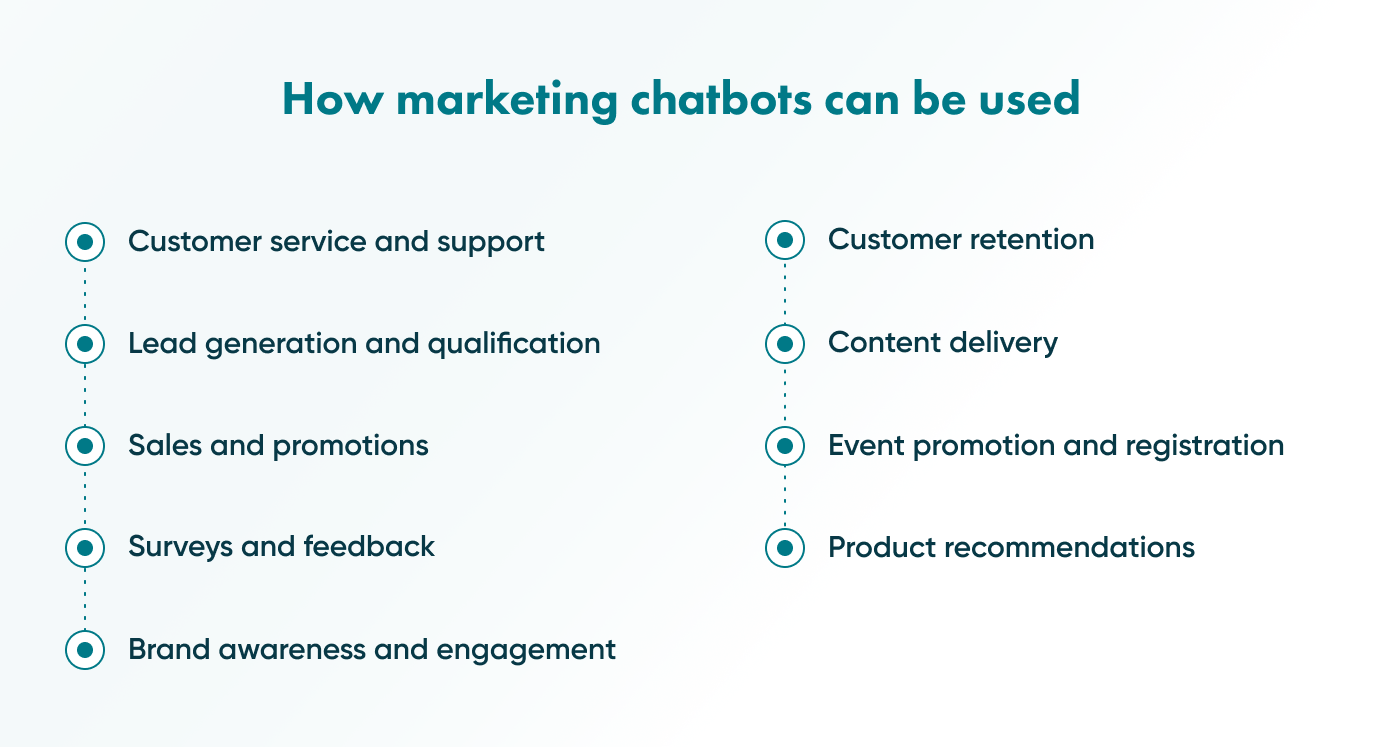
Customer service and support
The most common use is answering customer questions at any time of day.
A chatbot trained on your FAQs handles common queries quickly, and support agents deal with the rest.
Lead generation and qualification
A marketing chatbot can ask website visitors a few questions and collect their contact details and preferences.
Based on the answers, it qualifies the lead, so sales can follow up on the most promising ones first.
Sales and promotions
A chatbot can recommend products and make personalised offers during a conversation.
It can also hand out promotions and discount codes that encourage a purchase or a larger order.
Surveys and feedback
Chatbots can run surveys and collect feedback using open-ended questions, multiple-choice questions or rating scales.
Images, videos and emojis make a survey in a chat feel less formal. The answers can inform product and campaign decisions.
Brand awareness and engagement
A chatbot can greet visitors, answer questions about the brand and ask for contact details along the way.
This builds a list of potential customers for future campaigns.
Chatbots can also run in messaging apps such as Facebook Messenger or WhatsApp, where users talk to the brand directly.
Customer retention
Chatbots can help keep existing customers by supporting them around the clock.
A chatbot can contact customers proactively about known issues before they escalate.
It can also follow up after a purchase with relevant messages and offers that encourage repeat business.
Content delivery
Chatbots can send customers content that matches their interests.
For example, a chatbot can deliver a newsletter in a messaging app, where subscribers can reply and ask questions.
It can also walk users through a product demo.
Event promotion and registration
Chatbots can promote events and handle registration and ticketing.
Users get the date, time and location in the same chat where they register.
Product recommendations
Chatbots can recommend products based on a customer's previous purchases and browsing history.
They can also ask a few questions about what the user needs and suggest products based on the answers.
Chatbot trends in 2023
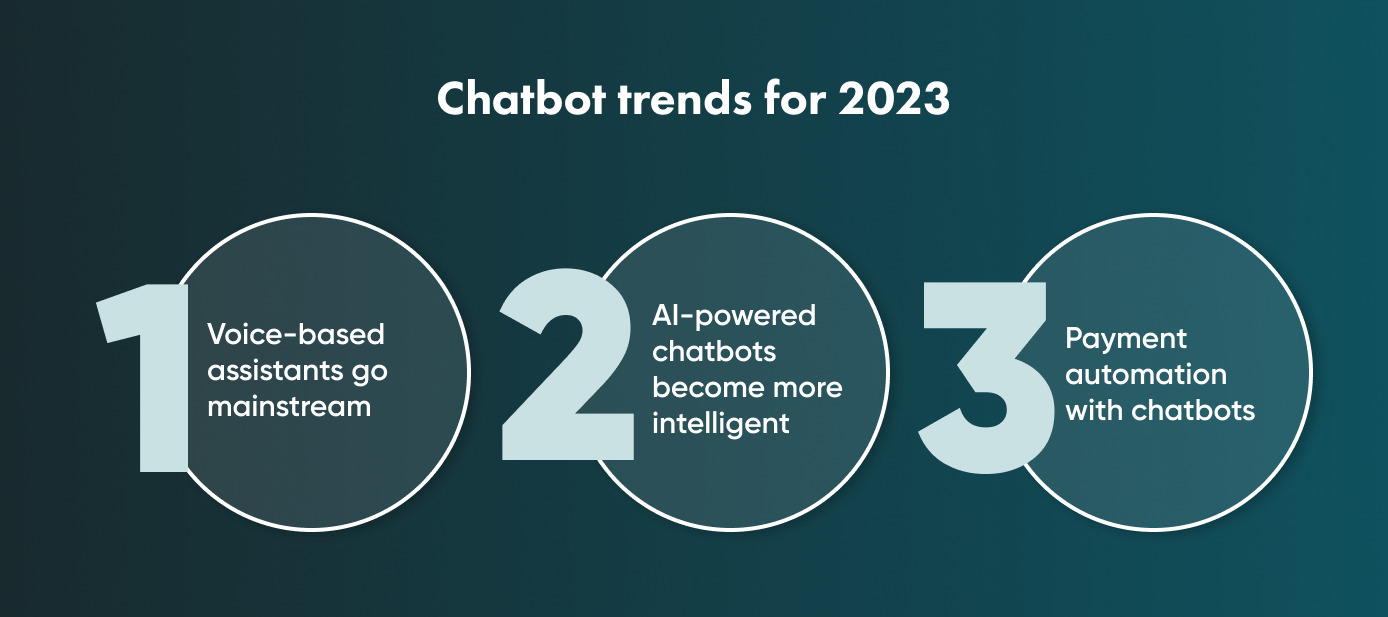
Voice-based assistants
Smartphones and smart speakers come with built-in voice assistants.
Voice commerce and voice search are slowly gaining popularity, so voice-enabled chatbots may become more common.
If your customers already search by voice, a voice interface for your chatbot is worth considering.
AI-powered chatbots become smarter
The more customer data a chatbot can use, the more relevant its answers.
AI models can also analyse the data that chatbots collect and find patterns in what customers ask for.
A chatbot pays off when you get many repeat questions. For low-volume B2B sales, a good contact form may be enough.
Chatbots enable payment automation
A chatbot with proper data protection can take simple payments in live chat or messenger apps.
Because the payment happens inside the conversation, the chatbot can also suggest related products (cross-selling and upselling).
It can also send payment confirmations and updates on a user's transactions and expenses.
For wider marketing automation trends, see our article The Top Marketing Automation Trends of 2023.
The challenges of marketing chatbots
Lack of personalisation
A chatbot cannot personalise its answers if it is not connected to the right data sources.
Limited contextual understanding
Older or poorly designed chatbots can misread the context of a question and give irrelevant answers.
Integration with existing systems
Chatbots may require integration with existing CRMs, databases, and content management systems, which can be complex and time-consuming.
Security and privacy
Chatbots may collect sensitive data from users, which requires proper security and privacy measures to be in place to ensure that the data is not compromised.
Wrapping Up
A chatbot is only as useful as the data and systems it is connected to, so plan the integration work early.
If you need a chatbot for marketing or any other purpose, start the process with Go Wombat.
FAQ
Why are chatbots the future of marketing?
Chatbots give customers personalised answers at any time of day.
They handle many conversations at once and can use customer data to suggest relevant products and offers.
What is the future of chatbots and AI?
Chatbots will handle more complex tasks as the underlying AI models improve.
AI also helps businesses analyse large amounts of data quickly and make better-informed decisions.
How is AI changing the marketing industry?
AI helps companies optimise advertising campaigns and improve customer experience.
Marketers use AI tools to find patterns in large data sets, target campaigns more precisely and automate routine tasks such as lead scoring and customer service.
Share and subscribe to our blog
Related articles

How Artificial Intelligence Enhances The Hospitality Industry
How hotels and travel agents use artificial intelligence, from guest-journey analysis and booking to chatbots, housekeeping and utility management, and the challenges that remain.

AI in Supply Chain and Logistics: How It Transforms Industry
How AI is used in supply chain and logistics: forecasting, route optimisation, warehouse automation, inventory, predictive maintenance and quality control, plus the challenges of adopting it.

AI in Healthcare: A Revolution for the Medical Industry
Where AI is used in healthcare today: the main types of AI, their benefits, use cases from diagnostics to drug development, and the problems that remain.

AI in Oil and Gas: The Technology Revolutionising the Industry
How AI is used in oil and gas: the benefits, applications from defect detection to exploration, and the technologies used alongside it.

How can we help you ?

