



How Does AI Manufacturing Cell Work From Sensor to Shipment?

Across three shifts in a Bavarian assembly plant, roughly 1,400 vehicles go through quality inspection every day. For each car, a generative AI system builds a bespoke inspection catalogue, cross-referenced with its configuration and production history, and directs cameras along the line to flag surface anomalies in milliseconds.
This is BMW Group Plant Regensburg, where the GenAI4Q pilot has been running since 2025 on a line that turns out a new vehicle every 57 seconds.
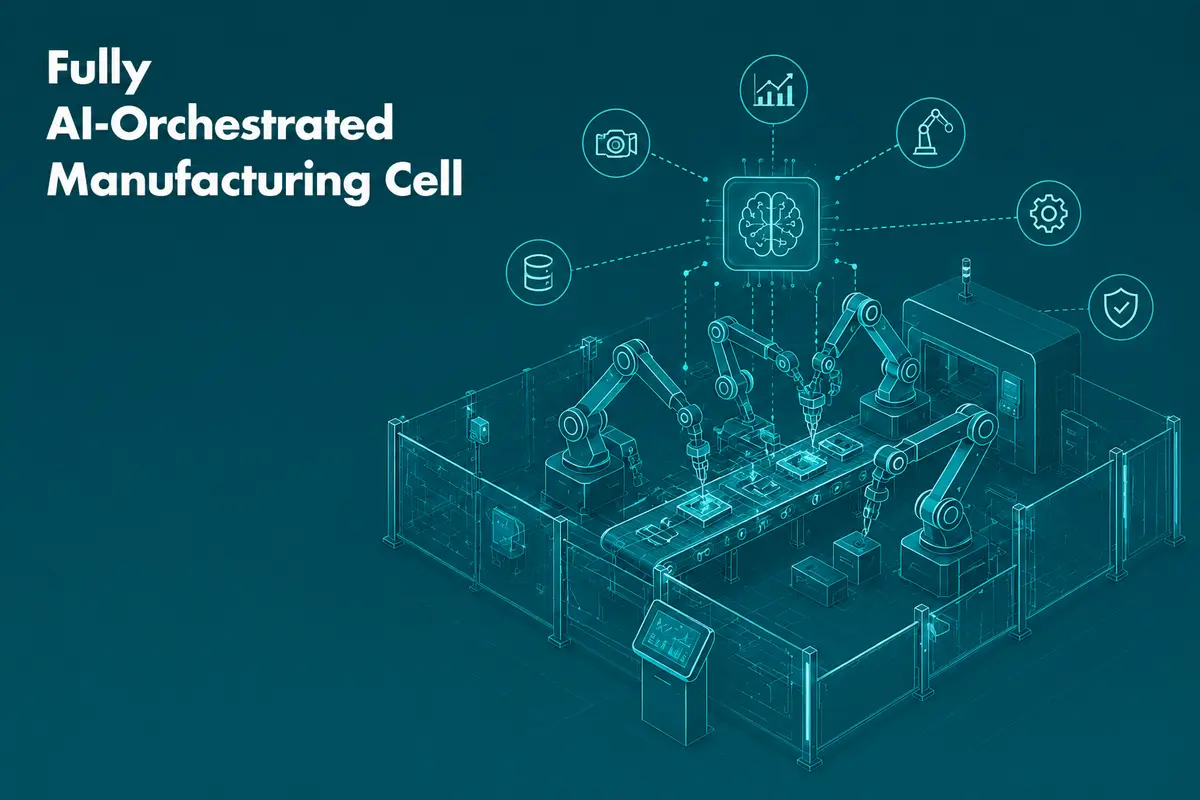
AI in manufacturing is past the pilot phase at many plants. The harder question for technical leaders now is what a fully orchestrated cell looks like when you build it end to end, and what architecture sits underneath it.
What Is an AI-Orchestrated Manufacturing Cell?
An AI-orchestrated manufacturing cell is a production unit where every operational decision is guided, adjusted, or executed by AI systems working together, from raw material intake to finished-goods dispatch. Traditional automation follows rules that engineers set in advance. An AI-orchestrated cell learns from sensor data as it runs, adapts to conditions the original design did not anticipate, and routes only the unusual situations to human operators.
Many factories already have individual AI tools: a quality vision system here, a predictive maintenance model there, a demand forecast somewhere else. Orchestration means those tools share data, act in sequence and pass decisions to each other without a human stepping in at every junction.
The Five Layers of an AI-Orchestrated Cell
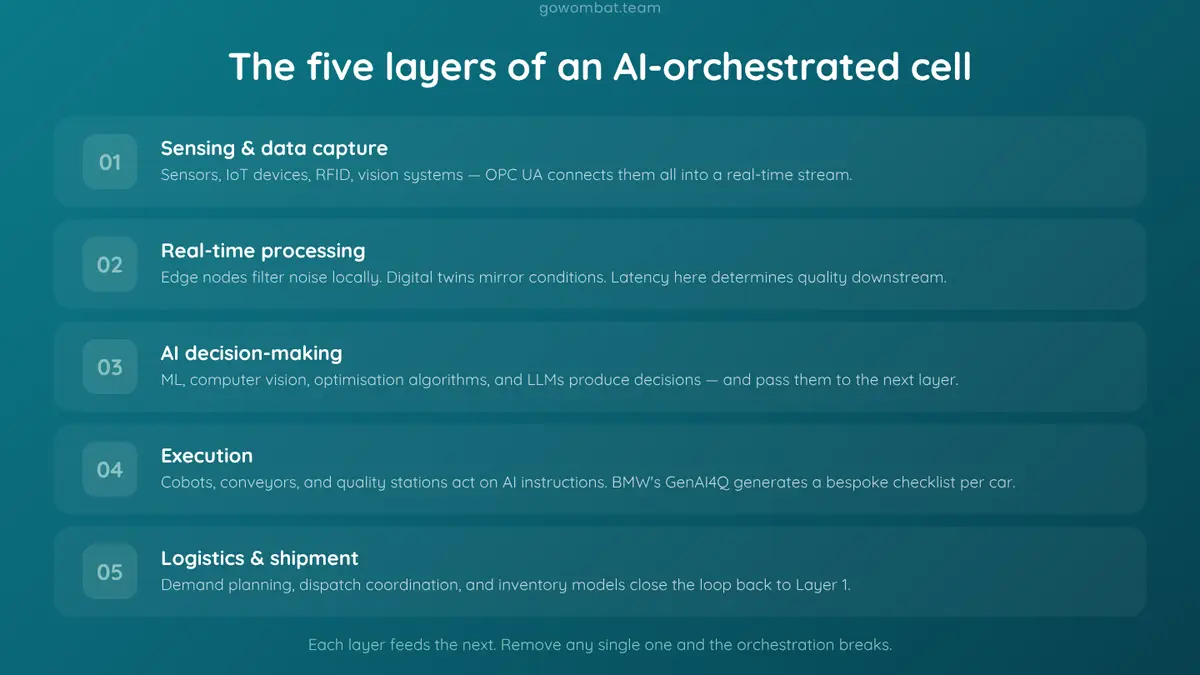
A fully orchestrated cell has five functional layers, and each one feeds the next. If one layer is missing, the chain breaks.
Layer 1: Sensing and data capture
Sensors on machines, conveyors, tools and components push a continuous stream of temperature, vibration, torque, cycle time, visual imagery, weight and position readings. Modern cells combine Industrial IoT devices with vision systems and RFID readers to build a real-time picture of every unit in production. The same sensor infrastructure also feeds predictive logistics and supply chain AI, which is why manufacturers increasingly plan the two together rather than as separate projects. Plants increasingly standardise on OPC UA, a protocol that gives devices from different vendors a common language. Without interoperability at this layer, nothing above it works.
Partner reference: One example at the sensing layer is Enao Vision's iPhone-based inspection system. In a June 2026 INSPECT America interview, CEO Korbinian Kuusisto describes on-device image processing and a browser workspace with factory connections including OPC UA and 24V signals. The quoted sub-$1,000 figure covers hardware; software is separately licensed. Manufacturers still need to validate lighting, product variation and integration requirements for their own line.
Layer 2: Real-time data processing
Raw sensor data from Layer 1 is noise until something processes it. Edge computing nodes filter and aggregate it locally before the stream reaches central systems, which keeps latency low. Catching a defect at Layer 4 is expensive; predicting it at Layer 2, before it happens, costs far less. AI agents processing industrial IoT data in real time close that gap at production scale. In parallel, digital twin platforms keep a software mirror of the physical cell that updates as conditions change. The quality of the data pipelines at this layer limits every AI decision built on top of them.
Layer 3: AI decision-making
AI models consume the processed data and generate decisions: adjust this parameter, reroute that component, flag this unit for inspection, reschedule this batch. The models are a mix: machine learning for anomaly detection, optimisation algorithms for scheduling, computer vision systems for quality assessment and, increasingly, large language models for unstructured reasoning. No single model covers the full range. The engineering work is in connecting them so that decisions pass from one to the next without manual handoffs.
Layer 4: Execution
Execution turns decisions into physical actions: collaborative robots adjusting grip pressure based on Layer 3 instructions, conveyor systems rerouting components, and quality stations running the inspection prescribed for each unit rather than one generic protocol for everything on the line.
BMW’s Plant Regensburg is an example of this layer. Instead of applying the same quality checklist to every vehicle, the GenAI4Q system generates a bespoke inspection catalogue per car, drawing on that vehicle’s configuration and documented production history. Cameras then carry out the inspection each catalogue calls for; a separate deflectometry system, deployed earlier in the same plant's paint shop, uses projected patterns to catch surface flaws human eyes would miss. The plant produces a new vehicle every 57 seconds, handling petrol, hybrid and electric models on a single line. Regensburg won the "Excellent Large-Series Assembly" category at Germany's Factory of the Year awards, with Kearney's judges citing the plant's innovative strength and dynamism in executing BMW's iFACTORY transformation, alongside its workforce's commitment and flexibility.
Layer 5: Logistics and shipment
The final layer closes the loop. Automated planning workflows feed back to Layer 1, adjusting production sequences based on live order pipelines and logistics windows. Dispatch systems coordinate with transport schedules. Inventory models help avoid both stockouts and excess stock. From the first sensor reading to the lorry bay, every handoff is tracked and every decision is logged. This breakdown of AI in supply chain and logistics covers the logistics end of the chain in more detail; the same patterns apply at cell level.
This is what “sensor to shipment” means in practice: a continuous, AI-mediated chain with no dead zones where data stops flowing and decisions stop being made.
What AI Handles, And What It Does Not
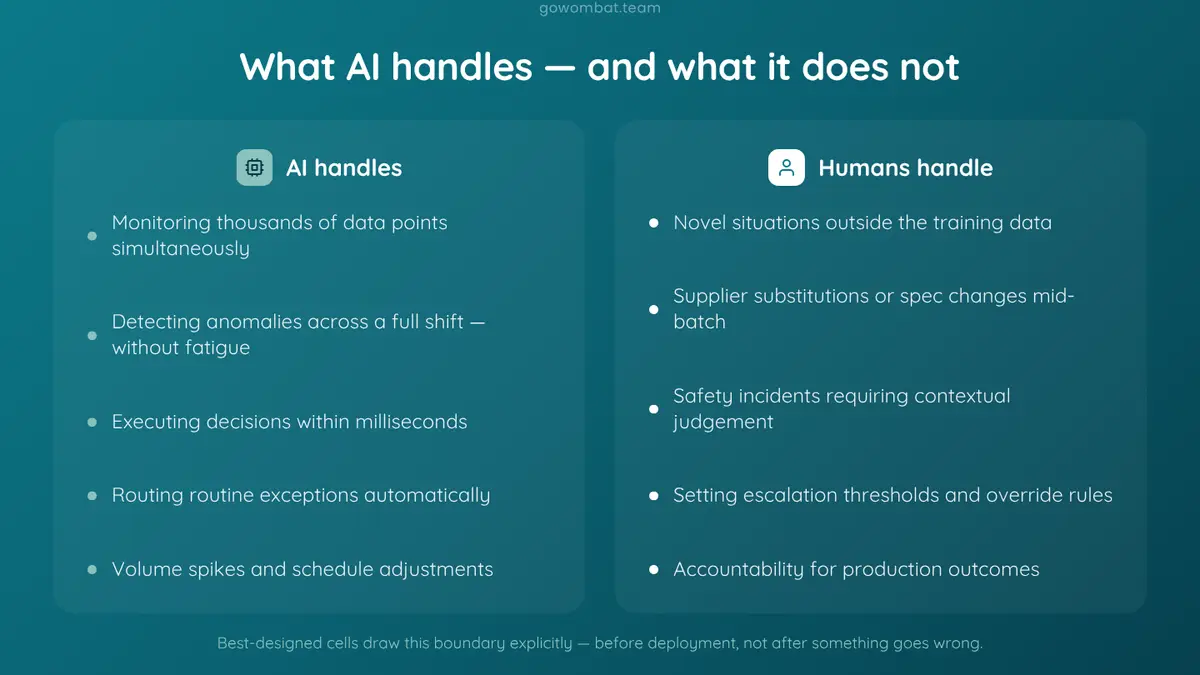
In a well-run cell, AI handles scale and speed, and humans handle novelty and accountability.
AI can monitor thousands of data points at once, find a pattern in hours of sensor noise that an operator would miss, and turn it into a decision in milliseconds. It does not get tired: an anomaly at 4 am gets the same attention as one at 2 pm.
The architecture breaks down in situations the model has never seen: a supplier substitutes a material without notice, a customer specification changes mid-batch, or a safety incident needs reasoning that no training set covered. Those are human decisions. Draw that boundary before the system goes live rather than discovering it after something goes wrong: engineers set the escalation thresholds, AI handles routine exceptions, and people handle the surprises.
Keeping humans on novel exceptions is a deliberate design choice. When AI is pushed into situations it was not built for, failures tend to be worse than when a person stays in the loop for those decisions.
Two Factories That Have Already Built This
The World Economic Forum's Global Lighthouse Network now counts 238 industrial sites across more than 30 countries, recognised as exemplars of AI-driven manufacturing (WEF, June 2026). In January 2026, 23 further factories joined the network, with the WEF noting that AI implementation had shifted from isolated pilots to coordinated, scaled deployment across sectors and geographies.
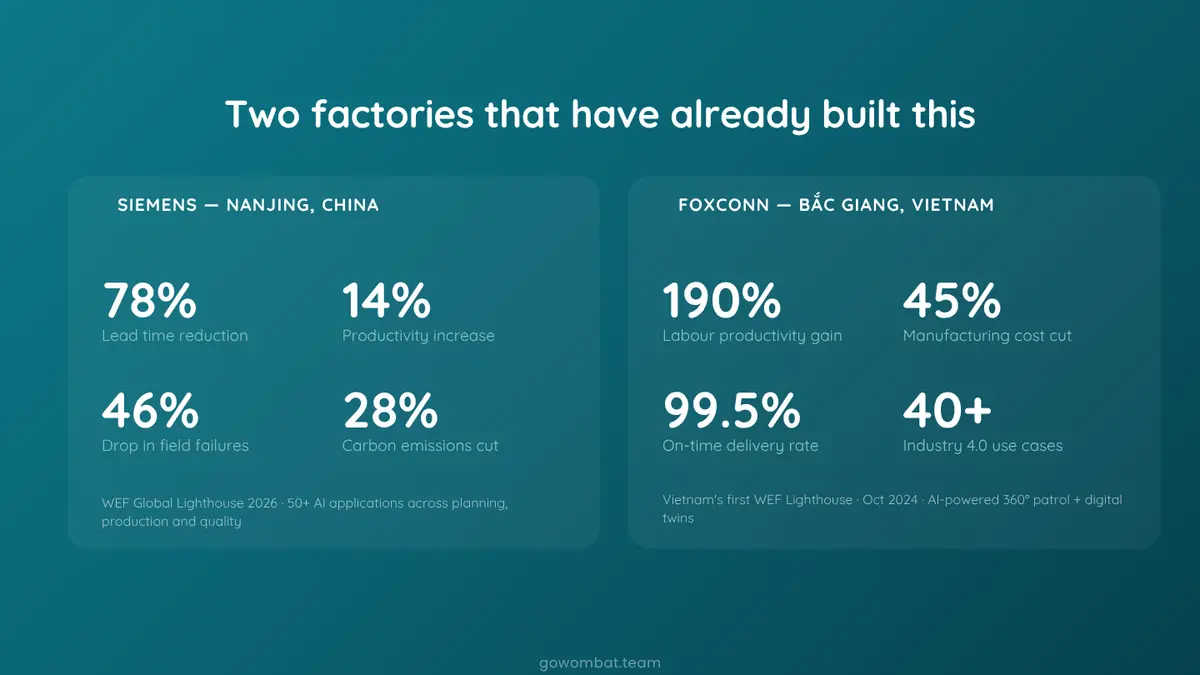
Two members of that network show what full orchestration produces at different points in the manufacturing value chain.
Siemens, Nanjing. Siemens’ electronics assembly plant in Nanjing runs more than 50 AI applications across planning, production, and quality. Between 2022 and 2024, the facility cut lead times by 78% and accelerated time-to-market by 33%. Productivity rose 14%. Field failures dropped 46%. Direct and energy-related carbon emissions fell 28%. Named a WEF Global Lighthouse in January 2026, the plant was recognised in the Productivity category for its digital twins and continuous AI-driven transformation: a coordinated AI system that spans a full production workflow rather than sitting in individual tools. The emissions figure shows that AI and data automation are increasingly central to sustainable manufacturing rather than a separate initiative from productivity. (Siemens, 2026)
Foxconn, Bắc Giang. Foxconn’s facility in northern Vietnam became that country’s first WEF Lighthouse factory in October 2024. Deploying more than 40 Industry 4.0 use cases, including AI-powered 360-camera autonomous patrol systems and real-time digital twins, the plant achieved 190% improvement in labour productivity, 99.5% on-time delivery, and a 45% reduction in manufacturing costs. (Foxconn, 2024)
In both cases the results came from many AI applications working across layers, not from a single tool.
What a Manufacturer Needs Before Deploying AI at the Cell Level
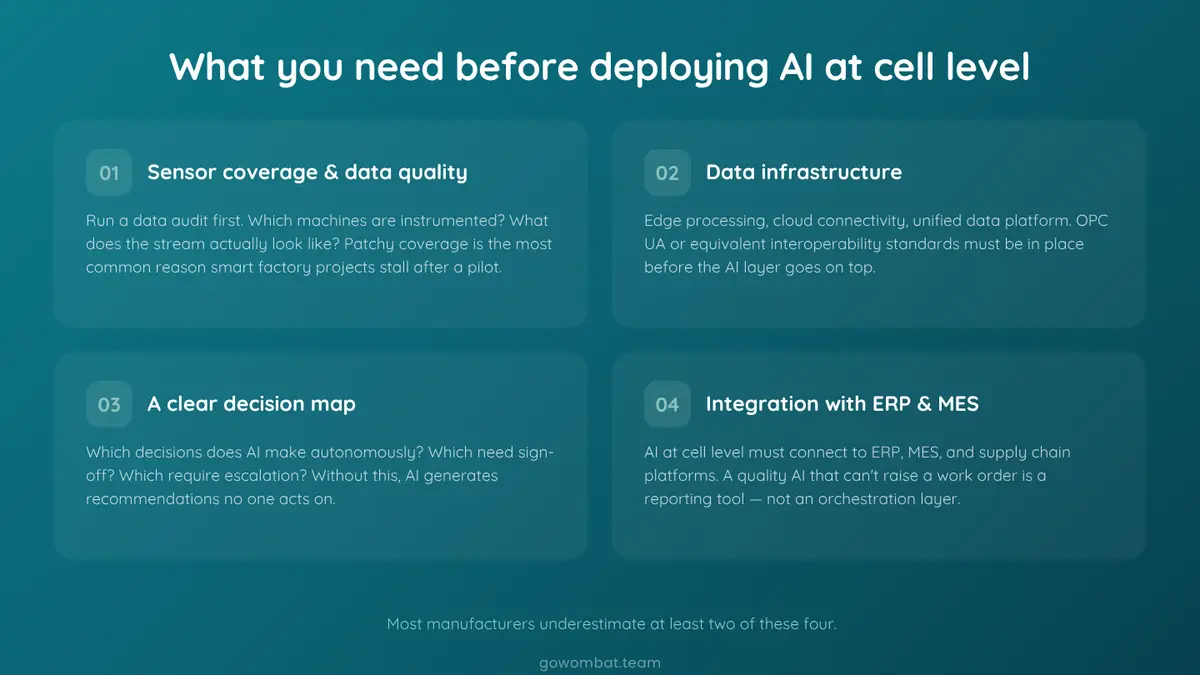
Four foundations need to be in place first.
Sensor coverage and data quality. AI cannot learn from data it cannot see. Start with a data audit: which machines are instrumented, which are not, and how good the existing data stream is. Patchy sensor coverage is a common reason smart factory automation projects stall after a promising pilot.
Data infrastructure. Edge processing, cloud connectivity, and a unified data platform are prerequisites, not afterthoughts. OPC UA or equivalent interoperability standards need to be in place before the AI layer is deployed on top of them.
A clear decision map. Which decisions should AI make autonomously? Which need human sign-off? Which require escalation? Manufacturers who cannot answer these questions before deployment find their AI systems generating recommendations that nobody acts on, because nobody agreed in advance who was responsible for acting on them.
Integration with existing systems. AI at the cell level must connect to ERP, MES, and supply chain platforms to close the loop between production data and business decisions. A quality AI that cannot raise a work order in the maintenance system is a reporting tool, not an orchestration layer.
Go Wombat works with manufacturers at this foundation stage, building the data architecture, integration layers, and AI pipelines that turn sensor data into production decisions. If you are scoping this work, a technical consultation is the right starting point.
Strategic Insights
The WEF Lighthouse Network's January 2026 cohort spanned automotive, electronics, pharmaceuticals and several other sectors, with most of the new sites in China and the rest spread across India, Turkey, Vietnam and Azerbaijan. AI in manufacturing is not limited to one sector.
The factories gaining an advantage are those where data flows without interruption from the first sensor to the final dispatch note, and where AI makes enough decisions quickly enough that operators can spend their time on the problems that need them.
Mid-market manufacturers can build this architecture too, starting with one instrumented line and an OPC UA data layer.
Talk to our engineers about what a sensor-to-shipment architecture would look like for your production environment.
Frequently Asked Questions
How is AI used in manufacturing today?
AI in manufacturing currently covers quality inspection, predictive maintenance, production scheduling, demand forecasting, and logistics coordination. Most factories run these as separate tools rather than integrated systems. The shift towards full AI orchestration, where these tools share data and act in sequence, is what distinguishes Lighthouse-level facilities from the broader market. That gap is now measurable in lead times, defect rates, and operating costs.
What is the difference between smart factory automation and AI orchestration?
Smart factory automation refers to programmable systems and connected equipment carrying out defined tasks. AI orchestration goes further: the system adapts its decisions based on new data, coordinates multiple AI models across the production workflow, and handles conditions it was not explicitly programmed for. Automation follows rules. Orchestration adjusts them in real time.
How does a manufacturing cell communicate sensor data to AI systems?
Many modern cells use OPC UA, an industrial communication standard that allows equipment from different vendors to exchange data in a shared format. Edge computing nodes process the data locally before passing it to central AI platforms or digital twin environments. Without this interoperability layer, data from different machines cannot be aggregated meaningfully enough for AI models to act on.
What does a manufacturer need before deploying AI at the cell level?
The four prerequisites are: adequate sensor coverage across relevant machines, a reliable data infrastructure including edge processing and cloud connectivity, a clear decision map defining which choices AI handles autonomously and which require human escalation, and integration with existing ERP and MES systems.
Is AI in manufacturing replacing workers or extending what they can do?
The factories with the most mature AI deployments, including WEF Lighthouse sites such as Siemens Nanjing and Foxconn Bắc Giang, report that AI takes over high-volume routine decisions while human operators focus on supervision, exception-handling, and continuous improvement. The practical outcome is fewer repetitive-task roles and a growing demand for engineers and technicians who can configure, oversee, and improve AI systems on the line.
Share and subscribe to our blog
Related articles

The Benefits of Machine Learning in Manufacturing
Where machine learning helps in manufacturing, and how we used it to detect used and counterfeit components on electronics assembly lines.

What Sustainable Manufacturing Looks Like with AI and Data Automation
How AI and data automation help manufacturers cut energy use and waste: energy management, quality control, circular manufacturing and practical first steps.

Why Is the Digital Twin of an Oil Refinery the Most Complex AI System You Will Ever Build?
Why a digital twin of an oil refinery is so hard to build: seven interdependent layers from physics simulation to control system integration, results from Cosmo Oil's refinery digital twin, a look at Honeywell's planned digital-twin work at the Dangote refinery, team and data prerequisites, and why projects fail.

How can we help you ?