



What Sustainable Manufacturing Looks Like with AI and Data Automation

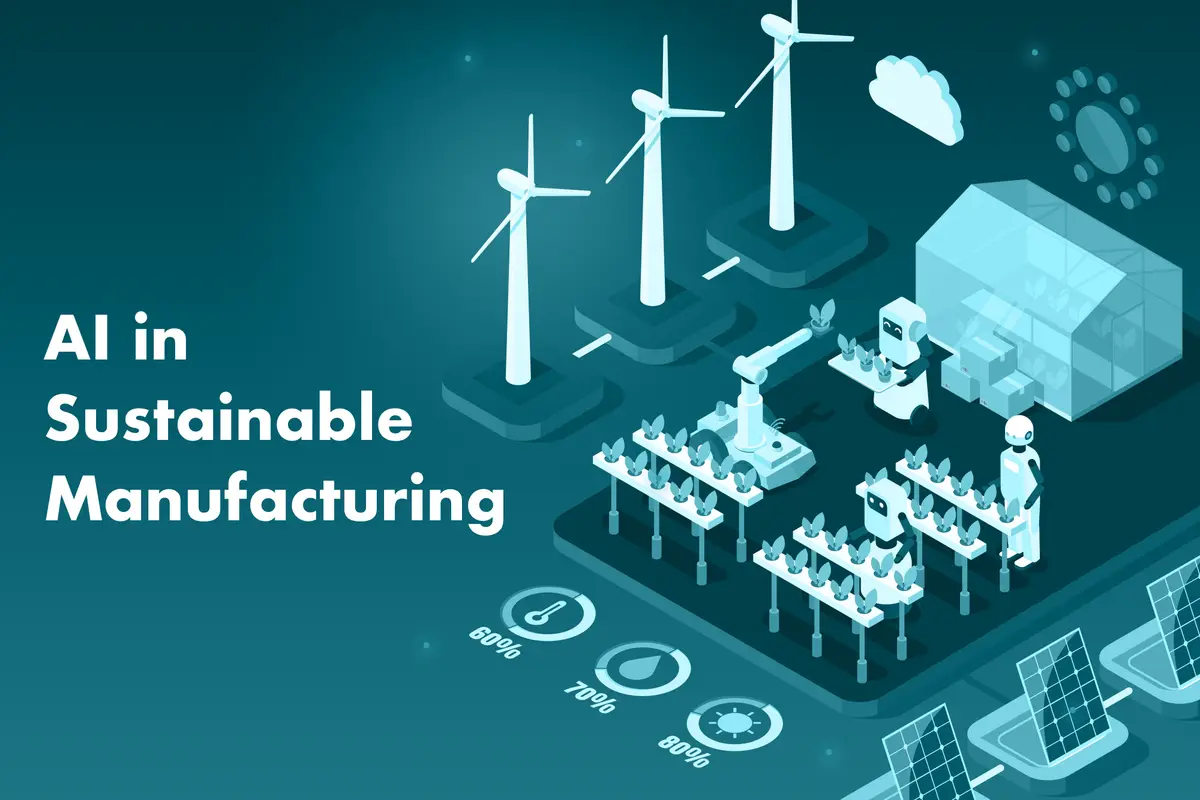
AI and data automation help manufacturers cut energy use, material waste and downtime: they show where resources are lost and adjust processes in real time. This article covers how that works in sustainable manufacturing, what it takes to implement, and where the limits are.
Why Sustainable Manufacturing Matters Today
Sustainable manufacturing means producing goods with efficient processes that reduce waste, emissions and energy use. Industry is one of the largest sources of emissions: according to Our World in Data, energy use in industry accounts for about 24% of global greenhouse gas emissions, and direct industrial processes for another 5%. Manufacturers that do not reduce their impact face growing regulatory, reputational and financial risk.
Key Benefits and Drivers of Change
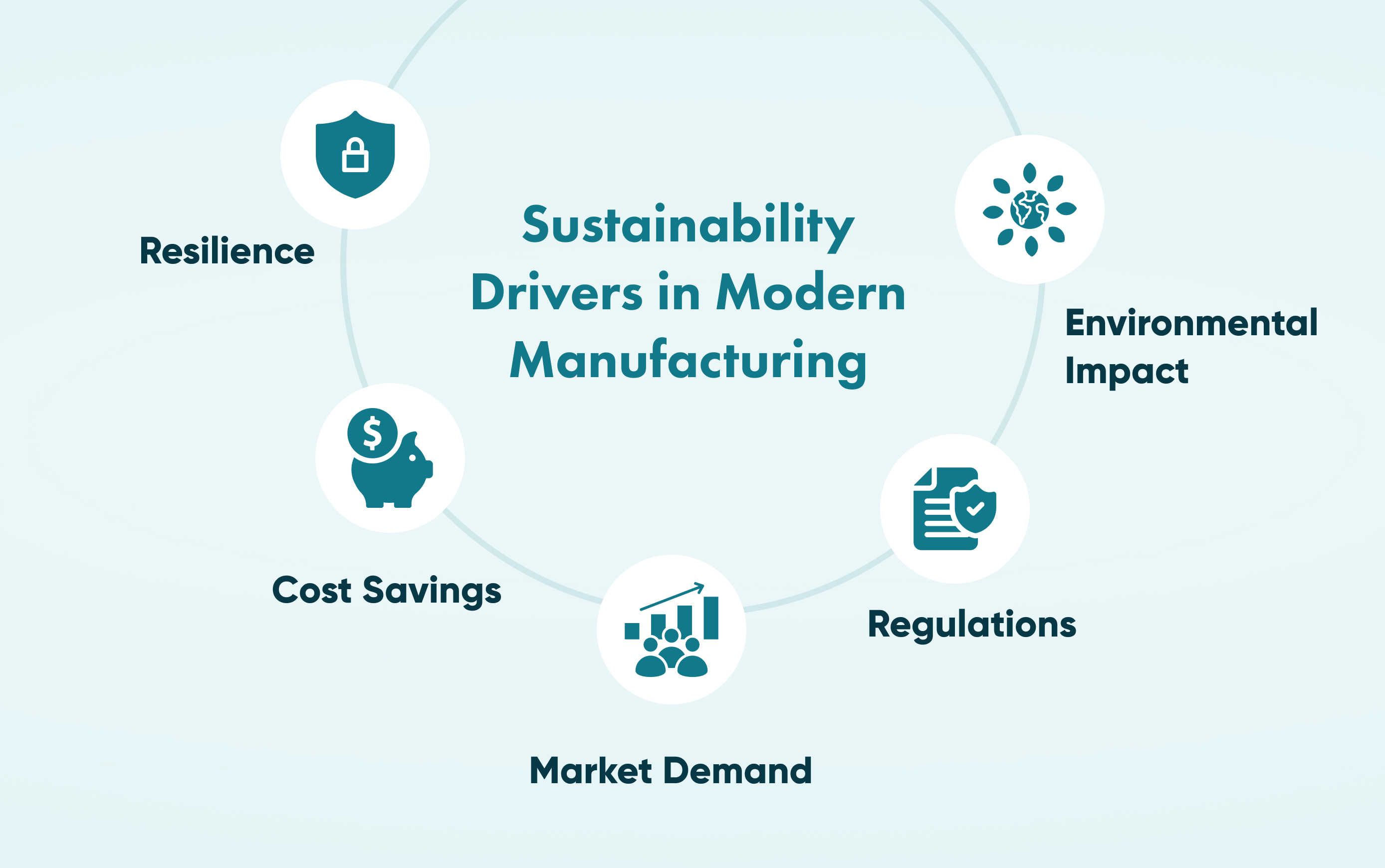
- Environmental impact: cleaner energy and less waste mean less pollution, help meet climate targets and preserve natural resources.
- Regulation: the EU's Corporate Sustainability Reporting Directive (CSRD) requires companies in scope to disclose information on their sustainability risks and impacts; it does not itself require emissions cuts. Its scope is also narrowing: reporting for later waves was postponed in April 2025, and under the political agreement on the Omnibus package of 9 December 2025, the CSRD will apply only to companies with more than 1,000 employees, so most mid-sized manufacturers will fall outside it.
- Market pressure: customers and investors pay attention to a manufacturer's environmental performance.
- Cost savings: energy-efficient equipment, recycling and lean processes lower long-term operating costs and improve margins.
- Resilience: circular supply chains and sustainable design help secure future operations.
How AI Enables Sustainable Manufacturing Practices
AI and machine learning let manufacturers make data-driven decisions about energy and materials. They collect real-time data from sensors and machines and use it to optimise processes and manage resources proactively. Combined with data automation, they reduce energy use and waste and support circular, resource-saving production.
How Does AI Optimise Energy Consumption?
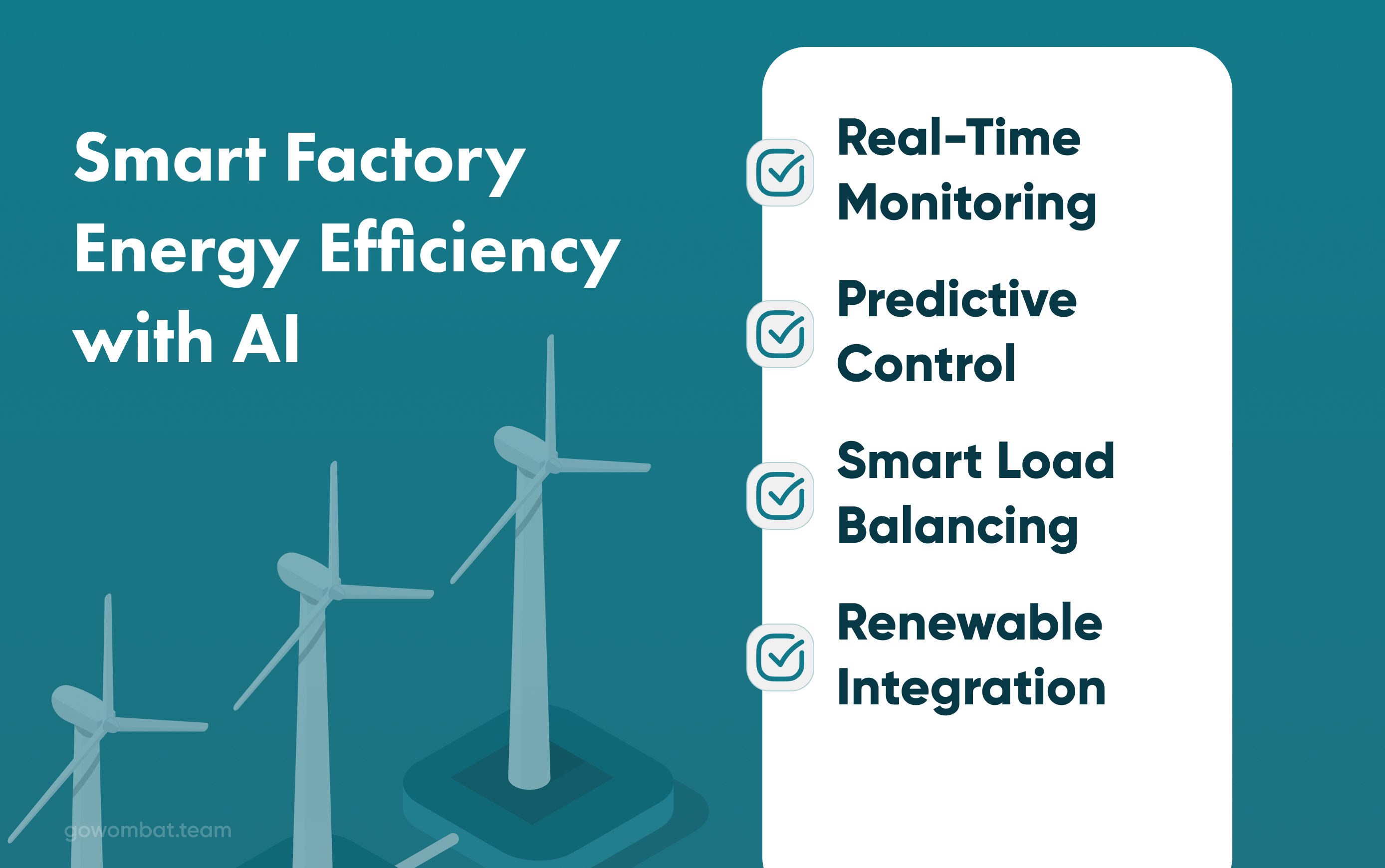
AI energy management systems cut power use through real-time analysis and control. They adjust lighting, heating and machines so that energy is used only when needed, and they balance loads across the whole facility. That matters because industry is the largest end user of energy. Data centres, often the focus of green AI discussions, used around 415 TWh in 2024, about 1.5% of global electricity consumption, according to the IEA.
- Minute-by-minute load control
AI moves non-critical work to times when electricity demand is low.
- Predictive control
AI anticipates changes in demand and prepares systems for them. Digital twins let teams test energy management strategies in a virtual environment first.
- Renewables integration
AI matches energy-intensive work to solar and wind output so that more of the clean energy produced is actually used.
How Does AI Reduce Waste in Production?
AI improves product quality and process efficiency, which reduces scrap and material waste. For examples from leading factories, see McKinsey's article on how manufacturing lighthouses are capturing the full value of AI.
AI detects defects early and forecasts equipment failures by automating data collection and analysis. With AI-driven solutions, less manual inspection is needed in repetitive tasks, which reduces human error and makes quality more consistent. Finding and fixing the most costly defects also cuts scrap, energy use and operating costs.
- Computer vision inspection
Image recognition finds defects on the line in real time.
- Predictive maintenance
Sensor data shows when equipment is likely to fail, so it can be fixed before it produces parts that are out of specification.
- Process optimisation
Analysis of historical production data shows which settings produce off-spec material, so they can be avoided.
- Inventory and supply forecasting
Better demand forecasts prevent overproduction and help plan material orders.
How Does AI Support Circular Manufacturing?
AI supports circular manufacturing by improving product design, reuse and reverse logistics, so products stay in use longer and consume fewer resources:
- Design optimisation: generative design tools produce components that use less material and are easier to recycle.
- Lifecycle tracking: AI estimates when products reach end of life and helps organise recycling logistics.
- Reverse logistics: AI optimises the collection and remanufacturing of returned products.
- Repair forecasting: AI identifies machines or parts close to failure that need repair or replacement.
How Does Data Automation Improve Resource Efficiency?
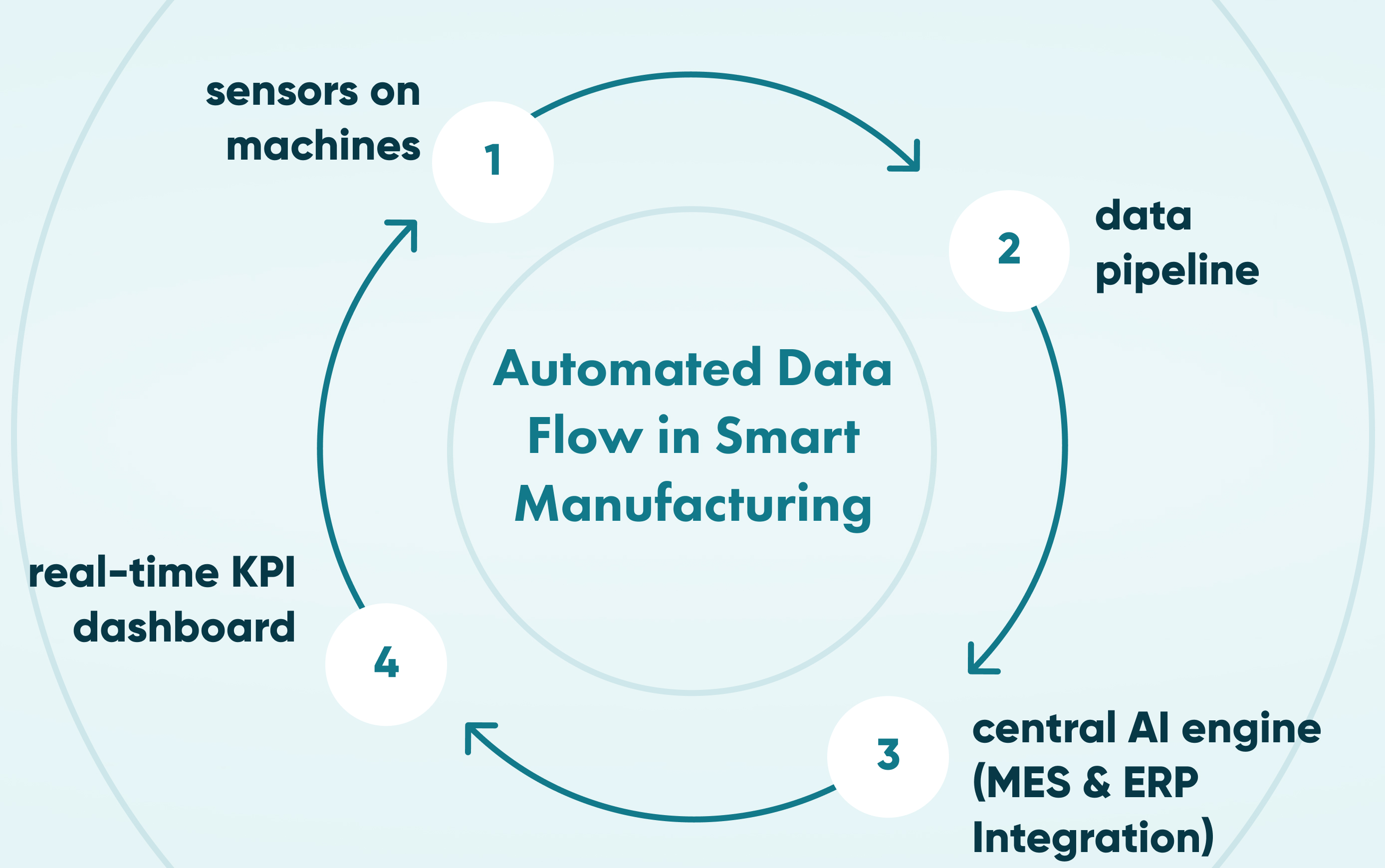
Data automation tools collect data from production, the factory floor, sales and other operations and load it into a data warehouse. That gives a complete picture of manufacturing performance and simplifies analysis and reporting. With the data in one place, decisions are faster, analysis is more accurate, and AI can act on it:
- Real-time insights: dashboards help managers to recognise waste, inefficiencies, or abnormal usage.
- Scalable consistency: automation removes manual errors in repetitive tasks and scales with output.
- AI integration: continuous data streams let AI adjust production on the fly, for example to energy prices or weather.
Comparative Impact of AI-Driven Sustainable Manufacturing
An illustrative comparison, not based on measured data: Company A uses AI across its operations, while Company B relies on traditional processes.
Energy costs • Company A: lowers energy costs through real-time optimisation and intelligent energy management. • Company B: energy costs rise due to inefficient scheduling and a lack of real-time control.
Downtime and repairs • Company A: reduces downtime through predictive maintenance and early fault detection. • Company B: experiences more downtime caused by unexpected breakdowns and reactive maintenance.
Material waste • Company A: reduces material waste with AI-driven defect detection and quality control. • Company B: generates more waste due to overproduction, late defect detection and poor quality control.
Decision-making speed • Company A: makes decisions faster with automated analytics and real-time insights. • Company B: decides more slowly because of manual data handling and fragmented information.
Compliance reporting • Company A: streamline compliance through automated reporting, dashboards, and real-time data collection. • Company B: compliance reporting is time-consuming, manual, and prone to errors.
Operational scalability • Company A: scale operations more easily using data pipelines, automation, and AI models. • Company B: scalability is limited and heavily dependent on manual effort.
Supply chain resilience • Company A: strengthen supply chains with AI-driven demand forecasting and predictive planning. • Company B: supply chains remain vulnerable due to reactive planning and limited visibility.
Brand and investor appeal • Company A: achieve higher brand trust and investor interest through ESG alignment and transparency. • Company B: lower credibility and reduced access to sustainability-focused investors.
Profit margins • Company A: improve profit margins by optimising efficiency, reducing waste, and lowering operational costs. • Company B: profit margins remain under pressure due to inefficiencies and higher operating expenses.
Benefits and Limitations of AI-Driven Sustainability
AI-driven sustainability has clear benefits and real barriers.
Pros:
- Lower energy costs through optimised consumption
- Less waste and fewer emissions
- Safer workplaces, as automation takes over hazardous or monotonous tasks
- More accurate forecasts, which make maintenance and management more proactive
Cons / Barriers:
- Poor data quality and data silos slow down AI implementation
- High initial integration costs and the complexity of legacy systems
- A skills gap: many manufacturers lack in-house AI and data analytics expertise
- The need for governance and transparency to ensure AI is used responsibly and customer rights are respected
Practical Steps to Implement AI for Sustainable Manufacturing
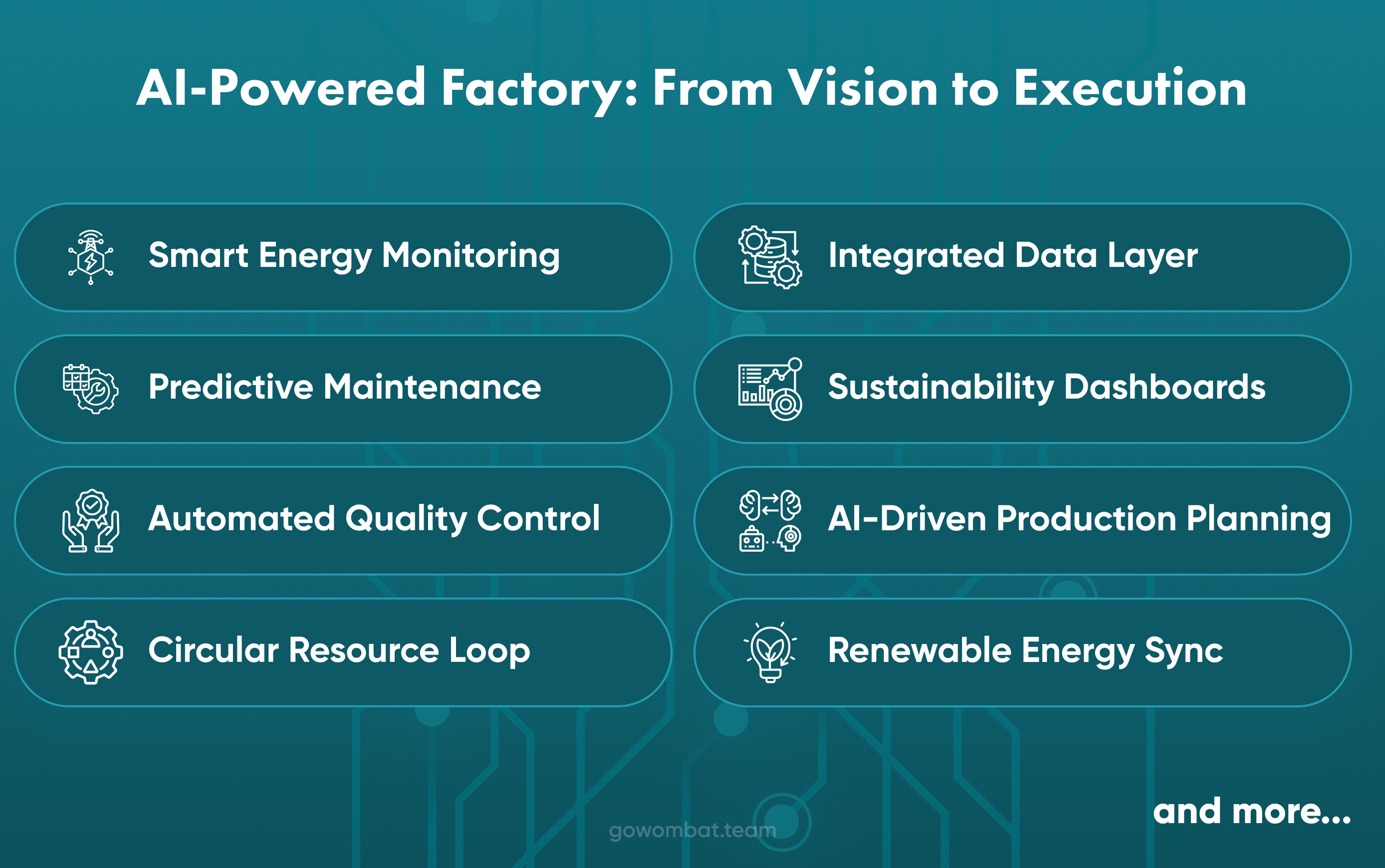
Manufacturers can adopt AI for sustainability step by step:
- Evaluate energy and waste hotspots in manufacturing processes to discover potential areas of improvement
- Build a reliable IoT data layer for data collection and monitoring
- Integrate ERP, MES and IoT systems to remove data silos
- Pick high-impact predictive use cases, such as maintenance or quality control
- Start with pilot projects to prove AI-powered solutions before scaling
- Track sustainability KPIs on real-time dashboards
- Train business users and operators in data literacy
- Put AI governance in place so that AI is deployed ethically, transparently and responsibly
Key Takeaways
- Sustainable manufacturing uses AI and data automation to improve energy efficiency, reduce waste and lower the carbon footprint of production.
- AI enables real-time monitoring, forecasting and closed-loop control, which helps sustainability initiatives last and scale.
- Data automation makes collecting, processing and reporting data across production operations fast and reliable.
Go Wombat builds AI solutions and data automation platforms for manufacturing and industrial companies, aimed at lower energy use, less waste and better use of resources. Get in touch with us to discuss your factory.
FAQs
How does AI contribute to environmentally friendly manufacturing?
AI helps by optimising energy use, reducing waste, enabling predictive maintenance and supporting circular production. It uses production-line data and analytics to make better operational decisions.
What kinds of data do manufacturers need to automate sustainability?
Manufacturers need energy consumption data, production metrics, supply chain information and sensor data, some of it unstructured. Historical data combined with live IoT data is the foundation for AI-driven sustainability work.
Why is the use of predictive maintenance so vital to sustainability?
Predictive maintenance reduces downtime and prevents sudden failures, which saves energy and raw materials. Scheduling repairs before equipment fails also extends asset life and reduces waste.
What are the obstacles to using AI for achieving sustainability?
Common obstacles are poor or unstructured data and integration problems, high upfront costs, complex legacy systems, a shortage of skilled staff, and the need for clear governance of AI.
In what ways could a small or mid-sized manufacturer initiate AI sustainability projects?
Start with a pilot focused on one use case, such as energy monitoring or quality control, build the IoT data foundation, and train teams in data literacy. Cloud-based AI services can lower the upfront investment and complexity.
Share and subscribe to our blog
Related articles

The Benefits of Machine Learning in Manufacturing
Where machine learning helps in manufacturing, and how we used it to detect used and counterfeit components on electronics assembly lines.

How RAG Helps AdTech Platforms Reduce Campaign Data Hallucinations
RAG helps AdTech platforms reduce AI hallucinations by grounding outputs in real campaign data, making reporting, attribution and recommendations more accurate and auditable.

Native vs Cross-Platform Mobile Development: How to Choose in 2026
Compare native, Flutter and React Native development to find the right approach for your mobile product based on performance, cost, speed and scalability.

How can we help you ?

