



What Is the Best Facial Recognition Model for Stadium Ticket Verification?

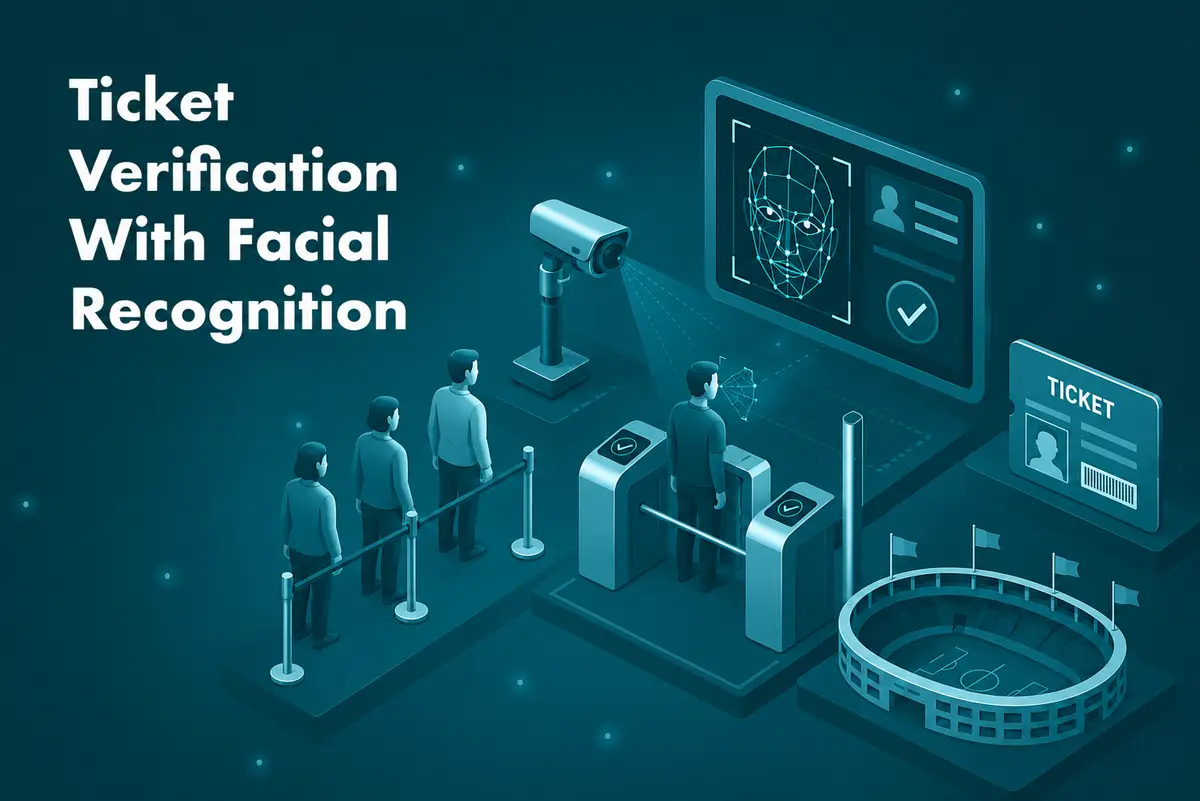
Facial recognition access control at stadiums matches a fan's face against a pre-registered ticket record. The fan looks at a camera for a moment and the gate opens, with no barcode or manual check. The system combines computer vision, biometric authentication and physical access control, and it has to work for 40,000 fans arriving in a short window. For venue operators, the open question is which model holds up at stadium scale, under stadium lighting, with a queue that will not wait.
This article covers what “best” means in measurable terms, how venues use facial recognition for entry today, and what a security director should check before signing a contract.
What “best” actually means for stadium-scale facial recognition
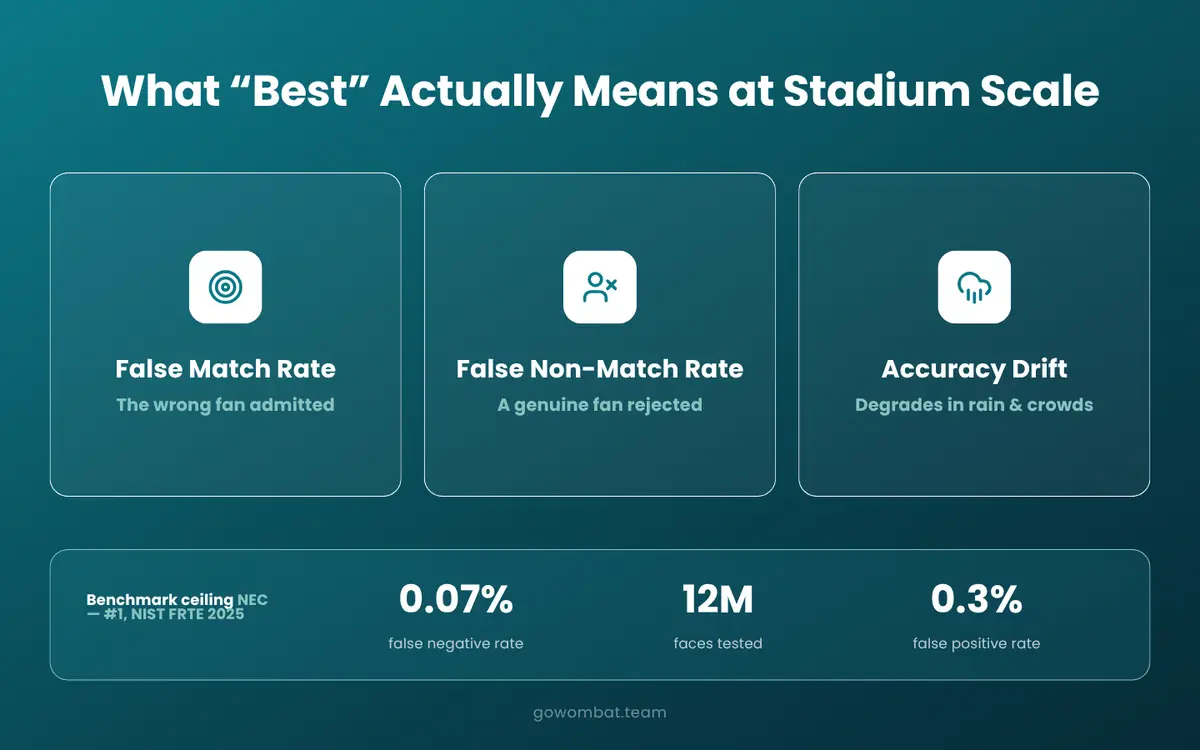
For biometric access control at a venue holding 40,000 people or more, “best” comes down to three numbers: the false match rate, the false non-match rate, and how far both drift under crowd lighting and motion blur.
The US National Institute of Standards and Technology runs the Face Recognition Technology Evaluation (FRTE), known until 2023 as the Face Recognition Vendor Test (FRVT). It is the closest thing the industry has to an independent benchmark. NEC's algorithm ranked first in NIST's FRTE 1:N identification results of March 2025, announced by NEC in April 2025, with a false negative rate of 0.07 per cent against a mugshot database of 12 million people, at a 0.3 per cent false positive rate. In March 2026, NEC reported a further improvement to 0.06 per cent. These are lab results for 1:N identification on mugshot photos. Stadium entry is 1:1 verification in uncontrolled conditions, where motion blur, lighting and rain lower performance, so ask vendors for 1:1 results from real gates. Error rates matter at this scale: at 1 per cent, a venue would face hundreds of failed scans an hour and a queue that backs up fast.
Some vendors market the same thing as AI ticket verification; the label matters far less than the error rates measured at a real gate.
How stadiums are already using facial recognition ticket verification
In North American sport, the technology is already past the pilot stage.
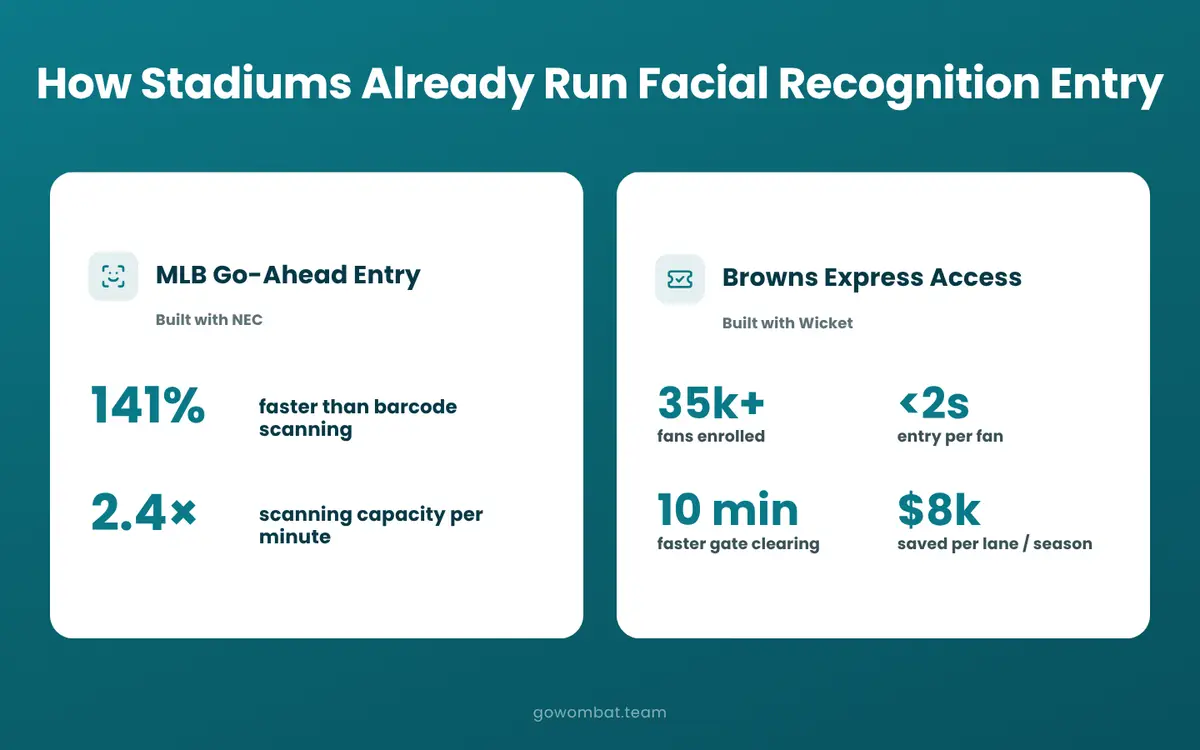
Major League Baseball's Go-Ahead Entry programme, built with NEC, now runs at ten ballparks, including Dodger Stadium, Great American Ball Park, American Family Field, Target Field, and Citizens Bank Park. Fans who opt in walk through a lane, glance at a camera, and they are through: no ticket presented, no barcode scanned. According to data cited by Sports Business Journal in 2025, Go-Ahead Entry lanes are 141 per cent faster than traditional entry lanes, with 2.4 times the scanning capacity per minute of barcode scanning.
The Cleveland Browns went a similar route at Huntington Bank Field, under the name Express Access, using facial authentication software from Wicket. The club's numbers were average entry of under two seconds per ticket, gates clearing about ten minutes faster on matchday, a 75 per cent reduction in the space needed for ticketing lanes, and average savings of 8,000 dollars per lane, per season.
Both deployments share one design choice: opt-in enrolment rather than a mandatory scan at the gate. That matters for fan acceptance and, as the case further down shows, for regulators.
What to check before choosing a model
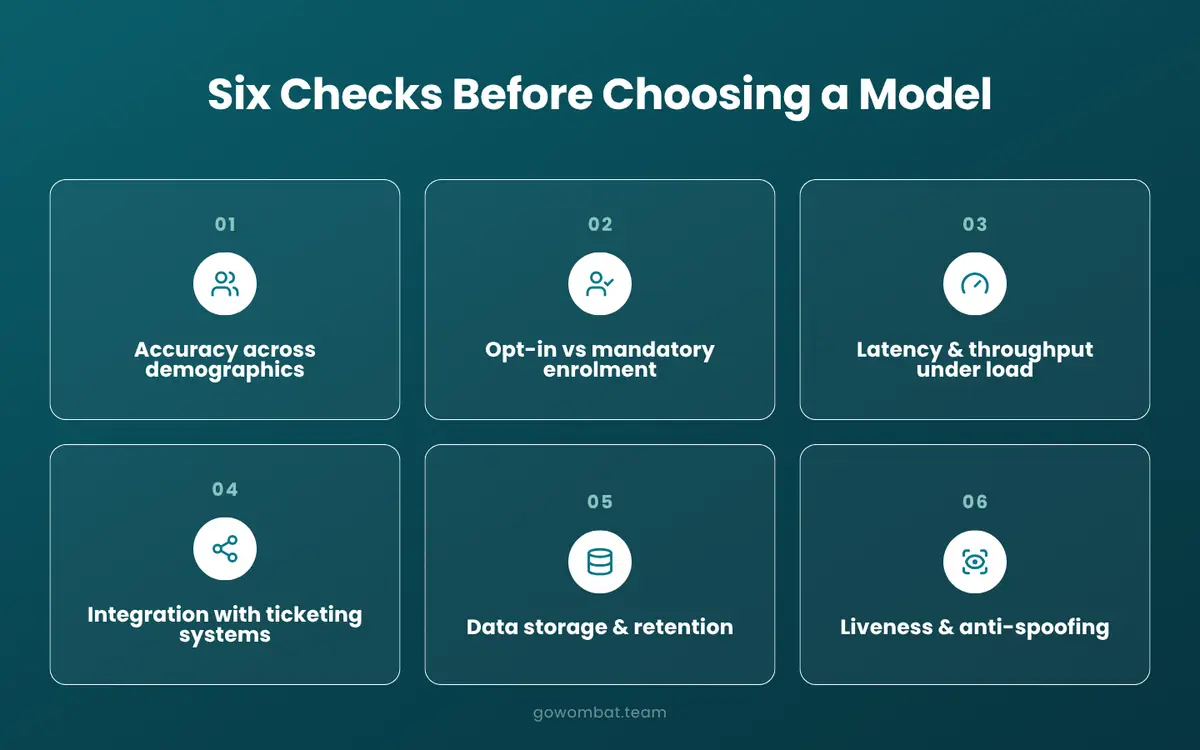
Choosing a facial recognition model for stadium ticket verification comes down to six operational questions rather than brand reputation.
Accuracy across demographics
NIST and other independent testers publish demographic breakdowns alongside the headline accuracy score, and for good reason. A model can top the overall rankings and still carry a noticeably higher false positive rate for specific age or ethnicity groups. That becomes a legal problem long before it becomes a customer complaint.
Opt-in versus mandatory enrolment
Regulators across Europe, and in a growing list of US states, treat consent as the factor that decides whether a deployment is lawful at all, not whether fans happen to like it.
Latency and throughput under load
A machine learning model that scores well in a lab benchmark can still fail at a real gate if it cannot process a moving queue of thousands of faces within a 90-minute entry window.
Integration with existing ticketing and access control systems
Facial recognition access control rarely replaces a stadium's ticketing platform; it runs alongside it. API compatibility and clean data handoff matter as much as raw accuracy.
Data storage location and retention period
Where the biometric templates actually live, and for how long, shapes both the security posture and the regulatory obligations attached to it.
Liveness and anti-spoofing controls
ISO/IEC 30107 sets out presentation attack detection standards, the technical line between a genuine face scan and a photograph held up to the lens. That distinction matters far more at a public gate than in a controlled office lobby.
Is facial recognition at stadiums legal? Privacy and compliance realities
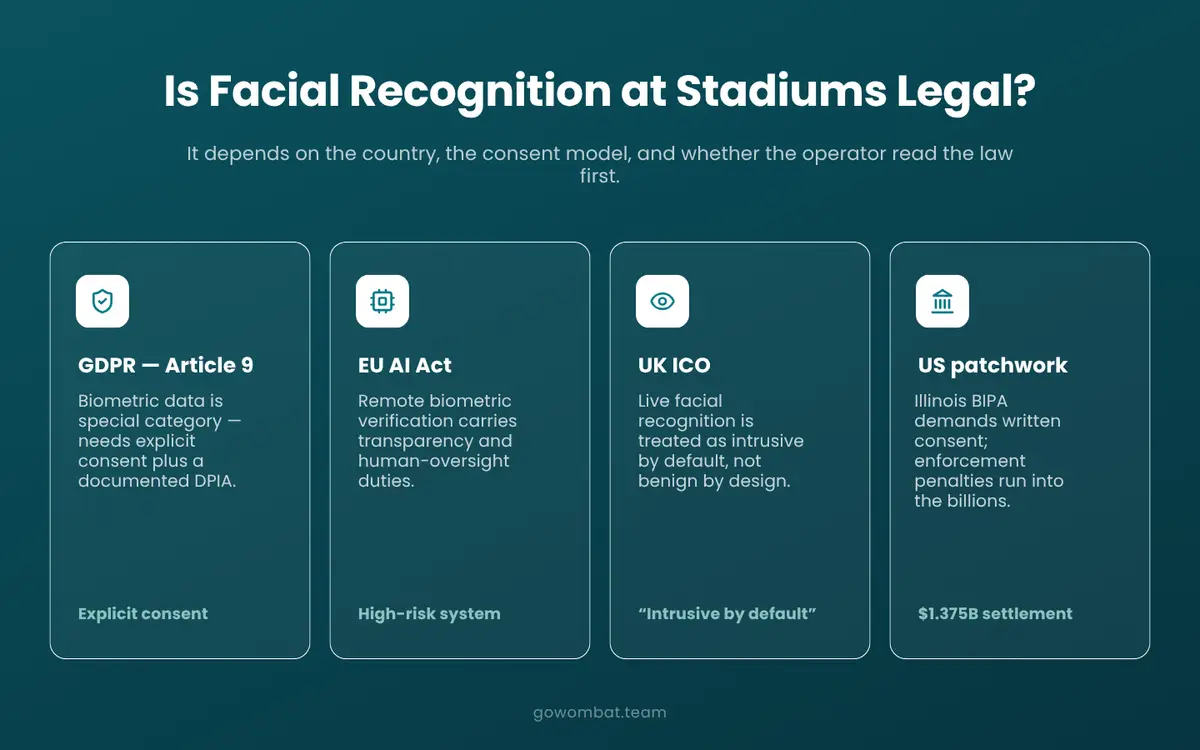
Is facial recognition at stadiums legal? Depends who you ask, honestly. More precisely, it depends on the country, the consent model, and whether the operator actually read the relevant law before switching the cameras on.
Under the GDPR, biometric data used to uniquely identify a person counts as special category data under Article 9. That means processing it generally needs explicit consent, and in most cases, a documented data protection impact assessment too. The EU AI Act adds a narrower layer here: it classifies remote biometric identification, matching a face against a database of many, as high-risk. Straightforward biometric verification, confirming that one specific pre-registered fan is who they claim to be, is explicitly carved out of that category. Stadium ticket matching sits on the verification side of that line, so it carries fewer of the Act's transparency and oversight obligations by default. The UK's Information Commissioner's Office takes a similarly wary view under UK GDPR. Live facial recognition, in its reading, is intrusive by default. Not benign by design.
Spain's data protection authority made that point about as directly as a regulator can. In a resolution dated December 2024 and made public in January 2025, it fined Club Atlético Osasuna 200,000 euros over the biometric access control stadium system running at its El Sadar ground. The ruling was that the club's consent basis failed the GDPR's necessity and proportionality tests, and the club was ordered to stop using the system and delete every scrap of biometric data it had collected. Osasuna has appealed to Spain's Audiencia Nacional. Here is the uncomfortable part: the club had actually followed what looked like a sensible process. Pre-registration. A selfie. An ID scan. Explicit sign-up. None of it saved them.
The United States piles its own patchwork on top of all this. Illinois' Biometric Information Privacy Act requires private companies to tell people in writing what biometric data they collect, why and for how long, and to obtain a written release first. In 2025, Google agreed to pay Texas 1.375 billion dollars to settle claims that included harvesting facial geometry and voiceprints without consent, alongside separate allegations over location tracking and incognito browsing data.
Most venue operators assume that if the technology works, the legal side will sort itself out eventually. The Osasuna case argues otherwise, loudly: a technically sound, fully functioning system got shut down anyway, because the consent model underneath it did not hold up under scrutiny.
Rolling out facial recognition entry without alienating fans
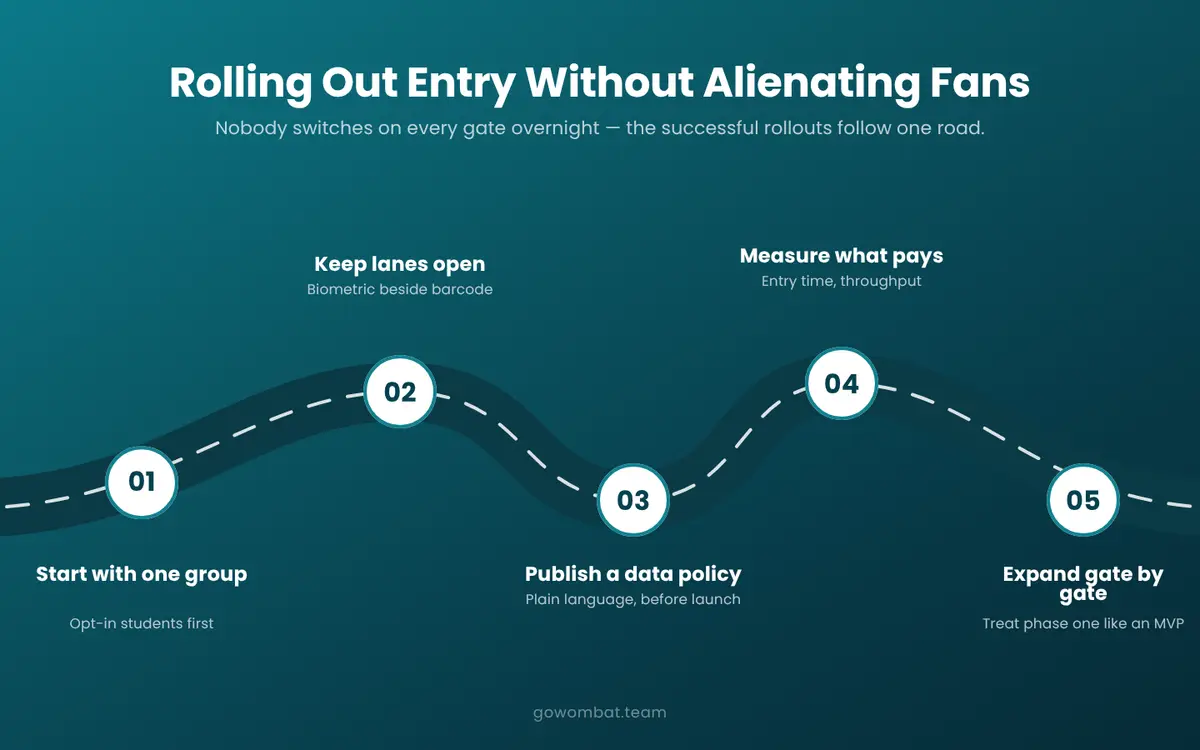
The venues above rolled out facial recognition entry gradually, not at every gate at once. A workable sequence looks like this:
Start with a single, well-defined group
Arizona State University's pilot at Mountain America Stadium, announced to start in October 2025, was limited to students on an opt-in basis, with plans to open it to other fans only gradually.
Keep the traditional lane open
Every deployment covered here, MLB's ballparks included, ran biometric entry alongside conventional ticket scanning rather than instead of it.
Publish a plain-language data policy
Publish it before launch, not after the first complaint lands. What gets collected, how long it is kept, who can ask for deletion: all of that should be public before a single camera goes live.
Measure the operational metrics that actually justify the spend
Track entry time per fan, lane throughput and the drop in queue-related incidents, and share the numbers internally: they build the case for phase two.
Expand gradually, gate by gate
Treat the first phase like an MVP development effort: use what enrolment data shows to size what comes next, rather than guessing at demand.
Where Go Wombat fits
Deploying facial recognition ticket verification at stadium scale means connecting computer vision models, existing ticketing infrastructure, identity and access management, and a compliance framework that may have to satisfy more than one regulator.
Go Wombat builds and integrates computer vision pipelines for real-time face matching, secures the resulting system through cybersecurity services built around biometric data, and automates enrolment and support workflows through AI agent development so staff are not chasing manual sign-ups on matchday. For clients in the sports industry weighing custom software development against an off-the-shelf vendor, the deciding factor is usually whether the system holds up with a full house, in bad weather and under a regulator's follow-up questions, rather than the accuracy figure on a spec sheet.
Our wider work in AI services and solutions covers this kind of integration end to end, right through to the data security and compliance work that keeps a biometric deployment on the right side of GDPR and the EU AI Act. Facial recognition entry is one part of a wider smart stadium technology stack, alongside dynamic pricing and crowd flow analytics, and works best when it is planned as part of that stack.
Assess your readiness for facial recognition entry with an engineering review of your current ticketing and access control stack.
Key takeaways
Facial recognition access control is already in use: MLB's ballparks and the Cleveland Browns' Express Access lanes show that the throughput and cost case works today.
Algorithm accuracy has improved a lot: in NIST's 1:N identification tests, the most accurate algorithms miss fewer than 0.1 per cent of matches at a false positive rate of 0.3 per cent, although gate conditions are harder than the lab. The harder problem sits elsewhere: consent, retention, jurisdiction, exactly what tripped up Club Atlético Osasuna, despite running a system that technically worked fine.
Any venue operator sizing up this technology should treat the legal and consent model as a design requirement from day one, not a compliance patch bolted on after the cameras go up. Book a scoping workshop with our engineers before you commit to a vendor.
Frequently asked questions
Is facial recognition at stadiums GDPR-compliant?
It can be. But only with a clear legal basis, usually explicit consent, plus a documented data protection impact assessment. Club Atlético Osasuna's 200,000-euro fine, made public in January 2025, shows exactly what happens when the consent model does not meet the GDPR's necessity and proportionality tests, even when the technology itself works fine.
How accurate is facial recognition ticket verification compared with traditional scanning?
The leading algorithms are very accurate in lab tests. NEC's algorithm, ranked first in NIST's FRTE 1:N results announced in April 2025, posted a 0.07 per cent false negative rate when searching a mugshot database. Ticket entry is a 1:1 check in less controlled conditions, so ask vendors for 1:1 results from real gates.
Do fans have to opt in to facial recognition entry?
In every deployment covered here, yes. MLB's Go-Ahead Entry and the Cleveland Browns' Express Access both run as opt-in programmes alongside conventional ticket lanes, and regulators across the EU treat consent as central to whether the system is lawful in the first place.
What is the difference between facial recognition and facial verification at venues?
Facial verification checks one face against a single pre-registered record, a straightforward 1:1 match used for ticket entry. Facial recognition, in the 1:N sense NIST tests, searches a face against a much bigger database, a use case that shows up in security watchlists far more often than routine stadium entry.
What does it cost to deploy facial recognition entry at a venue?
It varies by vendor and integration scope. The Cleveland Browns' figures are a useful reference for payback rather than price: an average of 8,000 dollars saved per ticketing lane, per season, once staffing and lane footprint reductions are counted.
Can facial recognition reduce queueing time at stadium gates?
Yes. Data cited by Sports Business Journal shows Go-Ahead Entry lanes running 141 per cent faster than traditional entry lanes, and the Cleveland Browns measured gates clearing around ten minutes faster on matchday after Express Access went live.
Share and subscribe to our blog
Related articles

How Smart Stadiums Are Evolving into Digital Ecosystems
How AI, IoT, digital twins and custom software are changing stadium operations, security, fan engagement and revenue in 2026.

Why Predictive Analytics Is the Key to Engagement and Loyalty
How sports leagues and entertainment companies use predictive analytics for personalisation, churn prediction and loyalty, with examples from the NBA, Formula 1 and LaLiga.

How RAG Helps AdTech Platforms Reduce Campaign Data Hallucinations
RAG helps AdTech platforms reduce AI hallucinations by grounding outputs in real campaign data, making reporting, attribution and recommendations more accurate and auditable.

How can we help you ?