



Why Predictive Analytics Is the Key to Engagement and Loyalty

Sports leagues, travel and entertainment companies use predictive analytics to improve fan engagement and customer loyalty. Predictive models find patterns in ticket sales, app usage, streaming, purchases and social media, and show how fans behave along their journey. With that insight, organisations can personalise experiences, spot fans who are drifting away before they leave, and increase loyalty, retention and lifetime value.
Why Predictive Analytics Matters for Modern Engagement
Fans and customers expect brands to know who they are, anticipate what they want next and deliver personal experiences immediately. If they are unhappy, they switch quickly to another sport, streaming service or travel company.
Four trends drive this:
- Personalisation is expected. Customers want offers, content and messages that fit them, on every channel.
- Attention is short. Messages that are late or irrelevant are ignored.
- Retention has to be proactive. Brands need to predict who may leave and re-engage them before they do.
- There is more data than ever, but many companies lack the tools to use it.
Companies that depend on loyalty are adopting AI-driven personalisation, VR experiences and data analytics to understand fan preferences. In the sports industry, predictive analytics is becoming a standard part of that toolkit.
Common Software Solutions Powered by Predictive Analytics
In real-world implementations, predictive analytics is delivered through:
- Custom analytics platforms with role-based dashboards and KPIs
- Mobile applications that surface personalised content, offers, and notifications
- AI-powered bots or assistants that provide recommendations and alerts
- CRM and loyalty system extensions driven by predictive scoring
- Stadium operations tools using real-time behavioural and sensor data
How Predictive Analytics Enhances Fan Engagement

What Is Predictive Analytics and How Does It Work?
Predictive analytics combines AI, machine learning algorithms, and statistical modelling to predict future behaviour and identify trends from past data. Typical results are:
- Ticket purchase likelihood
- Churn risk
- Content affinity
- Merchandise preferences
- Attendance probability
- Sentiment trends
- Key aspects of customer interactions
- Propensity to upgrade or subscribe
A simplified workflow includes:
- Data collection - capturing behavioural, transactional, and social interactions;
- Data integration - unifying ticketing, CRM, app, POS, OTT, and web data;
- Modelling - applying LR, random forests, gradient boosting, collaborative filtering and neural networks;
- Prediction - forecasting churn, purchases, content preferences, and CLV;
- Activation - delivering personalised journeys, interventions, and offers.
Predictive models and artificial intelligence are only as accurate as the data behind them, which is why data integration comes first.
How Predictive Models Transform Fan Experience
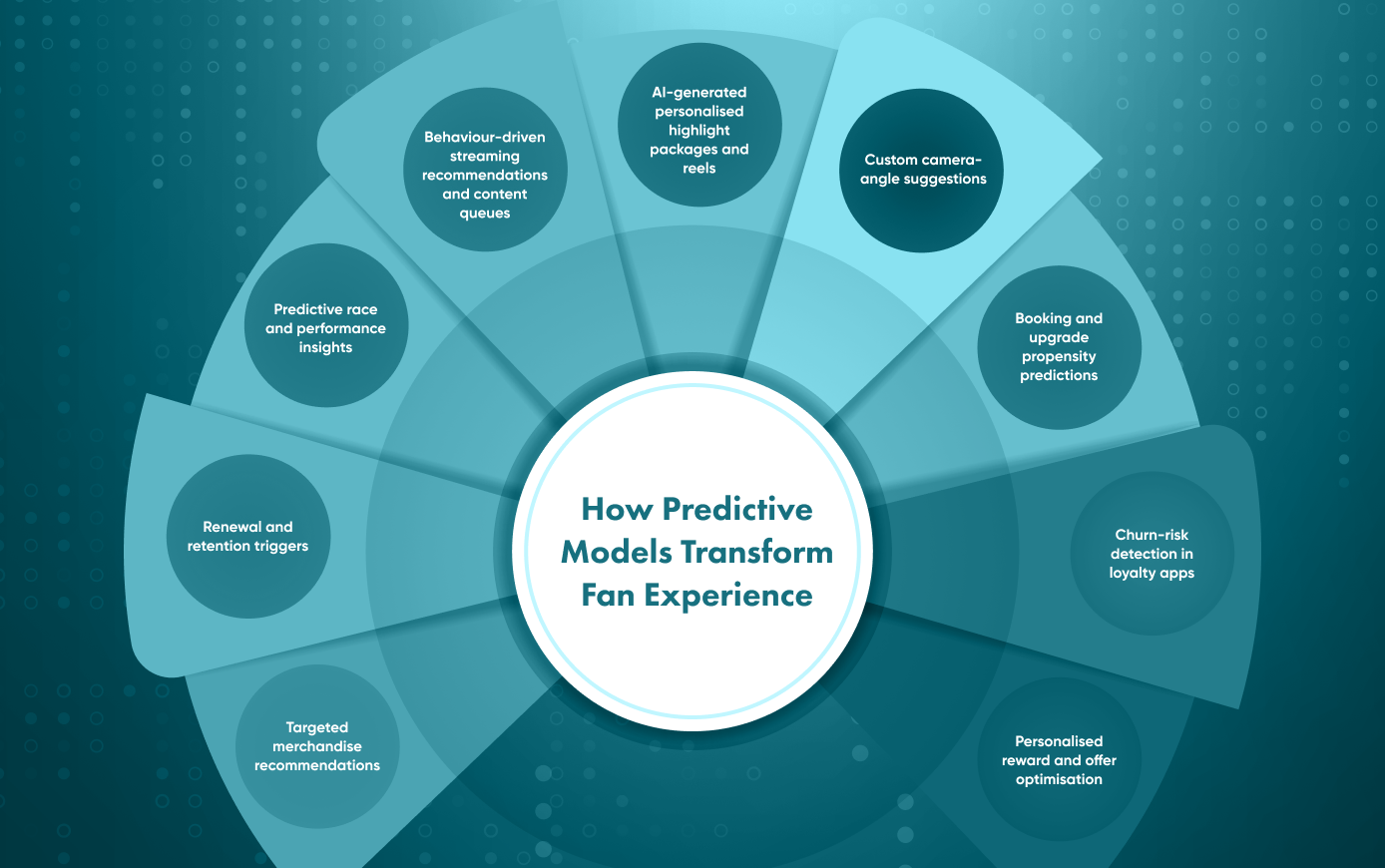
Predictive analytics changes the fan journey by making content, communication and experiences more relevant on every channel. Some examples:
NBA - personalisation at scale
In 2020, the NBA and Microsoft announced a direct-to-consumer platform on Azure that uses machine learning to personalise game broadcasts and bring together the league’s products and services. As a result, this provides a vast amount of insights and predicts future trends:
- Customised highlight reels
- Individually targeted merchandise recommendations
- Prompt renewal notifications
- On-demand content suggestions during matches
Formula 1 - predictive storytelling
Formula 1 works with AWS on “F1 Insights”, which gives fans predictive overlays such as overtaking probabilities, pit-stop strategies and tyre performance forecasts. F1 TV also uses behavioural modelling to recommend content, with the aim of increasing viewing time and subscription retention.
LaLiga - AI-powered highlights
LaLiga uses AI to generate personalised highlight packages for individual fans, based on their preferred team, players and match moments, to increase engagement across its global fan base.
Netflix - behavioural recommendations
Netflix reported in 2015 that its recommender system influenced the choice of about 80% of hours streamed on the service. The same principles are now the foundation of sports OTT experiences: personalised match highlights, recommended camera angles, and content queues tailored to fan behaviour.
Airline loyalty apps - personalised retention
Airlines use predictive analytics to estimate when a passenger is likely to book, when they may switch to another airline and when they are likely to buy an upgrade. Loyalty apps then show the rewards most relevant to each passenger, which increases customer lifetime value.
How Does Unified Fan Data Improve Loyalty and Engagement?
Data fragmentation is one of the biggest obstacles to predictive analytics. Fan data usually sits in separate systems for ticketing, CRM, OTT, POS, e-commerce, apps and social platforms, which rarely share data with each other.
A single fan data platform (a CDP or lakehouse) links all interactions to one identity. That enables:
- Accurate segmentation
- Improved churn prediction
- Consistent personalisation
- Better sponsor targeting
- Stronger CLV modelling
- Clearer understanding of fan journeys
NBA Fan Data Platform
The NBA’s Azure-based data platform brings millions of fan profiles together in one place, which makes real-time personalisation, audience-specific messaging and behaviour prediction possible.
Sports clubs
Clubs can combine ticketing, merchandise and app data to see which fans are most likely to buy season tickets, and then target their marketing at those fans, even on a small budget.
Unified data is what makes predictive analytics sustainable and scalable.
How Do Sports Organisations Personalise Experiences at Scale?
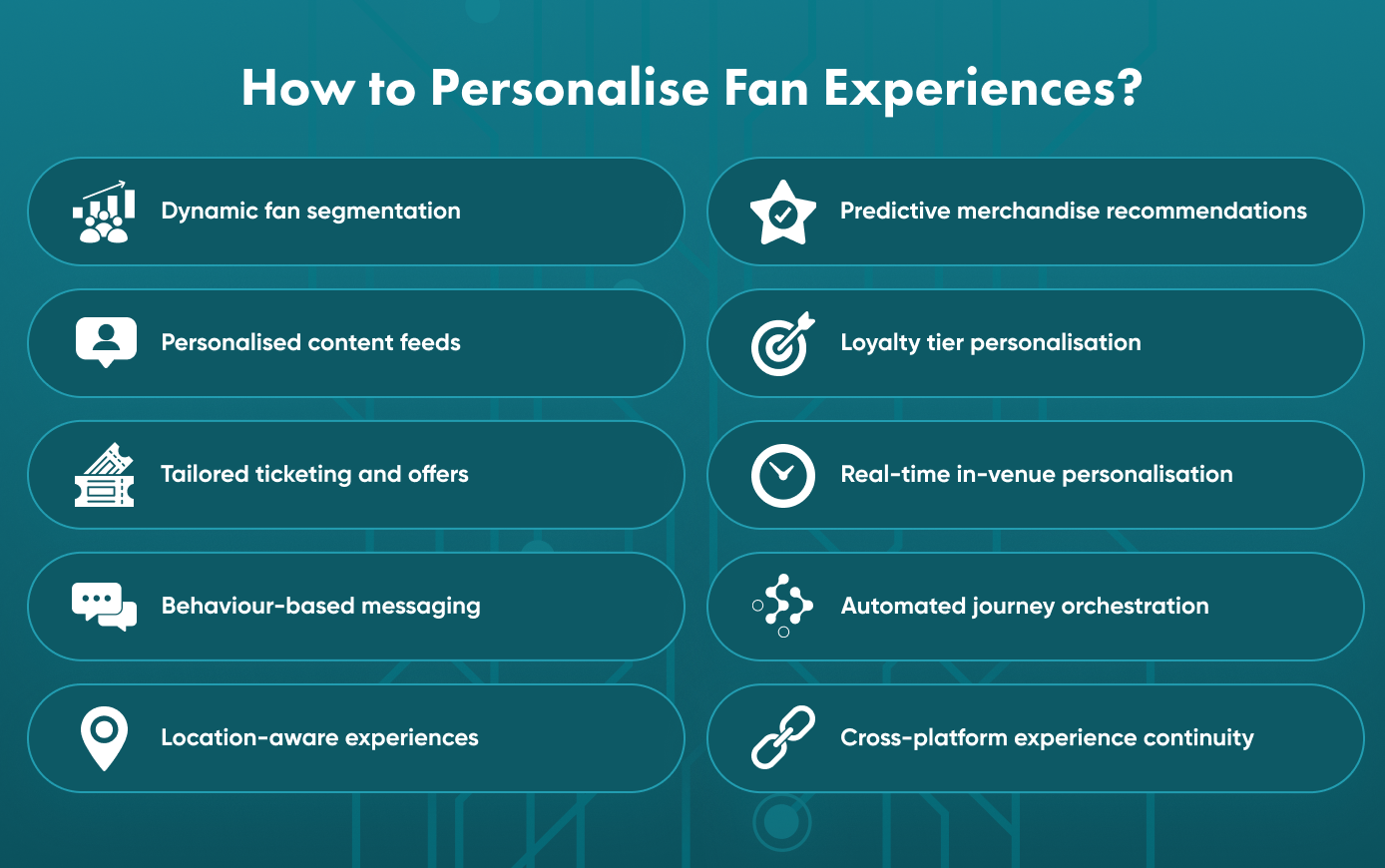
Predictive data analytics enables personalisation across digital, physical, and hybrid fan environments.
Types of Personalisation Powered by Prediction
1. Content personalisation
- Highlight packages for a fan’s favourite player or team
- Suggested games
- Individualised timelines or stories
- (Used in: NBA, LaLiga, F1TV, Premier League digital ecosystems)
2. Offer personalisation
- Ticket bundles based on past attendance
- Merchandise recommendations based on affinity scoring
- Discount timing optimised for purchase probability
3. Real-time experience personalisation
- Push notifications that respond to in-game events
- AR overlays with individualised stats (in 5G-enabled stadiums)
- Sentiment-based content changes
4. Sponsorship personalisation
- Targeted sponsor activations based on demographic or behavioural attributes
- Real-time offers activated by match events
Premier League and Microsoft Copilot: Fans get access to interaction with match data over decades, archived articles, and videos by means of conversational interfaces. Recommendations and insights adapt to each fan’s interests.
How Do Real-Time Analytics Enhance Stadium Operations and In-Venue Engagement?
Inside stadiums, real-time analytics give operations teams live information on crowds, queues and fan behaviour, so they can adjust as the event unfolds. Fans get a smoother, more personal experience.
Digital twins and operational intelligence
Venues use digital twins for operational intelligence. With these simulations, operators can keep security lines moving, reassign gates, send staff to the busiest concession stands or restrooms and manage energy use. They also work as a sales tool: the LA Clippers used a digital twin of the Intuit Dome to let buyers explore suites and in-arena views before the venue opened.
5G-enabled in-stadium engagement
UK stadiums have been testing 5G services such as augmented reality stats for your favourite teams or players, personalised instant replays, location-based offers sent to fans’ phones, and real-time queue updates that help staff redeploy and fans avoid long lines.
In-venue behavioural analytics
In-venue behavioural analytics show when fans are most likely to buy food and drink, which sections lose interest, and how a turning point in the game changes the mood in the stands. Clubs can use this to plan staffing, offers and in-venue content.
Predictive Analytics and Customer Loyalty
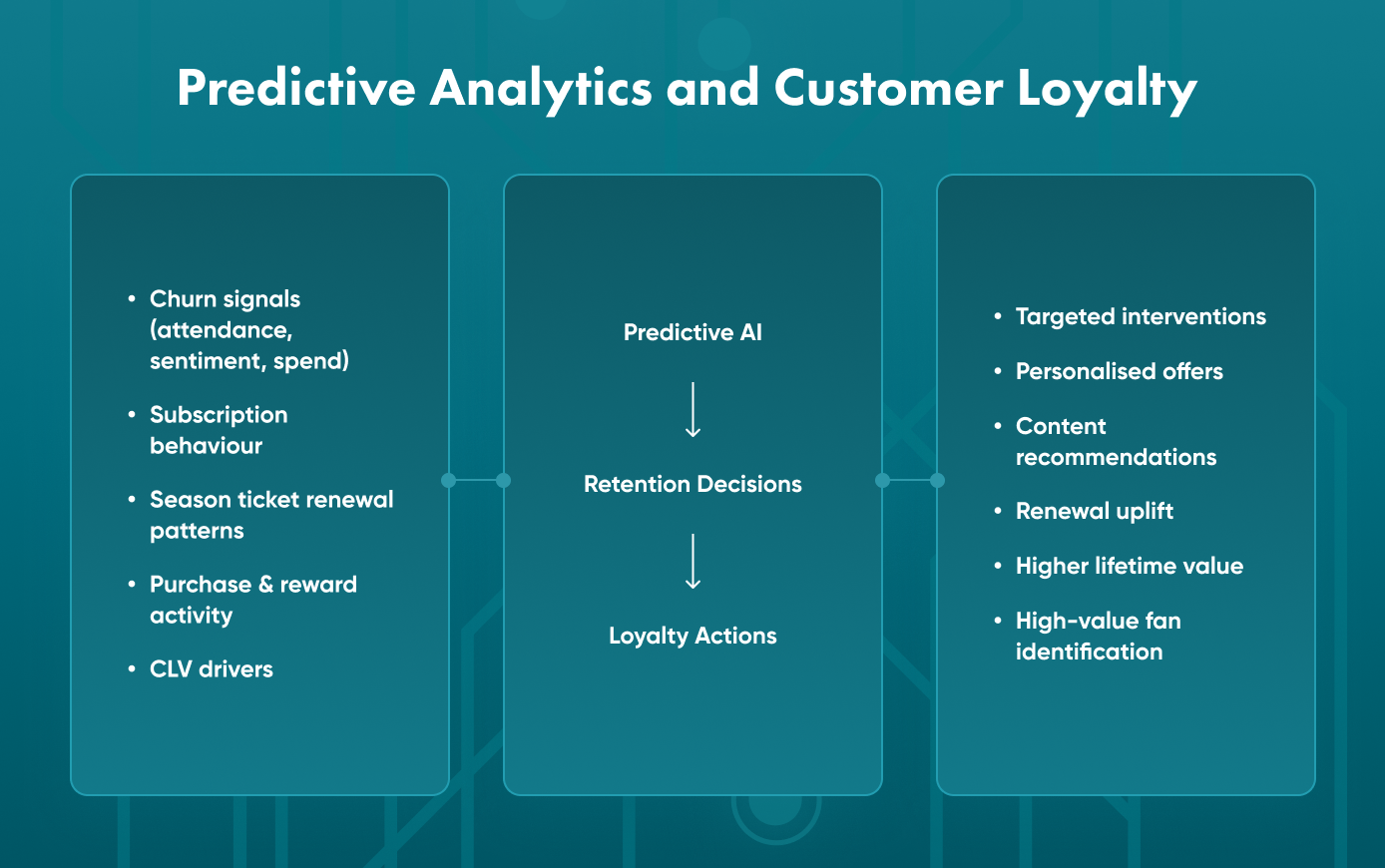
Predictive analytics helps increase loyalty, improve retention and raise fan lifetime value.
How Predictive AI Improves Retention and Lifetime Value
Organisations can identify fans at risk of leaving before they stop engaging, and act on it with targeted interventions.
Churn prediction
Churn models analyse signals that include:
- Falling attendance
- Less digital interaction
- Negative sentiment trends
- Lower merchandise spend
- Reduced OTT minutes watched
Interventions such as personalised offers or content recommendations can then be triggered automatically.
Subscription services: F1TV, NBA League Pass, Amazon Prime
Subscription platforms rely on predictive retention triggers. When a subscriber looks likely to cancel, the platform can suggest exclusive content, offer a tailored discount or send a personalised reactivation message.
Season ticket renewals
Churn models can flag season ticket holders who are unlikely to renew, so the club can contact them with personalised offers before the renewal deadline.
Starbucks - retail & entertainment loyalty
Starbucks uses AI to personalise rewards and anticipate menu preferences. Its loyalty programme is a common reference point for predictive personalisation and frequent repeat purchases.
Predictive CLV Modelling in Sports
CLV modelling helps sports organisations identify:
- High-value fans (premium experience candidates)
- Fans with high upsell potential
- Fans with high digital influence (advocacy value)
- At-risk segments with falling projected value
- Fans likely to convert from casual to loyal
CLV in sports is made up of direct spend (tickets, merchandise, concessions) and indirect value (sponsorship attribution, social influence, viewership impact).
Accurate CLV forecasts support decisions on loyalty programmes, premium seating, OTT packages and membership tiers.
What Challenges and Risks Should Organisations Prepare For?
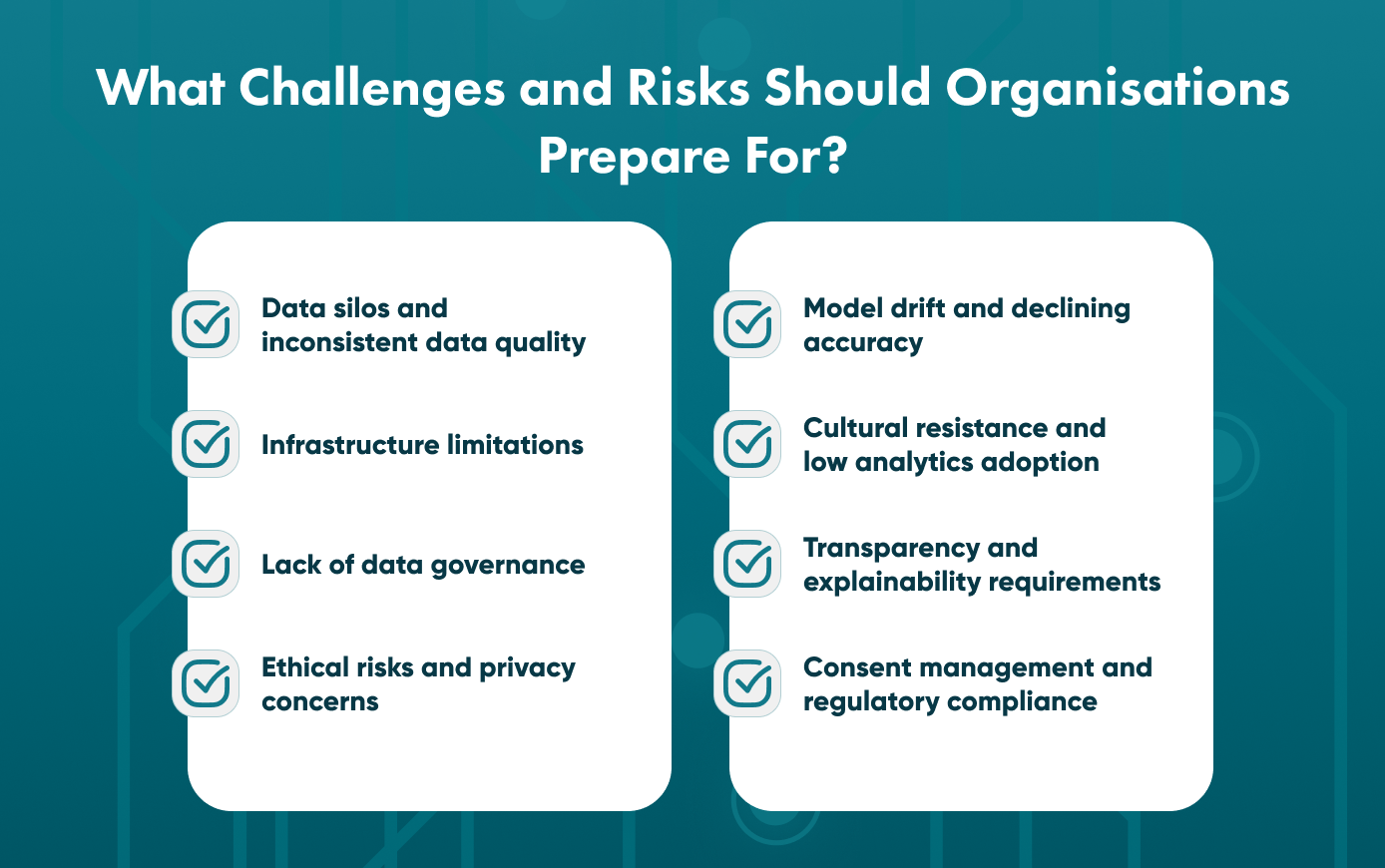
Adopting predictive analytics involves more than models. You also need to decide how data is stored, who can access it and whether your systems can handle the load.
1. Data silos and inconsistent quality
When data sits in separate systems, predictions are unreliable, and it is hard even to match the same fan across systems.
2. Infrastructure limitations
Some clubs still run older infrastructure that cannot support real-time analytics or large-scale data processing.
3. Lack of data governance
Without clear rules on who can access customer data and how it is stored, predictive projects stall early.
4. Ethical risks
Personalisation that goes too far feels intrusive, and algorithms can pick up bias if nobody checks them. Consent? That needs to be crystal clear, especially if you’re handling sensitive stuff like info on kids or location data.
5. Model drift
Fan behaviour changes over time, so models need regular monitoring and retraining.
6. Cultural barriers
If teams treat analytics as a separate dashboard that nobody uses, the models change nothing. Predictive insights need to become part of everyday decisions.
Managing these risks means building explainable AI, checking it for bias and putting data governance in place.
Conclusion and Key Takeaways
Predictive analytics depends on unified data: it is the foundation for accurate forecasts and useful loyalty programmes.
Sports teams, travel companies and entertainment brands use predictive models to retain customers, increase lifetime value and grow revenue.
When you build these models the right way - ethically, transparently, and in line with GDPR - you don’t just tick boxes. You earn trust.
Go Wombat can help you build the predictive analytics tools you need.
FAQ
How does predictive analytics make fan engagement better?
It analyses what fans do and predicts what they are likely to want next, so you can send content, offers and experiences that feel personal.
What tools help with predictive analytics in marketing and fan engagement?
Machine learning models, CDPs, CRM analytics, recommendation engines and behavioural forecasting tools. All of them can connect to your marketing automation or OTT platforms.
Why do you need unified data for predictive analytics?
Separate data sources give you incomplete fan profiles and poor predictions. Unified data lets you recognise the same fan across channels and keep your messaging consistent.
Can smaller sports clubs use predictive analytics too?
Yes. Even a modest dataset shows useful patterns. Start with one model, such as predicting which fans might leave, and build from there.
How does predictive analytics help with loyalty programs?
It tells you which fans are most likely to buy again, who’s at risk of leaving, and which rewards or offers will mean the most for keeping people loyal over time.
Share and subscribe to our blog
Related articles
How RAG Helps AdTech Platforms Reduce Campaign Data Hallucinations
RAG helps AdTech platforms reduce AI hallucinations by grounding outputs in real campaign data, making reporting, attribution and recommendations more accurate and auditable.
Native vs Cross-Platform Mobile Development: How to Choose in 2026
Compare native, Flutter and React Native development to find the right approach for your mobile product based on performance, cost, speed and scalability.

How Do You Build a Logistics Agent Network That Reroutes Freight Autonomously in Real Time?
A logistics agent network is a system of autonomous AI agents, each assigned a defined role, that monitor freight status, exchange decisions, and reroute shipments without waiting for human input at every step.

How can we help you ?

