



Internet of Medical Things: Benefits of IoT in Healthcare

According to Precedence Research, the market for the internet of things (IoT) in healthcare was worth USD 65.03 billion in 2025 and is forecast to reach USD 425.01 billion by 2035.
The part of IoT built for healthcare has its own name: the internet of medical things (IoMT).
Connected devices can improve patient care and save medical staff time.
This article explains what IoMT is, what it is used for and what benefits it brings.
What is the internet of medical things?
Healthcare is one of the areas where the internet of things is most useful, partly because of the growing number of medical wearables.
According to Global Market Insights, the market for wearable medical devices (which the report now calls clinical-grade wearables) was worth USD 137.7 billion in 2025 and is forecast to reach USD 617.9 billion by 2035.
The internet of medical things (IoMT) is the infrastructure of smart devices, software, healthcare systems, and separate smart services. Like regular IoT tech, IoMT connects devices to the internet, allowing them to send, receive, and otherwise process information automatically.
IoMT makes remote care possible and gives doctors more information about patients. Medical IoT devices fall into two broad groups:
- Devices for hospitals and specialists who work there
- Devices for patients
Smart devices such as sensors, wristbands and heart-rate monitors collect health data, and this data feeds each patient's electronic health record (EHR). Read more about EHRs and how to develop them in our detailed article.
With this information, doctors can act sooner and help prevent flare-ups of chronic diseases.
Benefits of IoT in the medical sector
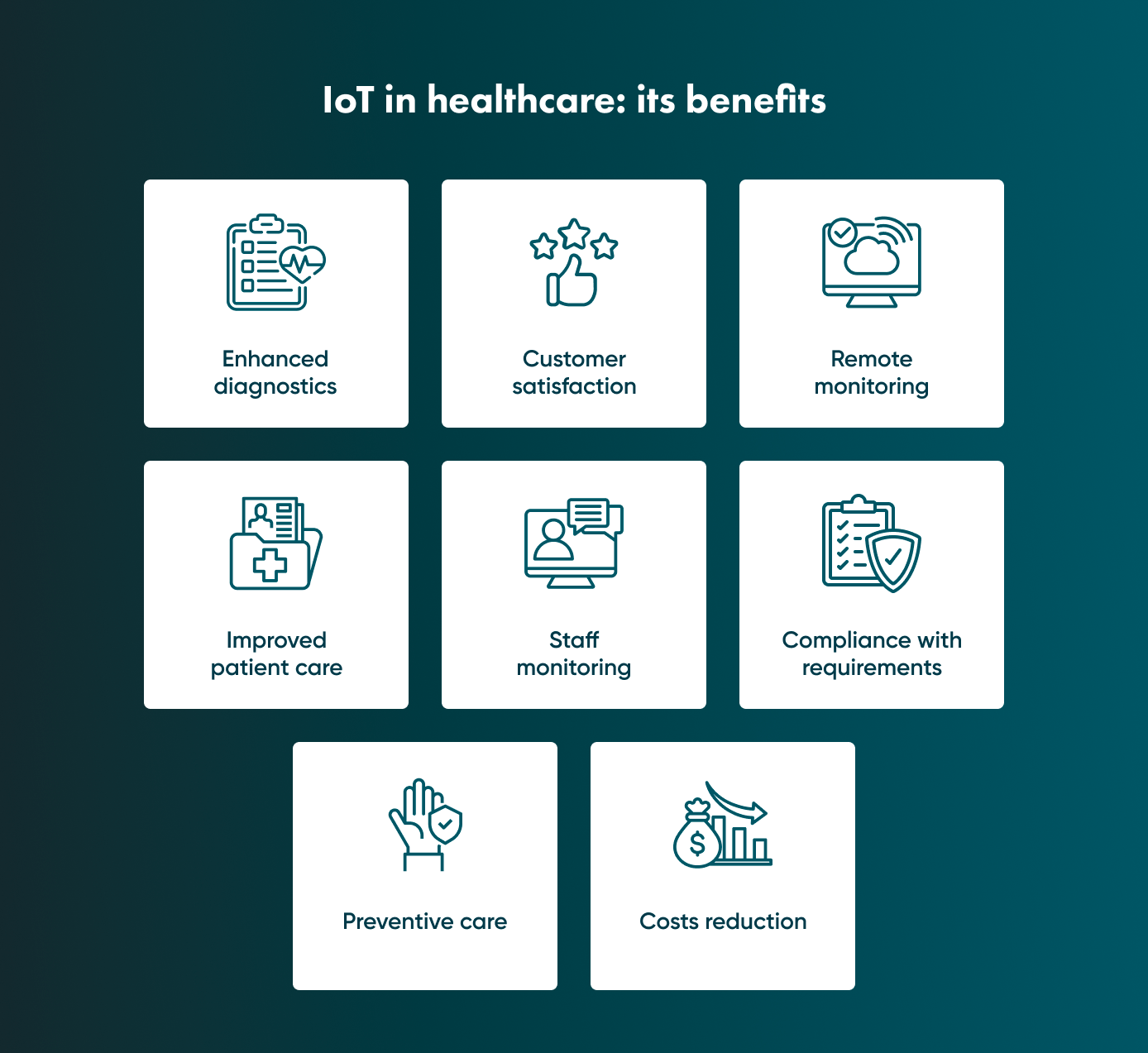
Enhanced diagnostics and treatment
Capsule endoscopy is a good example. The patient swallows a pill with a built-in mini camera that photographs the digestive tract.
Specialists analyse the images, and machine learning can automate part of the image processing.
Patient satisfaction
IoT can also make patients more involved in their treatment.
When patients track their own health and medication and share the data with their doctor, they communicate more often and better understand the doctor's diagnostic and treatment decisions.
Remote monitoring
Patients with chronic diseases may benefit from remote monitoring using medical wearables.
Wearable glucose monitors are one example: they help people with diabetes track their glucose levels continuously.
Readings go to the patient's phone and can be shared with their doctor. Other wearables let doctors follow a patient's general health at a distance.
Improved patient care
Connected monitoring devices let physicians see a patient's condition in real time and respond faster.
Staff monitoring and compliance with requirements
Managers in busy hospitals cannot check everything themselves.
IoT devices and software can automate compliance monitoring, which reduces compliance costs and legal risk.
More business opportunities
IoT also opens new business opportunities.
Data from connected devices is aggregated in the cloud, where machine learning models can analyse it.
Our in-depth article explains how to boost your business with IoT software.
IoT software development is complex. To discuss your project, contact Go Wombat.
Preventive care
Preventive care helps avoid serious complications and new diseases.
Continuous data from connected devices helps doctors spot problems early and help patients stay healthy.
Overall healthcare costs reduction
As healthcare costs rise, insurers are moving towards performance-based reimbursement, so providers have to show that their care works.
Wearables also let hospitals discharge some patients earlier and monitor them remotely at home, which reduces costs and is more comfortable for patients.
Use cases of IoT in healthcare
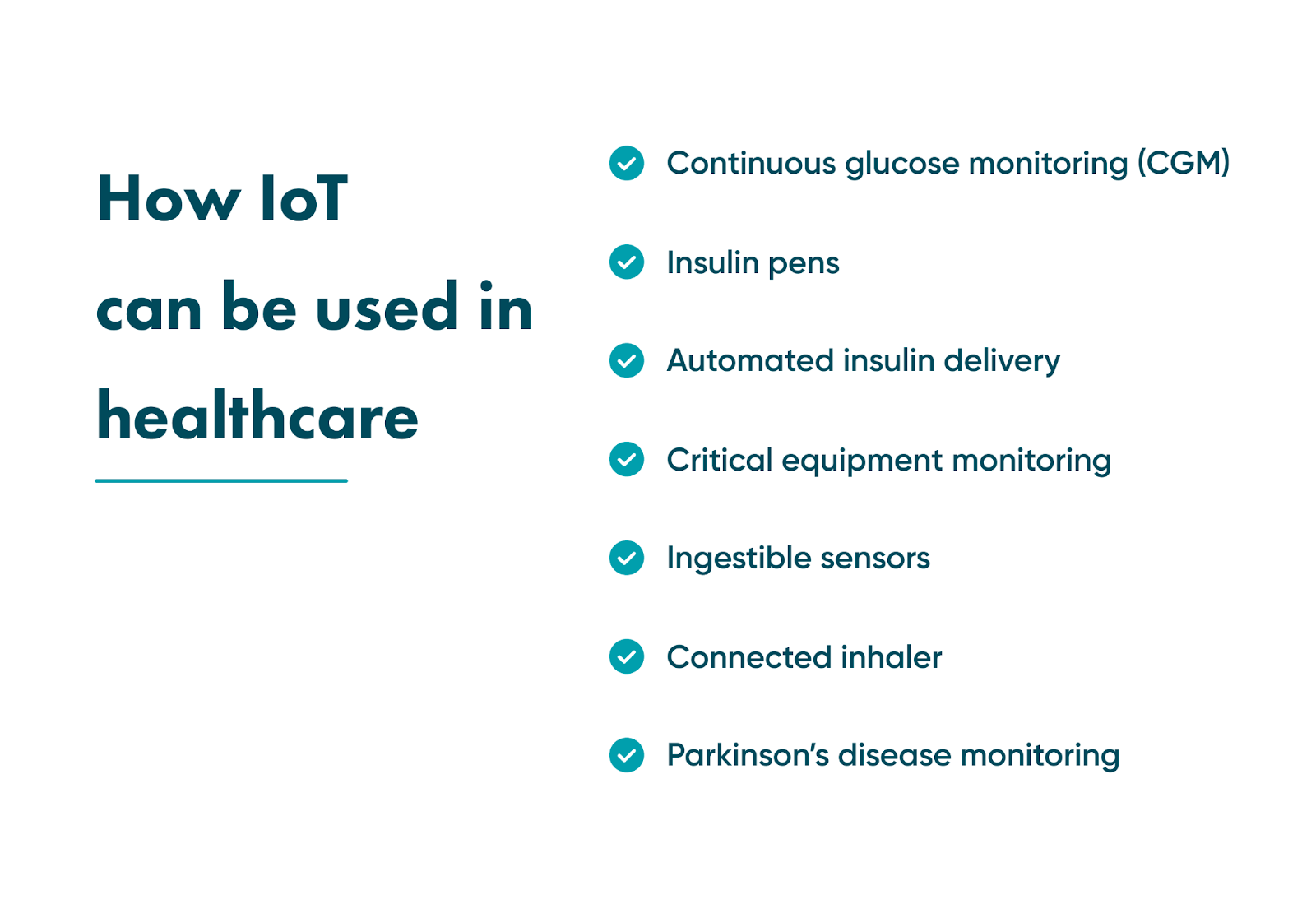
Below are the main uses of IoT in healthcare.
Intelligent continuous glucose monitoring (CGM)
Diabetes requires continuous monitoring, which makes it a natural fit for connected devices.
A CGM is a small sensor worn on the skin, usually on the belly or arm. It measures glucose levels continuously, so people with diabetes always have up-to-date readings.
Smart CGM systems send the readings to an Android or iOS app, where people can spot abnormal values quickly. Patients can share the data with their doctors.
Insulin pens
Smart insulin pens are another connected device for people with diabetes.
Smart pens and pen caps automatically record the time, amount and type of each insulin injection and store the data in an app. Some also calculate the dose and log meals and blood sugar levels, showing how meals and insulin affect glucose.
Automated insulin delivery
Automated insulin delivery is another diabetes use case. One example is OpenAPS (Open Artificial Pancreas System), an open-source initiative.
Such a system both measures glucose levels and delivers insulin.
It monitors a person's glucose level and automatically adjusts the amount of insulin delivered.
This helps keep glucose within a target range and avoid extreme highs and lows. When glucose falls, the system lowers or stops insulin delivery, which reduces the risk of low blood sugar at night (nocturnal hypoglycaemia), though it does not remove it.
Critical hardware monitoring
Hospitals rely on many electronic devices, and any of them can fail or lose power, so critical equipment needs monitoring and maintenance.
IoT solutions monitor critical equipment and alert staff to malfunctions before they put patients at risk. The e-Alert solution from Philips is an excellent example of such a tool.
Connected inhaler
Connected inhalers help people with asthma and other chronic respiratory diseases control their symptoms and treatment.
Propeller Health, now part of ResMed, does not make inhalers: it makes sensors that attach to existing inhalers. The sensor works with a mobile app that helps people with asthma track inhaler use and understand what causes their symptoms.
The main advantage is better adherence: it is easier to check that medication is taken on schedule and in the prescribed dose.
The sensor produces reports on inhaler use that patients can share with their doctors, who can then check whether the inhaler is used as prescribed. Patients see their own statistics in the app.
Ingestible pills
Ingestible sensors are pills that dissolve in the stomach and send a signal to a wearable on the body. The data then goes to a mobile app, confirming that the patient took the drug.
There are also ingestible sensors with a camera for endoscopy, which let doctors examine the gastrointestinal tract without a traditional endoscopy.
Parkinson’s disease monitoring
IoT devices also help with neurological conditions such as Parkinson's disease.
The disease is incurable, but its symptoms can be managed, and IoT helps track them.
In 2018, Apple added the Movement Disorder API to its Core Motion framework (the CMMovementDisorderManager class, watchOS 5.0 and later). It lets an Apple Watch measure resting Parkinsonian tremor in the 3–7 Hz range and dyskinesia symptoms. Apps need a special entitlement from Apple to use it.
Traditionally, a doctor assesses symptoms with tests in the clinic, and patients keep a diary to track changes. The API makes this monitoring automatic and continuous, and an iOS app can show the data as graphs.
Go Wombat's business development managers can answer your questions about software development: contact us.
What systems can be implemented using the internet of healthcare things?
Monitoring and navigation systems make medical institutions safer and more convenient for patients and staff.
IoT can track the location of equipment and route people to rooms and offices.
Applications in hospitals and other facilities include:
Assets location monitoring
Staff and managers can see where equipment is in real time and whether it is available. This improves asset management and logistics inside the hospital.
It also helps prevent theft and loss: a sensor on a piece of equipment can raise an alert if it leaves the hospital.
Optimal navigation
Large medical institutions have many rooms and offices, and finding the right one quickly is hard.
Getting lost wastes time and frustrates patients. IoT navigation systems can:
- Create digital maps with the locations of offices and rooms
- Perform step-by-step navigation around the hospital
- Build routes to any site within a medical institution
- Send personalised messages
Medical staff can use the same tools to plan their work and spend less time on routine tasks.
IoT is often combined with artificial intelligence; read more in our article about AI in healthcare.
Managers can also use IoT data to improve internal processes, for example by tracking staff workload to plan better schedules.
Go Wombat and the internet of things
IoT software for healthcare has to meet strict security requirements, and errors can cost money and harm patients' health. It needs experienced developers.
Go Wombat has experience in IoT-driven software development that includes complex algorithms.
To discuss a connected medical device or remote-monitoring app, contact us.
FAQ
How is IoT being used in healthcare?
Common uses include continuous glucose monitoring (CGM), smart insulin pens that log injections in a mobile app, and automated insulin delivery, which adjusts insulin doses automatically.
IoT is also used to monitor critical hospital equipment, in connected inhalers for asthma, in ingestible sensors that confirm a patient took their medication, and in monitoring Parkinson's disease symptoms.
What is the impact of IoT in healthcare?
The internet of medical things enables real-time patient monitoring, better drug delivery and more accurate diagnostics. Hospitals can track their equipment, and data management improves.
Who benefits from IoT in healthcare?
Both patients and physicians. Patients get less invasive diagnostics, such as capsule endoscopy, and more information about their own health.
Doctors can monitor patients remotely and act in time, and medical staff spend less time on routine work.
Share and subscribe to our blog
Related articles

A Comprehensive Guide to EHR System Development
What an EHR system is, how it differs from an EMR, its benefits and must-have features, and the steps to build a custom EHR for your practice.

AI in Healthcare: A Revolution for the Medical Industry
Where AI is used in healthcare today: the main types of AI, their benefits, use cases from diagnostics to drug development, and the problems that remain.

How Can IoT Software Solutions Boost Your Business in 2026?
How IoT software works, the business models it enables, the opportunities it creates and the integration and security problems to plan for.

How to Create a Mobile App from a Website
When a website needs a mobile app, how native and cross-platform apps compare, a React Native project of ours, and the steps to convert a website into an app.

How can we help you ?