



Types of Business Analytics


Business analytics turns data from sales, CRM, web logs and other sources into reports and models that support specific decisions. Its four core types answer four questions: what happened (descriptive), why it happened (diagnostic), what will happen next (predictive) and what to do about it (prescriptive). This article covers those four and four more specialised areas: exploratory, big data, real-time and social media analytics.
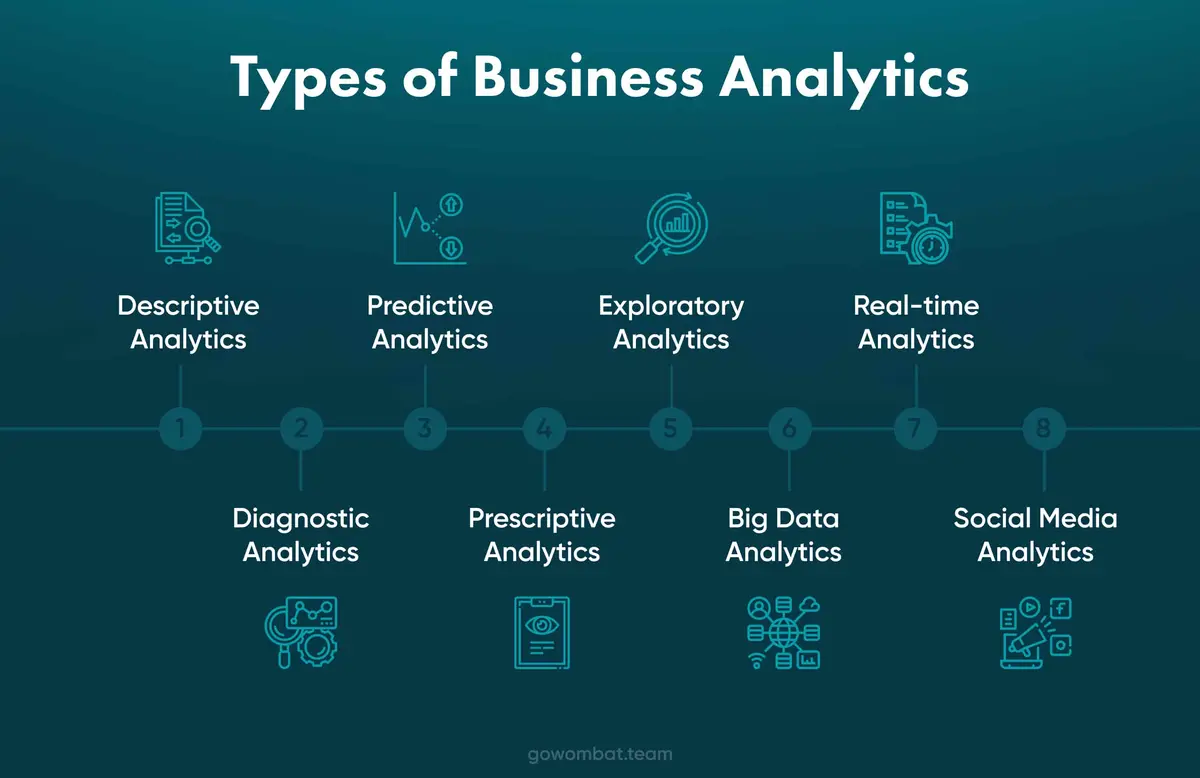
Descriptive Analytics
Descriptive analytics summarises what has already happened: last quarter's sales by product, churn by month, traffic by channel. Most other analysis builds on it.
It uses statistical analysis, data visualisation and dashboards to present past activity in an accessible way. For example, a retailer might use it to see which products sold best in a particular season or how customer foot traffic changes. These insights show how the business is performing and where it can improve.
Diagnostic Analytics
Diagnostic analytics looks for the reasons behind what descriptive analytics shows. It examines the data in more detail to find the factors behind observed trends and outcomes.
Suppose demand for a product fluctuates sharply. Diagnostic analytics uses techniques such as correlation analysis, regression modelling and anomaly detection to find the cause, whether it is external, such as a market change, or internal, such as a change in operations.
Predictive Analytics
Predictive analytics uses statistical models, machine learning algorithms and pattern recognition to forecast trends, behaviour and risks.
For example, an insurance company might estimate the likelihood of claims from customer profiles, driving patterns and historical claims data. A retailer could forecast sales to plan inventory and marketing. Forecasts help businesses prepare for risks and spot opportunities early.
Prescriptive Analytics
Prescriptive analytics goes a step further and recommends what to do. It uses algorithms, simulation models and optimisation techniques to compare possible outcomes and suggest the best option.
For example, a shipping company can simulate different delivery routes, taking into account traffic, delivery deadlines and fuel costs, to find the most efficient and cheapest ones. The same approach can support broader decisions such as market entry, investment allocation and product priorities.
Exploratory Analytics
Exploratory analytics searches data without a predefined question or hypothesis, looking for patterns, anomalies and correlations that nobody has considered yet.
For example, a healthcare provider could find unexpected patterns in treatment outcomes that lead to better care strategies, or a music streaming service could find new listener segments and build playlists and campaigns for them.
Big Data Analytics
Big data analytics processes very large, varied and fast-moving data sets, both structured and unstructured, that traditional tools cannot handle, to find patterns and trends that inform decisions.
For example, an e-commerce company can analyse petabytes of customer interaction data to personalise shopping, and a city can use big data analytics to manage traffic and public transport in real time.
Real-time Analytics
Real-time analytics processes data as it is generated, so companies can act immediately: adjust prices in a competitive market or monitor cybersecurity threats as they emerge.
Other examples are advertisers changing their messages during a live sports event and emergency services analysing incoming data as an incident unfolds.
Social Media Analytics
Social media analytics tracks likes, shares, comments and trends to measure brand sentiment, follow consumer behaviour and spot emerging trends. It shows how people perceive a brand and what drives engagement.
With this data, a brand can adjust its marketing in response to feedback, find influencers and advocates, and notice early when consumer preferences shift.
Conclusion
Descriptive, diagnostic, predictive and prescriptive analytics build on each other: each answers a harder question than the one before. Exploratory, big data, real-time and social media analytics are separate areas that can be combined with any of them.
At Go Wombat, our business analysis services make sure that the software we build is aligned with your objectives and backed by data. Contact us to discuss your project.
Business Analytics FAQs
What is the business analytics process?
The business analytics process typically involves data collection, data processing, data analysis, and decision-making based on insights derived from the analysis.
What are business analytics models?
Models are usually grouped by purpose (descriptive, predictive or prescriptive) and by method (statistical models such as regression, or machine learning models). The groupings overlap: a machine learning model can also be predictive, for example.
What is the role of a business analyst?
A business analyst connects business needs and IT: they analyse data, define requirements and recommend solutions.
What are the main types of data?
Data is usually classified by structure (structured, semi-structured or unstructured) or by source. Common sources in business analytics include transactional, customer and operational data.
What is big data?
Big data refers to extremely large and complex datasets that cannot be effectively processed using traditional data processing applications.
What are the types of big data?
By structure, big data can be structured, semi-structured or unstructured. By source, it includes social media data, sensor data and multimedia, among others.
Share and subscribe to our blog
Related articles

Business Analysis in Software Development: Full Guide
What business analysis in software development is, why it matters, the six BABOK knowledge areas and the techniques our analysts use.

Five Proven Strategies To Automate Business Processes
What business process automation (BPA) is, what can and cannot be automated, five strategies for introducing it and the benefits to expect.

Unlocking the Power of Data Visualisation in Business Intelligence
Data visualisation turns business intelligence (BI) data into charts and dashboards people can read at a glance. This guide covers the main chart types, tools and practices.

How can we help you?