



Why Generative AI Is the Next Step in CRM Automation

Generative AI is turning CRM systems into more than a record store. It predicts what customers are likely to do next, drafts personalised content and handles repetitive tasks. For companies that want to respond to customers faster and at a larger scale, a generative AI CRM offers speed and flexibility that rule-based CRM tools can’t.
Why This Shift Matters Now
Customers expect fast, personalised replies on every channel: email, chat and phone. Teams can’t keep up by hand, so they add AI to the CRM to draft replies, summarise calls and flag deals at risk. Generative AI is the part of the AI-powered tools stack that works with text: emails, tickets, notes and transcripts.
According to McKinsey’s State of AI survey (May 2024), 72% of organisations use AI in at least one business function. In the EU, Eurostat’s 2025 survey found that enterprises considering AI most often cite a lack of relevant expertise (71%), legal uncertainty (53%) and data protection concerns (49%) as obstacles.
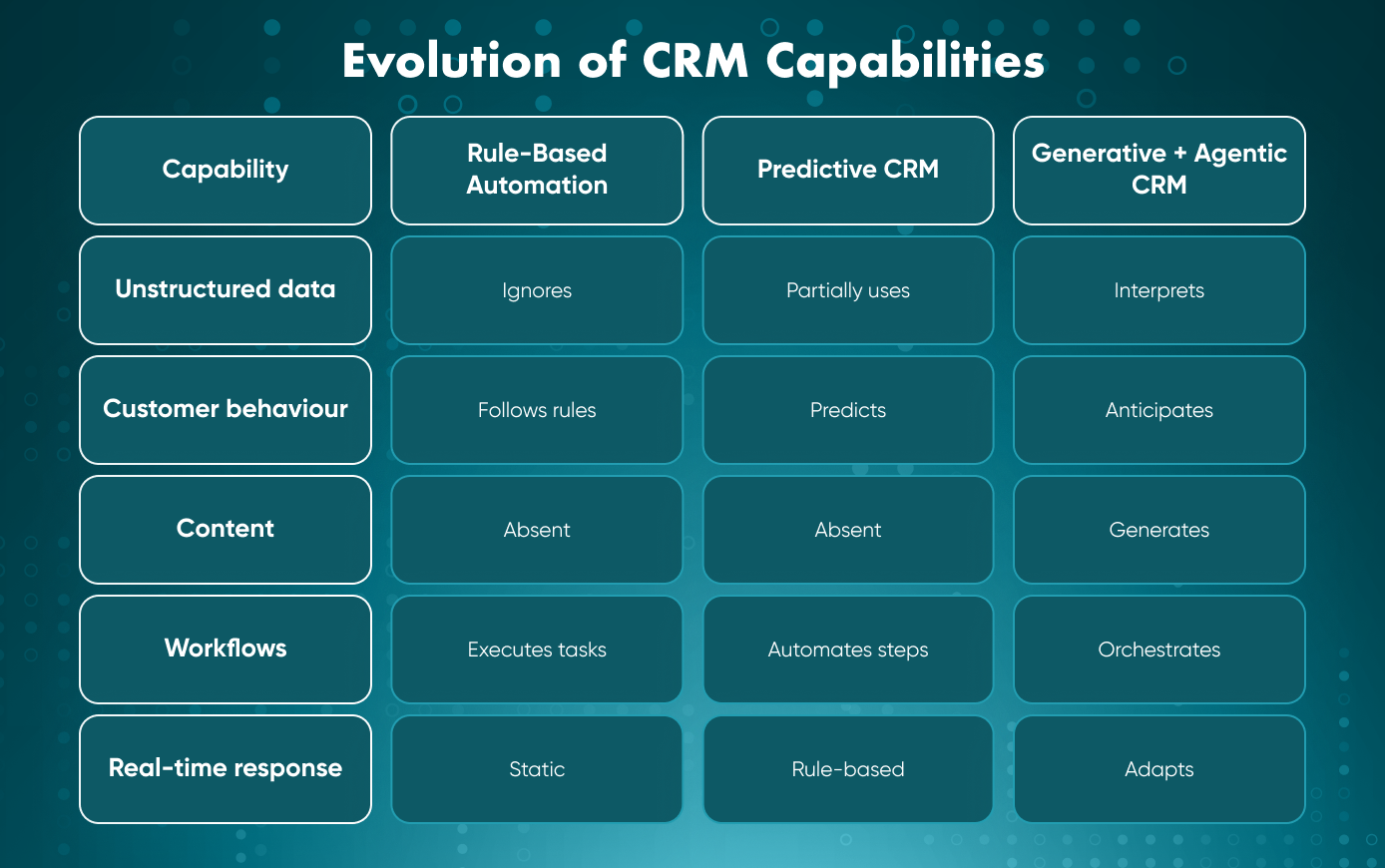
Generative AI adds what rules can’t: it reads free text such as emails, tickets and call notes, pulls out what matters and drafts the next step. AI agents go one step further and carry that step out.
How Generative AI Changes the Foundations of CRM Automation
How Does Generative AI Extend CRM Beyond Rule-Based Automation?
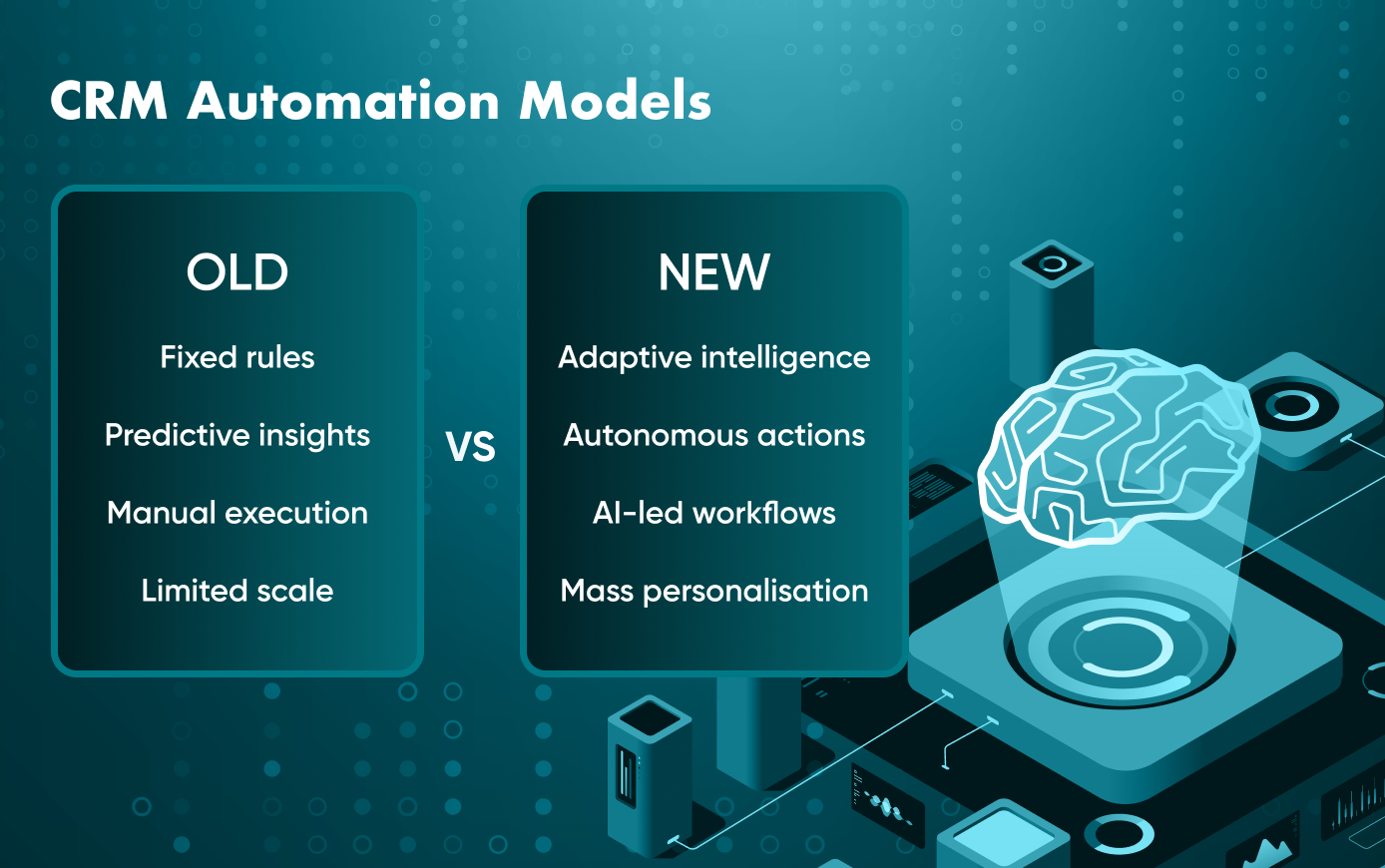
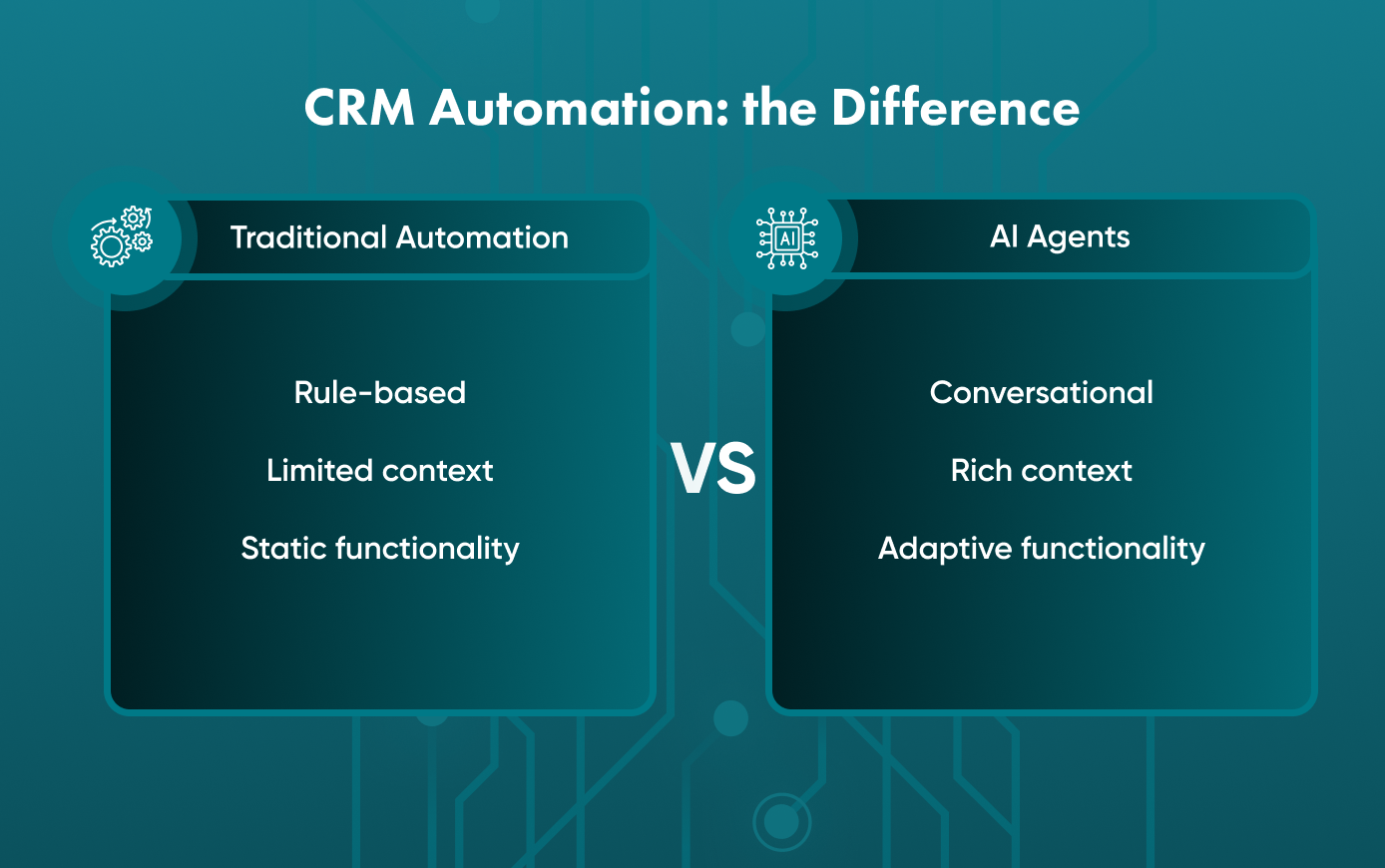
Classic CRM automation is rule-based: “If a customer clicks an email, send a follow-up.” It works, but only for cases someone has written a rule for.
Large language models (LLMs) can read emails, support tickets, customer feedback, internal notes and call transcripts. From that text they can analyse sentiment, anticipate what a customer needs, write summaries, draft content and propose customer journeys.
Take Salesforce, for example. Its Einstein GPT, announced in March 2023 and since developed into Agentforce, lets a sales rep open a lead and get a short summary of months of sales and service notes, plus a draft follow-up email that reflects the customer’s history. The rep no longer has to read through every note by hand.
The CRM stops being only a database and starts helping reps decide what to do next.
What Makes Generative Models Uniquely Suited for CRM?
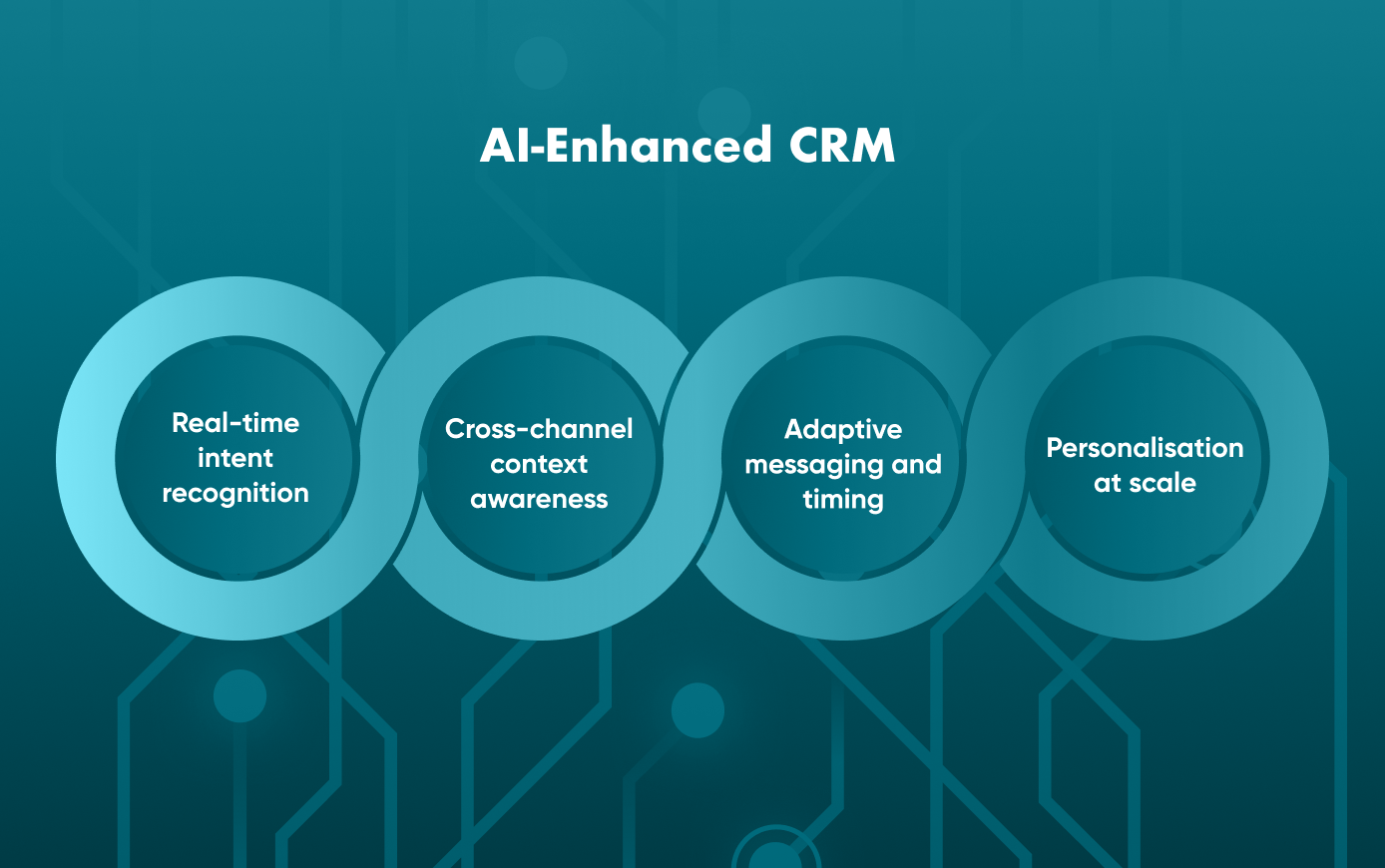
Beyond routine automation, generative AI CRM solutions can:
- Understand context across multiple channels
- Generate communication that sounds human
- Predict customer intent in real time
- Adapt workflows without the need for predefined rules
- Personalise thousands of customer journeys
This lets a small team offer the kind of customer experience that used to need a much larger one.
How Organisations Use Generative AI Across CRM Functions
How Does AI Improve Marketing, Sales, and CX Automation?
AI Marketing Automation
Marketers, sales reps and service teams use generative AI in the CRM to produce:
- one-to-one emails
- social media content tuned to segment behaviour
- product descriptions generated in real time
- copy variants for A/B tests
- personalised versions of standard texts
Sephora: AI-Powered Personalised Recommendations
Sephora uses AI to recommend products based on browsing history, reviews and previous purchases.
Sales Automation
Generative AI supports the sales process at each stage of the funnel:
- Lead generation based on tracked behaviour
- Personalised outreach
- Automatic meeting summaries
- “Next best action” suggestions
- Real-time suggestions for handling objections
Microsoft Sales agent (formerly Copilot for Sales): Sales Enablement
Microsoft’s Sales agent brings CRM insights into Outlook and Teams. After a sales call, it can summarise the main points and draft a follow-up email for the rep to review.
Customer Support Transformation
In customer support, generative AI enables:
- Instant answers through generative chatbots
- Sentiment detection in conversations
- Automatic complaint categorisation
- Escalation prevention
- Knowledge base article drafts
Lufthansa: AI-Driven Client Support
Lufthansa Group's AI assistants handle around 16 million customer conversations a year, with up to 375,000 interactions on peak days.
Which Industries and Businesses Benefit Most from AI-Enhanced CRM?
B2B SaaS: Cutting Churn and Speeding Up Product Adoption
AI shows SaaS companies what users are doing and lets them step in before customers lose interest. Teams use it for:
- Spotting accounts at risk of churn from drops in usage
- Setting up automated onboarding that matches each user’s role and goals
- Finding out which features keep customers long term
- Summarising customer success calls, so teams know what helps renewals
This lets SaaS teams support more customers without hiring at the same rate.
Manufacturing: Upgrading Service and After-Sales Support
Manufacturers manage complex service needs, spare parts and large contractor networks. AI-enhanced CRM tools help by:
- Forecasting service ticket volume and assigning teams in advance
- Sending maintenance reminders triggered by sensor or IoT data
- Sorting incoming support cases by how urgent or important they are
- Drafting service reports for technicians right after their visits
Fintech: Better Risk Detection and Personalised Financial Journeys
Fintech companies apply AI to large volumes of transaction and behaviour data to:
- Catch suspicious transactions as they happen
- Suggest personalised financial advice based on how customers spend
- Automate risk scoring and speed up KYC reviews
- Draft responses to customer disputes that meet compliance requirements
Healthcare: Smoother Patient Engagement and Less Paperwork
Clinical staff spend a lot of time on admin. AI in a healthcare CRM helps by:
- Setting up automatic follow-ups after appointments
- Drafting patient summaries from past visits and messages
- Spotting which patients are likely to miss appointments and sending reminders
- Using chatbots to sort patient requests before they reach staff
That leaves medical teams more time for patients.
Retail & E-commerce: Personalised Shopping at Scale
Retailers have to keep up with changing customer tastes. AI-powered CRM helps by:
- Recommending products based on what shoppers browse
- Adjusting offers in real time based on price sensitivity or stock levels
- Building lookbooks or bundles from past purchases
- Flagging customers who have the highest lifetime value
What Are Agentic CRM Workflows and Why Are They the Future?
How do agentic workflows transform CRM from insights to actions?
In an agentic workflow, AI agents act on customer data instead of only analysing it. An agent breaks a process into smaller tasks, completes them, hands work to other agents when needed and moves between systems such as the CRM, email and booking platforms. You get insight and action on top of your customer data and automated workflows.
What business value do agentic systems bring?
The first benefit is speed. In one McKinsey case study, a bank using AI agents to draft credit memos saw a potential 20–60% productivity gain, including a 30% faster credit turnaround. Personalisation gets more precise, and teams spend less time on busywork, which keeps overhead down. Users can also describe a workflow in plain language and the CRM drafts it, but someone still needs to review it before it goes live.
What Are the Limitations, Risks, and Constraints?
What challenges slow adoption today?
Four issues slow adoption:
1. Data quality
AI is only as good as the CRM data it reads. Duplicate, outdated or incomplete records lead to wrong summaries and poor recommendations.
2. Legacy systems
Many companies still run older software that is hard to integrate with AI tools, and upgrades are expensive.
3. Hallucinations
Language models sometimes invent facts or state a wrong answer with confidence, so any output that reaches customers needs checks.
4. Change management
Staff may worry about losing their jobs to AI or may not yet know how to use it. Both slow adoption.
What governance and compliance concerns matter most in the EU?
First, you’ve got to stick to GDPR rules. The EU AI Act adds its own obligations. People also expect transparency and clear records of how decisions are made. Bias has to be monitored so AI systems don’t make unfair decisions, and a human needs to stay in the decision loop.
In practice: set up AI quality gates to catch issues early, keep detailed audit logs, use retrieval-augmented generation (RAG) so answers can be traced to source documents, enforce data segmentation policies, and train teams to monitor these systems.
Conclusion
To get value from generative AI in a CRM, start with clean data, clear governance and a team trained to review what the AI produces. Agentic workflows can follow once those basics are in place.
FAQs
How is generative AI different from traditional CRM automation?
Traditional CRM automation follows fixed rules. Generative AI reads context from emails, calls and tickets, predicts what customers are likely to do and drafts personalised actions across channels.
Which CRM tasks can generative AI automate right now?
It can draft emails, score leads, respond to tickets, summarise calls, surface deal insights, create personalised customer journeys and prepare reports.
Why do companies have a hard time using AI in CRM?
The usual reasons are poor data quality, legacy systems, the risk of AI inventing facts, a shortage of skilled people and weak oversight. Many teams also know AI mainly from chatbots and underestimate what it can do in marketing, sales and reporting.
When will autonomous CRM really take off?
Some companies are already testing agent-like workflows. How fast others follow depends on the barriers above: data quality, legacy systems and governance.
What data makes AI-driven CRM automation better?
Behavioural data, sales data, customer satisfaction scores, well-maintained CRM fields, communication logs, product usage statistics, consistent event tagging and social media activity all help.
Share and subscribe to our blog
Related articles

What Are the Benefits of CRM Systems for Your Business in 2026?
What a CRM system does, its benefits for customers and for the business, which sectors use one, custom vs off-the-shelf, and the challenges to plan for.

Why Use a CRM System? 7 Reasons Businesses Can't Afford to Skip One in 2026
What a CRM system does, how CRM software changed by 2026, and seven reasons to use one, illustrated by the CRM platform Go Wombat built for Demco.

How Is AI Transforming Marketing Technology in 2026?
How AI is used in marketing technology in 2026: the main technologies, agentic AI, real examples, benefits, challenges and how to start.

How can we help you ?