



What Is MarTech? A Complete Guide to Marketing Technology in 2026


Marketing technology (MarTech) has stopped growing in tool count. The Marketing Technology Landscape, published annually by chiefmartec and MarTech Tribe, counted 15,505 tools in its latest edition, just 0.79% more than the year before and the flattest growth the census has recorded in 15 years. Its editor, Scott Brinker, calls this “peak MarTech”. The flat total hides real churn: nearly 2,900 tools were added or removed in twelve months.
For a business, the useful question is which of these tools belong in its stack, and why.
What is marketing technology (MarTech)?
MarTech is the software marketers use to plan, run and measure campaigns. Any tool built to help a team promote something counts.
The category is broad: content management systems, analytics dashboards, email platforms, CRM software and, increasingly, AI agents that draft or refine campaigns with limited human input. What these tools share is their job: helping a marketing team reach an audience, understand the response and act on it.
Most businesses already use MarTech without calling it that: a CRM, an analytics dashboard, an email sender or a social scheduling tool all count. The real question is whether your tools work well together.
What is a MarTech stack?
A MarTech stack is the full set of tools a company uses for its marketing. Most teams build theirs gradually: a CRM first, then an email platform, then an analytics suite when the board asks for better reporting.
The more tools a stack has, the harder it is to keep them integrated. Data gets duplicated, reports stop matching, and integrations that worked with ten tools start breaking at twenty.
Off-the-shelf platforms are built for an average customer, not for your combination of channels and data sources. A stack designed around your campaigns rather than a vendor's roadmap usually stays simpler.
How to build a MarTech stack without the mess
Four steps help keep a stack manageable:
- Audit what you already own. Teams often find overlapping tools that nobody remembers buying.
- Map your funnel first, tools second. Pick software to fit the stages that already exist, not the reverse.
- Test integrations before signing anything. A tool that can't sync with your CRM creates manual work.
- Review the stack every year and adjust it to how your marketing has changed.
MarTech vs AdTech: what's the difference?
Adtech is a subset of MarTech, just as paid advertising is a subset of marketing. People often expect them to be two unrelated categories.
MarTech covers the whole marketing function: content, email, analytics, CRM, and yes, advertising. Adtech tools deal specifically with buying, selling, and placing paid ads, from banner inventory and programmatic bidding to native placements that barely look like ads at all.
Some tools straddle both categories. A keyword research platform that reports organic search volume alongside cost-per-click data is doing MarTech and adtech work inside the same interface.
Go Wombat builds both. Our in-depth look at adtech covers the category, and Go Wombat's adtech development work spans programmatic bidding, inventory management, and the privacy-first targeting that has become table stakes since cookies started disappearing.
How MarTech is changing going into 2026
Three shifts define MarTech in 2026.
The first is a plateau. Chiefmartec's landscape grew just 0.79% this year, yet 1,488 new tools were added and 1,367 removed in the same period. Categories that filled up with AI writing tools two years ago, content marketing above all, are now losing the most products, as single-purpose apps give way to fewer, broader platforms.
The second shift is budget. According to Gartner data reported by chiefmartec, MarTech's share of the marketing budget fell to 19.4% in 2026, a five-year low, down from 26.6% in 2021. That is not a retreat: 62% of CMOs still plan to spend more on MarTech next year, but paid media and headcount are growing faster.
The third is the AI adoption gap. According to the Martech for 2026 report by chiefmartec and MartechTribe (December 2025), 90.3% of surveyed MarTech leaders use AI agents somewhere in their stack, but only 23.3% run them in full production, and 80.6% operate with a human in the loop.
Stacks are not shrinking into a single suite. They are splitting into layers: AI-native tools are winning the content creation layer, while established platforms such as CRM hold steady in orchestration.
Types of MarTech
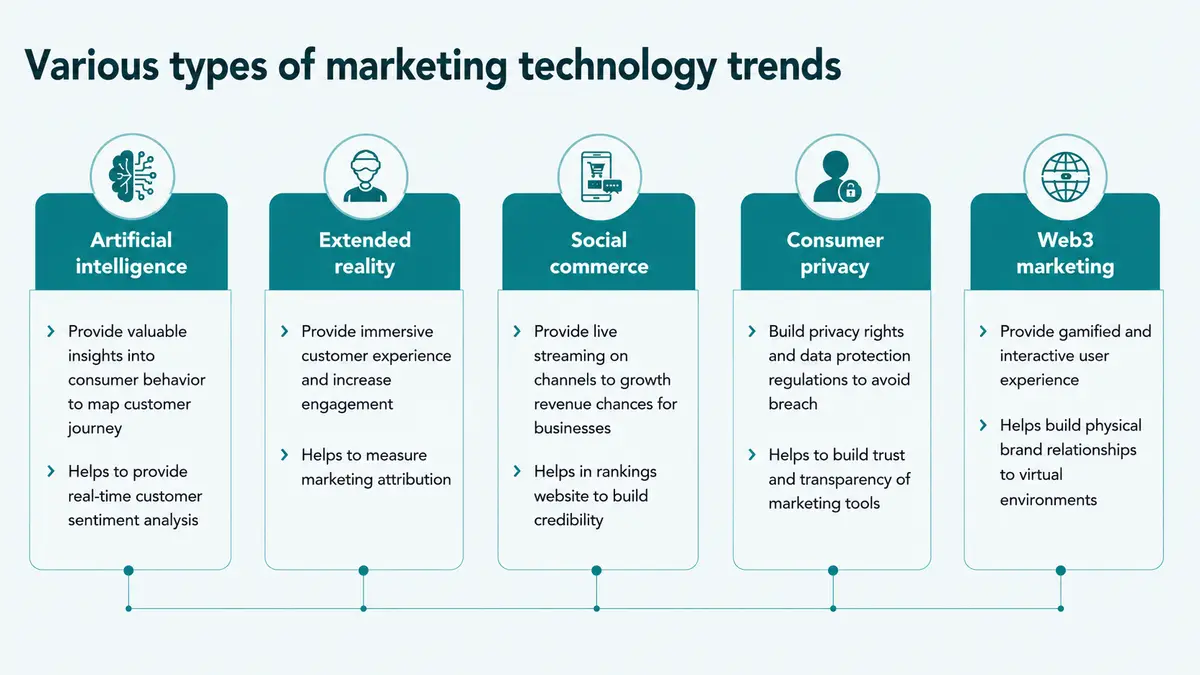
Most MarTech tools fall into these categories.
Content management
Content management platforms control the text, images and other assets on a website or app. Some are simple page builders; more capable ones also draft, tag and schedule content with AI.
Analytics
Analytics tools collect data on visitors and customers from websites, apps, email and other channels.
Lead generation
Lead generation software helps a business reach prospective customers through the channels they use.
Search engine optimisation
SEO tools help identify content gaps, track rankings and optimise pages for organic search.
Campaign management and CRM
Campaign management platforms bring every promotional channel into a single place. At the centre sits the CRM. A CRM built around your sales process keeps sales and marketing looking at the same data, instead of two different spreadsheets that never quite agree.
Email marketing
Email still delivers reliable returns relative to its cost, provided the platform behind it can segment lists properly and stay out of the spam folder.
Customer experience
Everything a customer sees shapes their experience, planned or not. CX tools help a business manage those touchpoints consistently.
Content creation
From image editing to AI drafting assistance, content creation tools have absorbed more generative AI features than almost any other MarTech category. Generative AI integrations now sit inside platforms that used to be pure editing software.
Attribution
Attribution tools trace a sale back to the channels that contributed to it, even when the customer converted on a different channel.
Automation
Marketing automation removes repetitive manual work and runs flows that need little day-to-day input. Marketing automation workflows designed around a company's funnel usually last longer than generic ones. BI and data visualisation tools turn the resulting data into reports a team can act on, and machine learning models find patterns in it.
Essentials of a MarTech stack
Whatever tools you choose, check them against these criteria.
Efficiency
Software should speed up campaign delivery. If a tool adds steps instead of removing them, it is not worth its licence fee.
Capacity
Email lists and databases grow. A stack needs enough headroom to handle that growth without a migration a year or two later.
Security
Privacy and security rules, GDPR chief among them, apply to any MarTech tool that touches customer or patient data. GDPR compliance work and broader security consulting both belong on the checklist before a new tool goes live, not after.
Flexibility
Lead channels, sales platforms and CRMs all need to integrate with the rest of a business's systems. Tools that can't adapt become expensive to work around.
AI readiness
AI features need clean, structured data. With messy inputs, even the best model produces mediocre output, which is why tools that impress in a vendor demo often disappoint on real company data.
MarTech challenges in 2026
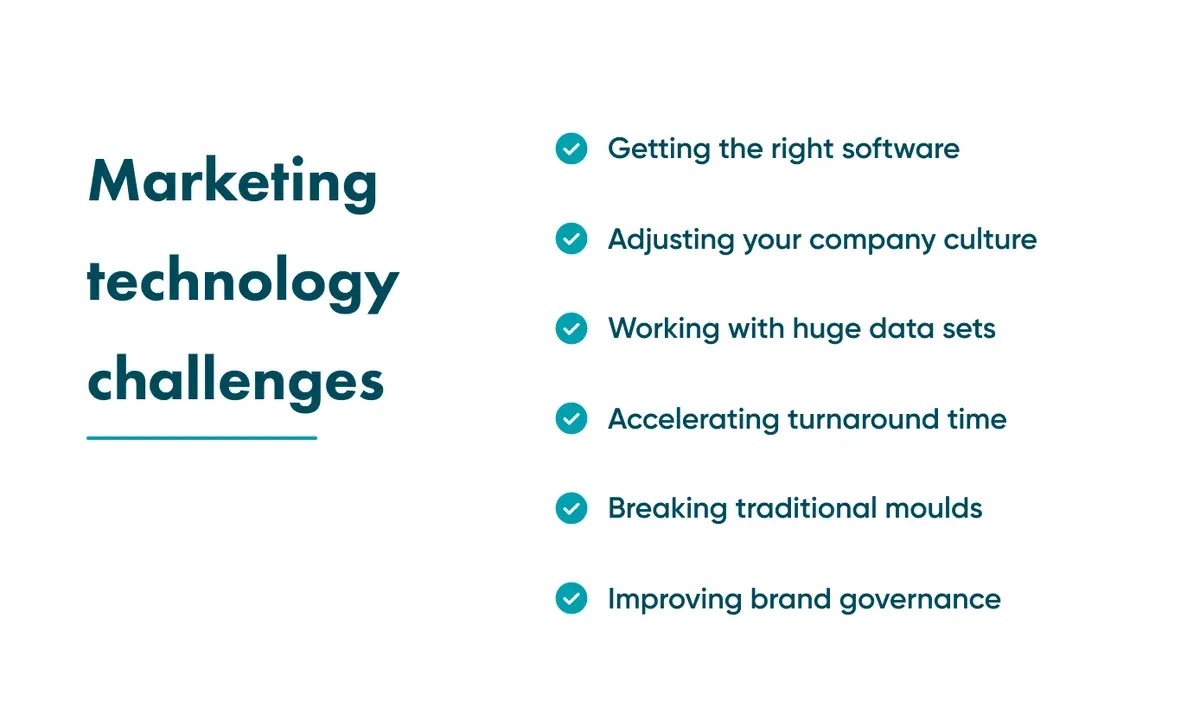
Digital marketing technology also brings challenges.
Finding the right software
Off-the-shelf platforms are built for thousands of different businesses, so their feature sets are broad rather than tailored. A discovery phase before you commit to a vendor helps you choose well.
Getting the team on board
Even a well-chosen tool fails if the team doesn't see why it should use it. Adoption takes deliberate effort, not just a training deck.
Working with large data sets
Marketing tools track hundreds of variables per user across contact lists, sessions and touchpoints. Handling that volume without slowing the system down is an engineering problem in its own right.
Tool sprawl
Stacks tend to gain tools faster than they lose them. A MarTech audit every year or two catches overlapping tools before they drain the budget.
The AI production gap
Most teams have piloted AI agents, but few run them in full production, mainly because governance and data quality take longer to sort out than the pilot itself. An agent rushed into production without that groundwork creates more clean-up work than it saves.
MarTech in practice: real Go Wombat builds
Go Wombat has built MarTech software for clients for years. Three examples:
4D, built for SilverBullet, is a contextual-targeting platform designed for the post-cookie era. It matches ads to audiences using context rather than tracking cookies, using machine learning to keep display, video, and in-app campaigns aligned across channels while respecting privacy rules.
Sourcepoint needed something different: an AI-driven compliance and privacy analytics platform, DIAGNOSE, that scans ad-supported websites and apps to check GDPR and CCPA adherence automatically. Sourcepoint's Privacy Lens, launched in March 2021, lets media buyers see how their inventory suppliers approach consumer data protection.
IDFree tackles the same cookie-less targeting problem from another angle. It builds audiences from anonymised demographic and location data instead of personal identifiers, then activates them across Google Ads, Meta, Snapchat, Xandr, and Adform, all while staying GDPR and CCPA compliant. Microsoft stopped supporting media buying through the Xandr DSP (Microsoft Invest) on 28 February 2026.
None of these three clients could buy an off-the-shelf tool that met their requirements, so each got a custom build. MarTech consulting can point a business to the right combination of existing tools when one exists; when it doesn't, custom development makes more sense.
Benefits of using MarTech
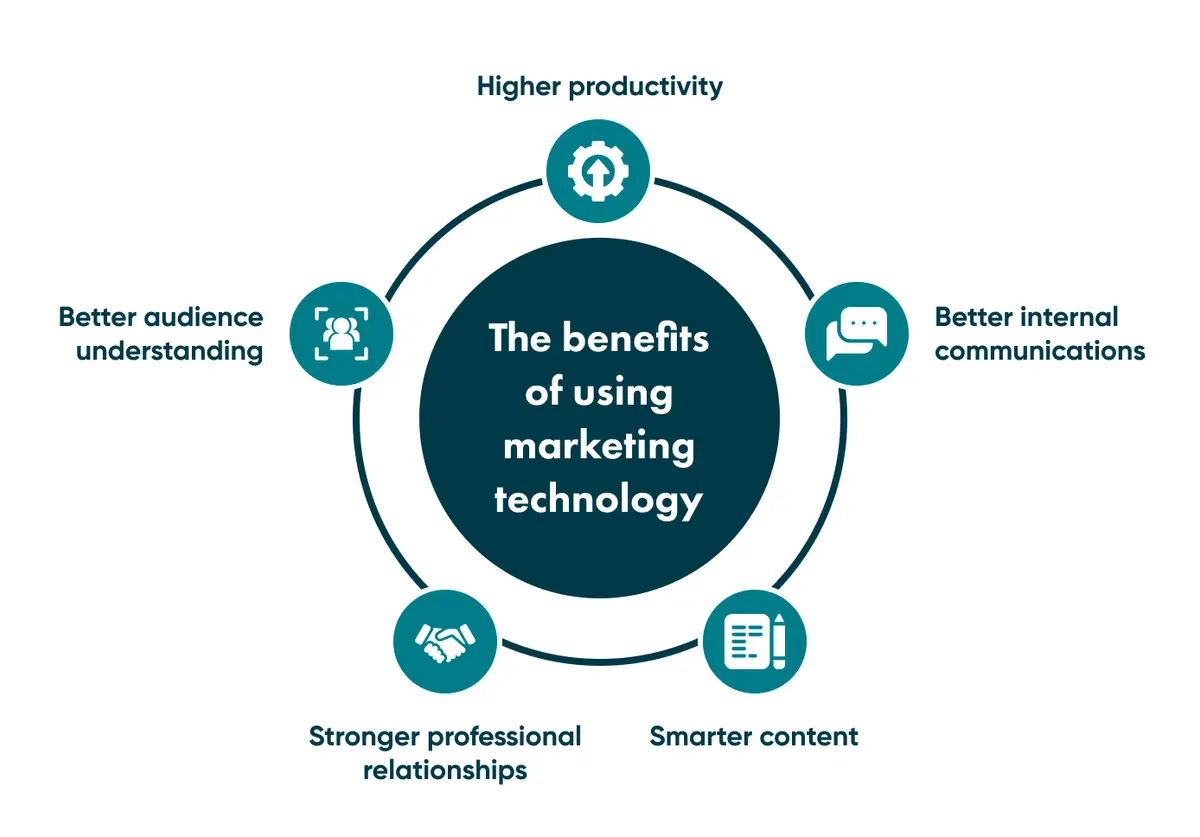
A well-chosen MarTech stack brings these benefits.
Higher productivity. Automation and content generation shorten turnaround times, so a team spends more time on strategy and less on repetitive execution.
Better internal communication. A CRM shared by sales and marketing keeps everyone looking at the same numbers and cuts meetings held only to reconcile conflicting reports.
Better content. Analytics tools show how an audience actually behaves, not how the team assumes it behaves.
Easier lead nurturing. When software handles routine follow-ups, moving a lead down the funnel takes fewer manual touches.
Better audience understanding. Search and social platforms show where your audience's attention already is, so the budget goes to the right channels rather than the familiar ones.
Key takeaways
With over 15,000 tools in the current landscape, the problem in 2026 is too many choices, not too few.
A stack works when its tools are chosen for a specific business, integrated properly and kept lean enough to manage.
Go Wombat builds MarTech and adtech software around how a business actually promotes itself.
Frequently asked questions
What is MarTech in simple terms?
MarTech is any software a business uses to plan, run, or measure a marketing campaign, from a CRM to an email platform to an AI content assistant.
What's the difference between MarTech and adtech?
Adtech is a subset of MarTech focused specifically on buying, selling, and placing paid ads. MarTech covers the wider marketing function, including content, analytics, and CRM.
How big is the MarTech industry in 2026?
The 2026 Marketing Technology Landscape counted 15,505 tools, a growth of just 0.79% year on year and the flattest expansion recorded in the census's 15-year history.
What tools typically make up a MarTech stack?
Most stacks include a CRM, an analytics platform, an email sender, a content management system, and increasingly, at least one AI-assisted tool for content or campaign optimisation.
Do I need custom MarTech software, or will off-the-shelf tools work?
Off-the-shelf platforms suit standard use cases well. Businesses with unusual data, compliance needs, or integration requirements, like the clients behind 4D, Sourcepoint, and IDFree, tend to outgrow them fast.
What's changing in MarTech because of AI?
Adoption is nearly universal, but production use lags behind. According to the Martech for 2026 report by chiefmartec and MartechTribe, 90.3% of surveyed leaders use AI agents somewhere, but only 23.3% run them in full production.
Ready to build MarTech that fits your business?
Off-the-shelf tools solve generic problems. If your marketing stack needs software built around your data, compliance requirements and channels, Go Wombat has been building this kind of software for over a decade.
Contact us to talk through what a tailored stack could look like for your team.
Share and subscribe to our blog
Related articles

What is AdTech? A look at its influence on industries
What AdTech is, its main platforms (ad exchanges, ad networks, ad servers, DSPs and SSPs), trends and the privacy issues it raises.

Five Proven Strategies To Automate Business Processes
What business process automation (BPA) is, what can and cannot be automated, five strategies for introducing it and the benefits to expect.

Why Use a CRM System? 7 Reasons Businesses Can't Afford to Skip One in 2026
What a CRM system does, how CRM software changed by 2026, and seven reasons to use one, illustrated by the CRM platform Go Wombat built for Demco.

How can we help you?

