



How Do You Build a Logistics Agent Network That Reroutes Freight Autonomously in Real Time?

Consider an illustrative scenario. A container ship diverts because the original port closes with 36 hours' notice: congestion triggered by a labour dispute that nobody's TMS predicted. The freight is mid-ocean, three carriers are involved and eleven customers are waiting.
The traditional response is a cascade of emails, phone calls and spreadsheet updates. Someone in operations checks carrier availability by hand, someone else contacts the freight forwarder, and by the time a new route is confirmed, two days have passed and two customers have escalated.
With geopolitical volatility, climate events and carrier consolidation, disruptions like this are no longer rare. The real question is how fast your logistics network can resolve one.
Rules-based automation helps: TMS logic and static routing tables reduce manual work in normal conditions. But they break at the edges, which is where real disruptions happen.
AI agents do not replace the operations team; they shorten the gap between an alert and a confirmed rebooking. The architecture that makes this possible is a logistics agent network, and you need to understand how it works before writing a line of code.
What is a logistics agent network?
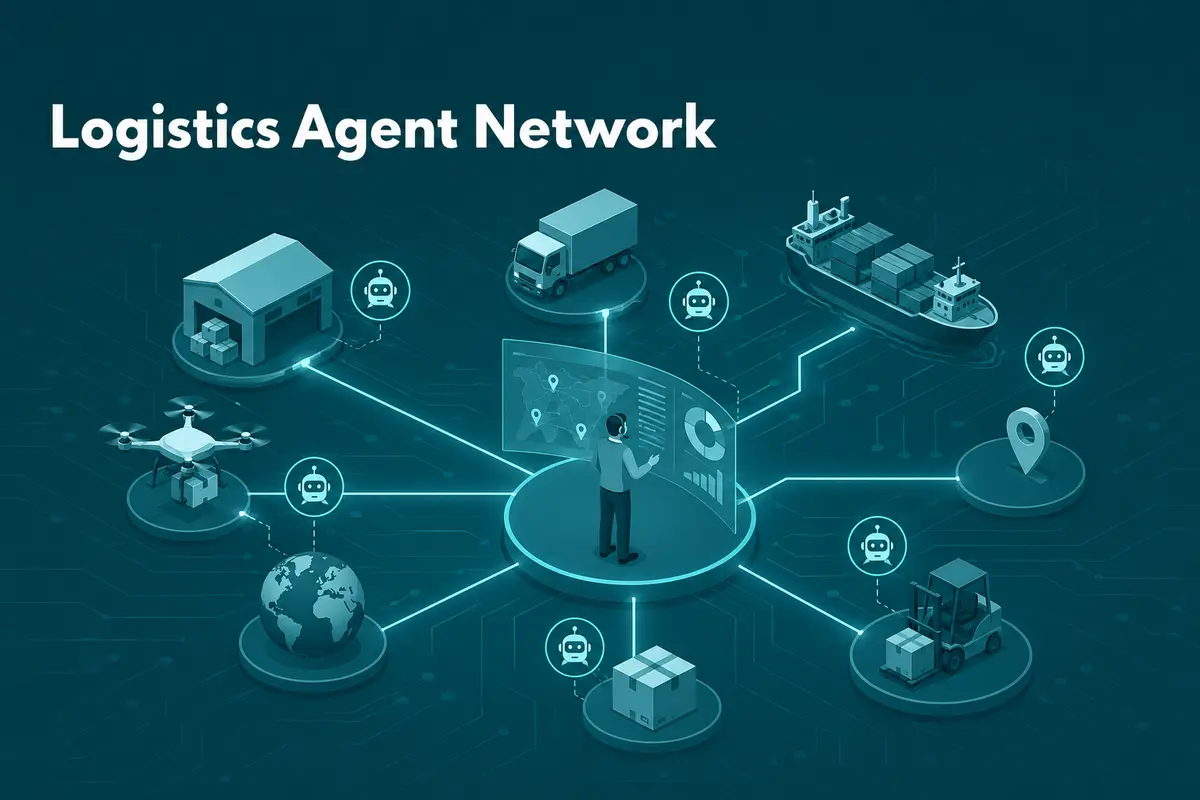
A logistics agent network is a system of autonomous AI agents, each assigned a defined role, that monitor freight status, exchange decisions, and reroute shipments without waiting for human input at every step. Unlike rule-based automation, these networks adapt in real time to live disruptions: port closures, carrier delays, weather events, and customs exceptions.
A traditional TMS follows pre-programmed logic: if event A happens, execute response B. That covers known cases well, but it cannot reason across several variables at once, weigh competing priorities, or handle a disruption nobody anticipated when the rules were written.
A multi-agent system treats each of those tasks as a separate concern. A monitor agent watches for events. A decision agent weighs options. An execution agent acts. A communication agent notifies stakeholders. They work in parallel rather than in sequence, coordinating through shared state.
In this context, "autonomous" means that the workflow resolves routine disruptions on its own, within the rules, cost and risk limits and escalation thresholds that the operations team sets.
The pattern applies across multiple industries: from ocean freight and 3PL operations to pharmaceutical cold chains and cross-border customs handling. The disruption profiles differ; the underlying architecture does not.
For the wider context, see our overview of AI in supply chain and logistics.
The anatomy of a multi-agent logistics system
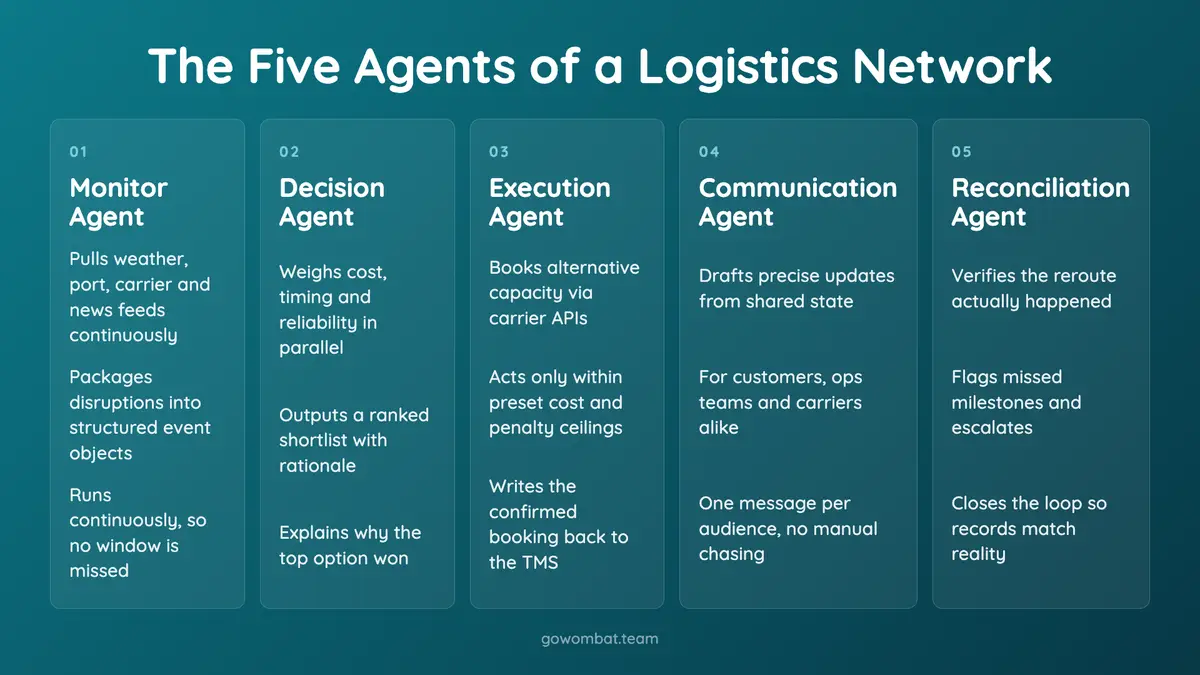
Most operations teams already have a version of this system. Someone watches for problems. Someone else figures out what to do. A third person actually does it. Someone tells the customer. And someone checks that the thing got done. A logistics agent network maps directly onto that structure, except each of those responsibilities belongs to a dedicated agent running on its own clock, not a person juggling four other priorities.
Monitor agent
The right signal has to arrive in the right format before anything else can happen. The monitor agent runs continuously, pulling from weather feeds, port status APIs, carrier tracking systems, news event streams and geopolitical risk alerts. It only detects; it does not assess or act. When a configured threshold is crossed, it packages what it knows into a structured event object (which shipments are affected, what the disruption is and how severe it is) and passes it downstream.
Decision agent
The event arrives, and the decision agent starts working through what it actually means. Which bookings are at risk? What alternatives exist on the carrier market right now? What does each option cost relative to the current plan, and how does it affect the delivery window? These are not evaluated sequentially; the agent pulls TMS records, live freight rate data, and historical patterns from comparable disruptions in parallel. A large language model handles the reasoning here because it can weigh partial, conflicting information across multiple constraints simultaneously, where a rules engine would simply fail to match and do nothing.
Execution agent
Recommendation and execution are deliberately separated. The decision agent's output is a ranked shortlist of options with rationale attached; the execution agent's job is to take the top-ranked option and act. That means calling carrier APIs, booking the alternative capacity, updating references in the TMS, and writing the new routing to shared state. Its action boundaries are defined before deployment: there is a cost ceiling, a penalty threshold, and a category of scenarios that bypass the agent entirely and land on a human operator's screen. What those limits are is a design decision made in advance, not improvised under pressure.
Communication agent
Customer-facing updates during a disruption are where trust is preserved or damaged. Generic delay alerts do not help; a message that names the affected shipment, explains the cause, and confirms the new expected arrival does. The communication agent draws on shared state to draft exactly that, for customers, internal ops teams, and carriers alike, without someone manually composing three versions of the same notification while also trying to fix the problem.
Reconciliation agent
Acting on a rerouting is not the same as confirming it worked. After the execution agent books an alternative, the reconciliation agent monitors the revised shipment against the new plan. If a carrier confirms the booking but no tracking update follows within the expected window, that gets flagged. If a milestone is missed, the agent triggers an escalation with a structured summary: what was booked, what was expected, what is actually happening, rather than leaving operations to piece it together later.
Together, these five roles handle routine resolutions without a human starting each step. Our post on agent as a backend covers the infrastructure behind this, such as state management and async job queues, which is what separates a production multi-agent system from a prototype that only works in demos.
The design principle here is identical to what makes microservices architecture maintainable: keep each component's responsibility narrow, its interface explicit, and its failure mode defined in advance. A multi-agent logistics network built this way is easier to debug, easier to extend, and easier to hand over to an operations team than a monolithic automation layer that nobody fully understands.
Communication agents need a lot of context to get this right. Historical communication patterns, customer preferences and the exact state of the affected booking decide whether a notification reassures the customer or triggers a follow-up call. Our article on machine learning in CRM systems covers similar patterns.
How does real-time freight rerouting actually work?
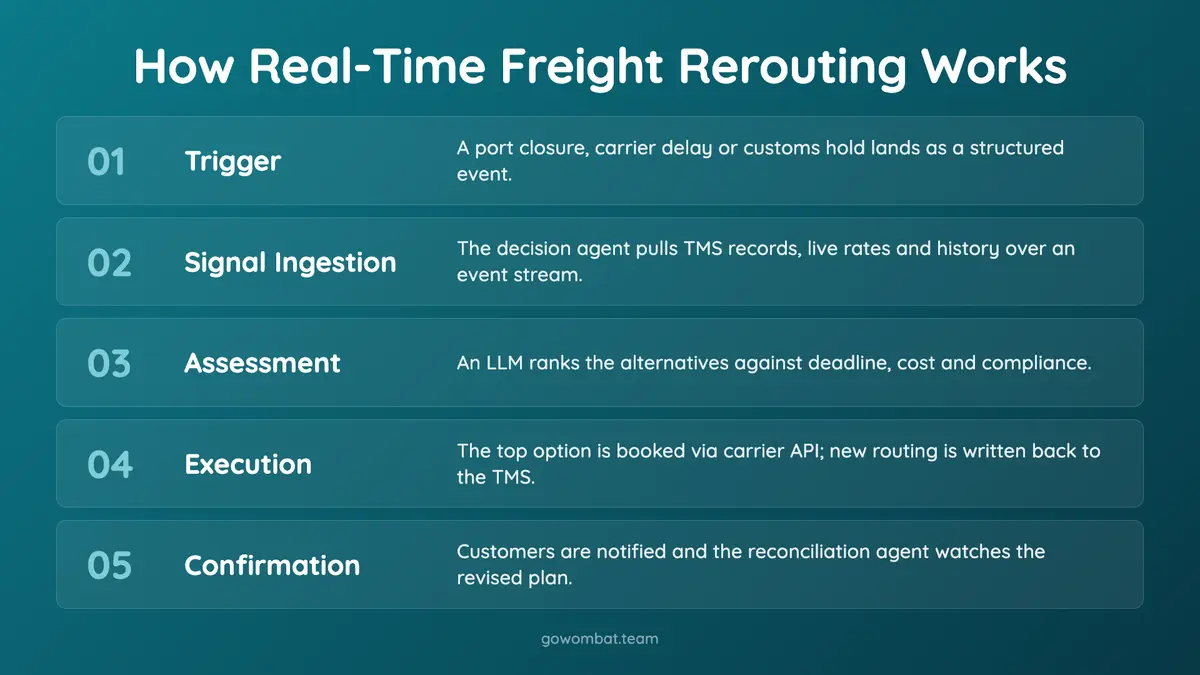
A single rerouting event shows where each agent boundary sits.
It starts with a trigger. A port congestion alert lands via a data feed. A carrier marks a vessel delayed by 48 hours. A customs exception flag appears on a shipment bound for Rotterdam. Whatever form it takes, the monitor agent packages it into a structured event object carrying the affected shipment IDs, the disruption type, and a severity classification, then passes it downstream. That is the entire extent of what the monitor agent does.
Signal ingestion
The decision agent queries the TMS for affected shipment details, checks current carrier availability via API, pulls live freight rates, and retrieves historical data from comparable events. In production systems running at any meaningful volume, this runs over an Apache Kafka or Apache Pulsar event stream. Batch processing cannot keep pace here; if data refreshes every four hours, the decision window has already closed by the time the agent sees the signal.
Assessment
The decision agent evaluates alternatives against ranked criteria: delivery deadline preservation, cost ceiling, carrier reliability scores, and regulatory compliance for the destination country. A rules engine fails at this point because real disruptions rarely match the exact conditions anyone anticipated when the rules were written. An LLM-powered reasoning layer handles novel constraint combinations and produces a ranked shortlist with rationale attached, which is what the execution agent needs to act.
Execution
The top-ranked option passes to the execution agent, which calls the relevant carrier API, books the alternative capacity, and writes the updated routing back to the TMS. LangGraph handles the orchestration here well: it manages the stateful workflow across agents, handles branching logic when a carrier API call returns an error, and maintains checkpoints so the process can resume from the last successful state rather than restart from scratch if something goes wrong mid-sequence.
Confirmation
The communication agent sends notifications to affected customers and internal teams. The reconciliation agent begins watching the revised shipment. If a human escalation threshold was crossed during the assessment phase, the system generates a structured summary for the operations manager rather than leaving them to reconstruct what happened from carrier emails and TMS logs.
What triggers a rerouting event?
Not every delay is worth the cost and friction of a full rerouting. The trigger configuration is one of the most consequential decisions in the whole build, and it often gets the least time in pre-launch planning.
Common triggers include port closures or severe congestion, carrier-declared force majeure, customs holds that will breach the delivery window, weather alerts above a defined severity threshold, and geopolitical events affecting a specific transit corridor. But which of those actually warrant automated action, and at what threshold, varies by client, cargo type, and delivery commitment. A 12-hour delay that is acceptable for bulk freight may be a rerouting event for time-critical pharmaceuticals. Getting those parameters set correctly before the agents go live is the difference between a system that handles real disruptions and one that either misses them or cries wolf on routine delays.
What separates a multi-agent decision from a single-agent one?
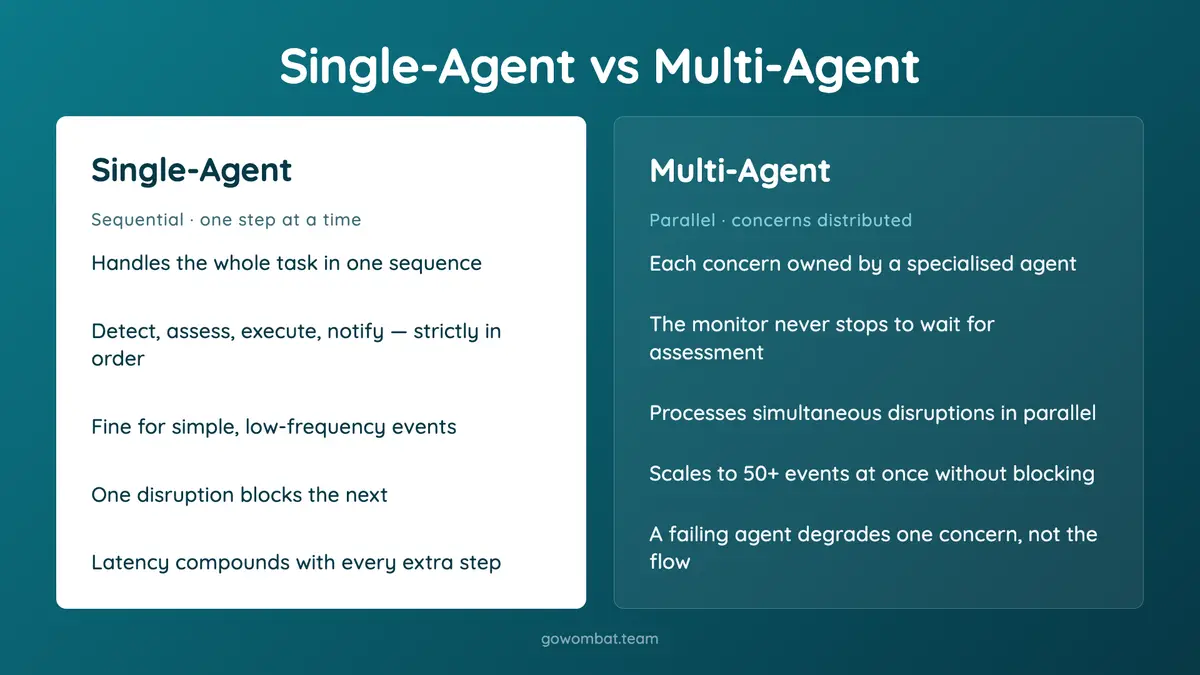
A single AI agent handles the whole task sequentially. It detects the event, assesses options, executes, and communicates, one step at a time. That works for simple, low-frequency scenarios.
Multi-agent architecture distributes those concerns. The monitor agent is always running, not waiting for an assessment to finish. The execution agent acts the moment it receives a decision, not after the communication agent has drafted the customer message. The system processes multiple simultaneous disruptions in parallel without any one event blocking the others.
The practical difference is throughput. A single agent handles one disruption a week without trouble. Fifty simultaneous disruptions across a global freight network need a distributed multi-agent system.
Real-world systems doing this today
Several platforms already run AI agents for logistics rerouting and disruption management in production.
Project44 AI Disruption Navigator
Project44's platform monitors more than 8 billion data sources and over 100,000 news posts hourly, classifying events across 120 risk categories and mapping each disruption directly to in-transit inventory. The system identifies disruption impact 75% faster than manual monitoring and cuts disruption-related costs by 40% for clients, according to Project44's published figures. Ford and Eaton are named project44 customers, but project44 does not publish customer names tied specifically to Disruption Navigator.
Flexport Control Tower
In February 2025, Flexport announced its Winter Release, which included a Control Tower product giving real-time oversight across an entire logistics network, including freight not managed by Flexport itself. Early adopters reported an average 10% reduction in freight costs. In February 2026, Flexport announced an AI agent that consolidates a company's shipments from multiple vendors into a single container. In a November 2024 interview with Freethink, Flexport CEO Ryan Petersen said the company aimed to automate about 50% of the manual work in freight forwarding by the end of 2025.
These are commercial deployments, and they follow the same principles described in this article.
Before committing to a build, check your infrastructure against what these systems depend on. Our AI readiness checklist covers data maturity, system integration and automation readiness.
What to get right before you build
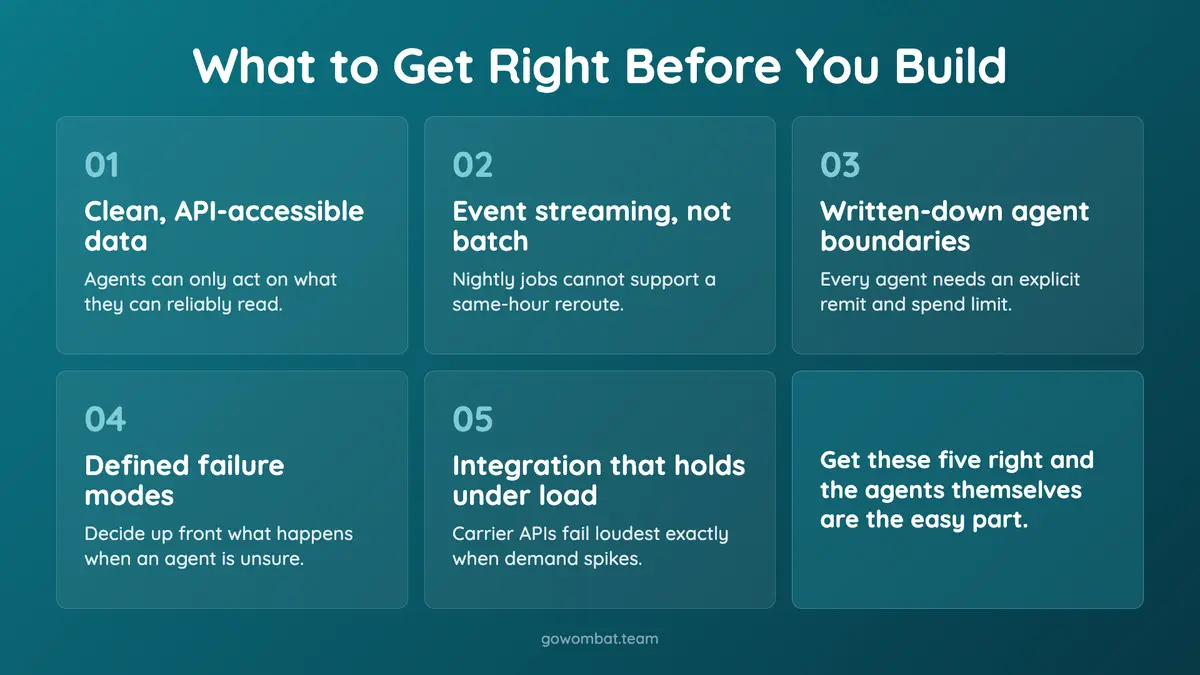
When a logistics agent project stalls after a promising prototype, the cause is usually upstream of the agent engineering: something was not ready when the engineering started.
1. Data that the monitor agent can actually use
Carrier tracking data spread across three systems, customs records locked inside an ERP that requires manual export, freight rates sitting in a shared spreadsheet: none of that works. The monitor agent cannot detect disruptions it cannot see, and it cannot classify what it sees if the data arrives in inconsistent formats. Normalising logistics data and making it accessible via API is foundational work, not a detail to sort out after the first sprint. Our article on big data in logistics describes what that foundation typically looks like, and the post on big data in the software development process covers how data architecture choices made at the application level shape what analytics and AI workloads can do later.
2. An event streaming layer, not batch processing
A rerouting use case runs on minutes, not hours. Apache Kafka and Apache Pulsar both handle the volume and latency requirements well; the choice between them usually comes down to operational preferences and what infrastructure already exists in your stack. The point is that the decision agent needs fresh signals, not yesterday's snapshot.
3. Written-down agent boundaries
The execution agent needs explicit, pre-approved limits. Booking alternative capacity up to a defined cost ceiling: yes. Cancelling an existing booking with a carrier penalty above a defined threshold: escalate to a human instead. Knowing exactly what the agent will and will not do on its own is what gives operations teams the confidence to let it run.
4. Failure modes that do not surprise anyone
Every agent workflow needs a defined answer to the question: what happens when this goes wrong? If the carrier API is unavailable, does the agent queue the request and retry, or escalate immediately? If no viable alternative meets the constraints inside the decision window, who gets notified and with what information? A system that degrades gracefully, logging what it tried, handing off cleanly to a human, is far easier to operate than one that silently fails or produces an ambiguous error state that nobody knows how to interpret.
5. Integration that holds under load
The execution agent writes rerouting decisions back to your TMS and ERP. If that integration breaks under volume or requires manual reconciliation after each event, the automation has moved the problem rather than solved it. Organisations running custom ERP software typically find this step faster because they control the data schema and the API surface; legacy off-the-shelf platforms often need a middleware layer. Either way, sound logistics software development treats TMS integration as a first-class concern from the start of the build, not something to figure out at the end.
Research published on arXiv in January 2026 demonstrates these principles under realistic conditions. "Project Synapse" introduced a hierarchical multi-agent LangGraph framework for autonomous last-mile delivery disruption resolution, tested against 30 complex disruption scenarios derived from over 6,000 real-world user reviews. The architecture held across varied failure conditions, with the LangGraph orchestration layer managing complex branching and recovery without requiring workflow restarts.
Where this architecture fits in your logistics stack
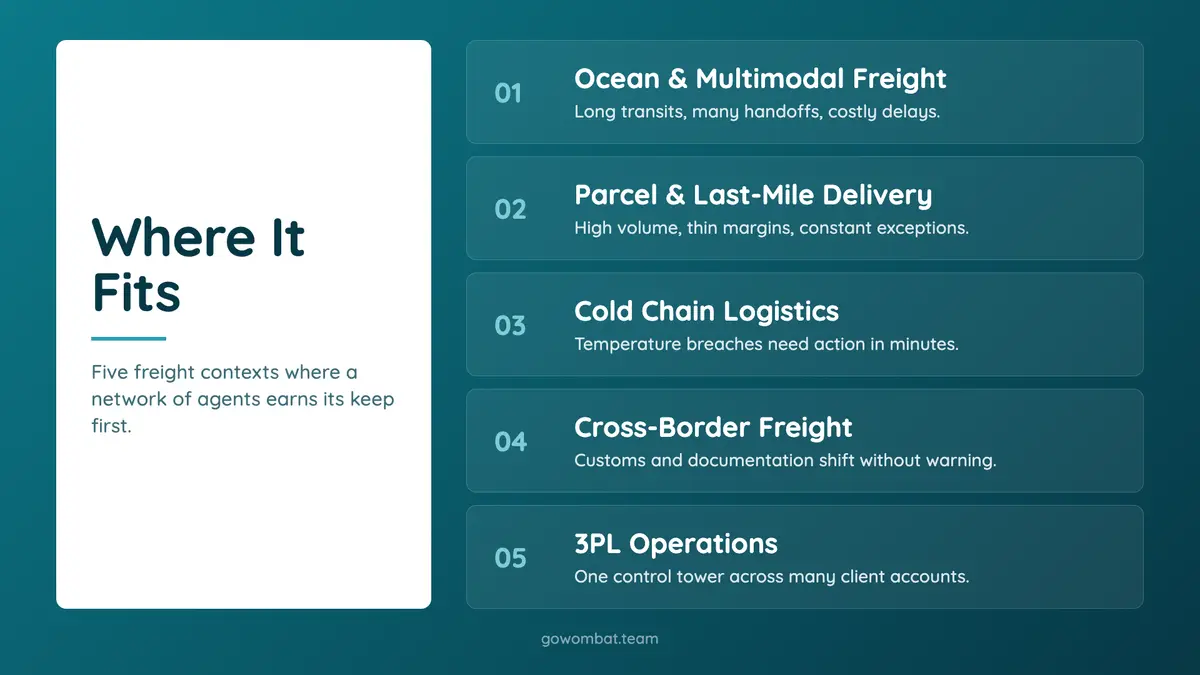
Not every logistics operation needs a full five-agent rerouting network from the first deployment. The architecture scales and it applies across more freight types than ocean shipping alone.
Ocean and multimodal freight
Ocean and multimodal freight is where the financial case is clearest. With long transit times, several carriers and handoff points, and frequent disruptions, every hour cut from the gap between a disruption and a confirmed alternative booking saves money and customer confidence.
Parcel and last-mile delivery
Parcel and last-mile delivery uses the same multi-agent pattern in a different register. DHL's deployment of HappyRobot AI agents now handles hundreds of thousands of emails and millions of voice minutes annually, covering appointment scheduling, driver follow-up calls, and high-priority warehouse coordination across several regions. The rollout followed more than 18 months of use-case validation and is positioned as freeing operations teams for higher-value work, not as a headcount reduction. Last-mile agent architecture prioritises communication and coordination over routing decisions, but the underlying structure, specialised agents with defined roles, coordinated through shared state, is identical.
Cold chain logistics
Cold chain logistics is a strong fit because the constraints are hard. A temperature breach at a transit hub leaves a narrow window before it becomes a spoilage event with regulatory consequences. An agent that detects the breach, finds an alternative cold storage facility and reroutes the shipment within that window is a straightforward application of this architecture with a calculable return. The regulatory side matters most in pharmaceutical and healthcare logistics, where temperature excursions have consequences well beyond the commercial loss.
Cross-border freight
Cross-border freight presents a different challenge. Customs holds are a persistent source of disruption, and they often give some warning before they are formally issued. An agent that watches clearance status in real time and prepares alternative routes before a hold lands shortens the resolution window in a way reactive TMS logic cannot. For clients in regulated industries such as fintech, faster resolution can also matter for compliance.
3PL operations
3PL operations benefit from an architectural feature that is easy to underestimate: client isolation. A multi-agent system serving several clients must keep each client's decision context, constraints and action boundaries separate while sharing infrastructure, and the agent architecture makes that separation explicit at the design level. For manufacturing and logistics software environments with complex multi-client requirements, this is often what makes the architecture viable where a monolithic automation layer would not be.
For operations at an earlier stage of supply chain automation, the sensible path is incremental: start with the monitoring and communication layers, prove the data pipeline works, then add autonomous execution. Each layer you get right makes the next stage of logistics app development easier.
What this means for logistics leaders
Rules-based TMS automation handles predictable disruptions well. The disruptions that cause the most damage, though, fall outside the pre-programmed rules: novel combinations of events, cascading failures, scenarios nobody wrote a rule for.
Multi-agent architecture shifts the question from "did we anticipate this scenario?" to "do our agents have the right boundaries and the right signals to reason through it?" That is a more defensible position for a logistics network operating across multiple continents, carriers, and regulatory environments.
Building this well means getting the fundamentals right: clean data, event streaming, clearly defined agent boundaries and integration that holds under load. Go Wombat's AI services and solutions team builds this kind of production agent system, and our custom software development team can build or refactor the surrounding systems (the data layer, TMS integration and event streaming infrastructure) in the same engagement.
If you are evaluating where to start, a structured discovery phase maps your current data infrastructure against the requirements of an agent architecture, identifies the highest-value rerouting scenarios to automate first, and surfaces the integration gaps before they become costly surprises mid-build.
Go Wombat builds production-grade AI systems for logistics, manufacturing, and enterprise software clients. If you want to explore where a logistics agent network fits your current architecture, start with a discovery session.
Frequently asked questions
How many agents does a logistics agent network typically need?
There is no fixed number. A minimal production system can run with three agents: a monitor, a decision agent, and an execution agent. More complex networks, handling multiple freight modes, carriers, and client contexts simultaneously, typically run five to eight specialised agents. The right number depends on the scope of disruptions you need to cover and the granularity of action boundaries you want to enforce at each step.
What data sources do freight-rerouting agents rely on?
The most common inputs are carrier tracking APIs, port status feeds, weather and oceanographic data, customs clearance systems, ERP and TMS records, freight rate APIs, and geopolitical news event streams. The monitor agent ingests all of these continuously. The quality and freshness of each feed directly affects the system's ability to detect disruptions early and assess alternatives accurately before a delivery window closes.
Can a multi-agent logistics system integrate with existing TMS or ERP platforms?
Yes, and this integration is critical to making autonomous freight management work in practice. The execution agent writes booking updates and routing changes back to the TMS; the reconciliation agent monitors those records to verify that confirmed actions have been carried out. Most modern TMS platforms expose APIs that make this integration achievable. Organisations on custom ERP or CRM platforms generally find integration faster because they control the data schema and the API surface directly. Legacy off-the-shelf systems without API access require an integration middleware layer, which adds complexity but is not a blocker if it is scoped properly during the build.
What is the difference between supply chain automation and supply chain AI agents?
Supply chain automation executes pre-programmed rules without deviation: if a shipment is delayed by more than 24 hours, send an alert. AI agents reason over context. They weigh competing constraints, evaluate options they were not explicitly programmed to consider, and generate responses that vary with the specific combination of conditions they encounter. Automation is deterministic; agents are adaptive. The two approaches complement each other.
How long does it take to build and deploy a logistics agent network?
A focused first deployment, covering one freight mode and one disruption type, typically takes three to five months from data audit to production go-live. The longest phase is rarely the agent engineering itself. It is getting the data infrastructure clean enough for the monitor agent to work reliably. Organisations that have already invested in real-time supply chain visibility infrastructure consistently move faster through this stage.
Share and subscribe to our blog
Related articles

AI in Supply Chain and Logistics: How It Transforms Industry
How AI is used in supply chain and logistics: forecasting, route optimisation, warehouse automation, inventory, predictive maintenance and quality control, plus the challenges of adopting it.

How Does Logistics App Development Work in 2026?
Logistics app development explained: app types, core modules and features, practical AI use cases and the build process step by step.

How Is Big Data Transforming Logistics in 2026?
How logistics companies use big data in 2026: the four types of analytics, the main benefits, and real deployments from UPS, Amazon, DHL and others.

How Predictive Logistics, AI, and IoT Build More Resilient Supply Chains
How predictive AI and IoT help logistics and manufacturing companies forecast demand, spot supply chain risks early and plan around disruptions.

How can we help you ?